
The Best AI Tools for Dungeon Masters in 2026 (Free & Paid)
The best AI tools for Dungeon Masters in 2026, tested and ranked. NPCs, battlemaps, session notes, encounter builders, worldbuilding, and free options.
Session prep eats time. You sit down to plan a two-hour game and surface three hours later with half a tavern, no map, and a villain whose motivation you forgot to write down. That is the problem AI tools for dungeon masters actually solve. Not replacing your creativity, but handling the repetitive parts so you can focus on the bits that matter at the table.
I have been building CharGen, an AI toolkit for tabletop RPGs, and testing every competing tool I can find. This list covers the 10 categories where AI genuinely speeds up DM prep in 2026, with honest recommendations for each.
2026 Update: This article has been refreshed for 2026 with three new tools added to the list: RoleForge for AI-generated session notes and campaign logs, StormScape for Discord session recording, transcripts and AI campaign reports, and Archivist AI for session transcription and searchable campaign history. Existing tool recommendations and all sections remain intact.
Updated 22 July 2026: Added a consent-first session-notes workflow, a practical way to turn reviewed recaps into campaign memory, and current CharGen features for session highlights and linked campaign facts.
If you are choosing between prepping a game yourself and letting an AI run one, I compare both categories in best AI dungeon master tools for 2026 prep.
1. AI Character and NPC Generators
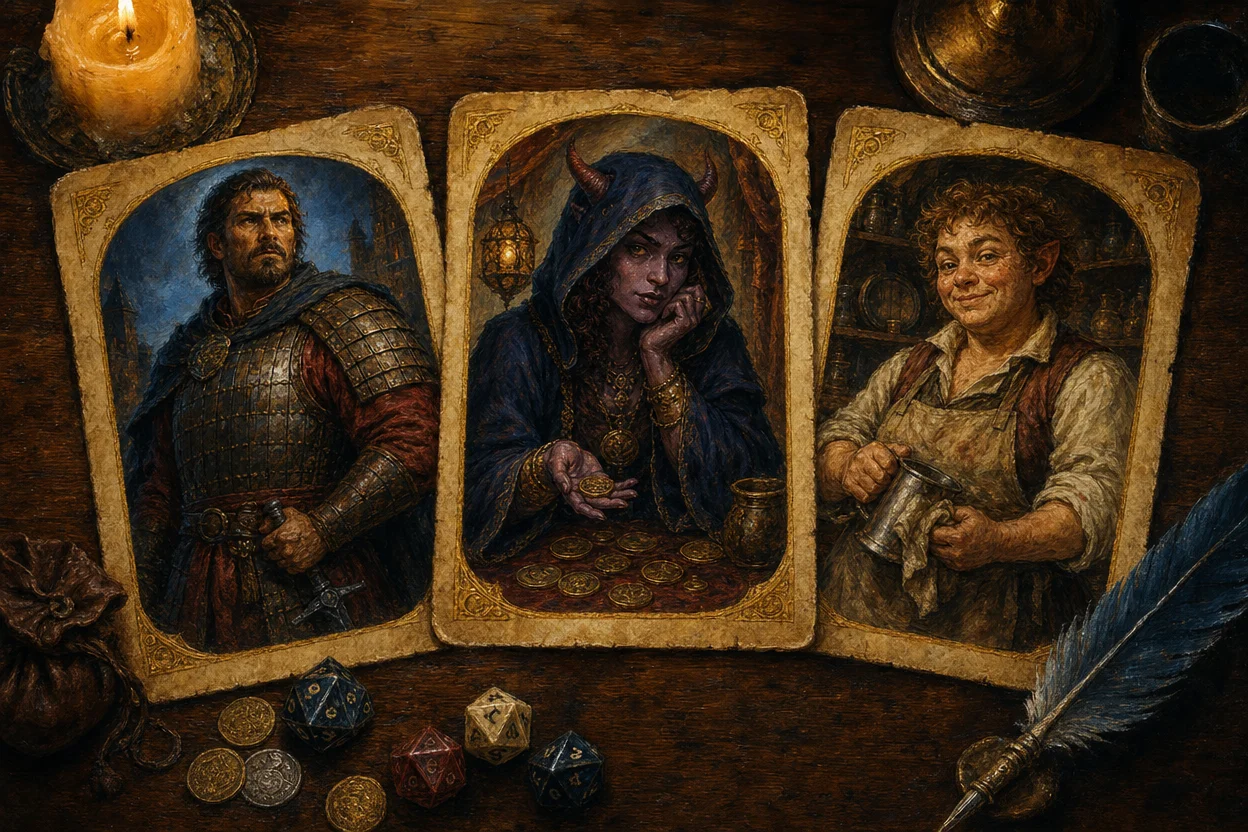
NPCs are the connective tissue of any campaign. A good NPC generator gives you a name, a personality, a visual, and enough backstory that you can improvise dialogue without stalling.
What to look for: Portrait art alongside the text output. Stat blocks if you need combat-ready NPCs. The ability to specify tone, setting, and role so you are not filtering through generic fantasy names.
My picks:
- CharGen NPC Generator produces full NPC profiles with AI-generated portraits, personality traits, backstory hooks, and stat blocks. The portrait is the part that saves the most time. Showing players an image of the barkeep changes the interaction completely. Free to start with a gold-based system.
- Tabletop Arc is a solid text-only NPC generator. You pick a theme, setting, and tone, and get a full profile in one click. No art output, but the text quality is strong for quick prep.
- ChatGPT works as a general-purpose NPC brainstorming tool. Give it enough context about your campaign and it produces usable results, but you will need to format and organise everything yourself.
2. AI Battlemap Generators
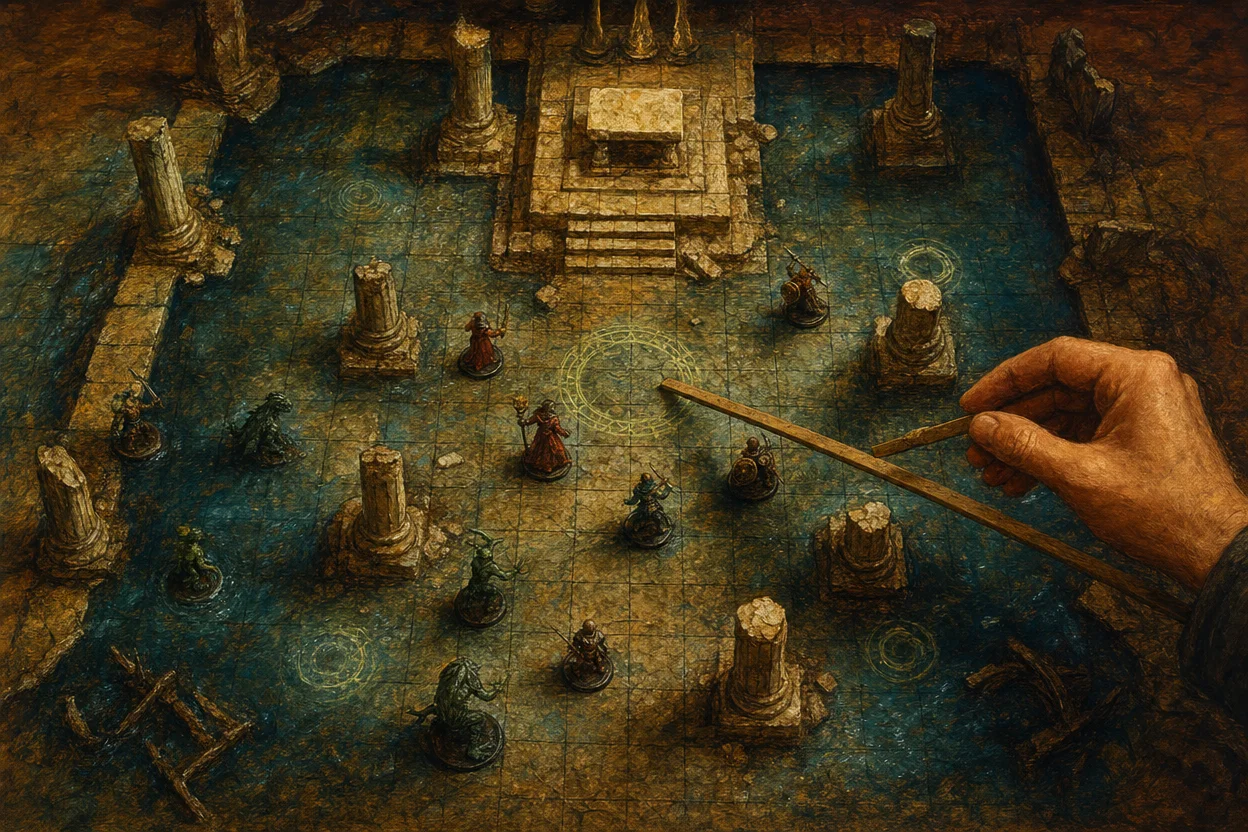
A good battlemap turns "you enter a cave" into a tactical encounter. AI map generators have improved dramatically, and the best ones now produce grid-ready output you can drop straight into Roll20 or Foundry VTT.
What to look for: Grid alignment, VTT export compatibility, and the ability to describe a scene in plain language rather than fiddling with tile editors.
My picks:
- CharGen Battlemap Generator takes a text prompt and produces a top-down battlemap. Describe "flooded temple with collapsed pillars and a raised altar" and you get something usable in under a minute. Works well alongside the monster generator for complete encounter prep.
- Dungeon Alchemist is a dedicated map-making app with AI-assisted room furnishing. It auto-populates rooms with props, lighting, and walls. More manual than a text-to-image generator, but produces cleaner tactical maps.
- Inkarnate is not AI-powered in the generative sense, but its asset library and layout tools are the industry standard for hand-crafted battlemaps. Worth mentioning because many DMs combine AI-generated rough maps with manual polish in Inkarnate.
- ZapGM bundles a full virtual tabletop with AI-generated battlemaps. Dynamic lighting, fog of war, drawing tools, and 60+ professionally designed maps you can customise with AI inpainting. If you want map generation and a VTT in the same window, ZapGM removes the export step entirely.
3. AI Token Makers
If you play on a VTT, every NPC and monster needs a circular token. Doing this manually in Photoshop or GIMP is tedious. AI token makers automate the crop, frame, and border process.
What to look for: Circular framing, transparent background support, batch processing if you need multiple tokens at once, and border style options.
My pick:
- CharGen Token Maker lets you generate a character portrait and convert it into a VTT-ready token in a single workflow. No separate app needed. The integration between the portrait generator and the token maker is what sets it apart. You generate an NPC, click through to the token maker, and have a Roll20-ready asset in under 30 seconds.
4. AI World-Building Tools
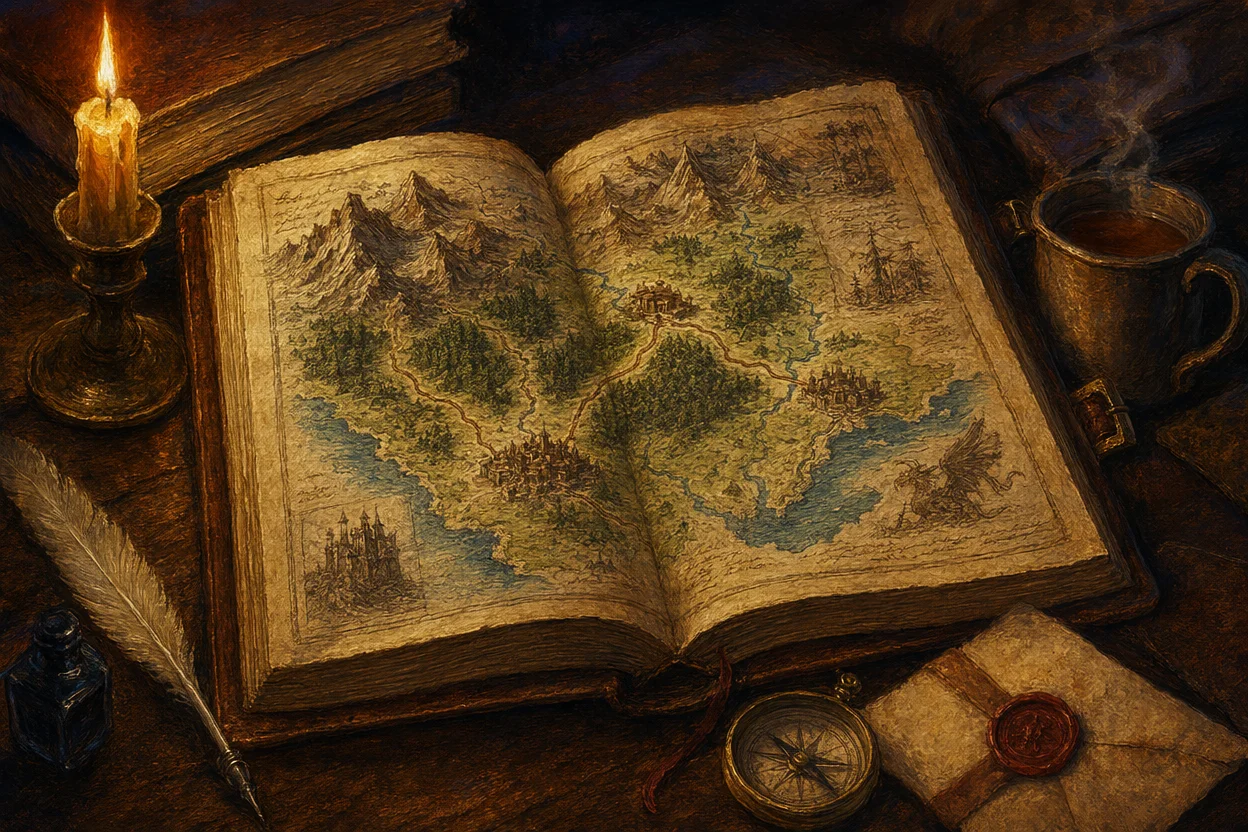
World-building is where DMs lose the most prep time. Building a region with settlements, factions, geography, and history from scratch can take an entire weekend. AI worldbuilding tools compress that into an evening.
What to look for: Linked entities (so your faction references your settlement, and your settlement sits in your region). Searchable campaign notes. The ability to expand and edit AI output rather than accepting it as-is.
My picks:
- CharGen World Codex and Region Generator handle the full chain: regions, settlements, factions, NPCs, and plot hooks, all linked together. The key advantage is that everything stays connected. Your faction leader is an NPC you can click through to, and the settlement she controls sits inside a region you can view on a single page.
- World Anvil is the most feature-rich world-building wiki available. Timelines, maps, articles, family trees. It is less AI-first than CharGen, but if your primary goal is building a massive setting bible for a long campaign, World Anvil has the deepest feature set.
- Kanka is a clean, lightweight campaign notes tool. Characters, locations, organisations, and calendars in a structured database. Less AI-powered, more organised notebook. Good for DMs who want structure without machine-generated text.
- StormScape positions itself as "the AI that remembers your campaign." It combines a linked campaign wiki (NPCs, locations, factions and items) with persistent campaign memory, so the NPCs and locations you create in session 3 are still contextually available in session 30. Useful if continuity across a long campaign is your primary pain point.
If World Anvil keeps coming up in your research but the learning curve puts you off, I have tested the strongest World Anvil alternatives for worldbuilding in a separate comparison.
5. AI Tavern and Shop Generators
Taverns and shops are session anchors. Players walk in, you need a name, an owner, a menu or inventory, and at least one reason to stay longer than five minutes. Generating these from scratch every session is a waste of your prep budget.
What to look for: Named establishments with personality, not just random item lists. Patron NPCs and plot hooks built into the location.
My picks:
- CharGen Tavern Generator produces a full tavern with a name, atmosphere, notable patrons, menu items, and built-in story hooks. The output is session-ready without editing.
- CharGen Shop Generator does the same for merchants. Balanced inventories tied to your party's level, with a shopkeeper personality that gives you something to roleplay.
6. AI Monster and Encounter Generators
Balanced encounters are tedious to build by hand. You need monsters at the right CR, interesting abilities, and enough variety that combat does not feel like the same fight with different hit points.
What to look for: CR-appropriate output, custom monster creation (not just pulling from the Monster Manual), and visual output for VTT use.
My picks:
- CharGen Monster Generator creates custom monsters with AI art, stat blocks, abilities, and lore. The visual output is the differentiator. Your players see the creature, not just a stat block description.
- CharGen Encounter Generator now sits beside the monster tools when you need a full scene rather than one creature. It gives you the encounter premise, party-level fit, live difficulty read, monster swaps, treasure direction, and a quest seed in one place. That is much closer to how I actually prep combat.
- Donjon 5e Random Encounter Generator is a fast, no-frills encounter builder for standard 5e monsters. Useful for random encounters when you need something in 10 seconds.
- Kobold Fight Club is the standard encounter balancing calculator. Not AI-generated content, but essential for checking whether your custom monster will TPK the party.
7. AI Session Notes and Recap Tools
Continuity is what separates a good campaign from a great one. If you cannot remember what happened three sessions ago, neither can your players. AI session tools capture, summarise, and organise what happened at the table.
What to look for: Automatic summarisation, searchable history, and NPC/location tracking across sessions.
My picks:
- CharGen Session Summary generates structured session recaps that you can search later. Useful for maintaining continuity when your campaign runs 20+ sessions.
- Archivist AI captures sessions, summarises them, and builds a searchable history with quest log tracking. It also handles live session transcription, so you can feed it a recording and get a cleaned-up recap with NPC names, locations, and plot threads extracted automatically. The strongest pure session-notes tool available if your primary need is campaign memory.
- Otter.ai provides real-time transcription. Not TTRPG-specific, but if you record your sessions, Otter gives you a searchable transcript to work from.
- StormScape also fits here. Its campaign memory engine automatically tracks NPCs, locations, and plot threads across sessions. You can search any moment across all your recorded sessions, and it links the answer back to the session where it happened. Different from Archivist in that StormScape leans harder into Discord-native recording and post-session intelligence reports alongside the memory layer.
8. AI Dungeon Generators
A dungeon needs rooms, corridors, traps, puzzles, treasure, and a reason to exist. Building all of that from scratch is hours of work. AI dungeon generators handle the layout and population so you can focus on the narrative arc.
What to look for: Room descriptions, trap placement, treasure distribution, and exportable maps.
My picks:
- CharGen Dungeon Generator produces themed dungeons with room descriptions, encounters, and lore. Pair it with the battlemap generator for a complete visual dungeon.
- Donjon Dungeon Generator creates randomised dungeon layouts with room contents. It has been around for years and remains one of the fastest tools for quick dungeon scaffolding.
9. AI Loot and Magic Item Generators
Loot rewards need to feel meaningful. A +1 sword is forgettable. A sword that whispers the name of the last creature it killed is a story hook. AI loot generators produce themed, level-appropriate items with flavour text that makes them worth picking up.
Try CharGen FreeWhat to look for: Level-appropriate rarity, thematic consistency with your campaign, and descriptive text that goes beyond stat bonuses.
My pick:
- CharGen Loot Generator produces magic items, treasure hoards, and mundane loot with descriptions, art, and mechanical effects. The items come with enough personality that players remember them.
10. AI Campaign Planning and Multi-Tool Workflows
The biggest time sink is not any single prep task. It is switching between tools. You generate an NPC in one app, make a token in another, build a map in a third, and write session notes in a fourth. The real advantage of AI tools in 2026 is when they work together.
What to look for: Tools that share context. An NPC you generate should feed into a token you create, which sits on a battlemap you built, inside a dungeon you designed.
My picks:
- CharGen is the broadest single-platform option. 15+ generators (NPCs, monsters, taverns, settlements, regions, dungeons, battlemaps, tokens, spells, loot, factions, buildings, and more) all in one workspace. The RPG Workshop lets you bounce between generator types without leaving the same workflow. That integration is the real time-saver. You are not copying text between tabs.
- Friends & Fables is the best option if you want AI to run your game rather than just prep it. Their AI Game Master handles combat, narration, and world-building in one platform. Different use case from prep tools, but worth knowing about.
- LitRPG Adventures has 30+ generators that produce raw material fast. NPCs, quests, towns, dungeons, magic items. The output needs more curation than CharGen, but the volume of generator types is impressive.
- ZapGM is worth a second mention here. It combines AI-powered lore creation, per-NPC text-to-speech narration, a built-in VTT with battlemaps, and a library of 1,400+ D&D 5e and Pathfinder 2e monsters. The standout feature is AI narration with distinct voices for each NPC, which no other tool on this list offers.
- RoleForge takes a different approach. It is a dedicated AI game master that handles combat rules, narration, and world state in one interface. Less about prep and more about running the game itself. If you want to play D&D solo or need an AI to co-run a session, RoleForge is built specifically for that use case.
11. New AI DM Tools Worth Watching in 2026
Three tools have gained enough traction in 2026 to earn a standalone section. They do not replace anything above; they fill gaps that the older tools leave open.
RoleForge: Session Notes and Campaign Logs
RoleForge is aimed squarely at busy DMs who run campaigns but struggle to maintain accurate session recaps between weeks. After each session it generates structured campaign logs covering key decisions, NPC interactions, and unresolved plot threads. You get a formatted document you can share with players or use as your own continuity reference.
What separates it from a general AI note-taker is that it understands TTRPG structure. It knows the difference between a named NPC and a throwaway vendor, tracks quest states across sessions, and flags contradictions ("In session 4 you said the temple was abandoned, but in session 9 it had guards"). If keeping a living campaign record is your bottleneck, this is the tool the "lazy DM" approach was waiting for.
StormScape: Session Recording and Campaign Intelligence
Correction (19 September 2026): An earlier version of this section said StormScape has a drag-and-drop encounter builder that places monsters, traps and terrain on a grid. That was wrong. StormScape's own feature page lists session recording, transcription, a campaign wiki, an audio bot and AI reports. It does not list an encounter builder. I have rewritten every StormScape mention in this post to match.
StormScape calls itself "the AI that remembers your campaign". It is a recall tool, not an encounter builder. A bot joins your Discord voice channel, records the session on separate tracks, and transcribes every word with speaker labels. While you play, it writes a summary every 20 minutes. After the session, it writes an intelligence report for the DM (story arcs, NPC relationships, pacing notes and prep suggestions) and a journey summary for each player. It also has a campaign wiki that links NPCs, locations, factions and items with @mentions, plus a Discord audio bot for music and sound effects.
The campaign memory layer (mentioned in the worldbuilding section above) is the real reason to look at it. Say your players cleared a ruined dwarven forge of kobolds in session 6 and left a survivor behind. When you prep session 20, StormScape can find that moment in the transcript. It will not build the fight for you. Pair it with an encounter tool such as the CharGen Encounter Generator and you get both halves: the memory from StormScape and a playable fight from CharGen.
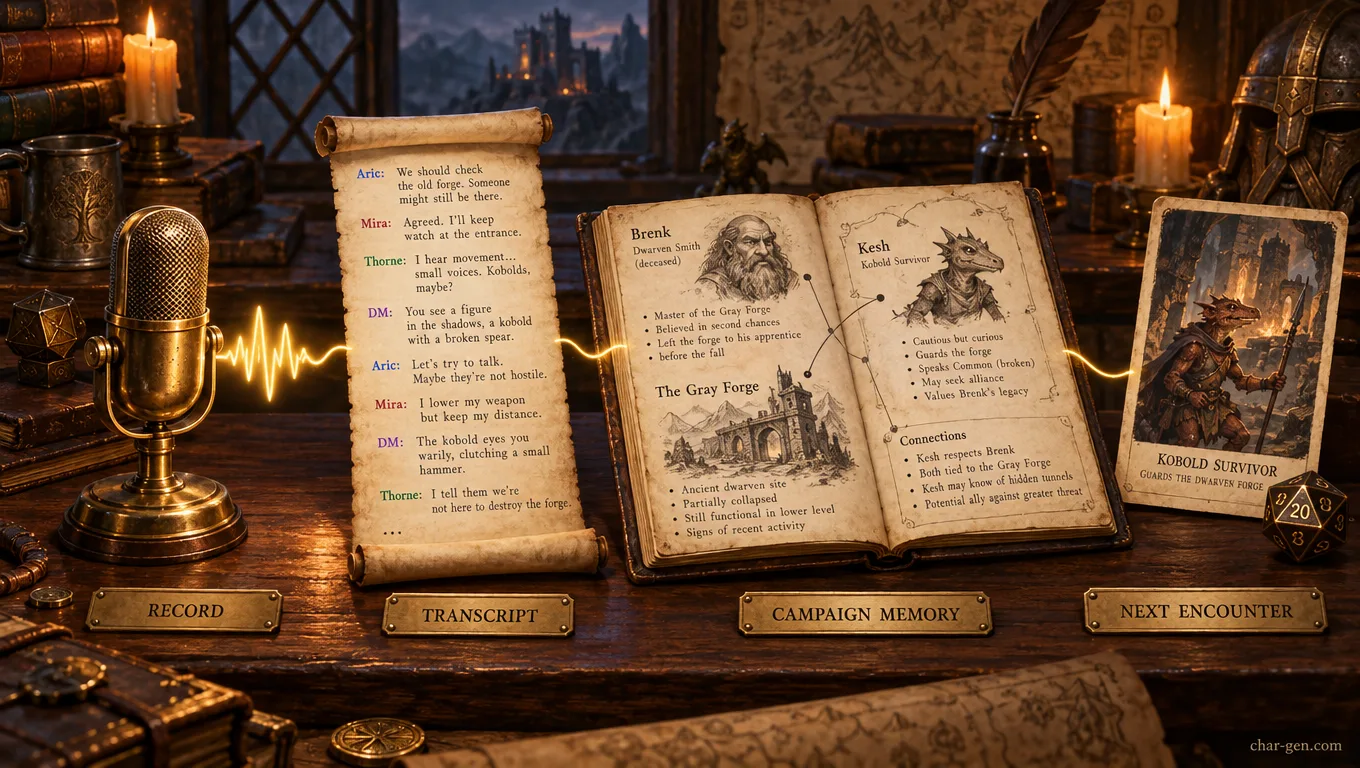
A note on sources: when I checked on 19 September 2026, stormscape.app did not load (it returned a Cloudflare 525 error). The feature list above comes from its most recent archived homepage, from January 2026. Check the live site before you sign up.
Archivist AI: Session Transcription and Searchable Campaign History
Archivist AI handles the part of campaign management that most DMs handle with a messy Google Doc: building a searchable record of everything that has happened. Feed it a session recording or a rough set of notes and it produces a structured recap with NPC names, locations visited, items found, and decisions made, all indexed so you can search "what did we promise the blacksmith?" six months later and get a direct answer.
The transcription layer is what makes it practical for long campaigns. You do not need to type anything between sessions. Record the audio, upload it, and let Archivist do the indexing. Works well alongside CharGen's Session Summary tool: CharGen for generating structured in-game documents (letters, lore entries, world records), Archivist AI for the meta-layer of "what actually happened at your table."
How to Pick the Right AI DM Tools for Your Table
Not every DM needs all 10 categories. Here is a quick decision framework:
- "I just need faster session prep": Start with an NPC generator and a battlemap generator. Those two cover 80% of weekly prep.
- "I run a VTT game": Add a token maker and a map tool. Visual assets matter more on screen than at a physical table.
- "I run a long campaign": Session notes and worldbuilding tools become essential after 10+ sessions. Campaign memory is what keeps the story coherent.
- "I want one tool that does most of it": CharGen is the closest to an all-in-one DM toolkit. Free to start with a gold-based system, no credit card needed.
The best approach is to pick one or two tools, use them for a few sessions, and expand from there. You do not need to adopt everything at once.
AI DM Prep Tools vs AI Game Masters: Which Do You Actually Need?
The AI tools market for dungeon masters has split into two distinct camps in 2026, and understanding the difference saves you from picking the wrong tool for your table.
AI prep tools generate assets before the session starts. You get NPCs, battlemaps, tokens, dungeons, and loot that you then bring to your own game. You are still the DM. The AI handles the tedious creation work so you can focus on story, pacing, and improvisation at the table. CharGen, Dungeon Alchemist, Donjon, and World Anvil all fall into this category.
AI game masters run the game for you. They narrate scenes, adjudicate rules, track combat, and respond to player actions in real time. Friends & Fables, RoleForge, MacerAI, and similar AI GM apps are built for this. They are excellent for solo play, async groups, or tables that want to play without a human DM.
Hybrid tools like ZapGM and StormScape sit in between. They generate prep content but also offer session-time features like AI narration, campaign memory, or a built-in VTT.
Most DMs I talk to want prep tools, not a replacement. The fun of being a DM is running the game, not generating the 47th tavern menu by hand. If that sounds like you, start with an all-in-one prep toolkit like CharGen and add specialist tools (encounter balancers, VTT map makers) as your workflow demands.
If you run content for other DMs or create TTRPG resources, CharGen also offers an affiliate programme with a flat 25% commission on first payments. Worth knowing about if you are already recommending tools to your community.
June 2026 Update: AI Tools Need a Delivery Step
The biggest change since I last updated this list is not another chatbot. It is the handoff from generated idea to something you can actually place on the table. The best AI tools for dungeon masters now need to produce usable files, not leave you with a paragraph in a browser tab.
Two CharGen releases pushed that point home for me in June 2026: the AI Miniature Generator and direct Foundry VTT export. One turns character art into a printable 3D model. The other packages campaign material for the virtual tabletop. Both remove the awkward final stage where a DM has to crop, reformat, rename, and rebuild everything by hand.
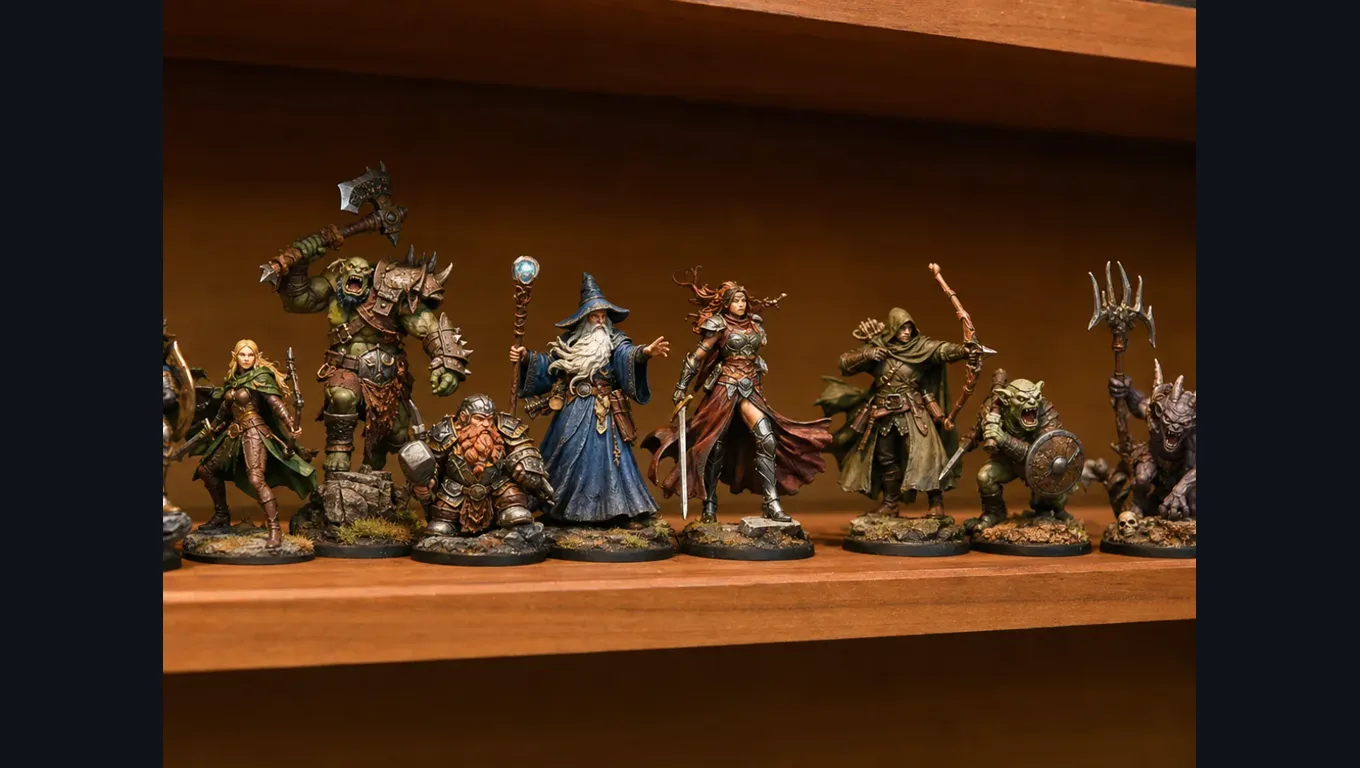
3D Miniatures Are Now Part of Ordinary Session Prep
I used to treat custom miniatures as a separate hobby. You would design a figure in a dedicated builder, learn enough 3D terminology to avoid a bad print, export the file, and hope the sword survived the supports. That is still the right route when you want precise control over every belt buckle. It is no longer the only route.
CharGen's miniature creation tool opens with the heading Create a 3D miniature. You can describe a character or upload reference art, choose between text-to-3D and image-to-3D, then preview the result in the browser. The page defaults to Rodin v2.5 and a print-ready STL, while OBJ and GLB remain available for other workflows.
A practical example: I can generate a half-orc harbour captain in the NPC Generator, keep his chipped tusk, seal-skin coat, and brass authority chain in the portrait, then use that image as the reference for the miniature. That is much more reliable than rewriting the visual description from memory in a separate tool. The portrait, token, NPC notes, and physical model all begin with the same character.
There are limits. Thin weapons, spread fingers, floating cloth, and elaborate antlers can still make a poor print. I would inspect every model in a slicer, check the base, and thicken fragile details before spending resin. FDM printers also need chunkier forms than resin printers. AI can get you to a strong first sculpt quickly, but it cannot inspect your supports or clean the build plate.
My rule is simple: use AI miniature generation for named NPCs, recurring villains, player characters, and one-shot bosses. Do not print all 18 dockworkers unless your campaign has taken a very specific turn.
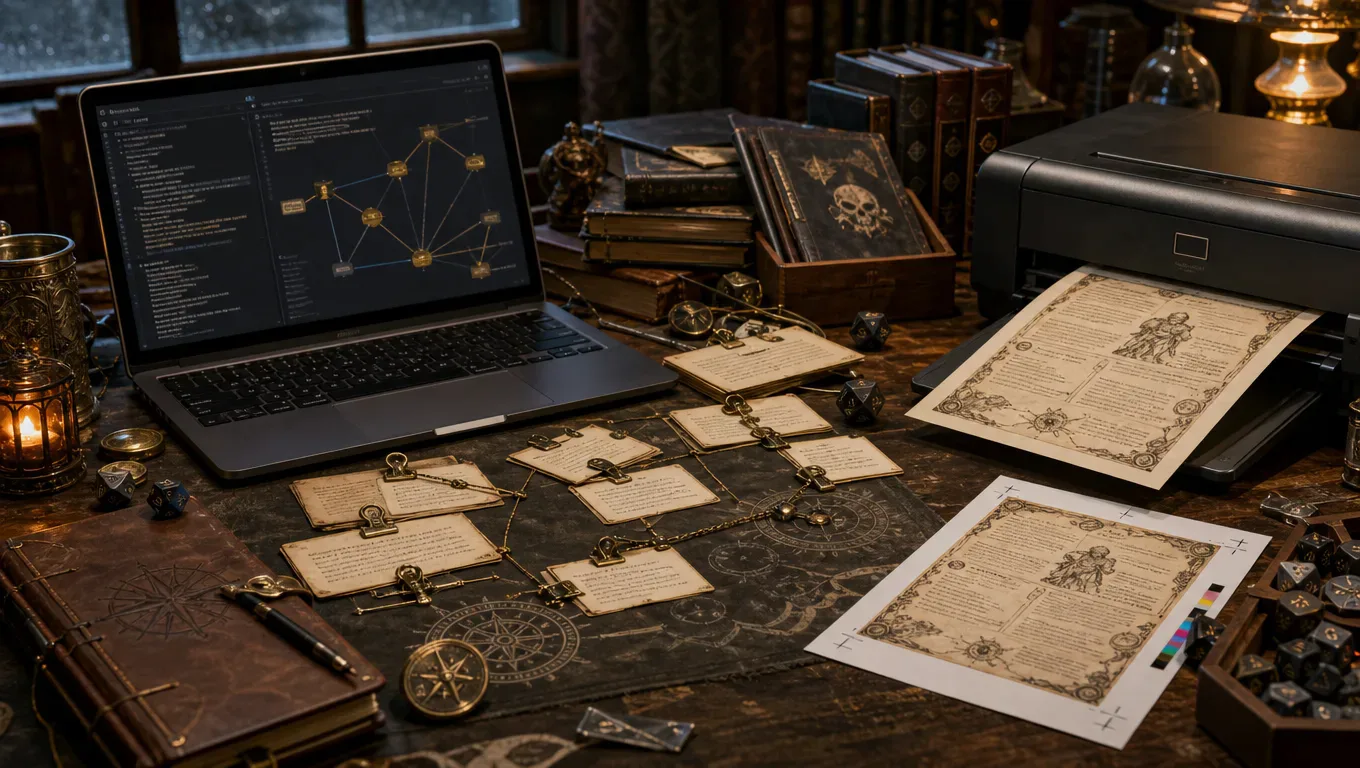
Foundry Export Matters More Than Another Generator Category
Generating a good monster is only half the job for an online game. The monster still needs to become an Actor or Journal entry. The battlemap needs to become a Scene. Its image dimensions need to survive the trip. Items need the right system fields. A folder full of loose PNG and text files does not solve that work.
CharGen now exposes three Foundry routes in the UI:
- Open an entity's Export menu and choose Foundry VTT (.json) for a single NPC, character, monster, item, or journal-style record.
- Open an image in the gallery and choose Foundry Scene to download a scene JSON file built around that map.
- Open a campaign or session-prep bundle and choose Export to Foundry (.zip) to build a module package containing the linked material.
That final option is the important one. Foundry's official module documentation explains that modules can carry content such as Actors, Items, Scenes, and Journal Entries. CharGen's campaign export follows that shape, packaging D&D 5e or Savage Worlds material into a module with an Import CharGen content button inside Foundry.
I would still check every imported stat block before play. Homebrew systems vary, Foundry modules change, and AI-generated numbers deserve a human pass. The export is best treated as prepared campaign data, not a rules authority. Even with that caveat, it removes a tedious chain of copy, paste, image upload, and folder creation.
My Current 25-Minute Prep Workflow
Here is the workflow I now use when I need a small encounter ready quickly:
| Time | What I do | What I keep |
|---|---|---|
| 0-5 minutes | Generate the named NPC and one custom monster | Profiles, motives, stat direction, portraits |
| 5-10 minutes | Make VTT tokens, or turn the boss portrait into an STL | Token files or a printable miniature |
| 10-18 minutes | Generate the location map and add one environmental complication | A scene image with an encounter hook |
| 18-25 minutes | Put the pieces in a campaign or session-prep bundle and export | Foundry module zip, plus the CharGen records |
The useful part is not the stopwatch. It is that I do not re-enter the same harbour, villain, and encounter context in four unrelated tools. When I change the harbour captain's coat from blue to weathered green, I have one source image to carry through the token and miniature steps.
For in-person play, I stop after the printable files and a short recap sheet. For Foundry, I take the module route. For Roll20, I still export the map and tokens as images because that remains the simpler handoff. The right endpoint depends on the table.
What I Would Still Do Manually
I would not ask an AI tool to make the final judgement on encounter difficulty, consent around session recording, or whether a generated miniature is physically printable. Those decisions need context the tool does not have.
I also keep a human-written sentence at the top of every session plan: what choice should the players face tonight? If I cannot answer that, another generated tavern, map, or monster will not fix the session.
The 2026 update to this list is therefore less about adding tool number eleven. It is about judging each tool by where its output goes next. A useful DM tool should leave you with a playable record, image, token, scene, module, or model file. If it only gives you more text to reorganise, it has saved less time than the demo suggests.
26 June 2026 Update: Encounter Builders Are Finally Catching Up
The next weak link in AI tools for dungeon masters is encounter prep. NPCs, maps, and tokens have improved quickly, but combat builders often still feel like calculators wearing a fantasy hat. They can tell you that a fight is "hard", then leave you to work out why the fight exists, what the enemies want, what happens if the party talks first, and whether the reward makes sense.
That is why I am paying more attention to encounter builders in the second half of 2026. A useful encounter tool should not stop at creature count. It should help with motive, terrain pressure, enemy behaviour, reward logic, and session handoff. If I still need five tabs after pressing generate, the tool has only solved the easy part.
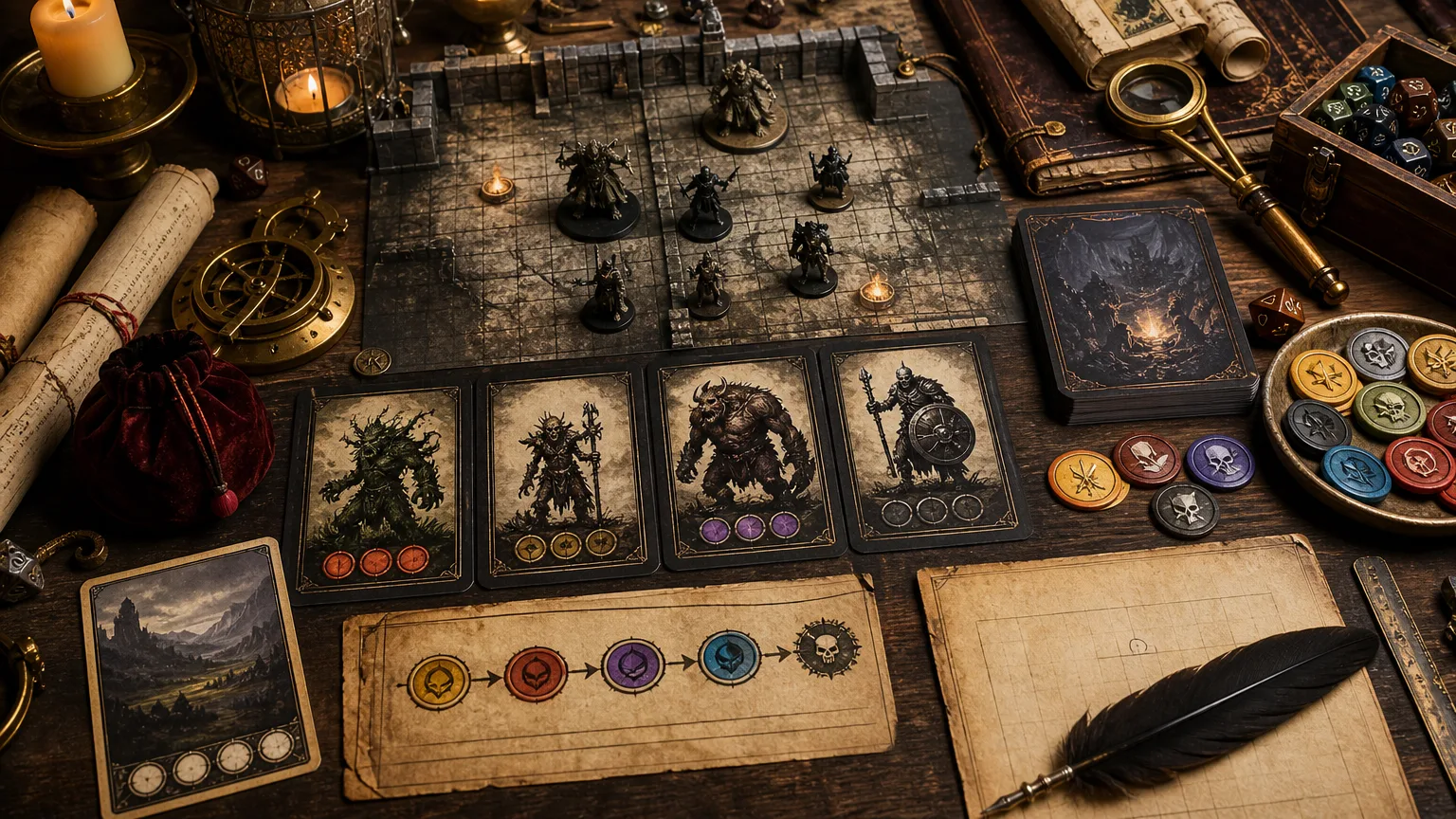
CharGen's Encounter Generator now has the shape I want from this category. I can start with a plain prompt like "smugglers ambush the party at a flooded lock gate", set the party level, then use the live difficulty meter before I commit to the fight. If the first monster mix feels too swingy, I can reroll or swap parts of the encounter without rebuilding the whole thing from scratch.
The important bit is the handoff. The same encounter can point towards loot, a quest seed, monster records, and a battlemap idea. That means the output is not just a paragraph I have to translate later. It becomes a small prep packet. For a weeknight game, that is the difference between "interesting idea" and "I can run this after dinner".
StormScape still deserves attention here, but as a partner to an encounter builder, not as one. It does not build fights. Its session transcripts and prep reports tell you what the party already did, and that is the context a good encounter needs. Kobold Fight Club is still the fast sanity check when I only care about danger bands. I also still cross-check important 5e fights against the D&D Beyond encounter building guidance, especially when a boss fight could end the night early. The difference is that I now expect an AI encounter builder to give me table material, not just maths.
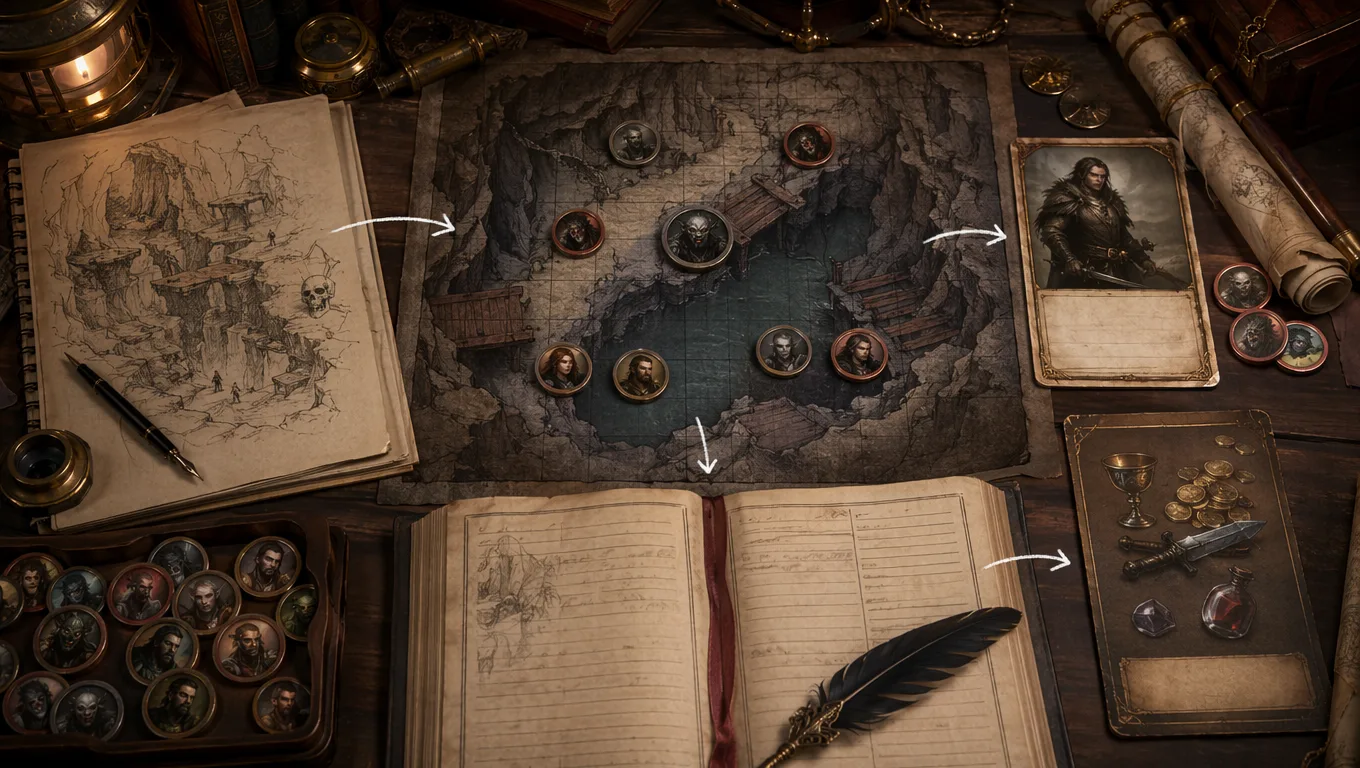
Here is the encounter checklist I use now:
| Prep question | What I want the tool to return |
|---|---|
| Why is the fight happening? | Enemy motive, pressure, or misunderstanding |
| What changes round by round? | Terrain shift, reinforcements, clock, hazard, or social option |
| What can the party learn? | Clue, faction detail, NPC confession, or map lead |
| What do they take away? | Loot, quest thread, token, map, recap note, or campaign record |
A combat encounter that only tests hit points gets old fast. A combat encounter that changes the campaign state is worth the prep time. When I rank AI DM tools now, that is the bar I am using: does the generated output create something playable, reusable, and connected to the next session?
July 2026 Update: Session Notes Need Consent and a Human Check
The biggest shift in the best ai tools for dungeon masters category is not another text generator. It is the expectation that a recap should become useful campaign memory. D&D Beyond's 2026 development roadmap now talks openly about DM prep features for documenting sessions, lore, and the tools used to run a game. Specialist tools are moving in the same direction. The category is settling around one job: help a DM remember what actually happened without turning a living campaign into a pile of unsearchable notes.
There is a catch, and it matters. Do not record your table without asking everyone first. A recent discussion in the D&D community made the point more sharply than any feature list could: players can be comfortable with written notes and still be uncomfortable with audio being captured for an AI service. I would ask before the session, explain where the recording goes, say who can read the recap, and give people an easy way to opt out. If someone does not want recording, use a shared scratchpad instead. That is not a lesser workflow. It is just a different input.
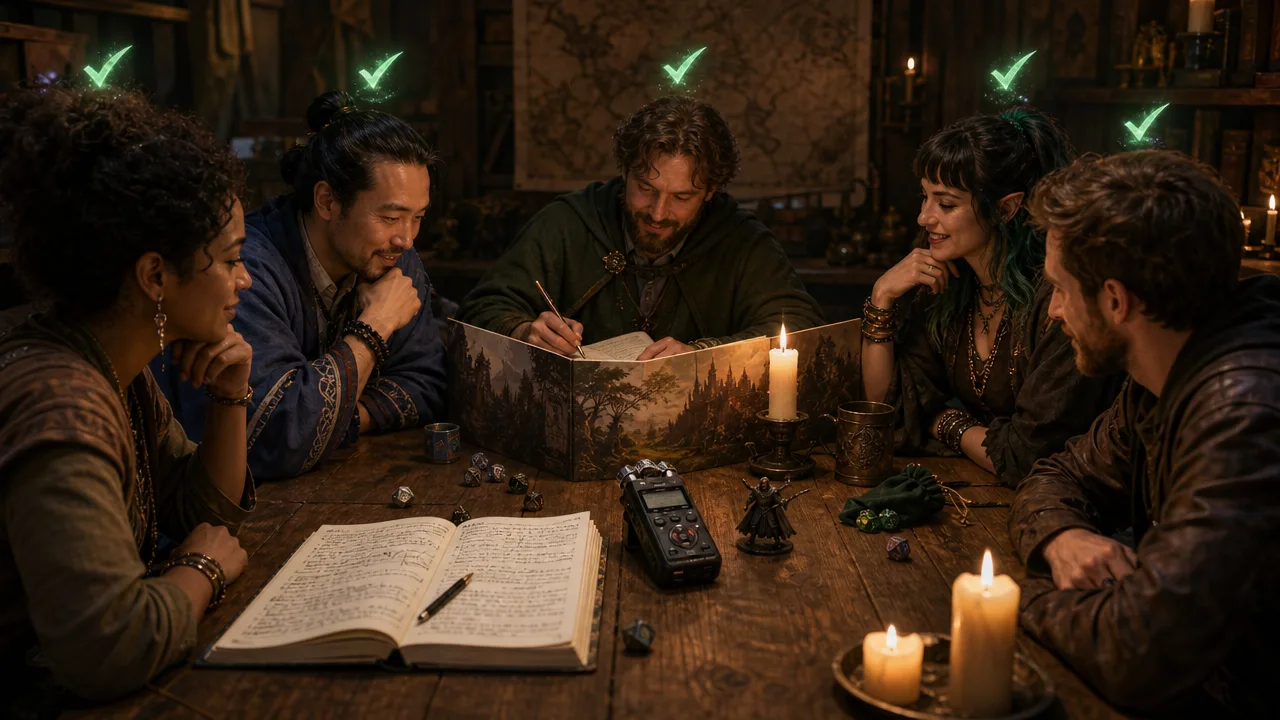
My own check is deliberately plain. I ask, "Are we all happy for this session to be recorded for a recap?" Then I keep the raw file private, let the group know where the player-safe recap will live, and delete anything I no longer need. The tool can save time. It does not get to make a privacy decision on the group's behalf.
Once the group agrees, the next failure point is treating the first generated summary as canon. AI hears names badly, mistakes a joke for a decision, and can merge two similar locations into one confident-sounding error. I take five minutes after each session to correct names, mark player-facing spoilers, and check the three facts that affect next week's prep: the active quest, the NPCs now in play, and anything the party promised, stole, broke, or learned.
| Review question | What I check | Why I care |
|---|---|---|
| Who changed state? | NPCs, factions, allies, and enemies | stops a recurring character quietly resetting between sessions |
| What moved forward? | quests, clues, debts, and deadlines | gives me a real starting point for the next scene |
| What stays private? | secrets, GM plans, and player-only information | keeps the shared recap useful without spoiling the game |
| What needs correcting? | misheard names, invented links, and table jokes | prevents a neat-looking error becoming campaign history |
CharGen now gives this workflow a few more useful handoffs. Session subjects can create an AI scene image directly from the recap, using party portraits as references where they are available. The Storyboard tab can turn selected session beats into a comic-style strip, which is genuinely handy when a player returns after a month away and needs the shape of the last game rather than a wall of prose. I would still choose the moments myself. A recap is a record, not a substitute for the DM deciding what mattered.
For longer campaigns, the strongest follow-up is to promote confirmed session facts into the campaign. CharGen's World Graph can take tracked people and places from session notes, then offer them as proper NPC, faction, settlement, region, tavern, shop, building, or hazard entries. I like that it asks for confirmation rather than treating every improvised tavern name as permanent setting history. When the party's ferry captain, the flooded docks, and the missing ledger have all survived the review, I can build the next session around them with the NPC Generator, RPG Workshop, and Session Summary rather than typing the same context into three tabs.
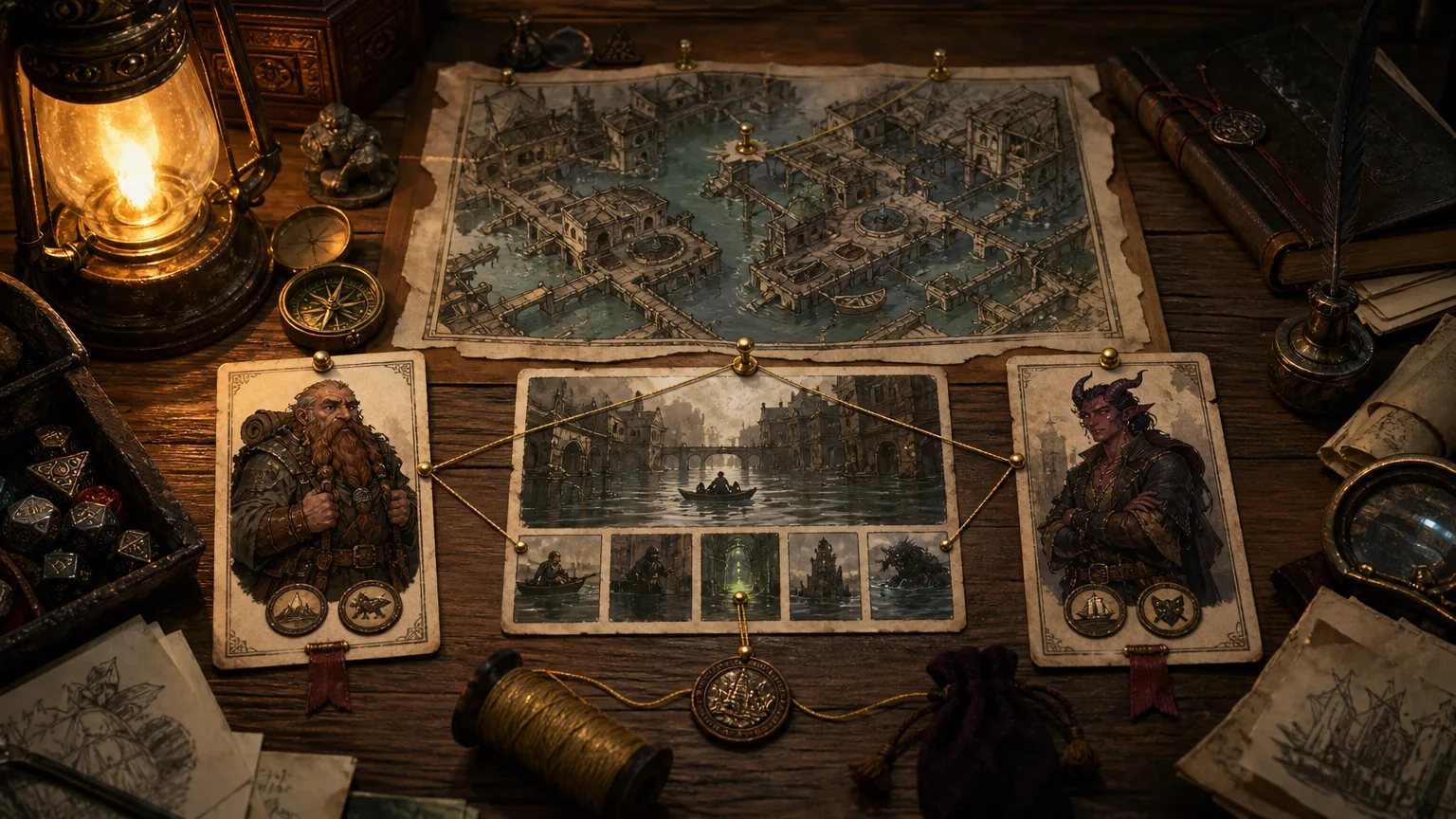
My five-minute after-session routine
I do this before packing away the dice, while the group is still chatting. It is short enough that I will actually do it after a late game, and it avoids the horrible Sunday-afternoon feeling of knowing I wrote something important but not where.
- I mark the next likely scene in one sentence. For example: "The party will meet Captain Vey at the south quay, unless they follow the drowned courier's clue first."
- I correct the names that came up more than once. If the recap says "Vay", that gets fixed before it spreads through every future note.
- I move only durable facts into the campaign record. A named ally, a location the party intends to revisit, a settled faction change, or a quest deadline earns a proper entry. A throwaway joke about stealing the mayor's horse does not.
- I write one private line for myself about pressure. It might be "the tide cult acts before the next long rest" or "Mara will ask for payment when the group returns". That is enough to restart prep later.
- I share a player-safe recap, then invite corrections. Players are excellent at remembering the promise you accidentally summarised as a rumour.
The fifth step matters more than it sounds. A shared recap is not just an administrative note. It gives a quieter player a low-pressure way to say, "My character did not agree to that," and lets the group protect the bits of the story they care about. If the notes are wrong, correct them in public rather than quietly fixing only your private version.
What I would not hand to an AI recap tool
I would not ask one to decide which player action was emotionally important. It can list a dramatic speech, but it cannot know that the table fell silent because someone had been carrying a character arc for eighteen sessions. I would not let it publish raw chat or audio automatically. I would not let it invent rules outcomes after the fact, either. A close call about surprise, a spell interaction, or whether a villain escaped remains a table ruling, not something a tidy summary should rewrite.
There is also a practical limit to campaign memory. Not every named object needs a card, and not every NPC needs a relationship graph. Over-recording makes the next session harder because you end up searching through clutter. I keep three levels in mind: a fleeting detail can stay in the recap, a recurring fact belongs in the campaign record, and a prepared element gets a proper CharGen entity only when I expect to use it at the table. The right amount of memory is the amount that lets you answer "what happens next?" quickly.
The practical rule is simple: capture what your group has agreed to share, review it while the session is fresh, and only then let it influence the campaign record. That keeps AI in the helpful assistant seat, where it belongs.
Frequently Asked Questions
What is the best AI tool for Dungeon Masters in 2026?
CharGen is the broadest all-in-one option for DM prep in 2026. It covers 15+ generator types (NPCs, monsters, battlemaps, tokens, dungeons, loot, taverns, settlements, and more) in a single workspace with a free-to-start gold system. For specific use cases: StormScape for recorded-session memory and AI campaign reports, Archivist AI for session transcription and campaign history, and RoleForge for AI-generated session notes. The right answer depends on where your prep breaks down.
What is the best AI tool for D&D session prep?
For a standard weekly session, the most useful combination is an NPC generator and a battlemap generator. CharGen handles both in the same workflow and adds encounter prep, dungeon layouts, and loot on top. For encounter-specific prep, the CharGen Encounter Generator builds the fight, and StormScape can supply the campaign context from your recorded Discord sessions. For DMs who record their sessions, Archivist AI eliminates the need to write recap notes between sessions.
Should I ask permission before recording a D&D session for AI notes?
Yes. Ask every player before recording, explain how the file and recap will be used, and give anyone a straightforward way to opt out. A shared written scratchpad is a good alternative. Once you have a recap, review it for names, spoilers, and invented details before treating it as campaign history.
How does CharGen help Dungeon Masters?
CharGen is a toolkit I built specifically for tabletop RPG prep. It generates NPCs with AI portraits, monsters with stat blocks and art, battlemaps from text prompts, dungeon layouts, taverns, settlements, regions, loot, and tokens, all in one place. The RPG Workshop connects these tools so you can move from NPC to token to battlemap without leaving the same session-prep context. Free to start with a gold-based system; no credit card needed.
Can AI replace a Dungeon Master?
No. AI tools handle prep work like generating NPCs, maps, and encounters, but the actual role of a Dungeon Master requires improvisation, emotional intelligence, and reading the room. These tools make prep faster so you can spend more energy on the parts that matter at the table.
Are AI DM tools free to use?
Most tools offer free tiers. CharGen uses a gold system where you earn credits by logging in and engaging with the community. Donjon and Kobold Fight Club are completely free. Tools like World Anvil and Dungeon Alchemist have free versions with paid upgrades for advanced features.
Which AI tool is best for new Dungeon Masters?
Start with CharGen for NPC generation and Donjon for encounter balancing. Those two cover the most common pain points for new DMs: creating characters on the fly and building balanced combat encounters.
Do AI tools work with Roll20 and Foundry VTT?
Yes. Battlemap generators and token makers produce images you can upload directly to Roll20, Foundry VTT, or any other virtual tabletop. CharGen's Token Maker outputs circular tokens sized for VTT use. Dungeon Alchemist exports maps in VTT-compatible formats. CharGen also offers Foundry VTT (.json) for individual entities, Foundry Scene for map images, and Export to Foundry (.zip) for campaigns and session-prep bundles.
How much time do AI tools actually save during session prep?
Most DMs report cutting prep time by 50-70% when using AI generators for NPCs, maps, and encounters. The biggest savings come from not having to search Pinterest for character art or manually balance encounter difficulty. A full session's worth of NPCs, a battlemap, and an encounter can be generated in under 15 minutes with the right tools.
What is the difference between an AI DM prep tool and an AI game master?
AI prep tools generate content before your session: NPCs, battlemaps, tokens, dungeons, and loot that you bring to your own game. You are still the DM. AI game masters like RoleForge and Friends & Fables run the game for you, handling narration, combat, and world state in real time. Most tabletop DMs want prep tools, not a replacement. CharGen is a prep tool. You generate the assets, you run the game.
Can I use AI DM tools for Pathfinder, not just D&D?
Yes. Most AI generators produce system-agnostic content: NPC personalities, location descriptions, and map layouts work across any TTRPG. CharGen generates content that works for D&D 5e, Pathfinder 2e, Call of Cthulhu, and other systems. ZapGM includes built-in Pathfinder 2e monster libraries alongside D&D 5e. For system-specific stat blocks, check whether the tool supports your ruleset before committing.
Do AI-generated assets look good enough to show players at the table?
The quality gap closed significantly in 2025 and 2026. AI-generated character portraits, battlemaps, and tokens are now good enough for VTT play and in-person sessions. The advantage over generic stock art is that every asset matches your specific campaign. A barkeep with a scar over her left eye, holding a dwarven ale stein, in a torch-lit tavern. That level of specificity is what AI generation gives you that pre-made art cannot.
Can AI tools create 3D printable D&D miniatures?
Yes. CharGen's AI Miniature Generator accepts a written description or reference image and creates a 3D model you can preview and download. The creation page defaults to STL for printing, with OBJ and GLB available too. Inspect the model in your slicer before printing, especially thin weapons, fingers, cloth, and supports.
Start Using AI DM Tools FreeImage Credits
- The 2026 miniature update image is adapted from CharGen-owned AI Miniature Generator artwork.
- The 2026 Foundry workflow image is adapted from CharGen-owned campaign export artwork.