
How to Prep a D&D Session in 30 Minutes With AI (2026)
How to prep a D&D session with AI in 30 minutes, using a human-reviewed workflow for NPCs, encounters, maps, tokens, and campaign notes.

There are two types of ai dungeon master search. The first comes from people who want an AI to replace the DM entirely: run the story, voice the NPCs, adjudicate the rules, and somehow replicate the experience of a human behind the screen. The second comes from DMs who have a session in four hours and need to generate an NPC, a battlemap, and three encounter ideas before their players arrive.
If you are searching for how to prep a D&D session with AI, I would start with the second job: make a small, playable set of assets, then decide what earns a place at your table.
I built CharGen for the second group. Not because AI-run campaigns are impossible, but because most DMs do not want a replacement. They want a faster way to do the work they already enjoy. The prep, not the performance. The asset creation, not the storytelling. And in 2026, the tools that solve that specific problem are genuinely good enough to change how session prep works.
This guide covers what I have tested, what actually saves time, and where AI still falls short for dungeon masters.
What "AI dungeon master" actually means in 2026
The phrase covers three distinct use cases, and confusing them wastes time.
AI as DM replacement. Tools like Jenova AI and AI Realm attempt to run full D&D campaigns with an AI game master. You describe actions, the AI narrates consequences, and combat runs through automated rules. These work for solo play and casual one-shots. They struggle with the nuance, improvisation, and emotional reading that a human DM brings to a long campaign. If your table has a DM, this is not the tool you need.
AI as campaign manager. Tools like Archivist focus on memory and continuity: turning session transcripts into searchable recaps, tracking NPCs across sessions, and answering questions about your own campaign history. Useful for groups that play weekly and lose track of plot threads between sessions.
AI as session prep assistant. This is where I spend most of my time. Generating NPCs with backstories, creating battlemaps for tonight's encounter, building monsters that have a reason to exist in the dungeon, producing VTT tokens so every face at the table has a portrait. The goal is not to replace the DM's creativity. It is to eliminate the three hours of admin that sits between "I have a great idea for tonight's session" and "I have the assets to run it."
CharGen sits firmly in the third category. It is not an AI DM. It is a toolkit that handles the production work so the DM can focus on storytelling.
The session prep problem AI actually solves
Every DM has the same bottleneck. You know what the session needs. You can see the tavern where the party meets the informant, the dungeon layout with the trapped corridor, the BBEG's lieutenant standing in the doorway. The problem is not imagination. It is production.
Turning that mental image into playable material used to mean hours on Google Image Search, forum trawling for stat blocks, manual token cropping in GIMP, and hand-drawn maps that look like they were scribbled during a fire alarm. AI tools compress that production gap.
Here is what I prep for a typical three-hour session and how long each piece takes with AI assistance versus without it.
| Prep task | Without AI | With AI tools | Tool I use |
|---|---|---|---|
| 3 new NPCs with portraits | 45-60 min | 5-10 min | CharGen NPC Generator |
| Battlemap for key encounter | 30-45 min | 2-5 min | CharGen Battlemap Generator |
| 2 custom monsters | 20-30 min | 3-5 min | CharGen Monster Generator |
| VTT tokens for all NPCs | 15-20 min | 1-2 min | CharGen Token Maker |
| Tavern or shop location | 15-20 min | 2-3 min | CharGen Tavern Generator |
| Total | 2-3 hours | 15-25 min |
Those numbers are real, not theoretical. I track my own prep time and the difference is consistent across sessions. The important qualifier: the AI generates the raw material. I still review, tweak, and connect everything to the campaign. The 15-25 minutes includes that curation step.
NPC generation: the highest-value prep task for AI
NPCs consume more prep time than anything else, and they are also the area where AI tools return the most value. A recurring NPC needs a name, a physical description, a personality, a motivation, a voice hook for roleplay, and ideally a portrait the players can see.
The CharGen NPC Generator handles all of those in a single generation. Describe what you need in plain language: "a paranoid halfling merchant who sells forged documents and is terrified of the city watch." You get back a portrait, a backstory, personality traits, and enough detail to roleplay the character that session.
What makes this different from asking ChatGPT to write an NPC description is the visual output. A generated portrait sitting on the VTT when the party walks into the shop changes the encounter. Players remember faces. They remember the specific detail in the art: the halfling's ink-stained fingers, the stack of parchment behind the counter, the nervous look. Text descriptions fade. Portraits stick.
For campaigns with recurring NPCs, Chroma keeps the character visually consistent across multiple scenes. The same ranger in a tavern scene, a forest encounter, and a throne room audience, recognisably the same person in each image. That consistency used to require commissioning an artist.
Battlemaps and dungeons: the 30-second encounter setup
The Battlemap Generator takes a text prompt and produces a gridded map. "Flooded temple ruins with a collapsed eastern wall and an underground river running through the main chamber." The output is a VTT-ready image you can drop directly into Roll20 or Foundry VTT.
I use this two ways. For planned encounters, I generate the map during prep and spend a few minutes annotating it with trap locations and monster positions. For improvised encounters, mid-session, I type a quick description while the players debate their approach and have the map ready by the time they commit to a plan.
The Dungeon Generator takes a different angle. Instead of a single map, it builds a dungeon concept: rooms with purposes, inhabitants, traps, lore, and narrative connections. You get the story of the dungeon, not just the floor plan. The best results come from pairing both: use the Dungeon Generator for the concept and lore, then the Battlemap Generator for the encounter maps.
Monsters that belong in the story
Random encounter tables serve a purpose, but the monsters that players actually remember are the ones with a reason to be there. The Monster Generator builds creatures with origins, motivations, and visual identity.
"A fungal colony that grows inside abandoned suits of armour, piloting the rusted shells like puppet bodies" is more interesting than "3 CR 4 plant monsters." The generator gives you both: the narrative hook and the portrait that makes it real at the table. When the party enters the armoury and you place a token of a mushroom-encrusted suit of plate mail lurching toward them, the encounter runs itself.
I pair this with the NPC generator when the monster has a creator or a history. The necromancer who raised it, the cult that summoned it, the alchemist whose experiment went wrong. CharGen lets me generate all of those in the same session, in the same visual style, and link them narratively without switching tools.
Tokens: the smallest prep task with the biggest table impact
A surprising amount of session quality comes from VTT tokens. When every NPC and monster has a distinct circular portrait on the map, players engage differently. They ask about the figure with the scar. They remember the shopkeeper with the blue headscarf. They notice when the same face appears in a different location.
CharGen's Token Maker generates VTT-ready circular tokens from any portrait in one click. I batch-create tokens for the entire session cast during prep: the three NPCs, the two new monsters, and any recurring characters who appear. Five minutes of token creation saves ten minutes of "which one is the guard captain?" confusion during play.
The tokens work in Roll20, Foundry VTT, Owlbear Rodeo, and any platform that accepts circular portrait images. No Photoshop, no manual cropping, no misaligned borders.
The tools I tested for AI session prep in 2026
I have used all of these in real prep over the past six months. Honest assessments. For the wider list, including the solo-play engines that run a game instead of prepping one, see my best AI dungeon master tools roundup.
CharGen is what I reach for first because it covers the most ground in one place. 15+ generators (NPCs, monsters, battlemaps, tokens, taverns, shops, dungeons, settlements, regions, factions, spellbooks, loot, magic items), 160+ AI models, 70+ art styles. The free tier works on a gold system: 25 gold on signup, 10 per daily login, and you earn more through community activity. No credit card needed. The weakness is that it is not a rules engine. You will not get a stat block that references page numbers in the Player's Handbook. You get a campaign-ready creative asset with visual identity, lore, and narrative hooks. I use D&D Beyond for the rules side.
StormScape published a well-structured prep guide that integrates AI shortcuts: "The Complete Guide to D&D Session Prep in 30 Minutes (Using AI + Smart Systems)". It sets out to cut prep from 3+ hours to 30 minutes with AI help, templates and a fixed workflow, and it says the method works whether you use StormScape or not. It also includes free templates and prompts. Their approach focuses on the prep framework, not just the generation. If you want a system for how to structure your prep and slot AI into specific steps, their guide is worth reading. The product itself is a different job: it records your Discord session, transcribes it, and turns it into a campaign wiki and AI reports, so it helps most with the "what happened last time?" part of prep.
Correction (21 September 2026): An earlier version of this paragraph said StormScape published a "Lazy DM" prep workflow. I could not find one. The StormScape blog's archived index (January 2026) lists the 30-minute session prep guide named above, and no Lazy DM article. stormscape.app returned a Cloudflare 525 error when I checked on 21 September 2026, so I could not re-read the guide itself.
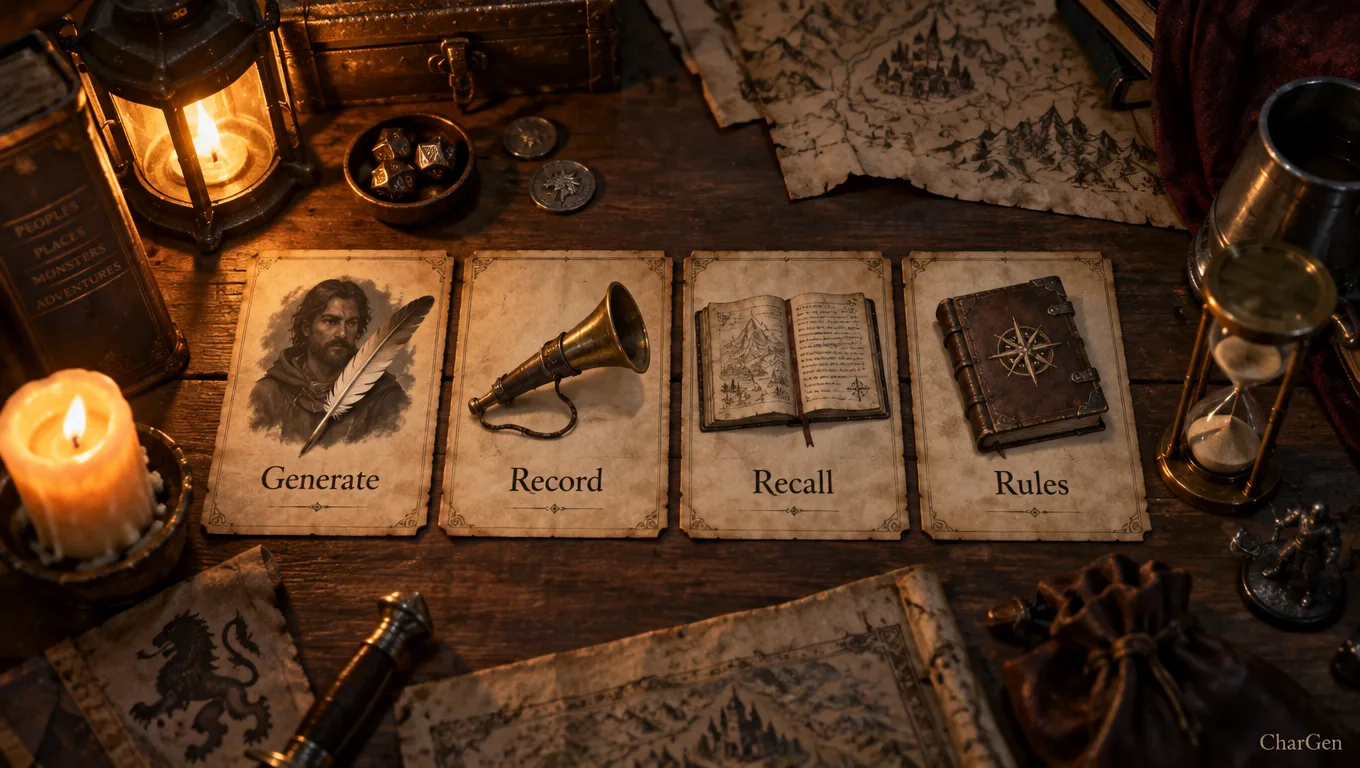
Archivist excels at campaign memory. Upload your session transcripts, and it builds a searchable database of everything that happened: NPC mentions, location descriptions, plot threads, player decisions. For groups that play every week for months, the "what happened three sessions ago?" problem is real. Archivist solves it.
TabletopArc generates NPCs, quests, towns, dungeons, and encounters with a TTRPG-specific focus. Their quest generation is strong for DMs who need a structured adventure hook rather than a single entity.
ChatGPT remains useful as a general-purpose brainstorming partner. When I need dialogue options for a specific NPC, or I want to stress-test a plot twist by asking "what would players try to do here?", a conversation with GPT-4 is faster than any structured tool. The limitation is that it produces text only. You still need a separate tool for portraits, tokens, and maps.
What AI session prep still cannot do
Honest limitations, because overpromising is the fastest way to waste a DM's time.
Improvisation. AI generates material before the session. When a player does something unexpected mid-game, the DM's brain is still faster than any tool. AI prep gives you more material to improvise from, but it does not replace the skill of reading the table and adapting on the fly.
Emotional reading. A good DM adjusts pacing based on whether the table is engaged, distracted, tired, or energised. No AI tool does this. The most it can do is give you more prep so you have options when the table's energy shifts.
Rules adjudication. For official D&D rules, use D&D Beyond or the published source material. AI generators are not licensed rules references, and trusting them for spell interactions or class features is a recipe for table arguments.
Table dynamics. AI cannot mediate player conflicts, manage spotlight time, or read the room for safety tools. These are human skills. The best AI prep frees up the DM's mental bandwidth for exactly this kind of work.
My weekly AI prep workflow
For context, I run a weekly campaign with five players, and my total prep time is about 30 minutes per session. Here is the routine.
Monday (10 minutes). Review last session notes. Identify what the party will likely encounter next. Open CharGen's RPG Workshop and generate the 2-3 key NPCs or creatures they will meet.
Wednesday (10 minutes). Generate battlemaps for any planned combat encounters. Create tokens for new NPCs and monsters. If the party is heading to a new location, generate the tavern, shop, or settlement they will arrive at first.
Friday before the session (10 minutes). Review everything I generated. Cut anything that does not fit. Add one unexpected detail to the main encounter: a twist, a complication, or an NPC who changes the situation. This is the creative step. AI made the raw material. I shape it into a session.
That is it. Thirty minutes, spread across three short blocks, produces enough material for a three-hour session with room for improvisation. The remaining time I would have spent on production goes toward actually thinking about the story, which is the part of being a DM that matters.
How to prep a D&D session with AI in 30 minutes
The weekly rhythm above works when I have a few days. This is the compressed version I use when the calendar has got away from me. It is not a promise that AI can write a good session while I make tea. The useful part is a hard limit on asset production, followed by a human review. The 2024 Dungeon Master's Guide still puts session preparation and running the group in the DM's hands, and it should. AI gives me raw material. It does not decide what my players will enjoy.
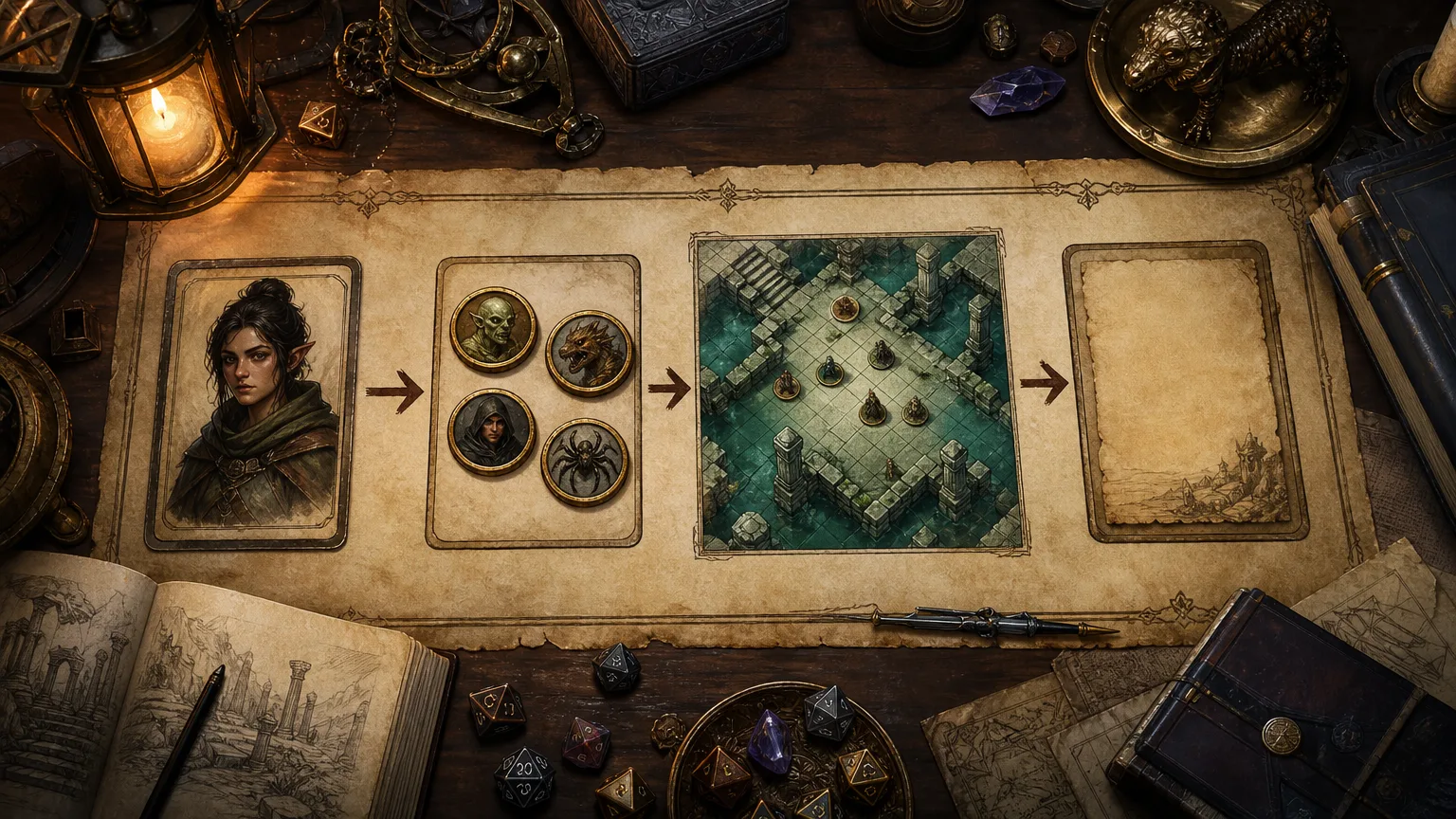
Minutes 0 to 3: write one promise for the session
I start with a sentence that tells me what changes by the end of the night: The party learns who paid the river cult, unless they accept the smuggler's bargain first. That is enough. It gives me a choice, a faction, and a consequence. It also stops the common mistake of generating a tavern, a dungeon, six NPCs, and a dragon because each one looks fun in isolation.
If I cannot write that sentence, I read the last recap first. A campaign memory tool can help retrieve the names and loose threads, but I make the decision myself. Archivist's current product describes recall across campaign notes and recaps, while CharGen keeps sessions, entities, and campaign workspaces close together. Either way, the output needs to fit the actual story rather than a generic fantasy prompt.
Minutes 3 to 9: make only the NPCs who can change the scene
For this example I need two people: the smuggler offering the bargain and a river cult lookout who wants the party gone. I use the NPC Generator for a portrait and the initial profile, then cut each result to a want, pressure, visible tell, and offer. The smuggler gets a cracked blue lantern and a route below the customs bridge. The lookout keeps touching a waterlogged signet ring and will trade information for safe passage.
That is enough for the table. I do not make a family tree, a childhood tragedy, or a full character sheet for someone who may never appear again. If either NPC survives and matters, I can add them to the RPG Workshop after the game, when I know which details the players actually cared about.
Minutes 9 to 16: build one encounter with an objective
The encounter is not "fight four cultists". The objective is to stop the cult from sending a coded warning downstream. That gives the battle a timer and makes retreat, capture, bribery, or sabotage all reasonable choices.
I use an Encounter Generator or the Monster Generator to get a premise, appropriate opposition, and visual direction, then I check challenge, monster abilities, and any rules interaction against my own books or D&D Beyond. AI is not a rules citation. It is especially bad at the confident little detail that sounds right until it slows combat down for twenty minutes.
Minutes 16 to 23: create one map that supports that choice
I generate a flooded shrine landing with two exits, waist-high crates, and a raised bell platform. The Battlemap Generator provides the starting image. Then I add three notes: where the warning can be sent, what counts as cover, and what changes after three rounds. I do not need a perfect map for every possible street in the city. I need one readable location where the party can make a meaningful decision.
Minutes 23 to 27: make tokens and a one-screen brief
Tokens come last because they depend on what I kept. I turn the smuggler, lookout, and two distinct cultists into VTT-ready circles with the Token Maker. Then I write the brief I will actually look at during play:
| What I keep on screen | Example for the flooded-shrine session |
|---|---|
| opening image | blue lanterns reflected in black water below the customs bridge |
| NPC pressure | the smuggler needs payment before the bell rings |
| encounter objective | stop the coded warning from leaving the shrine |
| complication | every third round, water rises and removes a safe square |
| likely reward | a canal map and the name of the cult's buyer |
Minutes 27 to 30: do the human review
This last pass is why the workflow remains useful instead of becoming a pile of handsome but unrelated files. I check that names match the campaign, that the map has a playable route, that no generated stat claim has slipped through untested, and that every asset points back to the session promise. If a generated detail is not helping tonight's choice, I remove it.
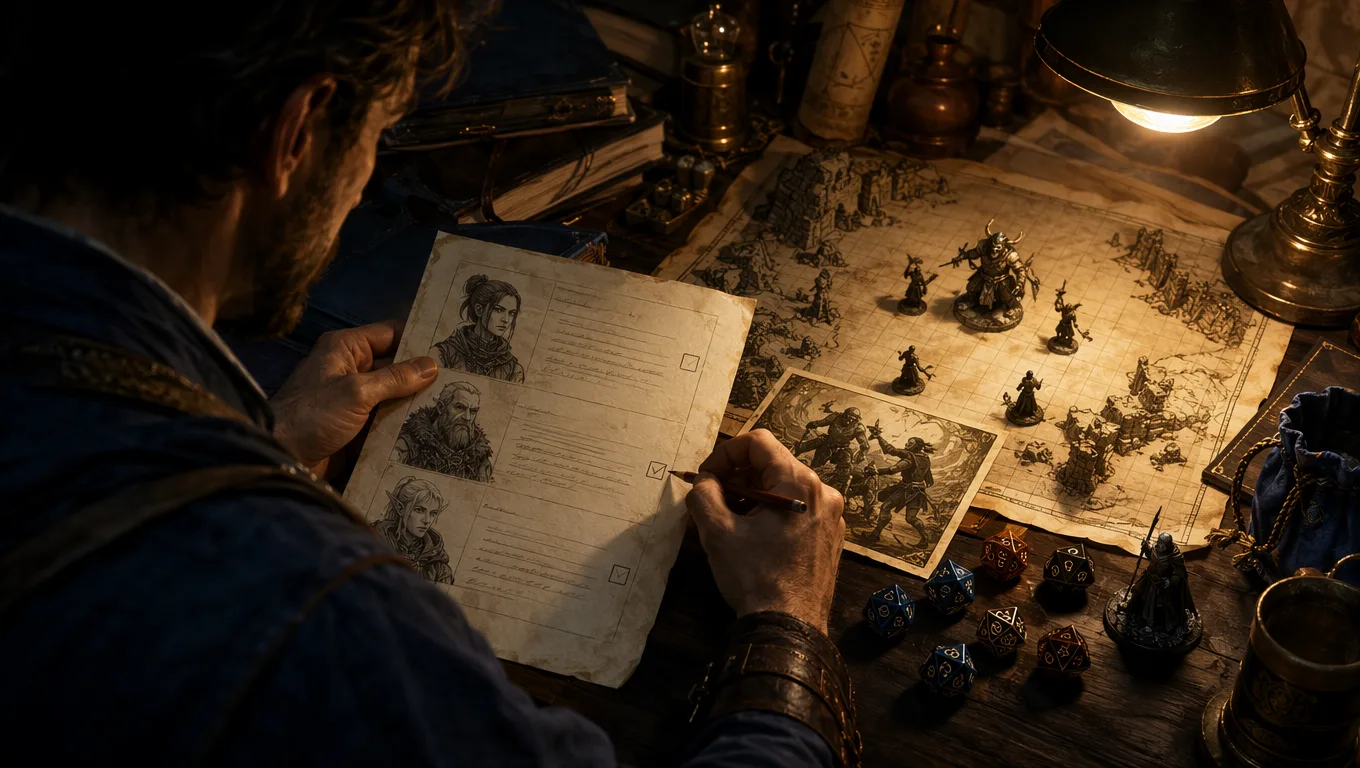
The same restraint applies to recordings and automated notes. Recent community discussion has made the consent issue very clear: do not record a table for AI transcription without everyone agreeing first. If I use a recap tool, I tell players what is recorded, where it goes, and how long I will keep it. Good prep should reduce work for the group, not quietly change the social contract.
Try the RPG Workshop FreeThe difference between AI tools and AI DMs
This distinction matters because the TTRPG community has strong feelings about it, and they are mostly right. I break the two categories down tool by tool in best AI dungeon master tools for 2026 prep.
An AI DM replaces the human behind the screen. An AI assistant gives that human better tools. The backlash against AI in TTRPG spaces is almost entirely directed at the first category, and understandably so. D&D is a social game. The DM is not a content delivery system. They are a collaborator, an improviser, and a friend. Replacing that with software misses the point of why people play.
AI session prep tools do not threaten that dynamic. They accelerate the boring parts (asset creation, token cropping, map drawing) so the DM has more energy for the interesting parts (storytelling, improvisation, player engagement). I built CharGen around that philosophy: no AI DM, just everything you need to prep one.
Start Prepping with CharGenFAQ
Is there a free AI dungeon master assistant?
Several tools offer free tiers. CharGen gives you 25 gold on signup and 10 gold per daily login, with additional gold from community activity. No credit card required. ChatGPT's free tier handles text-based brainstorming and NPC dialogue. For campaign memory, Archivist offers a free tier for smaller campaigns. The question is what kind of assistant you need: a brainstorming partner, a visual asset generator, or a campaign manager.
Can AI replace a human dungeon master?
For solo play and casual one-shots, AI DM tools like Jenova AI and AI Realm can run a functional game. For group play with recurring characters and long campaigns, no. A human DM reads the table, improvises based on player reactions, manages social dynamics, and adjusts pacing in real time. AI is best used as a prep assistant that makes the human DM's job faster, not as a replacement.
How much time does AI save on D&D session prep?
In my experience, AI tools reduce a three-hour prep session to about 30 minutes. The biggest time savings come from NPC generation (portraits plus backstories in seconds instead of manual writing and image searching), battlemap creation (text prompt to gridded map in under a minute), and token production (one-click circular tokens for VTTs). The DM still reviews and connects everything, but the production bottleneck is eliminated.
How do I prep a D&D session in 30 minutes with AI?
Start with three minutes for one session promise, then time-box the work: six minutes for the NPCs who can change the scene, seven for an objective-led encounter, seven for one readable map, four for tokens and a one-screen brief, and three minutes to review every detail yourself. Keep the campaign decisions, rules calls, and final cut under human control.
What is the best AI tool for generating D&D NPCs?
CharGen's NPC Generator is my pick because it produces portraits, backstories, personality traits, and motivations in one generation, all in a tabletop-specific workflow. TabletopArc generates structured NPC profiles with quest hooks. ChatGPT handles text-only NPC creation well but produces no visual assets. The best choice depends on whether you need visuals alongside the character concept.
Do I need multiple AI tools for session prep or just one?
Most DMs benefit from one primary toolkit and one or two specialised supplements. I use CharGen for visual assets (portraits, battlemaps, tokens, monsters, locations) and D&D Beyond for rules-accurate character sheets and spell references. If your campaign is long-running with many sessions to track, adding Archivist for campaign memory is worth considering. You do not need five tools. You need one that covers your biggest bottleneck.