
Best D&D Encounter Builders and Generators in 2026
My honest guide to every dnd encounter builder and generator worth using in 2026, plus the five-minute pass I run to balance a 5e fight before a session.
Short answer: for pure difficulty maths, Kobold+ Fight Club is still my first pick. For a 2024 or "5.5e" table, use a builder that runs the flat per-character XP budget: Kobold+, AideDD, Shieldmaiden or CharGen's Encounter Generator, which is free with an account. The full 2024 budget table for every level is further down this post.
Updated 26 September 2026: I added the full 2024 (5.5e) XP budget table for levels 1 to 20, checked line by line against D&D Beyond's free 2024 rules. I also added which builders run the 2024 maths and a worked example with the checks a table cannot do. Earlier notes are collapsed below.
Earlier update notes (July 2026)
Updated 13 July 2026: I re-checked the rules support that matters most before a 2024-rules combat. Kobold+ Fight Club now has an explicit 2024 encounter-rules strategy. D&D Beyond's older Encounter Builder is still a 2014-rules workflow, so I have added a practical check before the rankings.
Updated 29 July 2026: D&D Beyond has refreshed parts of its wider rules toolset, but its Encounters beta remains on the 2014 Dungeon Master's Guide encounter rules. I have added a short handoff check so a 2024 or 5.5e party does not quietly inherit the wrong difficulty assumptions.
Wednesday night prep gets silly fast. I have got a rough villain idea, a party that hits harder than the rules expect, and maybe forty minutes left before sleep becomes the better choice. That is exactly when a dnd encounter builder stops being a nice extra. It becomes the difference between a tense fight and me chucking six random stat blocks into a swamp map. Then I hope nobody notices. Some people call the same thing an encounter generator. The two words point at slightly different tools, and I explain the split below, because picking the wrong one wastes the exact twenty minutes you do not have.
I checked the tools people still reach for in 2026, looked at what they actually help with, and compared them against the boring reality of session prep. Some are proper encounter builders. Some are random generators. Some are really combat trackers with a builder bolted on. CharGen sits a bit differently, and I think that honesty makes this post better. If you want pure CR and XP maths, I would not pretend CharGen beats Kobold+ Fight Club or D&D Beyond Encounters. If you want the fight to become a monster, a map, and a playable VTT board afterwards, CharGen suddenly matters a lot.
What I actually need from a dnd encounter generator
I do not want a tool that only tells me the fight is "Hard" and then leaves me alone with a blank stare and a pile of monster names. I want a tool that helps me answer the real prep questions:
- is this fight roughly the right difficulty for the party in front of me
- can I find monsters that fit the location and story
- can I alter the fight quickly if one player cancels an hour before game time
- can I keep the result organised enough to run it without paper scraps everywhere
- can I turn the maths into something players can actually see on the table or VTT
That last point is where a lot of rankings go wrong. The old 2014 D&D Beyond encounter-building rules still cover the XP thresholds, multipliers, and the reminder that terrain, enemy position, and mixed monster types change difficulty in practice. Those rules are still useful. They just do not finish the job for you.
I also kept seeing the same complaint in community threads. People do not only want a difficulty label. They want a quick way to search thematic monsters, keep up with 2024 and 2026 rules changes, and avoid fights that are technically "balanced" but dull at the table. A 6 May 2025 r/DMAcademy thread asking for a Kobold Fight Club style tool with 2024 monsters made that tension obvious. People wanted the budget maths, yes, but they also wanted better monster support and faster variation.
The quick answer
| Tool | Best for | Why I would use it | Main drawback |
|---|---|---|---|
| Kobold+ Fight Club | the best pure 5e encounter builder | fast filters, quick party setup, random boss or horde styles, still the cleanest pure planning tool | it does not solve maps, art, or token prep |
| D&D Beyond Encounters | campaigns already living inside D&D Beyond | builder plus combat tracker in one, save and resume, direct monster access | still tied to D&D Beyond's ecosystem and edition friction can be annoying |
| Donjon Random Encounter Generator | weird or urgent random fights | very fast, environment filters, good when players go off-road | ugly interface and little hand-holding |
| Shieldmaiden | DMs who want builder and tracker side by side | good difficulty calculator, solid combat management, nice for live play | you get more value if you make an account and commit to the tool |
| AideDD Encounter Builder | a bare 2014 or 2024 difficulty check | one switch between 2014 and 2024 maths, plus a treasure roll for the same fight | plain interface, and it stops at the numbers |
| CritForge (now at getcritforge.com; the old critforge.com domain no longer resolves) | campaign-wide encounter management | track encounter history across sessions, solid monster search, good for ongoing campaigns: that is how I first described it. Its current pages list CR-balanced encounters with action economy warnings, saved to a campaign library, and I could not confirm the first two features there | less quick for one-off encounters than Kobold+, and new accounts join a waitlist for a 30-day trial |
| Vondy | AI-assisted encounter and NPC content (as I first listed it; not an encounter tool in September 2026) | generated encounter flavour text, NPC backstories, and room descriptions to flesh out the fight context; its homepage now sells a general AI app builder and I could not find that tool | not a CR calculator, better as creative prompt than mechanical builder, and I would not use it for encounter prep now |
| CharGen RPG Workshop | turning a balanced fight into a session-ready scene | monsters, art, battlemaps, and token follow-up in one workflow | it is a companion to a builder, not a drop-in CR calculator replacement |
| CharGen Encounter Generator | one free tool that does the maths and the scene | 2024 and 2014 5e budgets, Pathfinder 2e, Savage Worlds, live difficulty meter, then monster and map in the same place | Kobold+ is still quicker to open cold for a bare CR check |
Encounter builder or encounter generator: the words mean different things
Two searches land on posts like this one, and they want different tools.
An encounter builder is a calculator you drive. You enter the party. You choose the monsters. It tells you whether the fight sits at Low, Moderate, or High. Kobold+ Fight Club and D&D Beyond Encounters are builders. You keep every creative decision.
An encounter generator hands you a finished fight. You enter a level and an environment. It picks the monsters. Donjon works this way. You gain speed and you give up control.
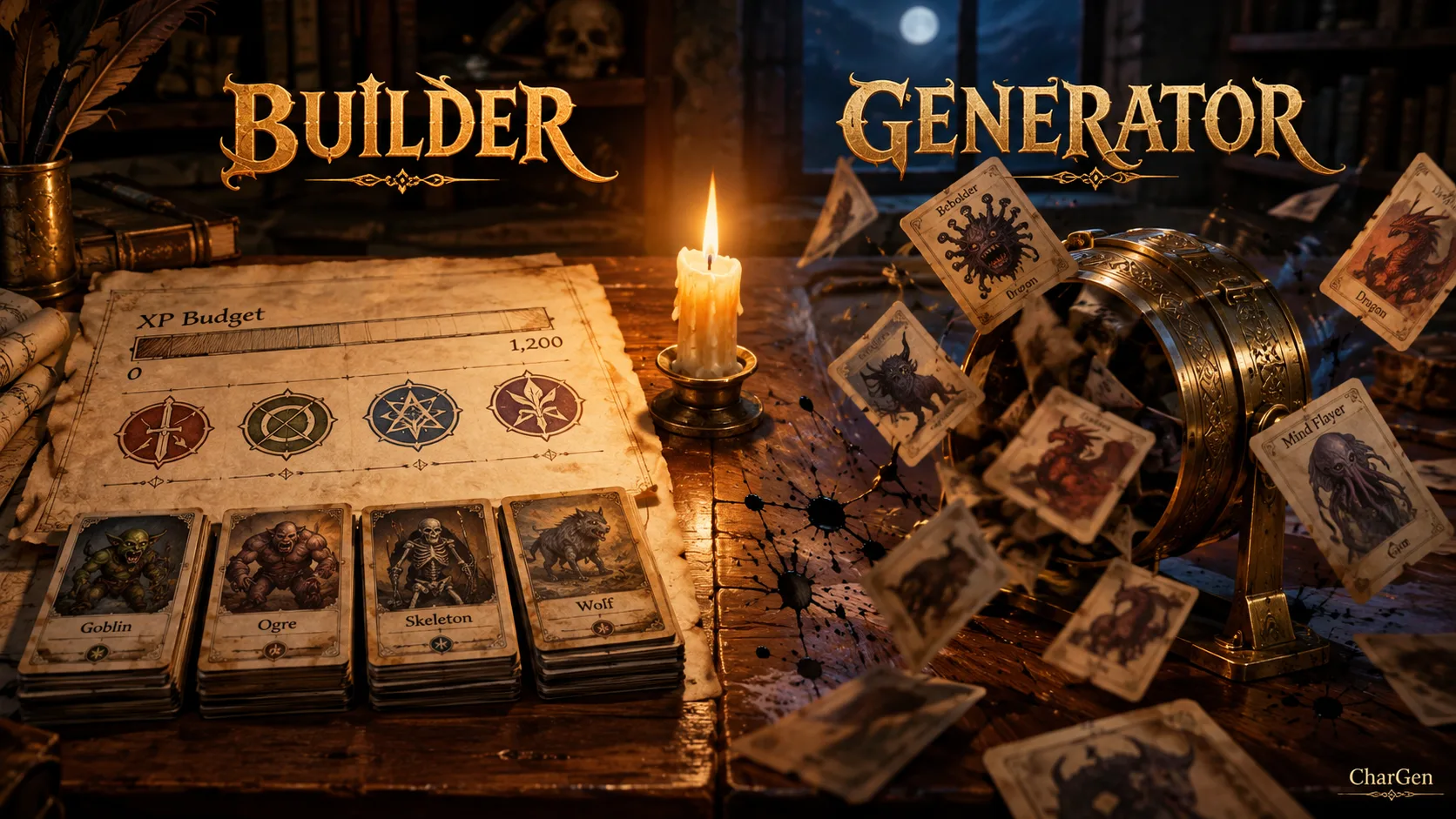
The difference decides which tab you should open. Open a builder when you already know the fight is three cultists and a summoned thing. Open a generator when you are staring at an empty swamp with no idea what lives in it.
I use both in one prep session, usually in that order. I generate when I am stuck for an idea. Then I rebuild the result properly once I can see its shape.
Worth mentioning though: most tools now blur the two. Kobold+ has random templates. Donjon lets you set difficulty. The label on the homepage is a weaker signal than how much the tool asks you to decide.
The five-minute encounter builder pass
Here is the routine I run when the session is tomorrow and I have five minutes.
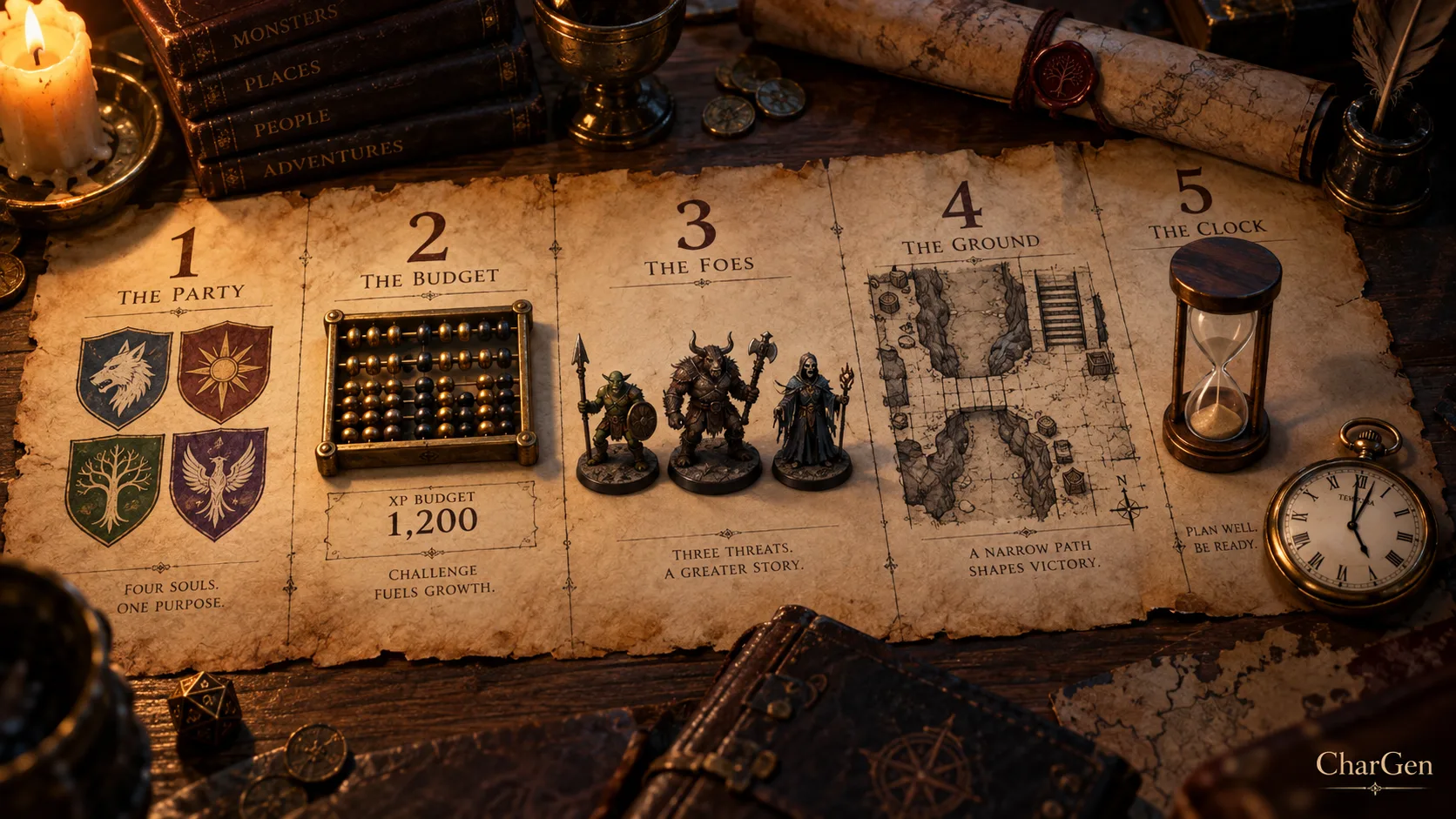
- The party. Write the level and the head count. Note who cannot attend.
- The budget. Multiply the 2024 per-character XP budget by the head count. Four level 5 characters at Moderate gives 3,000 XP.
- The foes. Add monsters until the total sits just under the ceiling. Stop below it.
- The ground. Choose one choke point, one piece of cover, and one exit.
- The clock. Decide how the fight ends other than at zero hit points.
Steps one to three are the part a builder does for you. Steps four and five are the part no builder does, and they change the fight more than one extra goblin ever will.
That last point is the one I would defend hardest. A fight can pass the maths and still be dull. Terrain and an objective are what make it a scene.
Is a 5.5e encounter calculator a different thing?
This question keeps appearing in search, so here is the plain answer.
There is no separate 5.5e maths. "5.5e" is community shorthand for the 2024 revision, not a new edition. The 2024 Dungeon Master's Guide dropped the old XP multiplier table and replaced it with the flat Low, Moderate, and High budgets I list further down this post.
So a 5.5e encounter calculator is just a 2024-rules encounter builder. Kobold+ Fight Club ships that strategy already. D&D Beyond's Encounters beta does not, and its own support note confirms it stays on 2014 rules.
One quick test tells you which set you are using. If the tool asks you to multiply your monster XP by a group-size factor, it is running 2014 maths. If it gives you a flat per-character budget and tells you to spend up to it, it is running 2024 maths. Both work. Only one matches your table.
Whichever builder you use, the numbers are the easy half. CharGen's own Encounter Generator runs the 2024 budgets and then gives the ogre a face in the same tool. A builder can tell you the ogre is affordable. It cannot tell you the ogre is memorable.
July 2026 update: check the rules engine before trusting the difficulty label
The most useful change I found while checking these tools again is a rules toggle, rather than a new AI button or a prettier monster card. A difficulty label only helps if the tool is measuring against the version of D&D your table is actually playing. That sounds obvious, but it is very easy to miss when a builder shows a large green "Moderate" badge and you are trying to prepare before work.
Kobold+ Fight Club now offers separate 2014 and 2024 encounter-generation strategies. Pick the 2024 option if your campaign uses the 2024 Player's Handbook, Dungeon Master's Guide, or newer monster books. The site describes it as the familiar generator behaviour adapted for the 2024 rules, and it keeps the useful filters, party setup, source controls, and random templates intact. In practice, that means you can still start with "four level 5 characters, difficult fight, ruined lighthouse" instead of learning a new tool at the same time as a new rules baseline.
D&D Beyond needs a more careful reading. Its current Encounter Builder is still the 2014-rules option, even though Maps and newer character workflows sit beside 2024 content. I would not call that a reason to avoid the service if your group already has its characters and combat notes there. It is a reason to write the ruleset at the top of your prep note. Mixing a 2024 party, a selection of legacy monsters, and a 2014 difficulty calculation is how a fight earns a reassuring label then feels oddly flat or far too sharp at the table.
Here is the five-minute check I now make before I accept any encounter result:
| Check | What I look for | Why it changes the session |
|---|---|---|
| ruleset | 2014 or 2024 selected on purpose | the same party level does not tell the whole story |
| party reality | healing, control spells, burst damage, and a likely absence | four identical level numbers are not four identical characters |
| monster source | current stat block or a deliberate legacy pick | an old monster may not play like the book on the DM's desk |
| terrain | cover, choke points, elevation, and escape routes | positioning often changes the fight more than one extra creature |
| exit condition | surrender, alarm, collapsing bridge, or reinforcements | combat needs a decision; just a hit-point race is not enough |
I used that checklist for a recent group of five level 5 characters heading into a flooded observatory. Their sheets made them look sturdier than they were: one player was away, the cleric had spent two key spell slots in the previous scene, and the map had a narrow spiral stair. A 2014-style calculation with several enemies looked manageable. A 2024 pass in Kobold+ made me drop one supporting creature and give the lead enemy a retreat route through the glass dome instead. The fight still had pressure, but it had an ending other than everybody crowding a stairwell and trading attacks until the snacks ran out.
That is the habit I would keep, even if you use a different builder. Treat the difficulty label as a starting estimate. Then check the party you have, the rules you chose, and the space where the fight happens. Once those decisions are fixed, CharGen's Battlemap and Monster Generator are where I make the encounter feel specific enough to remember next week.
That is the honest ranking. If you only want one site to calculate encounter difficulty, I would still start with Kobold+ Fight Club. If you want to build the whole experience around the fight afterwards, I would pair the builder with CharGen.
1. Kobold+ Fight Club is still the best pure encounter builder
Kobold+ Fight Club keeps winning this category because it knows exactly what it is. Open it, set party size and level, search monsters, watch the difficulty change, done. No sermon, no decorative clutter, no attempt to become your whole campaign brain.
I still like it for one reason above the rest: speed. If I need a level 5 sewer ambush for four players and I want something nastier than "three ghouls, I suppose", Kobold+ gets me there in seconds. The random encounter modes are useful too. The 2022 update posted on r/DMAcademy added boss, boss with minions, trios, hordes, encounter history, and better player management, which is exactly the sort of modest improvement that helps actual DMs rather than impressing product managers.
One recent example from my own prep: I needed a dockside fight for a group of four level 4 characters. I knew I wanted smugglers plus one heavier bodyguard, but I had not decided whether the fight should feel cramped and dirty or openly lethal. Kobold+ let me test both versions quickly. Version one used several weaker enemies and looked fine on paper. Version two used fewer creatures and one nastier bruiser, which fitted the narrow map and the party's real damage output far better. That took maybe three minutes.
The weakness is obvious. After the numbers are sorted, Kobold+ has done its job. It does not give me the map, the monster portrait, the token, or the visual continuity. That is not a flaw so much as the limit of the category.
2. D&D Beyond Encounters is best if your campaign already lives in D&D Beyond
I think D&D Beyond's builder gets judged too harshly by people who do not actually use D&D Beyond for the rest of their prep, and too kindly by people who do. My own view sits in the middle.
The official page says Encounters is a builder and combat tracker in one, free for registered users, with difficulty checks, monster lookups, save and resume support, and real-time updates for initiative and hit points. If your group already stores characters in D&D Beyond, that is genuinely handy. There is a reason people keep trying to make it work.
The best part is the handoff from planning into running combat. I can build the fight, launch it, and track the round flow without moving to another app. If you are an in-person DM who still wants a digital tracker, that matters. It also makes cliffhanger endings less irritating because you can pause and return instead of rebuilding the whole mess next week.
That said, I would not pretend it is frictionless. D&D Beyond forum posts over the last two years have been full of edition and workflow complaints, especially around 2024-era expectations, encounter saving, and the overlap between Encounters and Maps VTT (see the Maps and Encounters feedback thread and Encounters or Maps?). A 26 February 2026 feedback thread even argued that the Maps encounter tracker felt better for live combat than the old builder. That tells you a lot. The tool is useful, but the product boundaries are still not as tidy as I would like.
If you already subscribe to D&D Beyond and keep your party there, it is a very sensible choice. If not, Kobold+ usually feels quicker.
3. Donjon is still my favourite random encounter generator when I need something odd
Donjon looks like it was assembled by a wizard who has not updated his website since the age of chainmail. I mean that affectionately. It is still one of the handiest ugly tools in tabletop gaming.
The 5e random generator lets you set number of PCs, level, difficulty, and environment, then spits out encounter options quickly. That combination is why I keep coming back. The environment filter does more work than people expect. If the party is in the Underdark, swamp, coast, or urban district, I want that baked in before I even start making story adjustments.
Donjon is not the tool I use for my centrepiece villain fight. It is the tool I use when my players ignore the haunted lighthouse, steal a ferry, and force me to invent a riverbank problem in thirty seconds. It is also very good for shaking me out of my own habits. Left alone, I build too many encounters around the same handful of monsters. Donjon occasionally gives me a pairing I would not have chosen and then I can decide whether it is brilliant, daft, or salvageable.
One example, I once needed a level 3 forest interruption and got a result that nudged me towards a beast-heavy fight I would normally have skipped. The raw result was not ready to run as-is, but it did give me the right shape: something mobile, mean, and believable for the location. That is enough for a random tool.
The problem is polish. Donjon does not feel modern, and I would not hand it to a brand new DM as their only prep tool. Still, for a random encounter generator dnd workflow, it remains very useful.
4. Shieldmaiden is the best pick when the tracker matters as much as the builder
Shieldmaiden sits in a nice middle space. It has an encounter builder, a combat tracker, and a DM-facing focus that feels built by people who have actually had to juggle initiative, hit points, conditions, and player attention at once.
The official tool page talks about building encounters, calculating difficulty, and then running them in the combat tracker. Their About page is even more candid. The creators say they built it because, in their words, preparing and running combat encounters can be time consuming, challenging and stressful. Fair enough. That is the exact problem.
I like Shieldmaiden most for longer fights with a lot of moving parts. If the combat involves conditions, custom monsters, summoned bodies, or shared initiative visibility for players, it starts to pull ahead of simpler builders. The live tracking layer is the bit I would be paying for mentally, even if I did not spend money on it.
There is a limit, though. Shieldmaiden is strongest when you commit to the ecosystem and let it handle the running of combat too. If you only want a fast party-vs-monsters calculator and nothing else, Kobold+ is still lighter and faster.
5. CritForge and Vondy, newer tools showing up in searches
Two tools that have been appearing in encounter generator searches in 2026 and are worth knowing about.
CritForge (formerly critforge.com, now getcritforge.com) is a campaign management tool with an encounter builder built in. The strength over Kobold+ Fight Club is persistence: its pages say your encounters, NPCs and plots are saved and connected in one campaign library. When I first wrote this section I also said you could save encounter history across sessions, track what the party has already fought, and search monsters with campaign context in mind. I could not confirm those three features on its current pages, so treat them as unverified. If you are deep in a multi-session arc and want continuity across encounters, CritForge is built for that. For a one-off encounter I needed fast, Kobold+ is still quicker to open cold.
Vondy (vondy.com) used AI to generate encounter-flavour content rather than CR maths, room descriptions, enemy motivations, NPC backstories, and ambient details that fill in the scene around a fight. I would not use it as my difficulty calculator, but paired with Kobold+ or D&D Beyond, it was useful for fleshing out why a fight is happening and what the space looks like. If your problem is "the mechanics are fine but every encounter feels generic," Vondy addressed the narrative layer specifically. That was true when I first wrote this section. In September 2026 its homepage sells a general AI app and website builder instead, and I could not find that encounter tool, so I no longer recommend it here. The workflow section below covers the narrative layer with tools I could check.
Correction, 26 September 2026: critforge.com no longer resolves. CritForge now lives at getcritforge.com. Its features page lists an Encounter Builder with "action economy warnings, legendary creature callouts, and one-click rebalancing", plus wandering encounter tables, and says it uses SRD 5.2.1 content. Its pricing page offers a 30-day free trial with 40 Generation Power credits (new accounts join a waitlist first). Paid plans start at Solo, $150 a year ($12.50 a month) for 200 credits a month. I could not confirm the encounter-history features I first described on its current pages. Vondy's homepage now presents it as a general AI app builder. I could not find a D&D encounter tool there, so I would not open it for encounter prep today.
Neither replaces the core tools at the top of this list, but both are worth bookmarking if you want to see where the space is heading.
Where CharGen fits, and why I still think it belongs in this list
Right, so this is the bit where some comparison posts get dishonest. I have to correct my own post here, because I left this section stale for two months.
When I first wrote this comparison, CharGen did not calculate encounter difficulty. It does now. The Encounter Generator shipped a difficulty engine in June 2026, and it answers "what CR budget fits four level 6 characters?" directly. It uses the 2024 Dungeon Master's Guide per-character XP budgets, the 2014 thresholds, the Pathfinder 2e budgets from GM Core, and Savage Worlds. Each foe contributes XP weighted by its own CR. The meter updates live as you add or remove creatures.
So CharGen is a builder now, and I should say so plainly rather than keep the modest old framing.
What CharGen still does better than the others is everything that comes immediately after.
Once I know the rough fight I want, I move into RPG Workshop, Monster Generator, and Battlemap. That turns a balanced encounter into something I can show players. I can give the basilisk a look, give the shrine a floor plan, and then crop the necessary faces into tokens. None of the classic encounter builders solve that bit well.
If you want a CharGen-specific example, my older post on building balanced fights with CharGen's Monster Generator still holds up. That workflow is monster-first rather than calculator-first, which is why I would not call it a pure encounter generator. It is still useful because once the fight concept exists, CharGen helps me make it feel like part of the same campaign instead of a spreadsheet result.
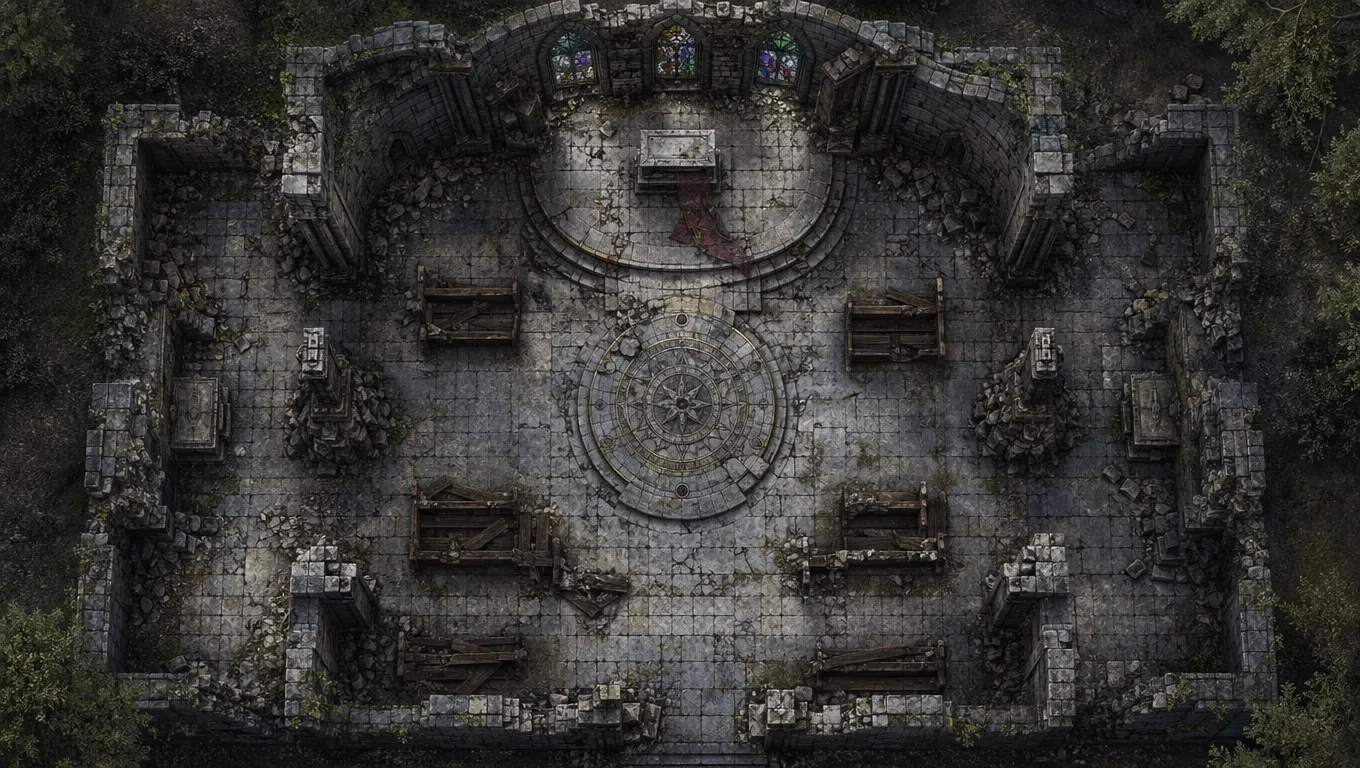
One concrete workflow I actually use:
- balance the fight in Kobold+ or D&D Beyond
- build the signature enemy in Monster Generator
- create or choose a matching board in Battlemap
- export tokens if the fight is going to a VTT
That chain fixes a common DM problem. The maths may be fine, but the fight still feels abstract until you give it visual identity. A level-appropriate manticore is one thing. A rain-soaked harbour manticore with broken wing leather, a custom token, and a map full of crane shadows is another. Players remember the second one.
I also like doing a quick visual A/B pass before I commit. CharGen's paid Arena is handy when I need to know whether a monster design is going to hold together across portrait, battlemap dressing, and token export. That is not encounter maths, but it is good prep.
Build the Monster and Map FreeJuly 2026 update: make the handoff explicit when your table uses 5.5e
The term “5.5e” has escaped the group chat and started appearing around D&D Beyond too. It is informal shorthand for the 2024 revision, not a new game that makes your 2014 books vanish. Still, it is useful shorthand when I am checking an encounter, because it tells me to stop assuming that every tool in the chain is using the same baseline.
The awkward detail is that D&D Beyond's broader character and rules tools have received 2024 updates, while its Encounters beta continues to use the encounter rules from the 2014 Dungeon Master's Guide. D&D Beyond's own support note says exactly that. It does not make Encounters useless. It just means I treat its difficulty badge as a 2014 estimate, then make a conscious call about the table in front of me.
Here is the handoff I now write in the notes field before I move from a builder to actual prep:
| Write this down | Why I do it |
|---|---|
| rules label: 2014 or 2024/5.5e | It stops a familiar tool from hiding which assumptions produced its label. |
| source for each unusual monster | A legacy stat block can be a deliberate choice, but it should not be an accidental one. |
| party resources right now | A fighter with Action Surge available and one who spent it an hour ago are not the same input. |
| encounter purpose | “Protect the observatory lens for three rounds” produces better decisions than “reduce every hit point to zero”. |
| exit or escalation | Reinforcements, a retreat route, a flooding room, or a surrender keeps the fight from becoming a long calculation. |
For a five-person level 5 group, I recently used this on a flooded observatory scene. The builder supplied a sensible starting mix, but it could not know that one player would be absent, the cleric was nearly out of spell slots, and the enemy's job was to delay the party while an ally escaped through a cracked dome. I removed one supporting creature, made the stair an obvious choke point, and gave the lead enemy a clear retreat trigger. That was a better adjustment than trying to chase a perfect numerical label.
Kobold+ Fight Club remains the cleaner choice when I want a tool that has a deliberate 2024 strategy. D&D Beyond remains convenient when the campaign, character sheets, and tracker are already there. The useful habit is the same for both: name the ruleset, read the output as a starting point, then turn it into a scene with an objective, terrain, and a way for the situation to change. After that, I use CharGen's Monster Generator and Battlemap to make those choices visible at the table.
14 August 2026 update: use the 2024 XP budget as a ceiling
I have added one more check to this comparison after reviewing the official 2024 Dungeon Master's Guide encounter tools again. The 2024 guidance uses Low, Moderate, and High difficulty categories. It gives an XP budget for each character level, then asks you to multiply that number by the number of characters in the party. The practical instruction is simple: spend as much of the budget as possible without going over.
That is a better handoff than copying a green difficulty badge into my notes. The table below shows the values I use for a quick check. These are per character values from the 2024 guidance, not the total for a whole party.
| Character level | Low | Moderate | High | Moderate for four characters | Moderate for five characters |
|---|---|---|---|---|---|
| 3 | 150 XP | 225 XP | 400 XP | 900 XP | 1,125 XP |
| 5 | 500 XP | 750 XP | 1,100 XP | 3,000 XP | 3,750 XP |
| 8 | 1,000 XP | 1,700 XP | 2,100 XP | 6,800 XP | 8,500 XP |
| 10 | 1,600 XP | 2,300 XP | 3,100 XP | 9,200 XP | 11,500 XP |
For example, a party of five level 5 characters has a Moderate budget of 3,750 XP. That does not mean an encounter at 3,750 XP is automatically right. The official guidance still tells the DM to check the number of creatures, the party size, the characters' abilities, and the actual situation. More than two creatures per character can make a fight harder to run. A single creature with a much higher Challenge Rating can also overwhelm a lower-level group.
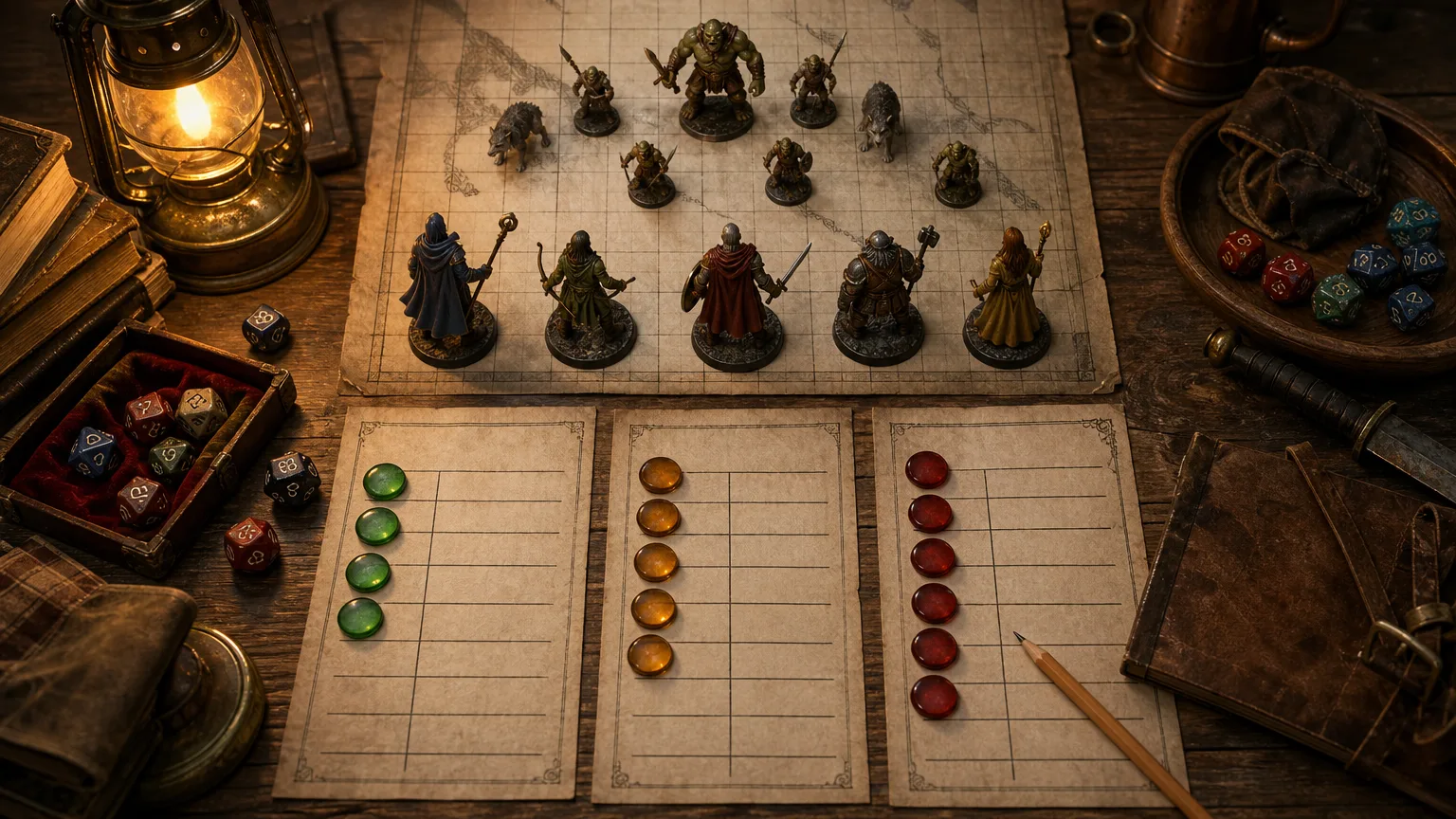
My updated five-minute pass is now:
- Write the party level and the number of characters.
- Multiply the 2024 per-character budget by that number.
- Keep the total at or below the chosen Low, Moderate, or High budget.
- Count the creatures, then check whether the action economy makes sense.
- Add the terrain, objective, escape route, and any player absence.
The numbers give me a ceiling, not a verdict. A narrow stair, a flying enemy, or a monster that can disable one character can change the real difficulty. I also adjust when one player cannot attend. The official table assumes a party count. It cannot know that the missing character was the group's only source of healing or area control.
One other distinction matters. The D&D Beyond Maps combat tool updates its Low to High estimate as I add or remove tokens. The separate Encounters beta remains based on the 2014 rules. I would therefore record the source beside the total before I move into monster, map, and token prep.
The full 2024 (5.5e) XP budget table and encounter calculator, levels 1 to 20
The August table above covers four levels. People searching for a 5.5e encounter calculator kept landing on this post, and the level they needed was often missing. So here is the whole table. I copied every value from the XP Budget per Character table in the 2024 free rules DM's Toolbox on D&D Beyond and checked it line by line on 26 September 2026.
Each figure is per character. Multiply it by the number of characters in the party. The last two columns do that for four characters, the party size the 2024 guidance uses for its single-monster rule of thumb.
| Character level | Low | Moderate | High | Moderate for four characters | High for four characters |
|---|---|---|---|---|---|
| 1 | 50 XP | 75 XP | 100 XP | 300 XP | 400 XP |
| 2 | 100 XP | 150 XP | 200 XP | 600 XP | 800 XP |
| 3 | 150 XP | 225 XP | 400 XP | 900 XP | 1,600 XP |
| 4 | 250 XP | 375 XP | 500 XP | 1,500 XP | 2,000 XP |
| 5 | 500 XP | 750 XP | 1,100 XP | 3,000 XP | 4,400 XP |
| 6 | 600 XP | 1,000 XP | 1,400 XP | 4,000 XP | 5,600 XP |
| 7 | 750 XP | 1,300 XP | 1,700 XP | 5,200 XP | 6,800 XP |
| 8 | 1,000 XP | 1,700 XP | 2,100 XP | 6,800 XP | 8,400 XP |
| 9 | 1,300 XP | 2,000 XP | 2,600 XP | 8,000 XP | 10,400 XP |
| 10 | 1,600 XP | 2,300 XP | 3,100 XP | 9,200 XP | 12,400 XP |
| 11 | 1,900 XP | 2,900 XP | 4,100 XP | 11,600 XP | 16,400 XP |
| 12 | 2,200 XP | 3,700 XP | 4,700 XP | 14,800 XP | 18,800 XP |
| 13 | 2,600 XP | 4,200 XP | 5,400 XP | 16,800 XP | 21,600 XP |
| 14 | 2,900 XP | 4,900 XP | 6,200 XP | 19,600 XP | 24,800 XP |
| 15 | 3,300 XP | 5,400 XP | 7,800 XP | 21,600 XP | 31,200 XP |
| 16 | 3,800 XP | 6,100 XP | 9,800 XP | 24,400 XP | 39,200 XP |
| 17 | 4,500 XP | 7,200 XP | 11,700 XP | 28,800 XP | 46,800 XP |
| 18 | 5,000 XP | 8,700 XP | 14,200 XP | 34,800 XP | 56,800 XP |
| 19 | 5,500 XP | 10,700 XP | 17,200 XP | 42,800 XP | 68,800 XP |
| 20 | 6,400 XP | 13,200 XP | 22,000 XP | 52,800 XP | 88,000 XP |
Two things stood out when I read it from top to bottom. First, the step from level 4 to level 5 is steep. A Moderate fight for four level 4 characters (1,500 XP) sits below the Low budget for the same party at level 5 (2,000 XP). Old prep notes from level 4 will feel soft a session later. Second, High pulls away from Moderate as levels rise. At level 1, High is 100 XP against 75 XP. At level 20, High is 22,000 XP against 13,200 XP.
Which encounter builders run the 2024 maths
I checked each tool's own page on 26 September 2026. This is what each one says it supports, not a guess from its age.
| Tool | 2024 (5.5e) budgets | 2014 thresholds | Cost | What I noticed |
|---|---|---|---|---|
| Kobold+ Fight Club | yes, a separate 2024 strategy | yes | free, no account | the quickest to open cold |
| AideDD Encounter Builder | yes, a 2024 switch beside the Calculate button | yes | free, ad-supported | it also works out individual and hoard treasure |
| Shieldmaiden | yes, its page says it builds for 5e and 5.5e | yes | free to start | best if you also want its combat tracker |
| D&D Beyond Encounters | no, its support note says it stays on 2014 rules | yes | free for registered users | handy only if your characters already live there |
| CharGen Encounter Generator | yes | yes, plus Pathfinder 2e and Savage Worlds | free with a CharGen account | adds terrain, an objective and tactics; Savage Worlds returns a ratio guide, not a number |
If all you need is the number, Kobold+ and AideDD are faster than CharGen, because neither asks you to sign in. CharGen needs a free account. Editing an encounter after it is generated is a premium feature. That is the honest trade-off.
A worked 2024 example, with the checks the table cannot do
Here is a Moderate fight for four level 4 characters. The budget is 375 XP times four, so 1,500 XP. I used XP values that the 2024 toolbox itself prints for these stat blocks:
| Creature | Challenge Rating | XP each | Count | XP total |
|---|---|---|---|---|
| Wight | 3 | 700 XP | 1 | 700 XP |
| Bugbear Warrior | 1 | 200 XP | 2 | 400 XP |
| Giant Wasp | 1/2 | 100 XP | 4 | 400 XP |
| Total | 7 | 1,500 XP |
That spends the budget exactly. The maths is done, but the 2024 guidance lists more checks in its Troubleshooting section, and I run three of them every time:
- Creature count. Seven creatures against four characters is 1.75 per character. The guidance flags more than two per character, and says the extra creatures should be fragile. This fight sits under that line.
- Powerful creatures. The Wight is CR 3 and the party is level 4, so no creature is above the party's level. The guidance warns that a creature above party level can drop a character with one action. Its own example is an Ogre (CR 2) killing a level 1 Wizard with a single blow.
- Stat blocks. This fight uses three. The guidance says more than two or three can be daunting to run. I would not add a fourth.
Then the absence check. If one player cancels, the budget drops to 1,125 XP (375 XP times three). I remove both Bugbear Warriors. The Wight and four Giant Wasps come to 1,100 XP. That is under the new ceiling, and it is one stat block lighter at the table.
This is the loop CharGen's Encounter Generator runs for me. I pick the 2024 rules and set four level 4 characters, and the difficulty is recomputed every time the foe list changes. It then adds terrain, an objective and tactics, which are the parts no budget table can give you. If the fight sits inside a dungeon crawl, CharGen's Dungeon Generator builds the rooms around it.
Open the Free Encounter GeneratorMy 30-minute workflow for a balanced fight that looks like a real scene
This is the routine I would actually use tonight if my session were tomorrow.
| Prep block | Time | Tool | What I do |
|---|---|---|---|
| difficulty pass | 5 minutes | Kobold+ Fight Club or D&D Beyond | set party size, test monster combinations, pick the fight shape |
| reality pass | 5 minutes | D&D Beyond rules or my own notes | check terrain, action economy, and any party-specific weirdness |
| monster pass | 8 minutes | CharGen Monster Generator | build or refine the lead creature so it has a clear identity |
| map pass | 7 minutes | CharGen Battlemap | create a board with cover, lanes, and one obvious hazard |
| token and notes | 5 minutes | CharGen tools | crop tokens, note the gimmick, and stop fiddling |
That time limit matters. Encounter tools can waste hours if you keep polishing after the useful decisions are already made.
My rule is simple: once the fight has a purpose, readable terrain, and a recognisable lead enemy, I stop. The final 20 per cent of prep usually adds less than people think.
Which dnd encounter generator I would choose for different jobs
If your real question is "which one should I open first?", here is the shortest answer I can give.
| If you need... | Open this first | Why |
|---|---|---|
| the best pure 5e encounter builder | Kobold+ Fight Club | quickest route to a sane fight budget |
| a builder plus combat tracker in one account | D&D Beyond Encounters | strongest if your characters already live there |
| a random fight because the party has gone off the plan | Donjon Random Encounter Generator | ugly, fast, and weird in useful ways |
| a longer combat with lots to track | Shieldmaiden | better if you want to run the fight in the same tool |
| campaign-wide encounter history and persistence | CritForge (formerly critforge.com) | saves encounters to a campaign library; I could not confirm that it tracks encounters across sessions |
| narrative context and flavour for a fight | none I could verify in September 2026 (Vondy used to fill this row) | I listed Vondy for AI-generated room descriptions, NPC motivations, scene flavour, but it is now a general AI app builder |
| the part after balance, monster look, map, and tokens | CharGen RPG Workshop | best visual follow-up workflow of the group |
| one free builder that also makes the monster, map, and tokens | CharGen Encounter Generator | 2024, 2014, PF2e, and Savage Worlds difficulty in one tool, no payment for the maths (generating is free with a CharGen account; editing a generated encounter is premium) |
My recommendation after testing these again
For pure encounter generation, Kobold+ Fight Club still wins.
I am saying that plainly because it is true, and because readers can smell it when a comparison bends itself into a product pitch. Kobold+ is the best dnd encounter generator if what you really need is fast, practical fight balancing. D&D Beyond is the better choice when your whole group already lives there. Donjon is the scrappy randomiser I never quite stop using. Shieldmaiden is the stronger "run the combat too" option.
CharGen is now a builder too, and it is the only one here that carries the fight through to art, maps, and tokens.
I would still open Kobold+ first for a pure CR check, because it is faster to reach cold and it needs no account. I would open CharGen when I want the difficulty maths and the finished scene in the same place, or when the table plays Pathfinder 2e or Savage Worlds, which Kobold+ does not cover: Roll20's GM Hub describes it as a D&D 5E encounter utility (checked 26 September 2026).
That is still a useful conclusion. A balanced fight is not automatically a memorable one. Once I know the encounter works on paper, CharGen is what helps me turn it into a monster with a face, a board with a purpose, and tokens that work in Roll20 or Foundry. If that part matters to you, open CharGen signup and start with RPG Workshop. Build the balanced fight elsewhere if you like. Then make it look like it belongs in your campaign.
FAQ
What is the best dnd encounter generator overall in 2026?
For pure 5e encounter building, I would pick Kobold+ Fight Club. It is still the fastest and cleanest tool for party setup, monster filtering, and quick difficulty checks.
Is D&D Beyond Encounters better than Kobold+ Fight Club?
Only if your campaign already lives in D&D Beyond. If your characters, monsters, and combat tracking are already there, the builder plus tracker combo is useful. Remember that its Encounters beta uses 2014 encounter rules, so note that when your table uses the 2024 revision. If not, Kobold+ usually feels quicker.
Can I use a 2014 encounter builder for a 2024 or 5.5e D&D party?
Yes, as a starting estimate, but write down the rules baseline and check the actual party resources, monster source, terrain, and objective yourself. Kobold+ Fight Club has a dedicated 2024 strategy. D&D Beyond's Encounters beta remains a 2014-rules workflow.
Does CharGen have its own encounter builder?
Yes, since June 2026. The Encounter Generator computes difficulty against the 2024 Dungeon Master's Guide XP budgets, the 2014 thresholds, Pathfinder 2e, and Savage Worlds, with a meter that updates as you edit the fight's foe list. It is free to generate an encounter with a CharGen account. Correction, 26 September 2026: editing an encounter after it is generated needs a premium plan. I then use the same tool for monster generation, battlemaps, visuals, and token prep. An earlier version of this post said CharGen had no builder, which was true when I wrote it and is not true now.
What is the best random encounter generator for D&D?
Donjon still gets my vote. It is quick, flexible, and good at giving me a usable prompt for a fight when players go somewhere I did not expect.
How do I make encounters feel less generic?
Use the builder for the maths, then add terrain, a clear objective, and one strong visual idea. That is exactly where pairing a builder with CharGen helps.
What are CritForge and Vondy?
CritForge is a campaign management tool with encounter building built in, good for keeping encounters across a multi-session arc in one campaign library. It moved from critforge.com to getcritforge.com and offers a 30-day trial. Vondy was an AI tool that generated encounter flavour text, NPC motivations, and room descriptions; in September 2026 it is a general AI app builder and I could not find that encounter tool. Neither replaces a CR calculator, but CritForge does address the creative and narrative parts of encounter prep that Kobold+ Fight Club leaves unfinished.
What is the difference between a D&D encounter builder and an encounter generator?
A builder is a calculator you drive. You pick the monsters and it scores the difficulty. A generator picks the monsters for you from a level and an environment. Kobold+ Fight Club and D&D Beyond Encounters are builders. Donjon is a generator. Use a builder when you know the fight, and a generator when you need an idea.
Is there a free 5e encounter builder?
Yes. Kobold+ Fight Club is free and needs no account. D&D Beyond Encounters is free for registered users. Donjon is free as well. None of them charge for the difficulty maths, so I would not pay for that part on its own.
Is there a 5.5e encounter calculator?
There is no separate 5.5e maths. "5.5e" is shorthand for the 2024 revision. The 2024 Dungeon Master's Guide uses flat Low, Moderate, and High XP budgets per character instead of the old multiplier table. Pick a builder with a 2024 strategy, such as Kobold+ Fight Club, and you have a 5.5e calculator.
How do I balance a 5e encounter in under five minutes?
Write the party level and head count. Multiply the 2024 per-character XP budget by the head count. Add monsters until the total sits just under that ceiling. Then choose one choke point and one way the fight can end other than at zero hit points. The last step takes thirty seconds and does more for the fight than the maths.
Image credits
- Hero and supporting images for this post were generated on 24 April 2026 through WaveSpeed using GPT Image 2 at medium quality and 1k resolution. The hero image was then cropped and resized to 1200x630 for the blog card.
- The 14 August 2026 XP-budget image was generated through WaveSpeed using GPT Image 2 at medium quality and 1k resolution.
- The 9 September 2026 builder-versus-generator and five-minute-pass images were generated through WaveSpeed using GPT Image 2 at medium quality and 1k resolution.
- The 26 September 2026 XP-budget ledger image was generated through WaveSpeed using GPT Image 2.5 Sunburst at default quality, then resized to 1200x675.