
DND Faction Generator: Build Campaign Politics Fast
Use a dnd faction generator to build guilds, cults, noble houses, rivals, and political hooks that matter at the table.
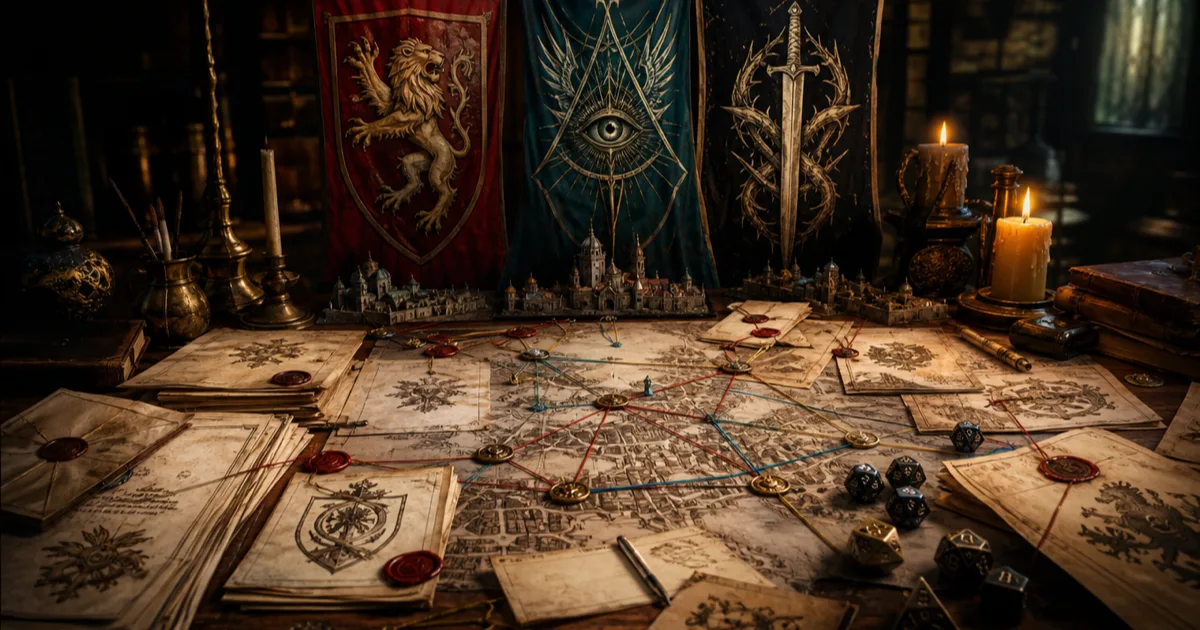
The first thing a dnd faction generator has to do is make me care about more than a cool name. I can invent the Iron Crow Syndicate in three seconds. The hard part is knowing what they want, who they hate, what they are lying about, and why the party should risk anything for or against them before the next session starts.
That is where most faction prep goes flat. A faction that only exists as a logo and a paragraph is decoration. A faction with a leader, public goal, private goal, rival, useful service, and one immediate problem can drive a whole arc without needing a villain speech. My favourite campaign city had a dock guild that secretly funded a saint cult, a knightly order that hated both of them, and a baker who was somehow on everyone’s payroll. The players remembered the baker.
CharGen's Faction Generator is useful because it treats factions as campaign machinery, not just lore. The output includes hierarchy, leadership, public goals, secret goals, outposts, allies, enemies, rivals, services, rumours, plot hooks, and internal conflicts. You can also pair it with the NPC Generator, Settlement Generator, and RPG Workshop when you want the faction to sit inside a town, region, or wider campaign file instead of floating in a notes folder by itself.
Why a dnd faction generator matters in 2026
D&D has always had factions, but the search intent has changed. People are not only asking for a list of guild names now. They want a fantasy faction generator that gives them tension they can use on Friday night.
That makes sense. The 2024 Dungeon Master's Guide on D&D Beyond puts a lot of emphasis on practical campaign tools, including campaign journals, Bastions, renown, and the social fabric around play. The exact rules are less important than the table problem underneath them: long campaigns need organisations that remember what the characters did.
A thieves' guild should react when the rogue burns a safe house. A temple should change its opinion after the cleric exposes a false relic. A noble house should offer worse terms if the party keeps doing favours for its rival. If your notes cannot track that, faction play becomes a series of disconnected errands.
I judge faction tools by four questions:
| Question | Why it matters at the table |
|---|---|
| What does the faction want in public? | Players need a clear first impression. |
| What does it want in secret? | The DM needs a reason for future reveals. |
| Who can the party talk to? | Factions need faces, not only banners. |
| What changes after player action? | Politics needs memory or it feels fake. |
That last point is the one I care about most. A good faction is not a quest vending machine. It is a pressure source. It pushes, reacts, recruits, threatens, bargains, and occasionally makes the players regret being clever.
The short version: best D&D faction tools
There are not many dedicated tools for this query, which is both annoying and useful. Annoying because you have fewer obvious choices. Useful because the weak spots are easy to see.
| Tool | Best for | What I like | Main limit |
|---|---|---|---|
| CharGen Faction Generator | DMs who want factions tied to NPCs, locations, secrets, and hooks | Rich faction output with leaders, goals, relationships, services, and plot hooks | You still need to choose which details deserve screen time |
| CritForge Faction Builder | D&D 5e campaigns that want staged faction tracking | Its Faction Builder docs show a clear four-step creation flow and escalation stages | More of a managed campaign builder than a quick free generator |
| World Anvil | Long campaign setting bibles | Excellent for storing lore, timelines, articles, and relationship notes | Slower if you need a faction idea in 45 seconds |
| Kanka | Free or low-cost campaign wiki tracking | Good entity relationships and campaign organisation | Not focused on AI faction creation |
| SessionRoll | Fast campaign seeds | Can create campaigns with villains, factions, NPCs, and hooks from a seed | Better as a broad campaign spark than a detailed faction workbench |
| MythosGen | Names and starter worldbuilding | Handy when you need names, kingdoms, taverns, or one-click faction starts | Less table-ready than a tool built around goals and relationships |
| Plain tables and notebooks | Old-school control | Complete authorship, no account, no tool dependency | Slow when the party forces six new groups into the city tonight |
I would use CharGen when I need the faction to become playable immediately. I would use World Anvil or Kanka when I already have the faction and need long-term storage. I would use CritForge if I wanted a more structured D&D 5e campaign management flow with escalation baked in. I would use a notebook when I am building the one central conspiracy of a campaign and want every detail by hand.
Different jobs. Different tools.
What CharGen generates for faction prep
CharGen's faction page starts with a plain promise: create guilds, secret societies, and powerful organisations for tabletop RPG campaigns. The empty state says Your Faction Awaits, and the tool frames the output around hierarchy, goals, secrets, notable members, relationships, and rivalries. The main button is Generate Faction.
That sounds normal until you compare it with a simple name generator. A faction name is only one field. CharGen gives you the parts I usually forget when I am tired.
| Output field | How I use it |
|---|---|
| faction type | thieves' guild, mage circle, noble house, cult, military order, trade group |
| leader and key members | the people players can flatter, threaten, bribe, or annoy |
| public goals | what the faction says it wants |
| secret goals | what makes the faction dangerous or interesting |
| allies, enemies, rivals, neutral parties | the relationship web that makes city play work |
| services | favours, training, safe houses, trade, forbidden magic, information |
| rumours | clues players can hear before they understand the truth |
| plot hooks | the bit that turns lore into tonight's session |
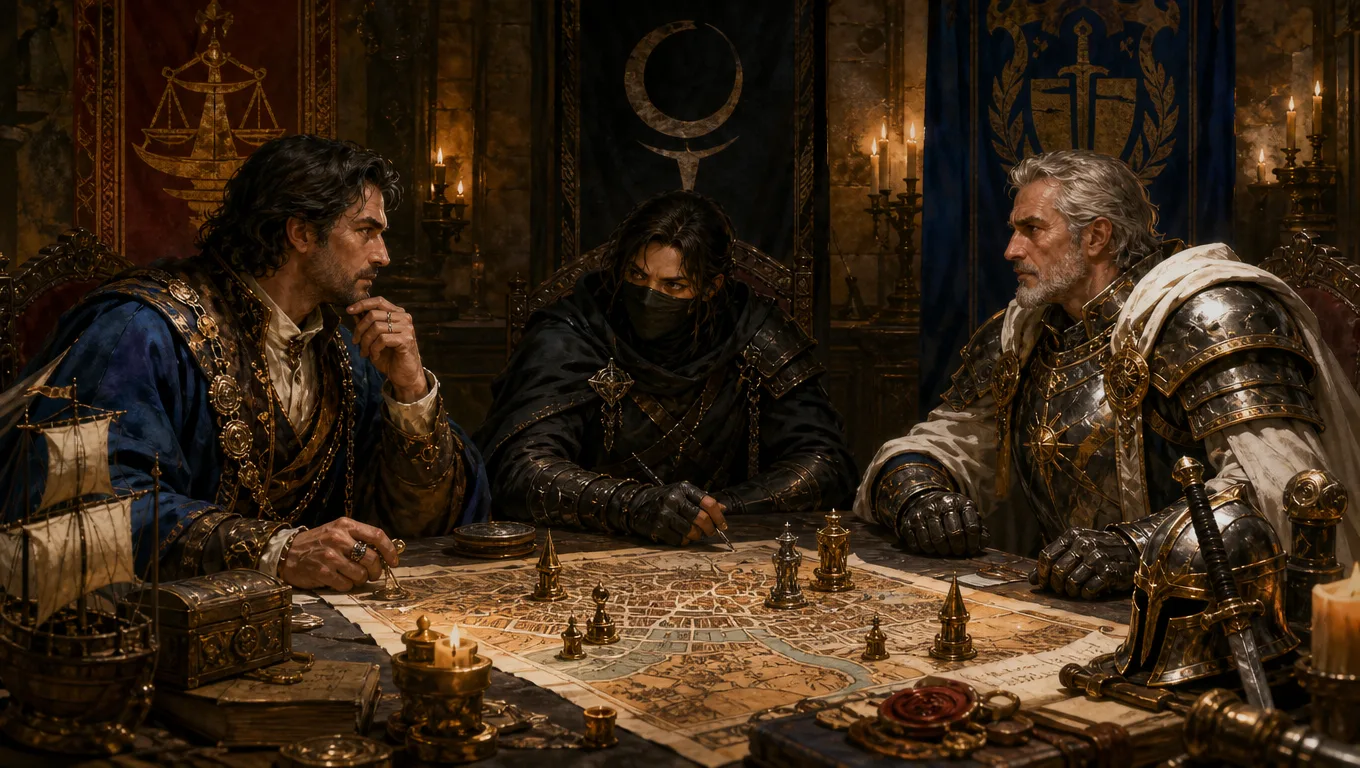
Here is a concrete example. I generated a merchant consortium for a salt-road settlement, then pushed it into play like this:
| CharGen detail | Table version |
|---|---|
| public goal | keep caravan prices stable after monster attacks |
| secret goal | provoke attacks to bankrupt independent hauliers |
| leader | polite guildmaster with a sick son and a private assassin budget |
| rival | shrine order that protects roadside pilgrims |
| service | discounted mounts, storage, escorts, market access |
| hook | a junior clerk offers proof that ledgers were altered |
That is enough for a session. The party can guard a caravan, expose the clerk, side with the guildmaster, work for the shrine, or sell the evidence. I do not need a ten-page history of the consortium. I need a decision with teeth.
How I build factions that players remember
My working rule is that every faction needs a face, a favour, and a fight.
The face is the NPC players remember. For the dock guild in my home game, that was Mara Vell, a one-eyed harbour clerk who stamped import permits with a bone-handled seal. She was not the leader. She was just the person the party met first. That made her more important than half the nobles in my notes.
The favour is what the faction can give. Information, protection, fake papers, rare spell components, a safe bed, an introduction to a countess, a squad of hired crossbows. Players care about organisations much faster when those organisations can solve a problem.
The fight is the conflict that will get worse if nobody acts. A rival guild is stealing members. A church schism is turning violent. A noble house is buying debt across a district. A rebel cell has split into idealists and arsonists. A faction with no fight can be interesting background colour, but it will not drive play for long.
This is the prompt pattern I use in CharGen:
| Need | Prompt I would use |
|---|---|
| city politics | three-way tension between dock guild, shrine order, and noble customs office |
| mystery arc | respectable historical society hiding a necromancer succession ritual |
| frontier campaign | ranger company protecting trade roads while secretly taxing villages |
| pirate game | smuggler league with public charity work and a blood debt to sea hags |
| academy game | mage circle split between ethical research and dangerous planar funding |
I like adding one contradiction. Charitable thieves, lawful smugglers, pacifist duelists, popular tax collectors, orcish archivists, gnome funeral bankers. Contradiction gives the generator something to chew on, and it gives players a reason to ask questions.
Turning one faction into a campaign web
One faction is useful. Three factions are where the fun starts.
I usually build factions in triangles because two-sided conflict gets stale quickly. If there are only two powers, players pick a side and the story becomes a tug-of-war. Add a third power and every decision gets messier.
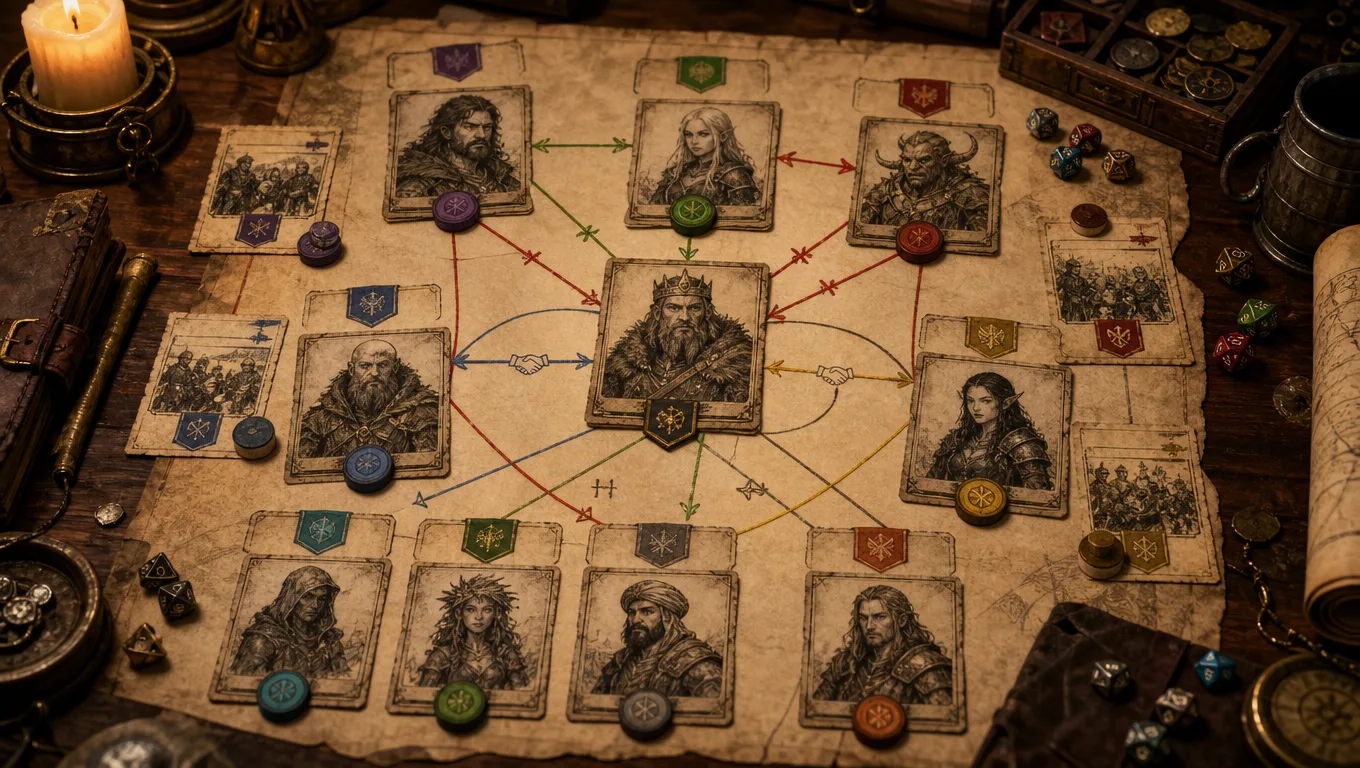
Here is a simple triangle I would run:
| Faction | Public role | Secret pressure | Wants from the party |
|---|---|---|---|
| Brass Lantern Guild | legal guides for the old city tunnels | sells route maps to smugglers | escort a survey team |
| Order of Saint Vey | public healers and shrine keepers | hides a saint's missing bones | recover a stolen reliquary |
| The Mud Court | poor district mutual aid group | preparing a violent rent strike | protect organisers from hired blades |
None of these groups has to be pure good or pure evil. That matters. If one side is obviously right and one side is obviously rotten, players stop negotiating and start clearing rooms. Fine for a dungeon. Less good for faction play.
CharGen helps because it can produce allied factions, enemies, rivals, and neutral parties as separate relationship types. I treat those as different temperatures:
| Relationship | Table meaning |
|---|---|
| ally | will help unless the cost is too high |
| enemy | wants active harm |
| rival | competes, but may bargain |
| neutral party | can be persuaded, threatened, or ignored at a cost |
That distinction keeps me from making every relationship a war. Sometimes a rival is more useful alive. Sometimes a neutral faction is the real prize. Sometimes an ally is only friendly because the party has not yet found the invoice.
What to compare before choosing a guild generator D&D tool
If you are searching for a guild generator dnd tool, do not judge it by the name list. Names are cheap. Judge it by what happens after the name.
I want five things:
| Feature | Pass test |
|---|---|
| leader details | I can roleplay a conversation without inventing everything mid-scene |
| hidden agenda | I have at least one reveal that changes player opinion |
| relationships | the faction points to other powers in the setting |
| player-facing services | joining, helping, or betraying the faction has a clear benefit |
| session hooks | I can turn the output into an encounter, clue, deal, or complication |
Worth mentioning though, too much detail can hurt. If a generator gives me twelve ranks, eight departments, and thirty years of history before I know what the party will do, I skim. That is not the tool's fault exactly. It is a DM discipline problem. The output has to become play.
My fix is brutal. I keep one sentence for the faction, one face, one secret, one rival, and one immediate hook. Everything else can wait.
Here is the trimmed version:
| Prep note | Example |
|---|---|
| sentence | The Brass Lantern Guild controls legal tunnel access under the city. |
| face | Elra Dorn, cheerful surveyor with a false eye made from amber. |
| secret | the guild sells route maps to smugglers at night. |
| rival | the Mud Court wants the tunnels opened for public shelter. |
| hook | a missing survey crew found a sealed pre-imperial gate. |
That fits on an index card. It also gives players three obvious moves: help the guild, expose the guild, or use the guild.
Using faction plot hooks without railroading
The best faction plot hooks do not tell players what to do. They create pressure and wait.
Bad hook: The faction hires the party to kill its enemy.
Better hook: The faction hires the party to guard a witness. The enemy offers proof that the witness is lying. A neutral temple will shelter the witness only if the party returns a stolen relic first.
Now the players have decisions. They can still ignore the whole thing, but the world does not pause. The witness disappears. The temple closes its doors. The enemy gains power. The hiring faction blames the party.
The actual point is simple: faction hooks need consequences.
For my own prep, I sort hooks into four types:
| Hook type | Use it when... | Example |
|---|---|---|
| job | the faction has a task | steal a ledger from a rival counting house |
| rumour | the faction is being discussed | people whisper that the guildmaster bought a priest |
| cost | the faction blocks a goal | no ship leaves port without the dock guild's seal |
| invitation | the faction wants a relationship | a masked envoy offers membership after a public duel |
CharGen gives you multiple hooks, but I rarely use all of them at once. I pick one for the next session and save the others as future consequences. If the party insults the guildmaster, the invitation becomes a threat. If they help the junior clerk, the rumour becomes evidence. If they burn the safe house, the cost becomes personal.
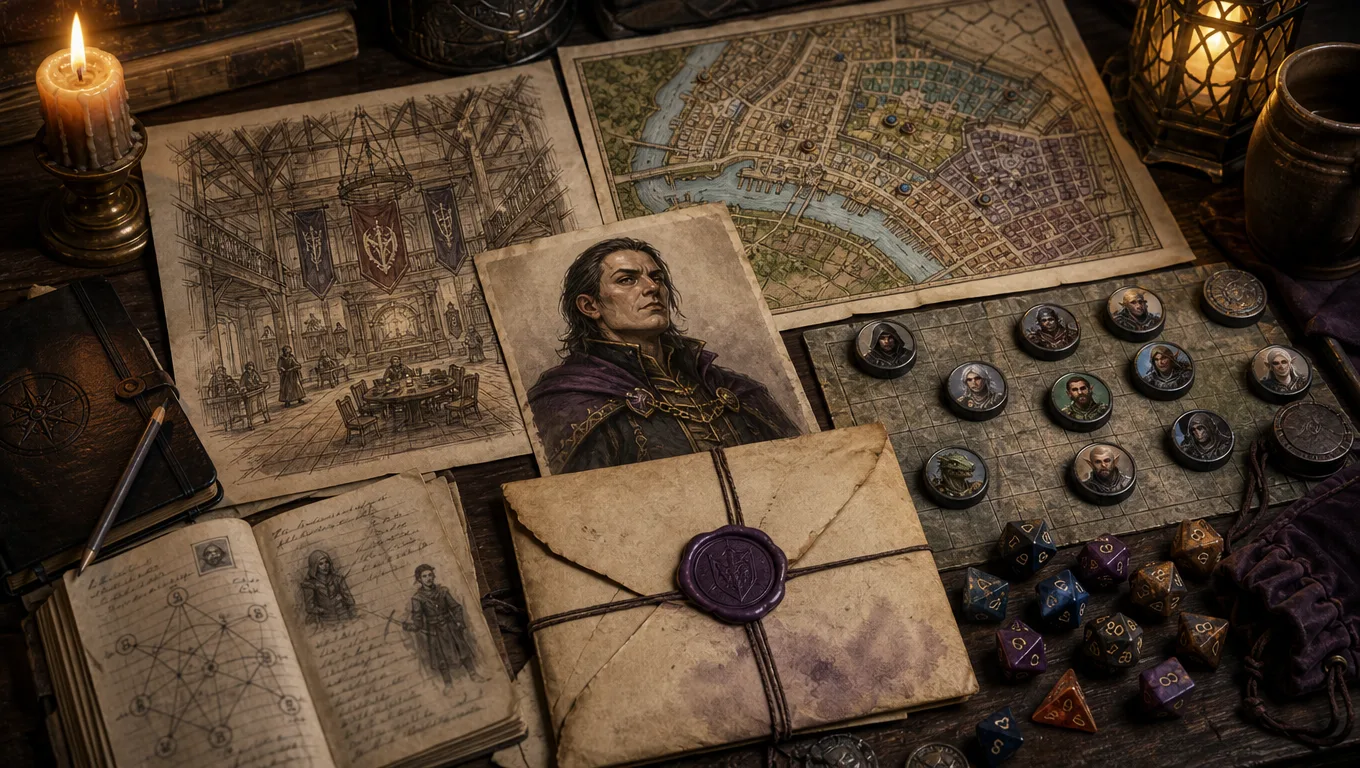
This is also where RPG Session Notes earns its place. After a faction-heavy session, I want notes that capture who the party helped, who they offended, and which promises are now live. Faction play punishes vague notes. Six weeks later, you will not remember whether the party promised the shrine order a relic or just nodded near one.
A practical workflow for D&D campaign factions
Here is the workflow I use when I am starting a city, frontier region, or political arc.
| Step | Tool | Output |
|---|---|---|
| make the place | Settlement Generator or Region Generator | districts, resources, social pressure |
| make three powers | Faction Generator | public goals, secrets, relationships |
| give each power a face | NPC Generator | leader, clerk, rival, informant |
| make one meeting place | Tavern, Shop, or Building Generator | neutral ground or faction base |
| create the visual cue | Image Generator or Token Maker | crest, leader portrait, token |
| record the fallout | RPG Session Notes | updated loyalties and loose ends |
For a one-shot, I would shrink that. One settlement, two factions, one neutral NPC, one secret. For a campaign, I would build three factions first and add more only when the players pull on a thread.
The temptation with any dnd political intrigue generator is to fill the map with groups. Resist it. Four meaningful factions beat twelve vague ones. The party needs enough names to make choices, not a census.
My usual starting set is:
| Slot | Purpose | Example |
|---|---|---|
| authority | controls law, money, or land | customs office, noble house, military order |
| outsider | threatens the current order | rebel cell, cult, rival city, monster pact |
| practical ally | can help the party now | guild, shrine, caravan company, tavern network |
| wild card | changes the obvious choice | scholar circle, spy ring, druidic court, debtor union |
That gives you politics without needing a lecture. Players learn factions by asking for help, getting refused, being followed, accepting a favour, and discovering that the nice clerk works for someone worse.
FAQ
What is the best dnd faction generator?
For my prep, CharGen is the best starting point because it creates faction goals, secrets, leaders, relationships, services, rumours, and plot hooks in one pass. If you mainly need a long-term campaign wiki, World Anvil or Kanka may suit storage better. If you want a managed D&D 5e builder with staged escalation, CritForge is worth checking.
What should a D&D faction include?
A playable faction needs a name, type, leader, public goal, secret goal, rival, useful service, and one hook the players can act on. History is useful later, but those parts matter first.
How many factions should a campaign start with?
Start with three or four. One authority, one rival power, one useful ally, and one wild card will usually give you enough motion for a city or region. Add more only when the players meet them.
Can I use a fantasy faction generator for Pathfinder or OSR games?
Yes, as long as the output is mostly narrative. Goals, leaders, secrets, territory, and relationships work across D&D, Pathfinder, OSR, Daggerheart, and most fantasy RPGs. You may need to adjust ranks, rewards, or mechanics for your system.
Final recommendation
Use a generator for the first draft, then be ruthless about what reaches the table. Keep one face, one favour, one fight, and one secret. If the players care, build more. If they do not, you have lost five minutes instead of an evening.
For the fastest start, open CharGen's Faction Generator, make three organisations with conflicting goals, then give each one an NPC contact. That is enough politics for the next session.
Image credits
All images in this post were generated for CharGen with WaveSpeed using GPT Image 2 at medium quality, then resized and converted for web use.