
D&D Character Backstory Generator: Playable Histories Fast
Use a dnd character backstory generator workflow to build playable histories fast, with 2024 backgrounds, CharGen prompts, and a no-AI option.
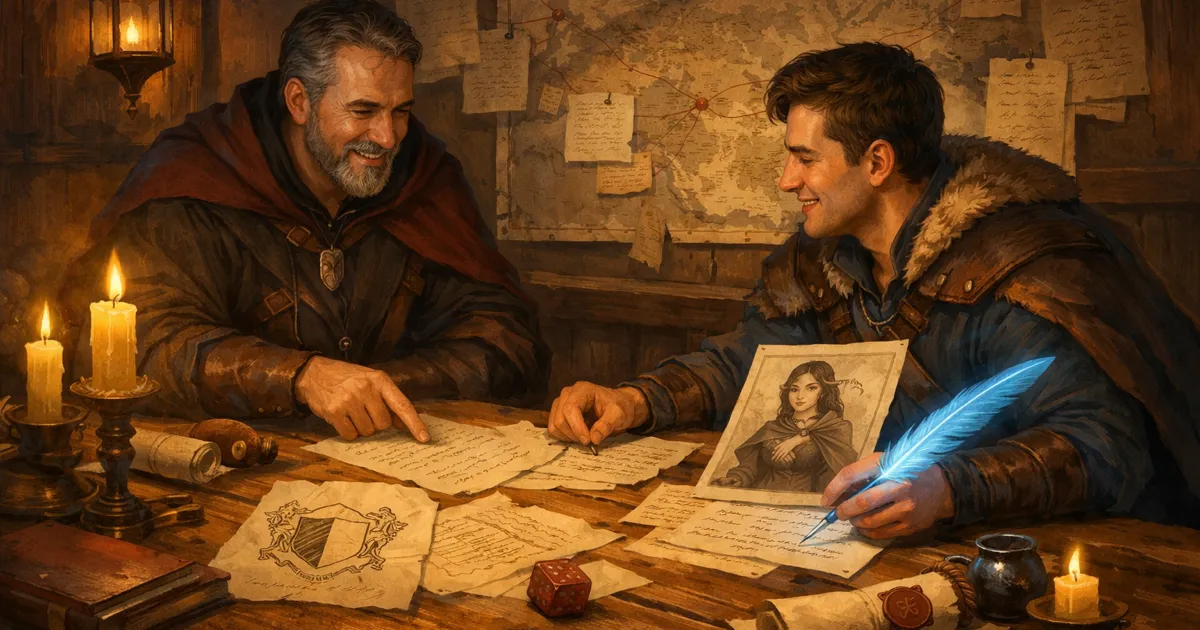
A dnd backstory generator became genuinely useful for me the moment I stopped asking it for a grand epic and started asking it for material I could actually play. Most characters do not need seven tragic chapters, a dead kingdom, and three secret bloodlines. They need a wound, a pressure point, a reason to stay with the party, and a few details your DM can pull on without breaking the campaign by accident.
That is the gap I keep seeing in search results. Plenty of pages will spit out lore. Fewer help you build a backstory that survives session one. Even fewer connect that backstory to art, names, NPC relationships, and future session notes. That last bit matters more than people admit. If your history does not create playable hooks, it is just decorative paperwork.
One note before I get into the workflow. CharGen now has a Backstory Generator that writes a first draft from a saved character or a short idea. The useful part is still the workflow around it. I combine it with NPC Generator, Name Generator, DnD Character Art, and later RPG Session Notes to build character histories that are short, specific, and easy to bring back into play.
Why most backstory generators fail at the table
Most generated backstories fail for one simple reason. They answer questions nobody at the table is asking.
I do not need to know every ancestor in a paladin's line. I do need to know why she flinches when a duke offers patronage. I do not need four paragraphs about a rogue's childhood district. I do need one person from that district who can show up with bad timing.
When I test generated backstories, I use three blunt checks:
- can I explain the character in under 30 seconds
- can the DM turn one element into a scene next session
- can the player make a decision from it when under pressure
If the answer is no on any of those, the backstory is too soft, too long, or too vague.
Official D&D material points in the same direction. The D&D Beyond backgrounds library is full of backgrounds that imply social role, skills, and campaign texture. The older Basic Rules section on personality and background is still useful because it pushes you toward ideals, bonds, and flaws instead of endless family-tree padding. That structure works because it creates action.
Right, so the target is not "deep". The target is playable.
What I want from a dnd backstory generator
I want five outputs, and I want them fast.
| Output | Why it matters | What bad generators do instead |
|---|---|---|
| Social role | Gives the character a place in the world | writes generic destiny fluff |
| Past rupture | Explains why life changed | piles on random tragedy |
| Present pressure | Creates urgency at session start | leaves everything resolved already |
| Future pull | Gives the character a reason to move | gives them no active goal |
| Table-facing detail | Helps everyone remember them | buries useful details in prose |
My short formula looks like this:
background role + past rupture + present pressure + future pull + one visual anchor
That is usually enough.
For example, instead of:
"A once-proud knight from a fallen house who wandered the north for many years after betrayal and now seeks purpose while wrestling with loss."
I would use:
"Disgraced house guard. Took the blame for a noble's failed escape. Owes money to the smugglers who got him out. Wants proof that the heir survived. Keeps the house signet but the stone is cracked."
Second version is easier to play, easier to remember, and much easier for a DM to use.
My CharGen workflow for backstory building
I use four connected steps. Not every character needs all four, but this is the system I come back to when I want a result in fifteen to twenty minutes rather than a whole lost evening.
1. Start with role and pressure in NPC Generator
I begin in NPC Generator, even for player characters sometimes, because it is very good at pulling out role, motivation, quirks, and immediate friction. The page is built around fields such as race, class, gender, age, and description, which is enough structure to stop me from drifting into mush.
My description field is usually one sentence, not a full prompt essay.
Three examples I would actually type:
Former city watch investigator who hid evidence to protect a sibling and now fears exposureTemple courier whose mentor vanished after delivering a sealed letter meant for a saint's relic vaultDwarven siege engineer dismissed after refusing an order that killed civilians
That gives CharGen something to work with. It also forces me to define the live problem before I romanticise the past.
When the output comes back, I am not looking for perfect prose. I am scanning for four things:
- one concrete motivation
- one contradiction or flaw
- one relationship hook
- one detail I can visualise
If I get those, I keep going. If I do not, I regenerate or tighten the prompt.
Worth saying clearly, I do not keep every flourish the model offers. If it gives me six dramatic turns in one paragraph, I cut it down. Too much drama makes a character feel pre-spent before the campaign even starts.
2. Use Name Generator for culture and tone
Good backstories fall apart surprisingly fast when the names feel borrowed from three different worlds.
CharGen's Name Generator has an extra prompt field, and that is the bit I care about most. I use it to steer names toward status, region, trade, or social class rather than just race.
Examples:
former noble household in a storm-lashed port cityshrine keeper family with old military tiesminers from an isolated border hold
Small change, big result. A name is not just flavour. It tells the table whether the character belongs somewhere specific.
One of my better recent tests was a half-elf messenger. The first pass sounded like generic fantasy soup. After adding an extra prompt about "canal-city couriers, trade district, practical working class", the names snapped into place and the backstory stopped feeling like it had been copied from a tavern wall.
3. Lock one visual anchor with Character Art
I then move to DnD Character Art. Not because every player needs a painted portrait on day one, but because visual anchors make backstories easier to write and far easier to remember.
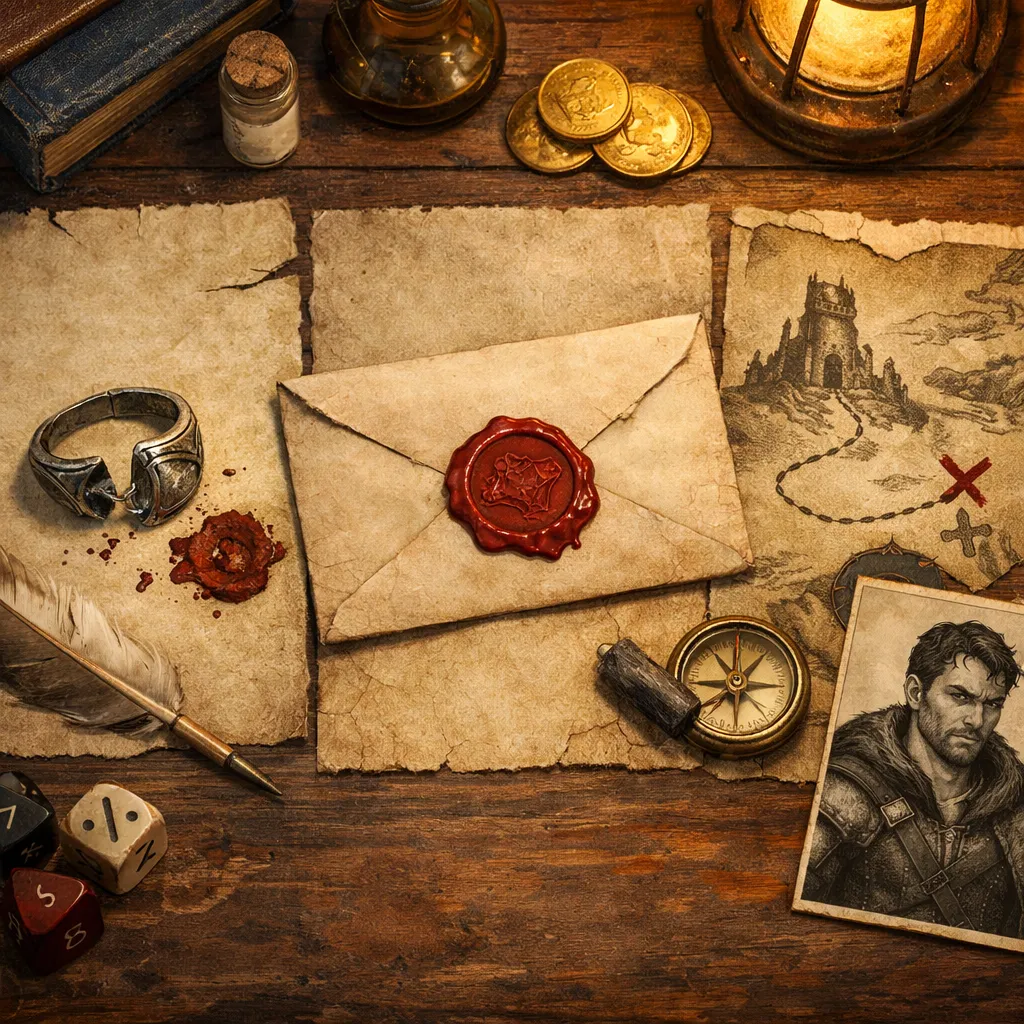
On the character art page I keep the prompt simple. I start with class identity, race, one piece of gear, and one scar or keepsake that comes from the backstory.
For the dismissed dwarven engineer, I might use:
Dwarf former military engineer, heavy coat with ash stains, damaged bronze pauldron, carries surveying tools and a folded field map, stern but tired expression
That one damaged pauldron does more work than a page of lore. The player remembers it. The DM can mention someone recognising it. Another player can ask where it came from. Story done, no speech required.
My rule here is strict. One anchor only, maybe two. If every detail is symbolic, none of them are.
4. Save later reveals in RPG Session Notes
Backstory should not all hit the table in session zero. Some of the best character material only becomes interesting after the campaign pushes on it.
That is where RPG Session Notes becomes useful later. I use it to preserve what changed:
- what the party learned was true
- what turned out false
- which NPCs are now tied to the character
- which visual or emotional detail has changed
That means the backstory keeps breathing without becoming chaos. If your cleric starts with "broken holy charm from her old abbey", and session six reveals the abbey sold out her mentor, that development should live in the campaign notes, not vanish into memory.
The three-part structure I trust most
If you only copy one thing from this post, copy this.
I build most backstories around three beats:
Past rupture
Something went wrong, ended, or changed.
Not five things. One.
Examples:
- the guild cast him out
- her patrol abandoned civilians
- his brother vanished with church money
Present pressure
What is making life awkward right now?
Examples:
- debt
- blackmail
- a promise that is coming due
- a lie that keeps getting harder to keep
Future pull
Why is this character still moving?
Examples:
- clear a family name
- find one missing witness
- earn enough power to refuse the next order
This structure is plain on purpose. It works for new players because it avoids panic. It works for experienced players because it leaves room to improvise once the campaign begins.
Three backstories I built in under ten minutes
I tested this keyword with three different character starts because examples matter more than theory.
Example 1: the ex-soldier who hates parades
Prompt basis:
Dwarf former line officer who obeyed one cruel command too long
Usable result after trimming:
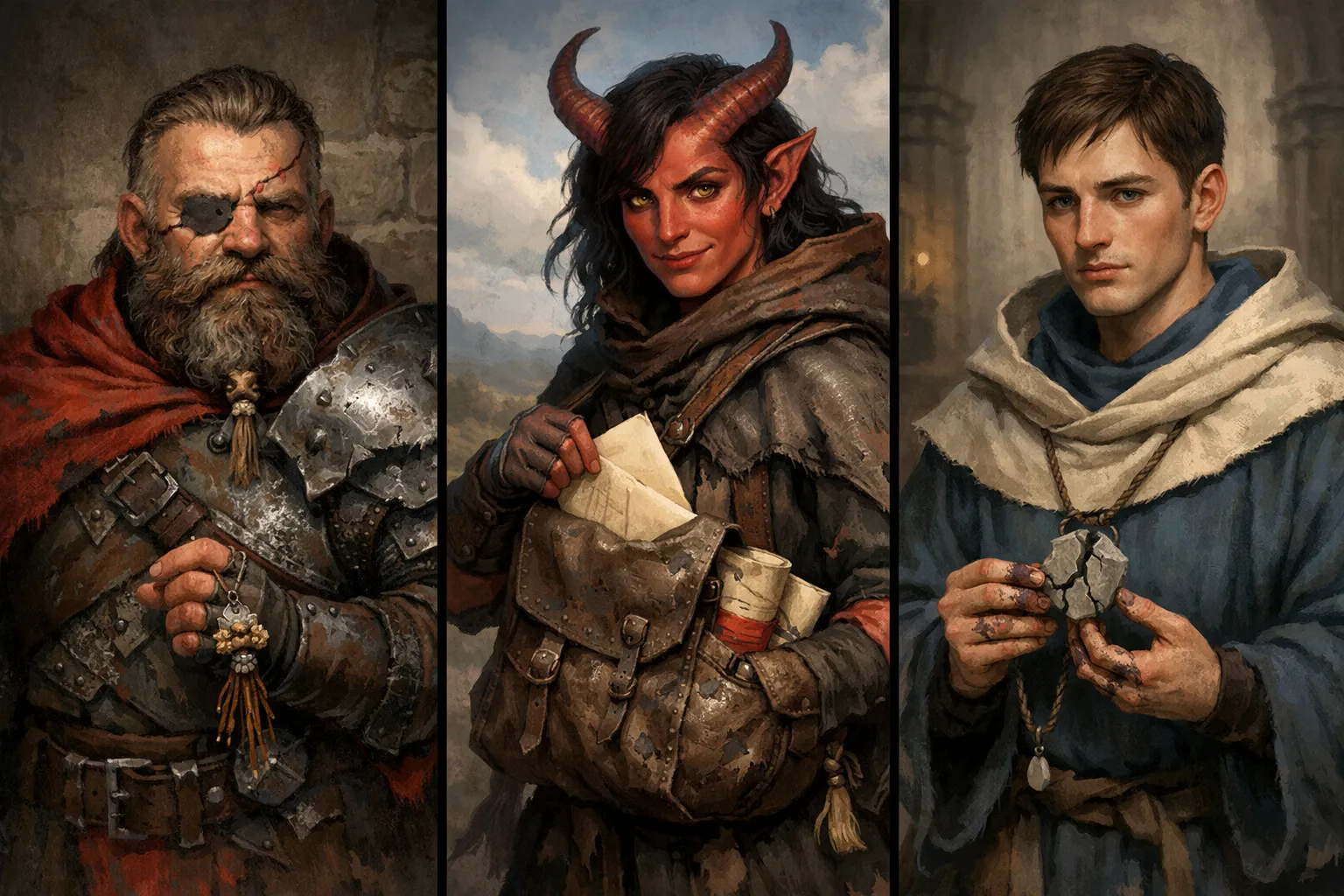
"Former fortress officer. Stayed loyal during a siege evacuation that was really a cover for abandoning labourers in the lower tunnels. Discharged with honours on paper, shame in private. Now works as a caravan guard and sends half his pay to survivors' families. Wants testimony from the quartermaster who signed the order. Cannot stand triumphal military music."
Why it works:
- one event defines the past
- current behaviour grows from that event
- future goal is clear
- table detail is memorable without turning into parody
Example 2: the courier with the letter she should have burned
Prompt basis:
Tiefling temple courier caught between faith and evidence
Usable result after trimming:
"Temple courier. Carried sealed messages between shrines until one packet contained proof that a revered cleric falsified miracle accounts to protect donor money. She kept the letter instead of delivering it. Now former allies think she stole sacred records. Wants to learn whether her missing mentor exposed the same fraud first. Keeps every message pouch she has ever failed to deliver."
That final detail is doing excellent work. It gives the player something to touch, the DM something to notice, and the group something to ask about.
Example 3: the acolyte who only trusts bad maps
Prompt basis:
Human novice scholar whose best discovery ruined his reputation
Usable result after trimming:
"Acolyte cartographer. Found old shrine routes that redirected pilgrims through a toll network run by local priests. Presented the evidence and was told to retract it. Refused, lost his place, and now sells copied maps to travellers while pretending it was his own choice to leave. Wants the original archive ledger before the church destroys it. Trusts damaged maps more than clean ones."
Again, short. Specific. Playable.
Common mistakes that make generated backstories worse
I see the same failures again and again.
Mistake: asking for "detailed lore"
Detailed lore sounds useful and often produces sludge. Ask for pressure, motive, contradiction, and one physical keepsake instead.
Mistake: stacking too many tragedies
You do not need dead parents, a cursed village, a lost crown, a demon pact, and a secret heir claim. Pick one serious break. Maybe two if your campaign is very big and your group likes operatic nonsense.
Mistake: resolving the arc before session one
If the character already knows the truth, made peace with it, and finished grieving, there is less to play.
Mistake: writing for a novel instead of a party game
Your backstory needs room for other players. If everything about your character demands the spotlight, the table will feel it.
Mistake: forgetting the campaign's actual scale
A village mystery does not need "last heir of the shattered astral empire" energy unless your DM explicitly asked for that kind of thing.
Search intent, translated into table reality
People searching dnd backstory generator are usually trying to solve one of three jobs:
- make a new character quickly
- turn a vague class idea into someone worth roleplaying
- fix a character sheet that has numbers but no personality
Most ranking pages only solve the first job. They produce text fast and call it a day.
I would rather solve the second and third. Those are the people who actually need help, and they are also more likely to appreciate a workflow that connects story, naming, art, and later campaign continuity. That is where CharGen has a real advantage over a plain random-text site.
If you want a related workflow once the character joins the campaign, read AI Session Notes D&D Workflow for Consistent Campaign Art. If you are building supporting cast at the same time, Quick NPC Creation for DMs in World Codex pairs nicely with this approach.
My quick template for a playable backstory
When I am tired, I use this exact format:
| Field | Keep it to |
|---|---|
| Former role | 3-6 words |
| Worst event | 1 sentence |
| Current pressure | 1 sentence |
| Active goal | 1 sentence |
| Person who matters | 1 line |
| Physical keepsake or scar | 1 line |
| Habit under stress | 1 line |
Example:
- Former role: shrine courier
- Worst event: kept a sealed letter that exposed fraud
- Current pressure: temple agents think she stole records
- Active goal: find missing mentor before the church does
- Person who matters: elder sister still serving at the shrine
- Keepsake: water-damaged message pouch with wax still attached
- Stress habit: counts doorways before entering a room
That took under two minutes, and I would happily sit next to that character at a table.
Tip: if you cannot explain your character without using the words "chosen", "ancient", or "secret heir", strip one layer off and try again.
July 2026 update: connect the story to the character sheet and campaign
The useful change to make in 2026 is not writing more history. It is making sure your first few backstory choices have a job on the character sheet, then leaving enough loose thread for the campaign to answer. The 2024 D&D rules frame a background as a character's formative place and occupation, and pair it with ability-score choices, an Origin feat, skills, a tool proficiency, and starting equipment. That is a much better starting point than picking a tragic event at random. You can read the official 2024 Character Origins guidance if you want the full breakdown.
I now do a quick origin pass before I ask CharGen for any prose. I write down the former role, match that role to the class or useful proficiencies, choose one unresolved pressure, then pick one object that can appear in the portrait. A ranger who used to be a river warden might have Survival, a boatman's tool kit if the table allows it, a missing patrol partner, and a copper whistle with the river's old seal. None of that needs a family tree. All of it gives the player a decision to make when the party reaches a flooded village.
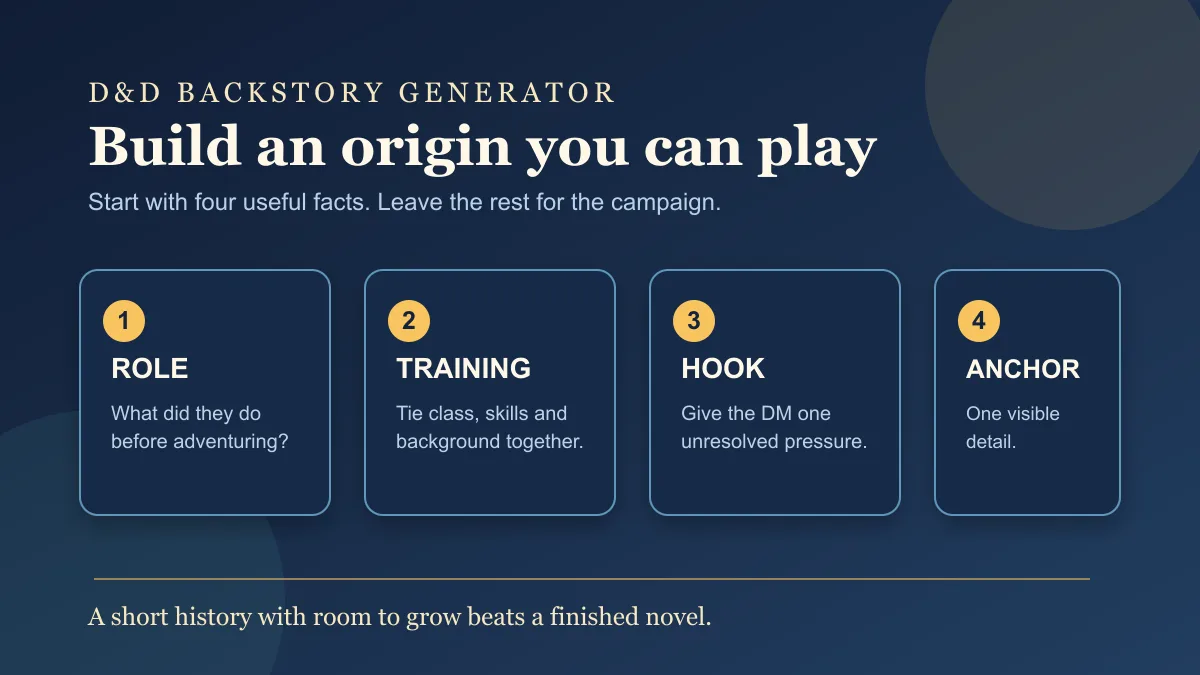
That order also answers one fair complaint about AI backstories. A recent D&D community discussion made the sensible point that a character does not need a dark past to be interesting, and that a few loose paragraphs leave the DM room to use the material. I agree. Give a generator constraints that connect to play, then treat its output as a menu. Keep the useful motive, bin the melodrama, and ask your DM which detail fits the setting.
The five-minute compatibility check I use
Before session zero, I check five things:
- Can I point to one background choice that explains a skill, tool, feat, or piece of equipment?
- Does the character have a present reason to travel with this particular party?
- Is the unresolved hook small enough that it will not demand the whole campaign?
- Can I describe the physical anchor to another player without reading notes?
- Have I asked the DM which name, place, or NPC should be changed to fit their world?
If the answer to the fourth question is no, I open D&D Character Art and make the keepsake visible. For the river warden, I would use a weathered green cloak, the copper whistle, a small tide chart tucked into a belt pouch, and no more than that. A backstory visual is a memory aid, not a police sketch.
Once the campaign is running, I use the Campaigns area to keep the original hook from becoming stale notes. CharGen's current campaign context can draw on tracked entities and pinned documents, and the Documents tab gives me a sensible home for a letter, contract, or handout that matters to the character. If that river warden meets the missing partner in session four, I update the relevant campaign note and let the next NPC or location prompt refer back to it. The history now has consequences without forcing the generator to pretend it knew the ending on day one.
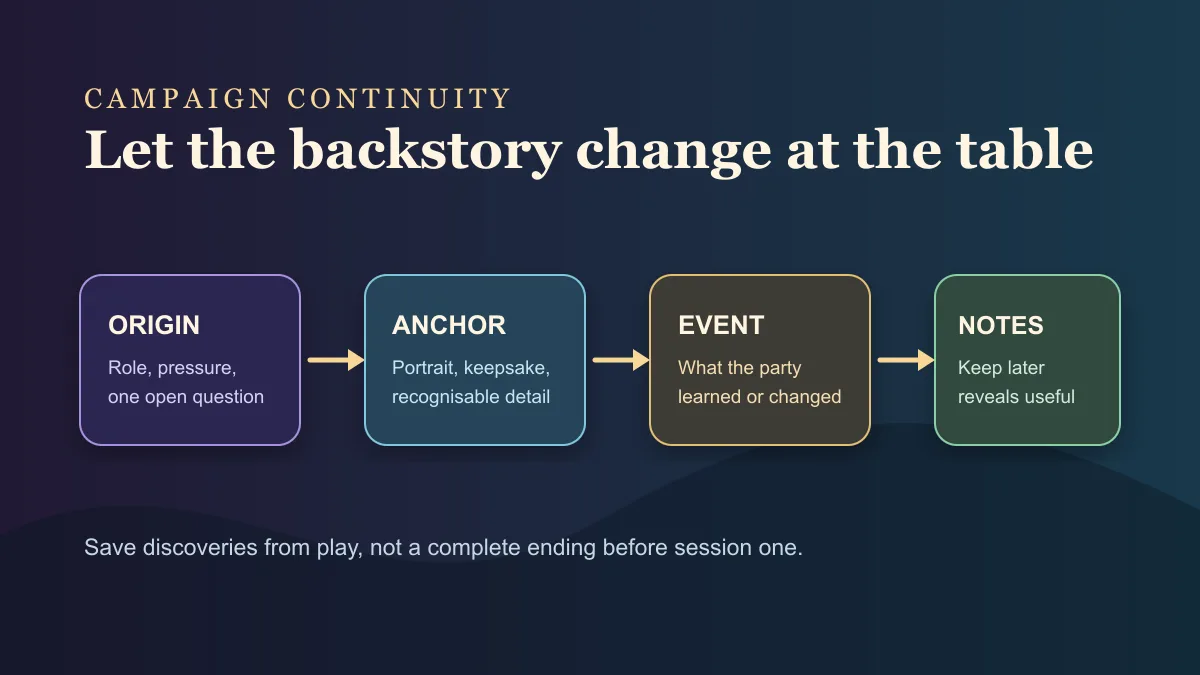
The handoff is simple: origin first, visible detail second, actual table events third, campaign notes after that. It keeps the player in charge of their character while still giving the DM material worth bringing back. I would rather play a cheerful dwarf trying to repay a debt to an old mentor than another lost heir with three kingdoms in the attic.
D&D character background vs backstory
The words sound similar, but they do different jobs. A background is a rules-facing part of character creation. A backstory is the personal history you build around it. A good dnd character backstory generator workflow keeps the two connected without treating them as the same thing.
The official 2024 Character Origins rules describe a background as the place and occupation that shaped your character before adventure. A background also gives ability-score options, an Origin feat, two skill proficiencies, a tool proficiency, and equipment. That list gives your history useful boundaries.
| Term | Its job | Example |
|---|---|---|
| Background | Sets formative role and rules choices | Acolyte with Religion, Insight, and Magic Initiate |
| Backstory | Explains what happened before play | The acolyte kept a ledger that exposed a false miracle |
| Campaign hook | Gives the DM a future pressure point | The temple wants the ledger before the party reaches the city |
I write the background first, then ask what event made the character leave that life. A Sage might have found a forbidden map. A Soldier might have refused an order. A Criminal might have protected the wrong witness. The history grows from the rules choice, so the character feels like one person instead of a list of disconnected prompts.
The link to D&D Character Generator helps when I need the mechanical shell before the prose. I check the class, background, ability priorities, and equipment first. Then I send the unresolved part to CharGen as a focused prompt. That order makes it easier to reject a dramatic detail that does not fit the actual character.
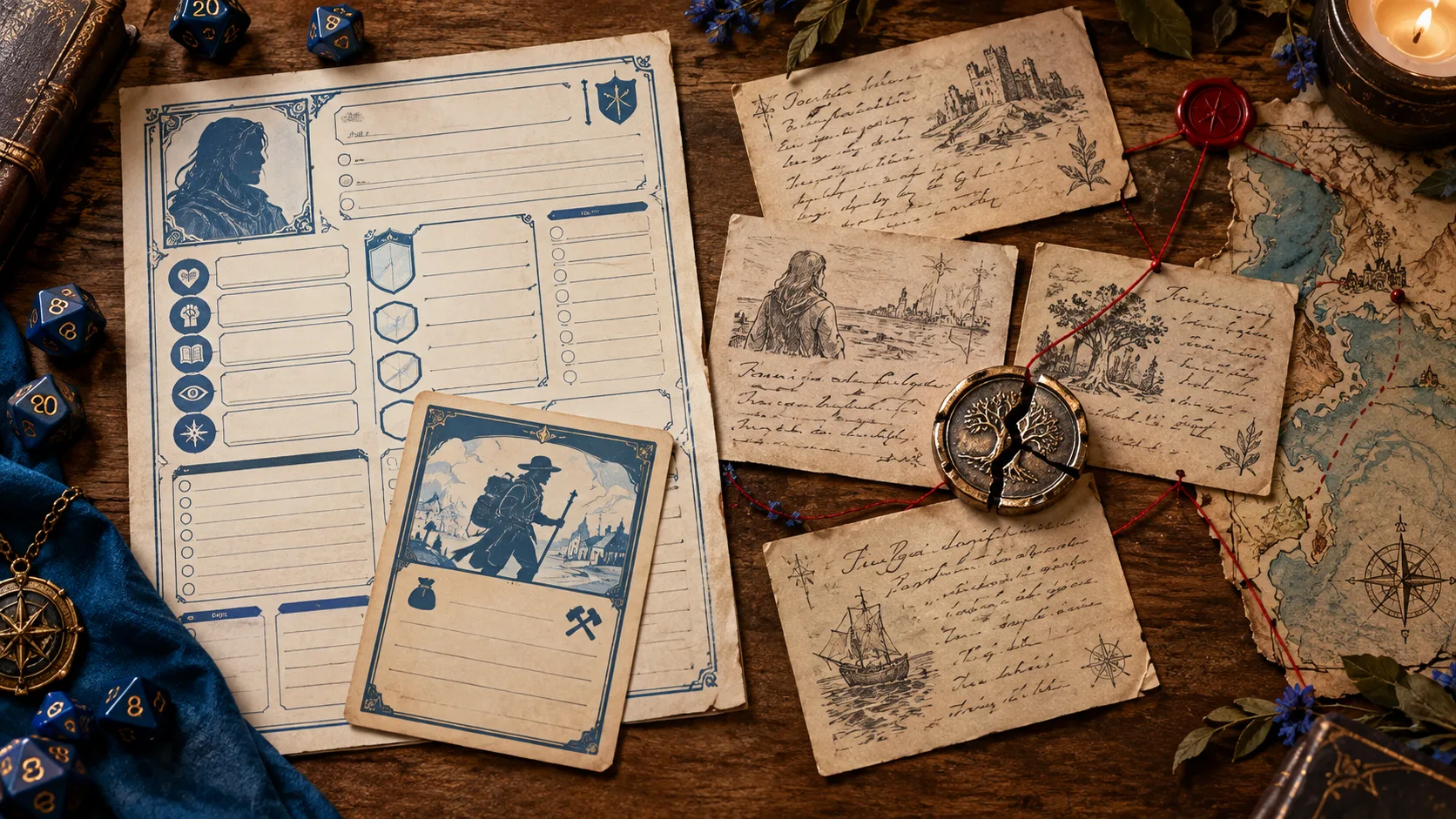
For example, a Criminal with thieves' tools does not need a royal bloodline. They might have copied a key for a client, learnt that the target was a child, and kept the key instead of finishing the job. The tool proficiency now has a memory attached to it. The DM has a former client, a moral problem, and a reason for the character to distrust locked rooms.
How to make a D&D backstory without AI
Some players and groups do not want generated writing at the table. That is a fair boundary. You can make a strong backstory with a blank page, the 2024 background list, and five short answers. A dnd backstory generator no ai search often means the player wants prompts, not a machine-written character. I understand that distinction.
Use this five-minute version:
- Write the former role in six words or fewer.
- Name one event that ended or changed that role.
- Add one current pressure that is still unresolved.
- Choose one person the character still needs or fears.
- Write one object, habit, or phrase that other players can notice.
Here is a complete example written without AI:
Former village apothecary. Sold medicine during a fever and hid the shortage from the reeve. Now a surviving family wants the truth. Her old mentor knows where the missing supplies went. She keeps a chipped brass measure and checks every bottle twice.
That is 47 words. It gives the player a past, a present problem, a relationship, a prop, and a reason to make choices. The DM can place the mentor in a later town. Another player can notice the repeated bottle check. Nothing needs a second page.
If the group welcomes AI help, I use the same five answers as the prompt. CharGen can suggest alternatives, but I keep ownership of the final choices. If the group does not welcome AI help, stop at the worksheet. The method still works. The useful part is the constraint and the review, not the source of the first idea.
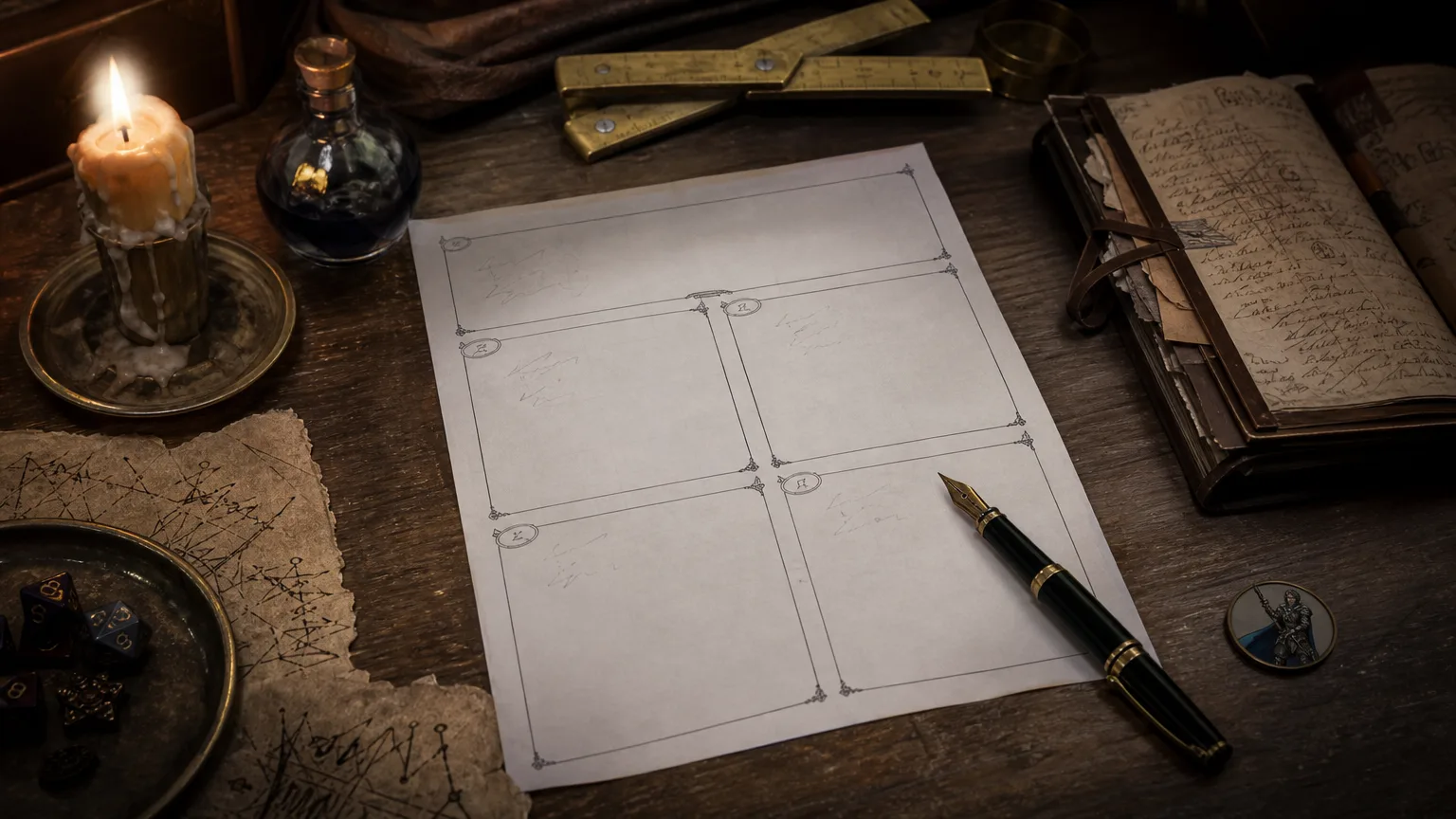
I also ask the DM before I attach a famous city, deity, organisation, or historical event to the character. A backstory can be well written and still be wrong for the campaign. Five minutes of setting review prevents an hour of repair later. It also leaves room for the DM to offer a better connection.
FAQ: dnd backstory generator workflow
What is the best way to use a dnd backstory generator?
Use it to produce hooks, not finished fiction. Ask for role, rupture, pressure, goal, and one memorable detail, then trim hard.
How long should a D&D backstory be?
For most campaigns, 150 to 300 words is plenty. You can keep private notes beyond that, but the table-facing version should stay lean.
Should I write backstory before stats and class choices?
Usually I sketch class and role first, then write the backstory. Mechanical choices and history should inform each other, but one does not need to fully finish before the other begins.
Does CharGen have a backstory generator?
Yes. The Backstory Generator writes a backstory from a saved character or a short idea, with the tone and hooks you choose. I still pair it with NPC Generator for motive and friction, Name Generator for tone, Character Art for a visual anchor, and RPG Session Notes to keep later reveals straight.
How do 2024 D&D backgrounds help with a backstory?
Use the background as a practical prompt. It gives your character a formative role, ability-score options, an Origin feat, skills, a tool proficiency, and equipment. Pick one part that the history explains, then add one unresolved situation your DM can use later.
What makes a generated backstory feel human instead of artificial?
Specific limitations. A cracked ring, a debt that is overdue, a missing witness, a sibling who still writes once a month. Tiny practical details beat grand declarations every time.
What is the difference between a D&D background and backstory?
A background is a rules-facing origin with ability-score options, an Origin feat, skills, a tool proficiency, and equipment. A backstory explains the personal events around those choices and gives the DM a hook to use.
Can I make a character backstory without AI?
Yes. Write the former role, one turning event, one current pressure, one important person, and one visible detail. That five-minute worksheet is enough for a playable first draft.
October 2026 update: keep the generated backstory playable
The CharGen Backstory Generator can start from a saved character or one short idea. Its tone choices are tragic, heroic, grim, and light. A draft can include family, a defining event, a secret, a rival, and three DM hooks.
That gives you useful material, but the output can run longer than your table needs. The generator aims for about 400 to 600 words. I still prefer a 150 to 300 word summary for a character sheet or a session introduction. Keep extra history in private notes, then trim the public version to the detail that creates a choice.
For example, keep the mentor who taught your ranger to read tide marks. Cut the names of four distant cousins unless one can appear in the campaign. A short detail gives the DM room to respond. A long family tree can become homework.
The generator does not spend Gold when you create or save a backstory. Account access may still be required. I review the tone, names, and hooks before I use the result. The same check works when a character's history feeds into a D&D mystery and its clue trail.
My recommendation if you want to finish tonight
Open NPC Generator, write one sentence about role plus present pressure, then generate. Keep only the best motive, best contradiction, and best detail. Move that into DnD Character Art and add one visible anchor from the history. If the name feels generic, fix it in Name Generator with the extra prompt field.
That is enough to turn "I guess I am playing a cleric" into someone the table can remember.
If you have not started using CharGen yet, sign up here: CharGen account.
Build Your Character Backstory FreeImage note: visuals for this post were generated with OpenAI image generation via the project automation pipeline.