
How to Build D&D Treasure Hoards by CR: A 2026 Loot Guide
A D&D loot generator for treasure hoards by CR, dragon hoards and found chests. Balanced 5e and 2024 rewards with story hooks for your table.
The party kills a night hag, searches the root cellar, and I hand them 140 gold plus a potion of healing. Technically fine. Painfully forgettable. That is why I reach for a dnd loot generator now, especially when I need treasure that fits the monster, the room, the party level, and whatever bad decision got everyone into the fight in the first place.
Loot is one of those DM jobs that sounds small until it keeps happening. Every dungeon room needs something. Every boss needs a reward. Every shop visit needs prices that do not quietly wreck your campaign economy. The 2024 Dungeon Master's Guide put fresh attention on treasure themes and magic item handling, and D&D Beyond's 2024 DMG magic item preview shows the real pull: players like prizes that feel specific. A broom with a weird use, a weapon with a story, a charm that makes the wizard nervous. Not just another line of coinage.
CharGen's Loot Generator is built for that version of treasure. You give it the party level, a theme, and optional context like the defeated monster or location. It produces a reward bundle with coins, gems, magic items, descriptions, and enough flavour to make the find feel like it belonged there all along.
Why a dnd loot generator beats another random table
Random tables still have their place. I like Donjon for quick mechanical rolls, and the old habit of rolling treasure behind the screen is part of the hobby's texture. The issue is fit. A table can tell me that the party found an uncommon item. It usually cannot tell me why a drowned noble's vault contains a silver comb that whispers the names of missing heirs.
A good dnd treasure generator free tool should do three jobs at once:
- respect the party's level
- match the encounter or location
- give the reward a reason to exist
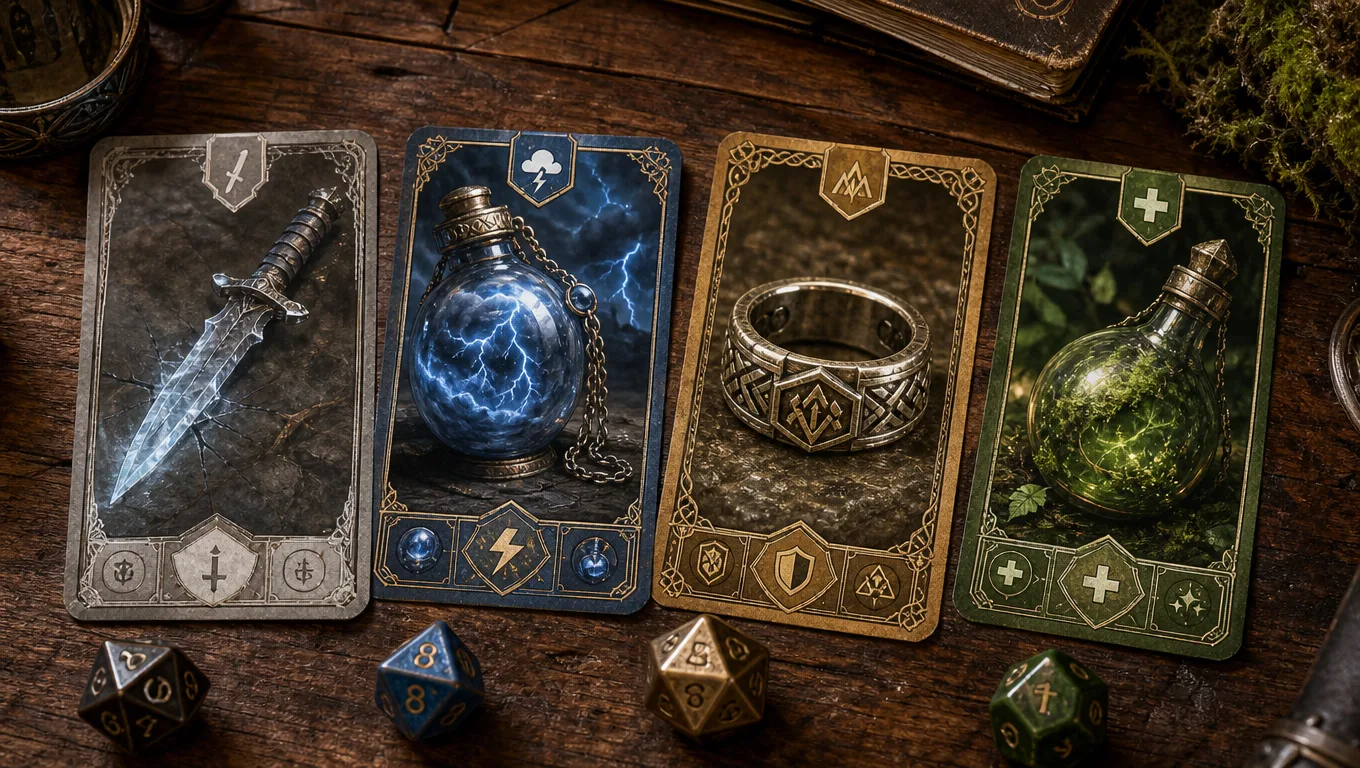
That third bit matters more than most loot guides admit. Players rarely remember exact gold totals. They remember the ugly signet ring taken from a cult treasurer, the mossy healing flask recovered from a druid circle, or the dagger with a crack through the glass blade. Those details turn rewards into campaign memory.
Here is the difference at my table:
| Reward type | Fast but bland | Table-ready version |
|---|---|---|
| Hag cellar | 140 gp, potion of healing | 87 gp in clipped royal coins, a blackthorn wand that smells of rain, and a cracked bottle of sleep draught |
| Bandit camp | 50 gp, shortbow | stolen tithe box, three coded debt slips, and a bow marked with a rival gang's notch pattern |
| Dwarven tomb | +1 warhammer | oath-ring hammer head wrapped in funeral linen, warm only when held by someone who has kept a promise |
| Dragon hoard | 2,000 gp, rare item | melted coin piles, a merchant prince's ledger, fire-cloud garnet, and a shield scarred by older dragon breath |
None of those rewards needs a huge lore dump. One or two concrete details are enough.
How I use CharGen's Loot Generator
The page opens with a simple promise: build level-appropriate loot for D&D 5E, Pathfinder, and other fantasy RPGs. Under the tool, the useful controls are the ones I care about during prep: party level, theme, and encounter context. The empty state says, "Tell us about the encounter and we'll roll the dice on a fitting hoard." That is exactly the right mental model.
Right, so my usual workflow looks like this.
| Step | What I enter | Why it helps |
|---|---|---|
| Party level | level 4, level 7, level 12 | keeps rewards from jumping too far ahead of the campaign |
| Loot theme | bandit stash, monster loot, ancient ruins, noble cache | gives the generator a material culture to work with |
| Encounter context | "green hag in a flooded orchard shrine" | makes the reward fit the scene instead of arriving from nowhere |
| Campaign note | "the party is short on healing, but the rogue already has a magic dagger" | avoids rewards that duplicate what players already have |
For a real example, I tested a level 5 party that had just beaten a corrupted knight in an abandoned chapel. A plain random treasure generator would probably give coins, a gem, and maybe a weapon. In CharGen, I would ask for something like:
Level 5 party, corrupted knight in abandoned chapel, old sun-god order, reward should include one useful consumable, one story clue, and no permanent +1 weapon.
That prompt gives the tool boundaries. I am not asking it to design the whole session. I am asking it to build a reward bundle that does not make me sigh when I read it aloud.
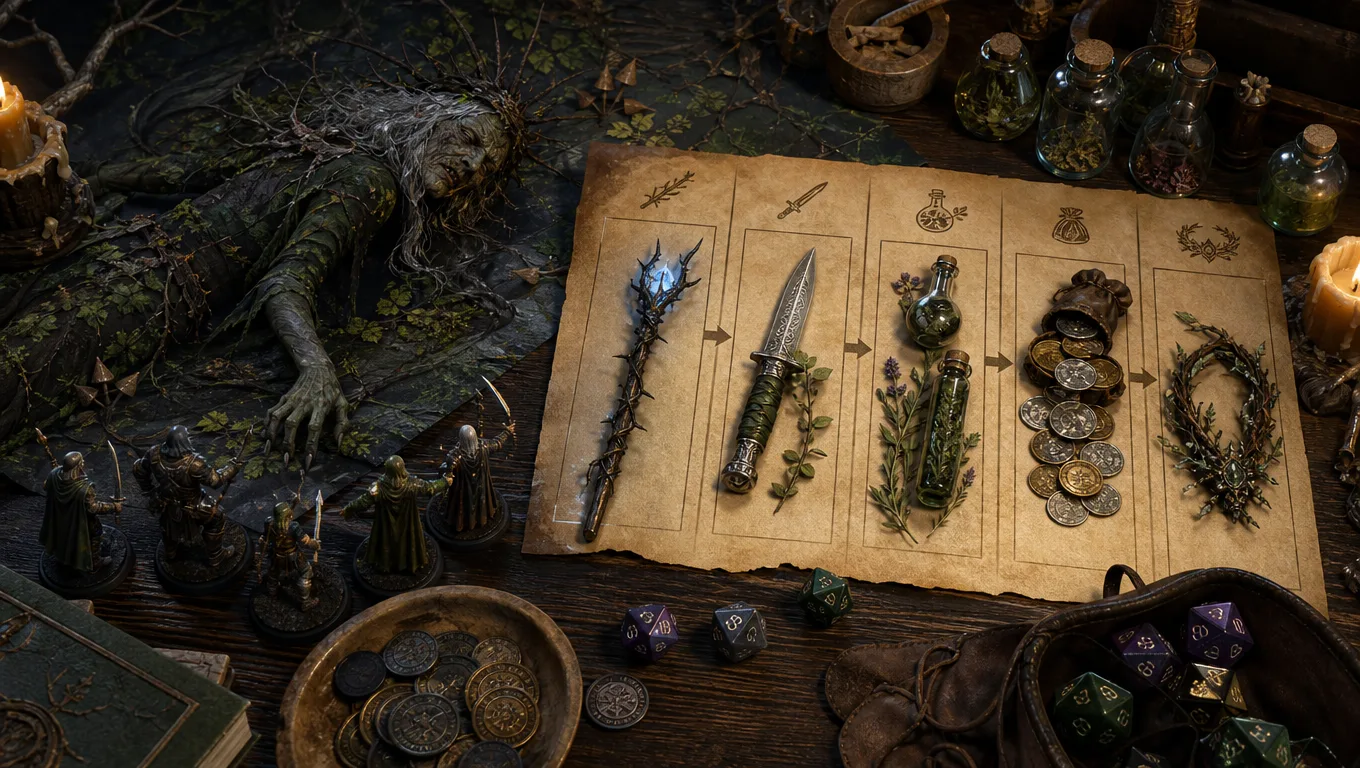
The best outputs usually combine money, utility, and story. Coins pay for downtime. Consumables give the party an immediate option. The odd item or clue points back into the campaign. If the reward only does one of those, I usually generate again or edit it.
What makes the best loot generator DnD tables can trust
I judge loot tools differently from image generators or NPC writers. Speed is useful, but bad loot can quietly warp a campaign. Too much gold removes pressure. Too many permanent magic items make every later reward feel smaller. Too little treasure makes victories feel flat.
Here is the checklist I use before I trust a tool.
| Test | What I want | Why it matters |
|---|---|---|
| Level scaling | low-level parties get modest items, high-level parties get stranger prizes | stops a level 3 group from walking away with campaign-warping gear |
| Context fit | rewards reflect monster, location, faction, or patron | makes treasure feel placed, not dropped from a vending machine |
| Mixed reward types | coin, gems, consumables, curios, magic items | gives different players something to care about |
| Editability | I can cut or replace one item quickly | no generator should have final say at the table |
| System flexibility | D&D 5E and Pathfinder outputs can be adapted | useful when running homebrew or mixed rules |
| Story hooks | at least one reward suggests a future scene | keeps loot connected to play |
CharGen's Loot Generator does well because it is part of the same RPG tool stack as the Monster Generator, Shop Generator, Magic Item Generator, and RPG Workshop. I can generate a monster, create its reward, send a special item into the magic item workflow, and later place the item for sale in a shop if the party ignores it. That connected workflow is more useful than a single isolated roll.
Worth mentioning though: I still review every output. AI can suggest a rare item that sounds brilliant and is too strong for the party, or produce a price that does not fit my economy. The tool gets me 80 percent of the way there. I do the final DM judgement.
Best D&D loot generator options in 2026
There are more loot tools around than people realise. Some are old-school table rollers. Some are AI prep assistants. A few are general fantasy tools with a loot button attached. I care less about the brand label and more about the job each tool does best.
| Tool | Best for | Where it wins | Where it falls short |
|---|---|---|---|
| CharGen Loot Generator | story-rich rewards tied to encounters | context, themes, magic item descriptions, links to other RPG generators | still needs DM review for exact economy and item strength |
| Donjon treasure tools | quick traditional rolls | fast, familiar, rule-table feel | little narrative fit without DM editing |
| 5eTools treasure tools | source-heavy reference workflows | broad lookup and table access for experienced DMs | can feel dense if you only need tonight's reward |
| Vondy-style AI generators | quick text-based ideas | easy prompts and short outputs | weaker visual and campaign workflow support |
| Homebrew spreadsheets | strict economy control | perfect for DMs who track every gold piece | slow when the party takes an unexpected route |
My honest pick is CharGen for session prep and Donjon or 5eTools for cross-checking. If I need the feel of old tables, I use a table. If I need a reward that reflects a black dragon's flooded shrine, a thieves' guild ledger, or a noble's cursed wedding chest, I use AI and then trim the result.
That distinction saves time. Do not ask one tool to be everything.
July 2026 update: make exploration rewards matter with Found container
I used to treat a searched desk or chest as a quick break between the interesting bits. Someone rolls well, I glance at a note, then it is a few coins and we move on. That works when the party is racing through a dungeon. It is a missed opportunity when the group has just found the captain's cabin, a sealed crypt, or the back room of a shop they already distrust.
CharGen's Loot Generator now separates Defeated foes from Found container. The distinction is small on the page and useful at the table. Defeated foes is still the right choice after a fight. Found container is for the things characters uncover by searching, such as a chest, lockbox, crate, barrel, desk, cabinet, hidden cache, sarcophagus, or safe. You can choose a protection level, or leave it on Auto, then add a short description of who owned it and where it sits.
That gives the result a shape before the treasures arrive. A trapped noble's writing desk should not produce the same bundle as a goblin's battered crate. One owner might keep correspondence, a signet, and an expensive but practical potion. Another might keep stolen trade goods, a key with no obvious door, and a map with a route marked out in charcoal. The coins are still there, but they are no longer doing all the work.
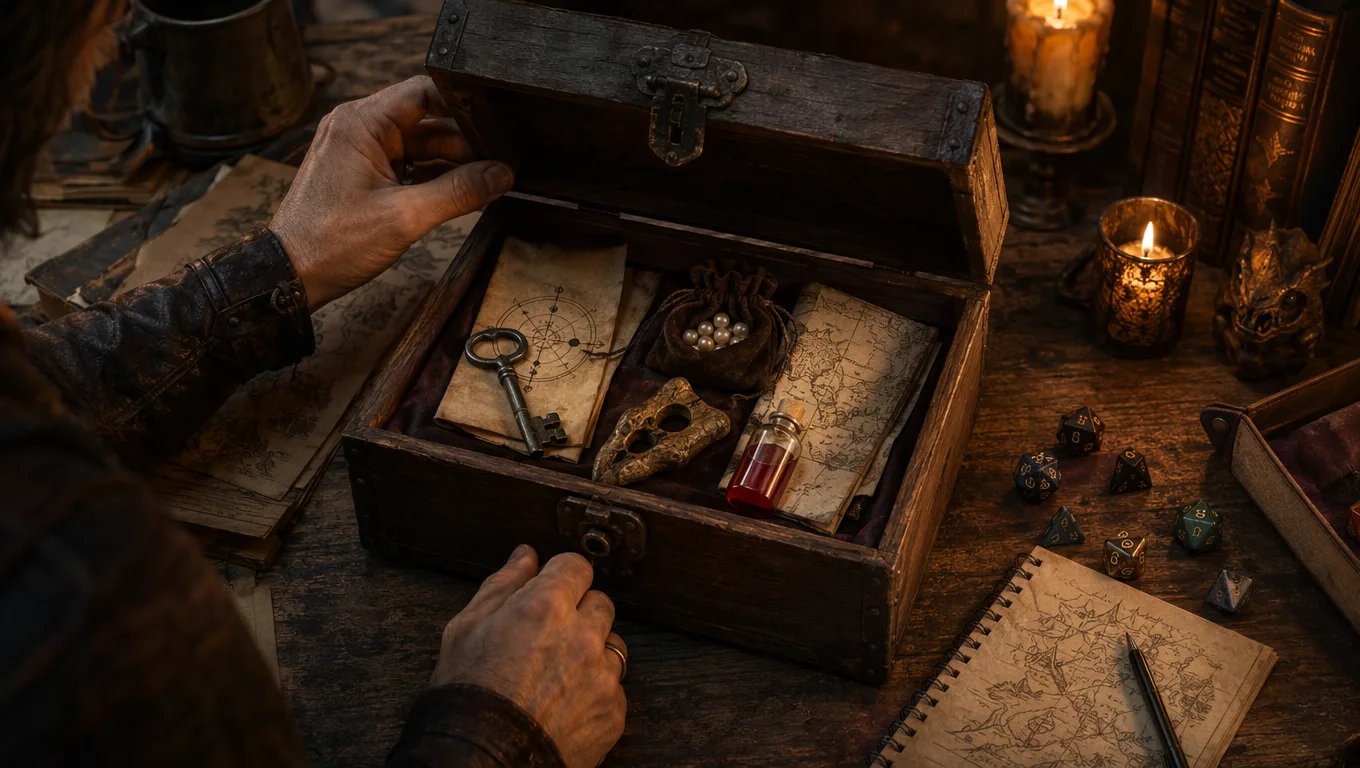
Here is the prompt I would actually enter before a session:
Level 6 party, found container, locked harbourmaster's strongbox in a damp cellar, include modest valuables, one useful consumable, one clue about unpaid smuggling debts, and no permanent weapon.
I like that format because it tells the generator what matters without asking it to write an adventure for me. The valuable part pays out the scene. The consumable gives someone a choice during play. The clue pushes the players towards a person, place, or problem. The hard limit keeps a routine search from quietly becoming a level-up reward.
The 2024 Dungeon Master's Guide keeps treasure, magic items, rarity, and reward themes in the same conversation, which is a helpful reminder that a hoard is more than a price tag. Recent DM discussions make the practical version clearer. Newer DMs still ask how to avoid making level 3 rewards too strong, while other tables want magic shops to feel special rather than inevitable. My answer is usually the boring one: favour a mixed bundle, keep permanent bonuses deliberate, and give the find a connection to the people who left it behind. The 2024 Dungeon Master's Guide is the rules reference I check when I need a reality check on the reward tier.
My found-container routine
I use Found container when the party searches a location rather than defeats a creature. The source field is the first decision. A chest in a tomb might be trapped because it protects a burial gift. A desk in a customs office might be locked because it holds ledgers. A crate in a smuggler's cellar might be unprotected, because the danger is in the evidence rather than the box. The protection setting is not just decoration. It tells me what kind of moment the search should become.
The second decision is the owner. I add one phrase that identifies who kept the container and one phrase that identifies why it is here. "Retired duellist's travel chest beneath a burned inn floor" is enough. "Minor cult courier's desk in a rented room" is enough. That little bit of context produces more useful personal objects, keys, letters, maps, keepsakes, and oddities alongside the treasure. Those are the items players pick up, inspect, and bring back three sessions later when everyone else has forgotten the gold total.
A five-minute check before I put the result on the table
I do not use every generated entry unchanged. I scan the result with four questions:
- Does the owner make sense for every item, including the mundane ones?
- Is the protection a scene, or just a damage roll I can remove?
- Does one item have a clear job, such as healing, access, evidence, or a future complication?
- Is the permanent magic strong enough to deserve the campaign time it will take up?
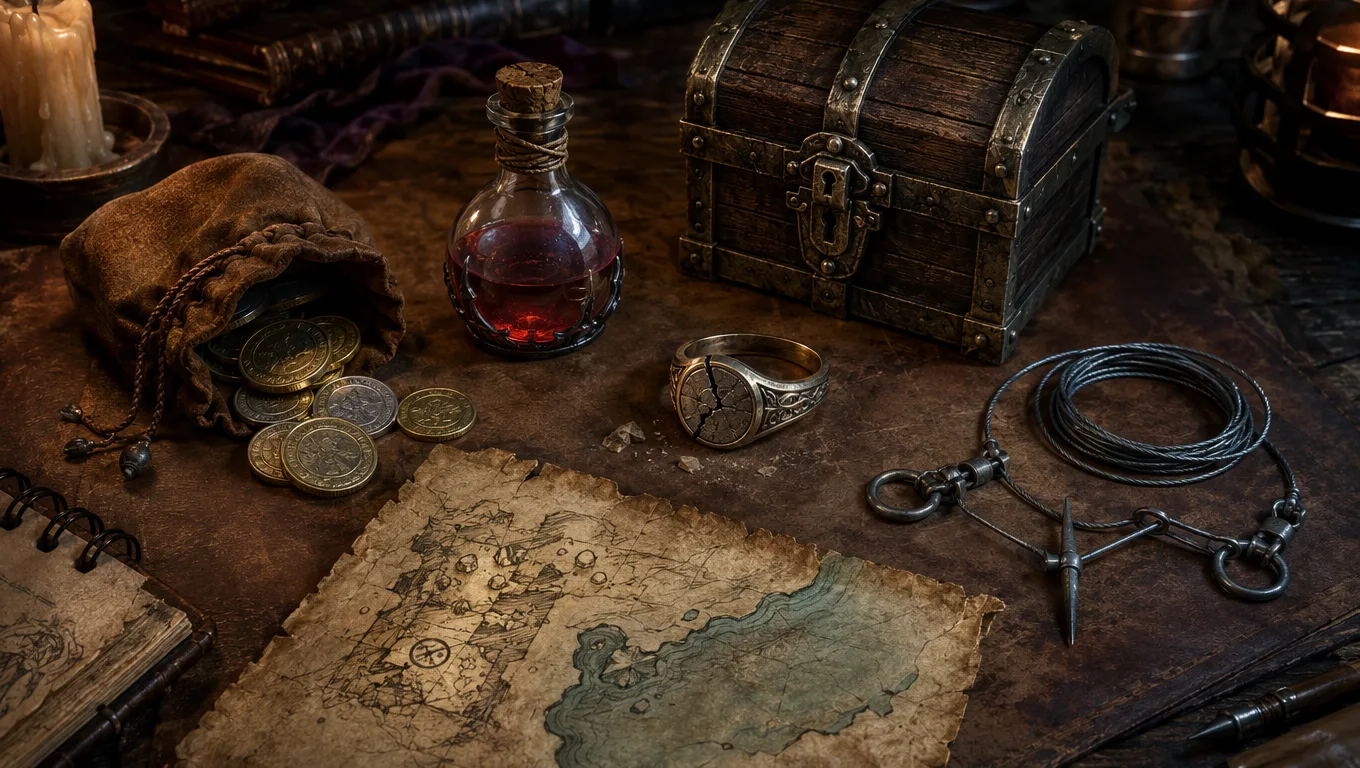
For a level 4 party, I would rather see a locked desk yield a potion, a small purse, a false-bottom key, and a letter that names the next suspect than a random uncommon weapon. The first reward supports the next session without changing every fight. If I want a major item, I build the scene around it and make sure at least one player has a reason to care.
Found-container loot also makes a useful handoff into the rest of CharGen. A recovered signet can become an entry in the Magic Item Generator. A letter can point towards an NPC made in the NPC Generator. A stash of questionable stock can turn into the starting inventory for the Shop Generator. I do not need to promote every spoon and scrap of parchment into a campaign record. I only save the pieces that change what the party does next.
If you want a quick test, generate one defeated-foe reward and one found-container reward for the same location. A drowned chapel is a good example. The defeated foe result might pay out from the guardian. The found-container result can reveal what the priests hid before the guardian ever arrived. Those are two different stories, and they should not feel like the same coin pile in different packaging.
Treasure hoard generator by CR: the numbers I start from
People search for "treasure generator" and "hoard generator" as often as "loot generator". The job is the same. You need a reward pile that fits the fight. The Dungeon Master's Guide already gives you a budget for it. I use that budget as the frame. Then the generator adds the story.
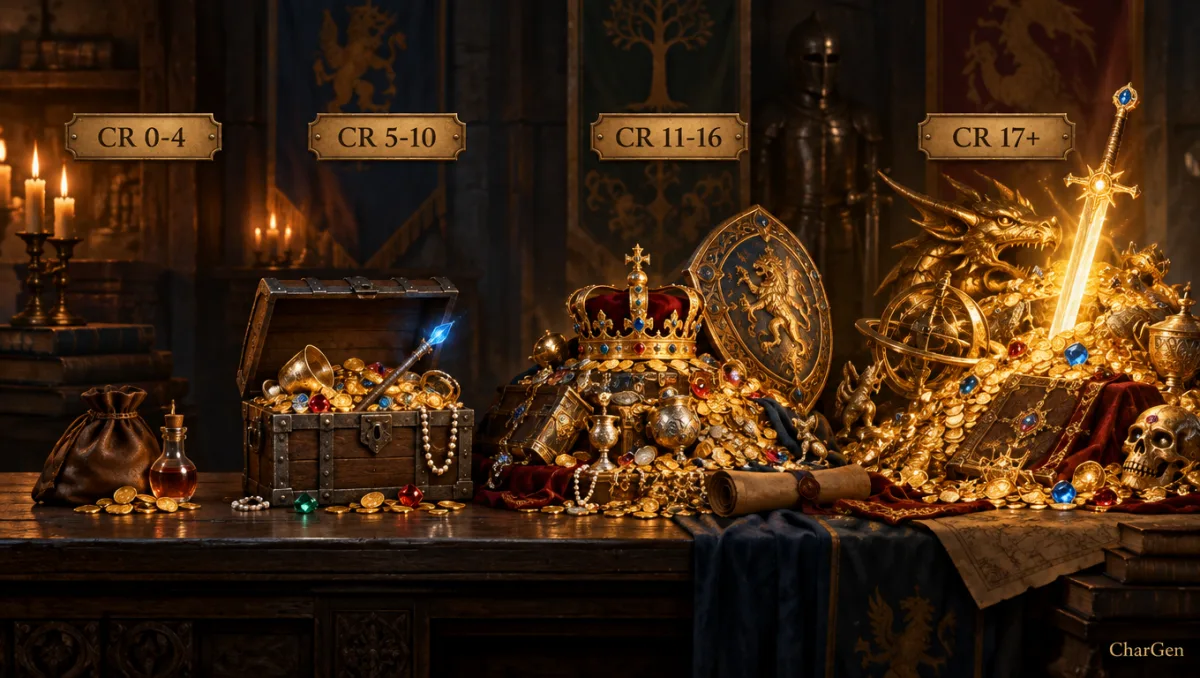
The 2024 Dungeon Master's Guide splits treasure into two kinds. Individual treasure is the coin one monster carries. A treasure hoard is the big payout at a story milestone. The Random Treasure Hoard table is on page 120. It has four bands by challenge rating. Chartopia's 2024 hoard chart lists the dice for each band:
| Hoard band | Coins (2024 DMG) | Average coins | Magic items |
|---|---|---|---|
| CR 0-4 | 2d4 x 100 GP | 500 GP | 1d4-1 |
| CR 5-10 | 8d10 x 100 GP | 4,400 GP | 1d3 |
| CR 11-16 | 8d8 x 10,000 GP as printed | 360,000 GP as printed | 1d4 |
| CR 17+ | 6d10 x 10,000 GP | 330,000 GP | 1d6 |
Look at the CR 11-16 row. As printed, it pays more on average than the CR 17+ row. DMs on the D&D Beyond forums think this is a misprint for 8d8 x 1,000 GP. That gives an average of 36,000 GP. I use the 1,000 GP version at my table. It keeps the bands in order.
The 2014 DMG also tells you how many hoards a campaign needs. Page 133 says a typical campaign has "seven rolls on the Challenge 0–4 table, eighteen rolls on the Challenge 5–10 table, twelve rolls on the Challenge 11–16 table, and eight rolls on the Challenge 17+ table." That is 45 hoards from level 1 to 20. The largest share, 18 of 45, is in the CR 5-10 band. So a lot of your hoard prep happens at that tier.
How I turn the budget into a CharGen hoard
The dice give you a number. They do not tell you what the coins look like or why they are there. That is where I use CharGen's Loot Generator. The form has five inputs for a combat reward:
| Field | What the form offers | What I enter for a hoard |
|---|---|---|
| Loot source | Defeated foes or Found container | Defeated foes for a boss, Found container for a vault |
| Party Level | 1 to 20 | the party's current level |
| Loot Theme | Dungeon, Dragon's Hoard, Noble's Cache, Ancient Ruins, Mountain Keep, Magical Treasury, Battlefield Spoils, or a custom theme | the theme that matches the owner |
| Game System | D&D 5E, Pathfinder 2E and others, or a custom system | the system I run |
| Monsters Fought | one creature per line, such as 3 goblins or 1 dragon | the boss and its guards |
I do not expect the output to match the DMG dice exactly. I check the coin total against the band average. If a CR 5-10 hoard comes back at 40,000 GP, I cut it to about 4,400 GP. If it comes back with four permanent magic items, I keep one and save the others. The DMG sets the size. The generator sets the flavour. I make the final call.
The 2024 DMG also sorts magic items into four treasure themes: Arcana, Armaments, Implements and Relics. I find these useful as a prompt shortcut. A lich's hoard leans Arcana. A warlord's hoard leans Armaments. If I want that lean, I choose Other in the Loot Theme field and type it, for example Relics of a drowned sun temple.
Dragon hoard generator example: a young red dragon for a 5e boss fight
"Dragon hoard generator" is one of the most specific searches that brings DMs to this page. So here is a full worked example. I use it as my template for any dragon boss.
The setup. My party is level 9. The boss is a young red dragon. In the 2014 Monster Manual it is a CR 10 creature. It has claimed a ruined monastery inside a volcano. That puts the hoard in the CR 5-10 band. The budget is 8d10 x 100 GP, so about 4,400 GP, plus 1d3 magic items.
The form. I set Loot source to Defeated foes. I set Party Level to 9. I pick Dragon's Hoard as the Loot Theme. I leave Game System on D&D 5E. In Monsters Fought I enter 1 young red dragon and 4 kobolds on two lines.
What I hold the result to. Before I read the result aloud, I check it against five points:
| Check | Target for this hoard | Why |
|---|---|---|
| Coin total | 3,000 to 6,000 GP | stays near the 4,400 GP average |
| Magic items | 1 to 3, one of them useful to a player now | matches the 1d3 roll |
| Fire damage | at least two objects show heat damage | a red dragon's lair should look burned |
| Former owner | one object from the monks | the monastery had a life before the dragon |
| Future hook | one object that points to a person or place | the hoard starts the next arc |
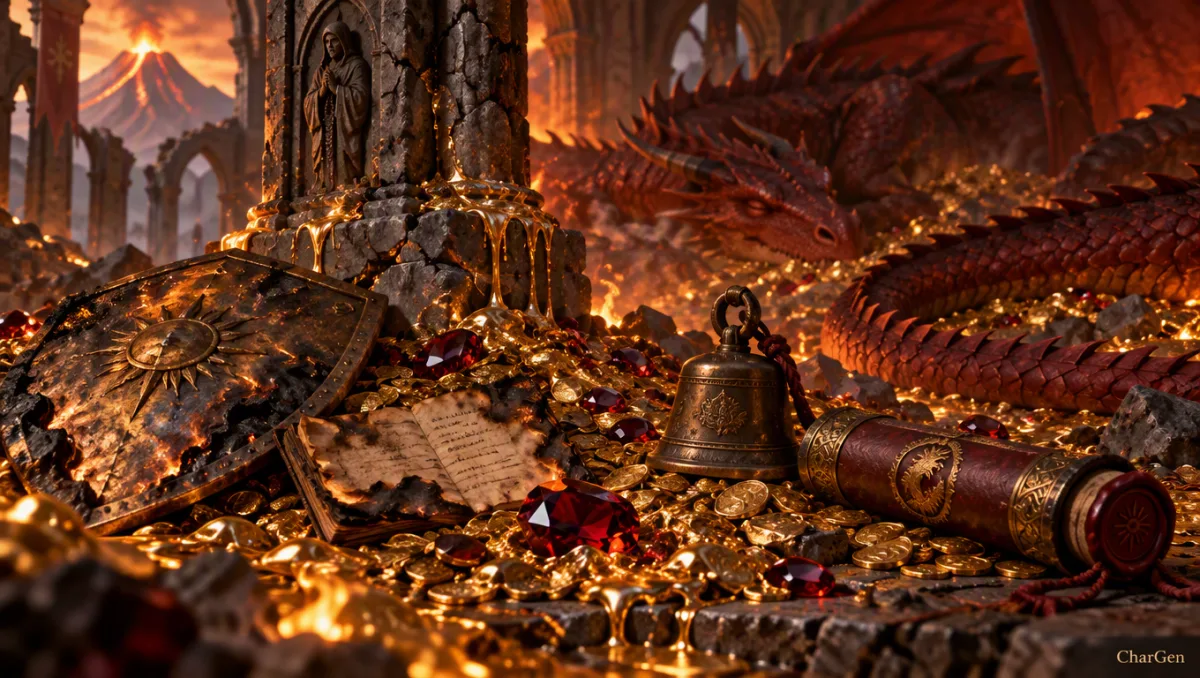
A good result for this setup has melted coin, fire-coloured garnets, a scorched shield and a monk's bell or ledger. If the result has none of the fire detail, I regenerate once. If the second result is still bland, I keep the best items and add the burn marks myself. That takes about two minutes.
Hoard items from Fizban's Treasury of Dragons
If you own Fizban's Treasury of Dragons (2021), add one hoard item to a dragon boss. Hoard items grow stronger when they sit in a dragon's hoard. CBR's guide to hoard magic items lists four states: slumbering, stirring, awakened and ascendant. A young dragon's hoard raises an item to stirring. An adult's raises it to awakened. An ancient's raises it to ascendant. The item needs at least one year in a living dragon's hoard.
For the level 9 party, I put one slumbering hoard item in the pile. The dragon's hoard has already raised it to stirring. That gives the players a reward that grows with the campaign. It also gives them a reason to visit an older dragon later. I write that reason on my prep note next to the coin total.
Use the same template for other dragons. Change the band to match the CR. Change the damage check to match the breath weapon. A green dragon's hoard should show acid and rot. A white dragon's hoard should be frozen. The five checks stay the same.
How I stop AI loot from breaking the campaign
The biggest worry with any ai loot table generator is power creep. It is easy for a model to write a cool item. It is harder for it to understand that your party's monk will use it every fight for the next 18 sessions.
I use five guardrails.
Keep permanent bonuses rare
Permanent +1, +2, and +3 items change the campaign math. I am not afraid of them, but I do not hand them out just because a boss fight happened. At low levels, I prefer consumables, situational items, keys, clues, and weird utility objects.
Examples I like:
- a candle that burns blue near undead
- a cracked mirror that shows the last person who lied in the room
- three arrows tipped with frost glass
- a charm that lets one character speak with a dead animal once
Those are fun without turning every later fight into an arms race.
Tie the reward to the owner
A lich's vault, a goblin ambush, and a merchant caravan should not all pay out the same way. Owner logic solves half the problem.
If the enemy used the item, I ask whether the party can safely use it. If the enemy hoarded it, I ask why. If the item was stolen, I ask who wants it back. Suddenly a loot result becomes a future scene.
Concrete example: after a smugglers' den fight, I gave the party a pearl-inlaid compass that did not point north. It pointed towards the nearest unpaid debt. That item came from a loot prompt, but it worked because it matched the smugglers' whole business.
Give each player a different kind of reward
Not every reward has to suit every character. In fact, that can make loot feel thin. I prefer a small bundle where different players care about different pieces.
For a level 6 crypt reward, I might use:
- the fighter gets a shield oil that hardens for one combat
- the cleric gets a cracked saint token with one divination use
- the rogue gets a burial key with an old guild mark
- the wizard gets a brittle scroll with a partial ritual
- everyone gets coin and gems to split
Nobody gets the entire spotlight, but everyone gets something to talk about.
Use prices as suggestions
Magic item pricing has always been a table argument. The 2024 rules discussion did not erase that. Community projects like Better Magic Item Prices on Reddit show how much DMs still care about item value, gold flow, and reward pacing.
I treat generated prices as a first pass. If the number feels wrong, I change it. A campaign with scarce magic shops needs different values from a high-magic city game where brokers and auction houses are common. No tool knows your economy better than you do.
Save the best items for later
When a generator produces a brilliant item that is too strong, I do not throw it away. I save it in my prep notes, mark it for a later tier, and use a smaller version now.
The full item might be:
Crown of the Storm Saint, very rare, stores lightning damage and releases it as a reaction.
The level 4 version becomes:
Storm Saint's Nail, single-use charm, reduces lightning damage once and sparks with a saint's name.
Same flavour. Better timing.
Prompt formula for a random treasure generator DnD reward
The fastest way to get better loot from AI is to stop asking for "cool treasure" and start giving constraints. A short, specific prompt beats a dramatic paragraph.
My formula:
Party level + encounter owner + location + reward purpose + hard limits.
Examples:
| Situation | Prompt I would use |
|---|---|
| low-level undead fight | Level 3 party, skeleton knight in ruined watchtower, reward should include modest coins, one defensive consumable, and one clue to the old garrison. |
| swamp monster | Level 5 party, giant leech brood in alchemist's marsh lab, include useful harvested materials, strange potion ingredients, and no permanent weapon. |
| noble vault | Level 8 party, corrupt noble's hidden vault, include art objects, blackmail documents, one social-use magic item, and prices suitable for a wealthy city. |
| dragon hoard | Level 12 party, young red dragon in volcanic monastery, include fire-themed gems, damaged relics, one rare defensive item, and a future hook tied to the dragon's old rival. |
If the first result is too generous, add a limit: keep permanent magic items uncommon or lower. If it is too bland, add owner history: the treasure belonged to a failed moon cult before the monster took it. If it ignores a player need, add one party note: the group lacks healing and has no reliable cold damage.
Do not overpack the prompt. The goal is a reward bundle, not a novel.
My favourite CharGen loot workflows
I use the Loot Generator in three different ways depending on prep pressure.
The five-minute boss reward
When I know the boss but not the treasure, I open Loot Generator, set the party level, pick a theme such as Dungeon or Magical Treasury, and list the boss in the Monsters Fought box. (An earlier version of this post named two themes the form does not offer. The live list is below.)
For a fungal ogre in a collapsed mine, I want rot, spores, old mining gear, and one useful thing that survived the damp. The result might include coin sealed in wax, a pickaxe head with a faint tremor sense, and a pouch of spore dust that blinds one creature when thrown. That is enough for tonight.
The campaign clue bundle
Sometimes loot is an excuse to move information. I ask for one item that points at the next location and one item that complicates the current one.
Example:
Level 7 party, vampire accountant's office, reward should include a ledger clue to the river district, one cursed luxury item, and no combat weapon.
The reward can then carry plot without a separate exposition scene. Players love finding evidence when it comes with money attached. I cannot blame them.
The shop stock handoff
If the party is heading back to town, I generate a few loot-style items, then move the best ones into a shop inventory. CharGen's Shop Generator makes this easy because both tools think in terms of items, prices, owners, and flavour.
A moss healing flask from a druid ruin can turn up later behind the counter of a suspicious apothecary. The players recognise it, ask where it came from, and now the shopkeeper is part of the story. That is a much better use of generated loot than leaving it as a one-scene reward.
Try the Loot Generator FreeWhat I would not automate
AI is good at suggestions. It is not the DM.
I do not let a generator decide who deserves the campaign's signature weapon. I do not let it override a player wishlist I already approved. I do not accept a cursed item unless I know how the curse will feel at the table. Most importantly, I do not use generated loot to dodge my own pacing decisions.
If the party just finished a major arc, give them something memorable. If they cleared a minor guard room, keep it modest. If they ignored every clue and robbed the mayor's laundry, maybe they get expensive buttons and a legal problem.
That last one is not theoretical.
FAQ
What is the best dnd loot generator in 2026?
For story-rich D&D rewards, I use CharGen's Loot Generator because it builds level-appropriate treasure with encounter context, item descriptions, coin values, and magic item ideas. For old-school table rolls, Donjon and 5eTools are still useful cross-checks.
Can I use a dnd loot generator for Pathfinder?
Yes. CharGen's loot tool supports D&D 5E and Pathfinder-style fantasy rewards, and most generated items can be adapted to any fantasy RPG. I still check exact item maths against the system I am running.
What should I put into an AI loot prompt?
Include party level, the defeated monster or owner, the location, the reward purpose, and any hard limits. For example: Level 5 party, corrupted knight in abandoned chapel, include one useful consumable, one story clue, and no permanent weapon.
How much treasure should a D&D party get?
It depends on tier, campaign economy, and how common magic is in your world. Use generators for a starting point, then adjust coin totals, rarity, and item strength against your own campaign pace.
Are AI-generated magic items safe to use as written?
Not always. Review action economy, recharge timing, save DCs, permanent bonuses, and whether the item duplicates another player's niche. I often keep the flavour and tune the mechanics myself.
Can a D&D loot generator make treasure for a chest or desk?
Yes. In CharGen, choose Found container, select a chest, desk, cache, crate, sarcophagus, or your own container type, then add context about the owner and location. The result can include valuables, personal objects, keys, maps, letters, and clues, plus a note about whether the find was locked, trapped, or hidden.
How do I generate a treasure hoard by CR in 5e?
Find the CR band of the boss. The 2024 DMG uses four bands: CR 0-4, 5-10, 11-16 and 17+. A CR 5-10 hoard averages 4,400 GP and 1d3 magic items. Enter the party level, a theme and the boss in CharGen's Loot Generator, then check the coin total against the band average.
How much treasure should a young red dragon hoard have?
A young red dragon is CR 10 in the 2014 Monster Manual, so its hoard uses the CR 5-10 band. In the 2024 DMG that is 8d10 x 100 GP, about 4,400 GP, plus 1d3 magic items. Add fire damage to the objects and one item from the lair's former owner.
My recommendation
Use a loot generator when you already know the scene but do not yet know the reward. Give it party level, owner, location, and limits. Keep the output that feels specific, cut anything that would distort your campaign, and save the best too-powerful ideas for a later tier.
For tonight's prep, start with one boss reward and one clue item in CharGen's Loot Generator. That is enough to make the next treasure chest feel placed instead of pasted in.
Image credits
Images in this article were generated for CharGen's blog image workflow using WaveSpeed GPT Image 2.
Generate D&D Loot with CharGen