
Best AI Dungeon Master Tools for 2026 Prep
The best AI dungeon master tools for 2026, split into solo-play AI DMs that run the game and prep assistants that speed up your session prep.
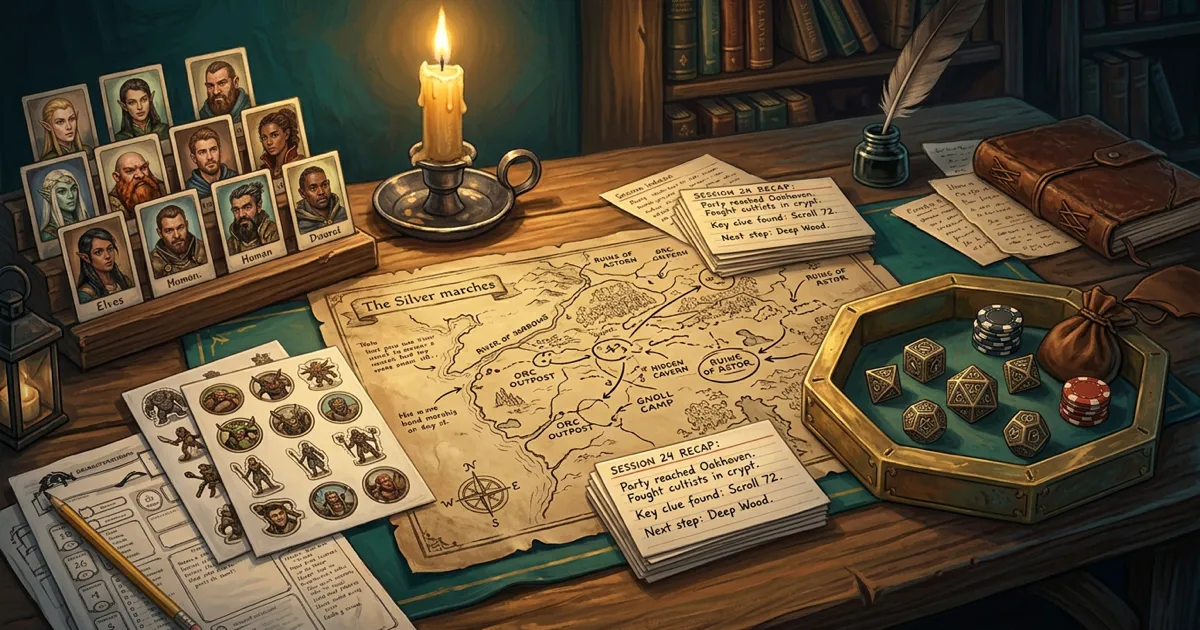
Wednesday night is where my prep stack usually gets exposed. I have a half-finished encounter, three NPCs who suddenly matter, and one player asking for a recap because they missed last session. The reason I keep testing the best ai dungeon master tools every few months is simple: the wrong tool does not just waste time, it scatters your campaign across six tabs and two bad filenames.
Quick framing before the list, because it decides everything: an ai dungeon master is one of two things. Either software that runs the game for you (solo-play), or software that speeds up the prep for a game you still run yourself. Most DMs want the second. I cover both below, with an honest comparison table, so you do not buy the wrong category.
March 2026 is a good time to refresh the list. On 3 March 2026, D&D Beyond staff pointed players to the new 2026 roadmap and calendar release, which is another reminder that many home campaigns are about to absorb more side quests, horror arcs, and one-shot spillover. On the AI side, OpenAI introduced GPT-Image-1.5 on 16 December 2025 with much tighter editing and instruction following, while Midjourney V7 has now been the default model since 17 June 2025 and keeps features like Draft Mode and Omni Reference in the mix. Those changes matter because most DMs are not fighting for abstract image quality. We are trying to prep faster without making the campaign feel generic.
I also checked what has shifted in CharGen itself before writing this. The recent product work has leaned into practical prep, not fluff, with additions like the new Hazard Generator and better support around campaign-facing content. That fits what I keep seeing in DM spaces. People are not short on raw text generation any more. They are short on systems that help with continuity, art, tokens, and recap memory at the same time.
So this is my 2026 field list. Not a hype parade, not a giant spreadsheet of every AI app on the internet, just the tools I would actually reach for if I had a session to run this week.
The quick answer: which tools are worth a DM's time?
If you only want the short version, this is where I land after another round of testing.
| Tool | Best for | Main weakness | Where I would use it |
|---|---|---|---|
| CharGen | all-in-one campaign prep, NPCs, monsters, session memory, tokens, art | easiest to overuse if you generate before deciding what matters | weekly prep, recurring campaigns |
| ChatGPT Images | edit-heavy handouts, signboards, poster fixes, visual revisions | not built around campaign entities or token workflow | prop art, patch jobs, UI-like edits |
| Midjourney V7 | dramatic mood boards and high-flair scene art | still awkward when I need repeatable campaign admin | big reveals, location concepting |
| Archivist | campaign recap memory and searchable continuity tracking | paid plans can scale up for heavy-session groups | campaign recaps, continuity checks, post-session memory |
| ElevenLabs | voice lines, mood-setting narration, audio props | easy to overdo, and players notice quickly if every NPC sounds produced | letters read aloud, villain stings, recap intros |
My favourite point in that table is not who wins. It is why. The strongest tools all solve a specific job. The bad stack is what happens when you ask one tool to be your campaign memory, your portrait engine, your map brain, your token cropper, and your audio booth all at once.
Why the best AI dungeon master tools in 2026 look different
The 2024 and 2025 discussion was mostly about whether AI could make nice pictures. Fine. We are past that bit now. In 2026, the more useful question is whether a tool survives contact with a real campaign.
For me, that means five tests.
- Can it save prep time this week?
- Can it help me keep recurring NPCs coherent?
- Can it reduce boring admin after the session?
- Can it produce assets that still work on Roll20 or Foundry?
- Can I come back in three weeks and still understand what I made?
That last one is where a lot of DM tech falls apart.
I have seen beautiful NPC art become useless because it was saved as final-final-actual-use-this.png. I have seen decent recap tools fail because they summarised events but lost the who-changed-what layer. I have also seen flashy voice tools flatten a scene because every generated line sounded a bit too polished, a bit too eager, and not at all like the grubby smuggler I meant to portray.
Worth saying clearly, none of these tools replace encounter judgement, pacing, or your table instincts. If you do not know why a rival priest is lying, no prompt box is going to rescue that scene. What the good tools can do is remove the admin drag around the interesting decisions.
1. CharGen is still the best overall AI dungeon master tool
If I had to cut everything down to one subscription and one browser tab, I would keep CharGen.
That is not because it wins every isolated category. Midjourney can still beat it for pure painterly drama on a hero scene. ChatGPT Images can be brilliant when I want one signboard corrected or one handout adjusted without rebuilding the whole image. But weekly DM prep is not a beauty contest. It is a continuity problem.
What makes CharGen useful is the way the pieces sit together:
- NPC Generator when I need a cast quickly
- Monster Generator when I want encounter logic before art
- D&D AI Art when I need portraits, scenes, or environment images
- Token Maker when those portraits have to become usable pieces on a VTT
- RPG Session Notes when notes, NPC state changes, and campaign memory need to stay linked
- Paid Arena A/B tests when I want to test whether a prompt holds up across two model families before I commit
That stack solves a very specific headache. I can prep a suspicious dockmaster, generate a portrait, crop a token, note that he lost two fingers after session eleven, and carry that forward without starting from zero next week.
Try the NPC GeneratorConcrete example, I recently needed eight city NPCs in under an hour: a customs clerk, a washed-up duellist, a bruised temple guard, a river pilot, and four people who were meant to be background colour until the players inevitably fixated on them. I started with one-line roles in NPC Generator, promoted only three portraits to higher quality, built tokens for the two most likely combat pieces, then saved one recap note per recurring face in RPG Session Notes. That is the sort of boring, useful workflow that wins campaigns.
The main risk with CharGen is that it is easy to generate too much because the routes are close together. If you start polishing every innkeeper like they are the campaign villain, your prep night disappears. My rule is simple: only recurring NPCs get premium attention.
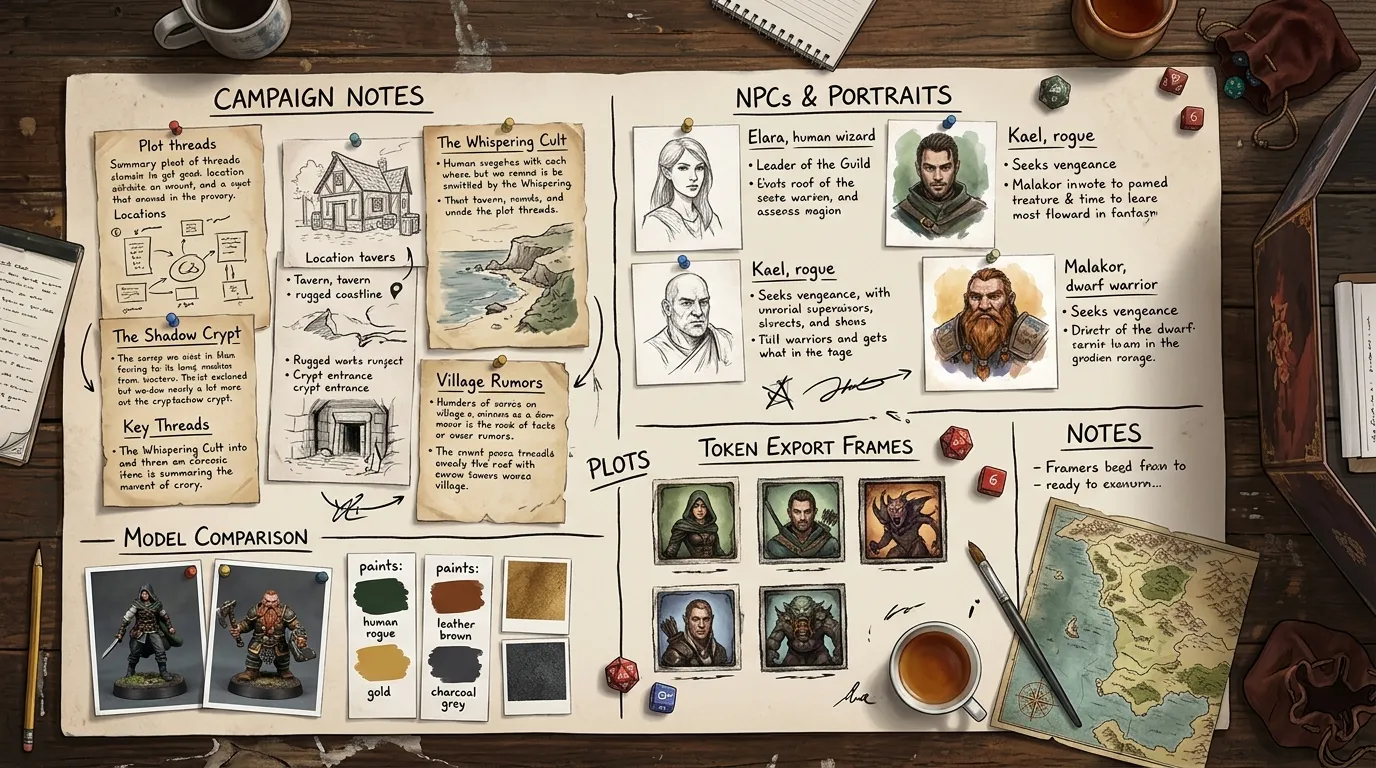
2. ChatGPT Images is my favourite edit-heavy side tool
OpenAI's December 16, 2025 image update made a noticeable difference to how I use generated art for tabletop prep. The big shift was not just prettier output. It was cleaner editing.
That matters when you are fixing props rather than creating everything from scratch.
If I need a wanted poster with legible text, a tavern noticeboard with one name changed, or a player handout where the wax seal should stay put while the parchment wording changes, ChatGPT Images is one of the few tools I trust enough to try before opening an editor. OpenAI's own announcement specifically called out stronger instruction following, denser text rendering, and more precise editing, and that matches my experience.
Where it helps me most:
- patching one visual detail without restarting the whole image
- making handout-style props that include readable text
- adjusting a scene image after I realise the mood is right but the composition is wrong
Where it does not replace CharGen for me:
- campaign entities
- token workflows
- worldbuilding generators
- recap linkage
In other words, ChatGPT Images is a scalpel. CharGen is the workshop.
If you run a mystery-heavy campaign with lots of letters, guild notices, branded shop signs, or faction pamphlets, this tool earns its place fast. If your sessions are more about cast management and encounter prep, it becomes a secondary lane rather than the main one.
June 2026 update: OpenAI has moved on again since I first wrote this section. GPT-Image-2 shipped on 21 April 2026, replacing GPT-Image-1.5 inside ChatGPT, with sharper text rendering and noticeably faster edits. Everything I said above about prop patching still holds, it just got better at the exact jobs I was already using it for. Handout text that needed two or three rerolls in March now usually lands first try.
3. Midjourney V7 is still excellent for big scene energy
I still use Midjourney when I want one image to hit hard.
The official Midjourney model documentation says Version 7 was released on 3 April 2025 and became the default model on 17 June 2025, with Draft Mode and Omni Reference added to the lane. That sounds dry, but the practical result is easy to spot. It is very good at dramatic composition, richer texture, and images that feel expensive even when the underlying prompt is not especially elegant.
For dungeon masters, that means three very good use cases:
- splash art for a villain reveal
- location mood boards before I build a battlemap
- campaign posters and chapter-divider art
I would not use Midjourney as my only DM tool, mostly because it does not solve the admin bits that actually drain me. You still need somewhere to keep notes, somebody still has to turn that lovely portrait into a token, and your players still need a recap after the dice stop rolling.
That said, I am not going to pretend the output is not lovely. When I want a cursed lighthouse on a black coast, or a throne room that feels damp, ceremonial, and slightly wrong, Midjourney is often where I start. I just make sure it is feeding a workflow rather than becoming the workflow.
One limitation that matters for tabletop use, character consistency is still work. Reference features help, but recurring NPCs can drift if you change pose, lighting, costume detail, and mood at the same time. That is why I prefer to test anchor prompts in CharGen's paid Arena before I commit to a full portrait set.
June 2026 update: Midjourney has not stood still either. V8 entered alpha on 17 March 2026 and V8.1 followed at the end of April with much faster renders and HD output. My testing for this section was done on V7, and the verdict carries over: the composition is even stronger on V8.1, the campaign-admin gaps are exactly the same. It still does not know who your dockmaster is.
If the subscription is the sticking point, I have written up the Midjourney alternatives I actually use for fantasy art, tested against the same DM workflow.
4. Archivist is the recap tool I wish existed two years ago
I used to recommend NotebookLM in this spot. It is a good general research tool, but it was never designed for tabletop campaigns. You had to do all the organising yourself, feed it clean sources, and hope it understood the difference between an NPC and a location. Archivist skips that entirely because it was built for exactly this problem.
Feed it your session recordings, notes, or Foundry and Discord logs. It builds a living campaign compendium. Characters, NPCs, locations, factions, quest threads. All tracked, all cross-linked, all searchable. When a player asks "who gave us that amulet in session four?" you can just ask Archivist instead of scrolling through three months of messages.
I use it for:
- automated session recaps that separate plot beats from combat noise
- a compendium that links NPCs, locations, and factions with wiki-style cross-references
- "Ask Archivist", a query tool trained on your actual campaign history, not generic D&D lore
- cast analysis that shows speaking time, engagement, and pacing per player
- printable two-page session handouts for the table
It works with any TTRPG system and connects to Discord, Foundry VTT, and Obsidian. The free tier gives you 30 days with two sessions to test whether it sticks.
The reason I swapped NotebookLM out is scope. NotebookLM is a general tool that happens to work with your notes if you do the filing. Archivist is purpose-built for the exact problem DMs actually have: keeping a campaign's memory intact without becoming a full-time note-taker yourself.
Where CharGen handles what your world looks like, the faces, the monsters, the maps, Archivist handles what happened and who was involved. Generate your cast in CharGen before the session, then let Archivist file the events away after.
Pricing: Free 30-day trial (1 campaign, 2 sessions) | Casual $10/mo (4 sessions) | Seasoned $20/mo (3 campaigns, 10 sessions) | Pro $35/mo and up for heavier groups.
5. ElevenLabs is useful when you want audio, not when you want everything
I am cautious with generated voice in TTRPGs because it can turn tacky very fast. One over-produced villain monologue and the table mood goes from tense to "why does this cultist sound like a luxury podcast host".
Still, there is a real use case here.
I like ElevenLabs for small audio pieces that support a scene rather than dominate it:
- an in-world proclamation played before a city session
- a dream message with obvious magical distortion
- a short recap intro for players who listen during the commute
- a villain note or shrine warning handed over as an audio file
That is enough.
I would not voice every NPC. I would not replace live table delivery with clips every week. Used sparingly, though, it can make one moment land harder. I had a temple bell notice read aloud before a plague-session arc last year and it worked because it lasted nineteen seconds, not four minutes.
This is also where CharGen's own video cutscene generation becomes relevant. If I want a fuller media beat, I would rather keep it connected to the same campaign stack than stitch a dozen unrelated media apps together.
Prep versus play: where I draw the AI line
Every tool on this list shares one assumption, and I should make it explicit, because it is the most argued-about question in DM spaces right now. AI belongs before the session and after it. It does not belong in the chair.
If you read r/DMAcademy or any of the bigger TTRPG forums in 2026, the debate has mostly settled into that shape. Using AI for prep support, recaps, and brainstorming barely raises an eyebrow any more. Using it to run the game, or quietly shipping AI text into the fiction mid-session, is where the pushback lives. The wider industry has drawn an even harder line: the ENnie Awards stopped accepting any AI-assisted submissions from the 2025-2026 cycle onwards. You do not have to agree with that policy to read the signal. A large part of this hobby treats the live, human-authored part of the game as the part that matters.
I build AI tools for a living, so I am clearly not anti-AI. But on this one the sceptics are mostly right, and the reasons are practical rather than ideological.
First, models still cannot hold a campaign's state. Run one as a live DM for more than a session or two and it contradicts itself, forgets who has the amulet, or invents a new faction out of nowhere. People have run this experiment over and over and the failure mode is always continuity, not prose quality.
Second, an AI never says no. Ask one whether your fighter can flap his arms hard enough to fly and it will find a way to make it interesting. That sounds generous until you realise a campaign without refusal has no stakes. Half of DMing is adjudication, and adjudication needs an owner.
Third, and this is the one that actually matters to me, the model cannot read the table. When a player mentions a backstory detail for the first time in eight sessions, a human DM hears the invitation and pivots the scene. A model sees a sentence. The dramatic timing of a campaign lives in exactly those moments, and no recap file substitutes for noticing them live.
Before the session, the picture flips completely. Prep work produces assets, not rulings. You can check a statblock, rewrite a name, bin a portrait. You stay the editor. That is the whole design behind CharGen's Session Prep bundles: generate the dungeon, the cast, and the hooks the night before, throw away what does not fit, and walk into the session with material you have already judged. Same logic for the Dungeon Generator when I need a floor plan to riff on, or the NPC Generator when Wednesday's cast is three faces short. After the session, recap summarisation is admin, not play, so that side of the line is fine too.
One honest caveat on etiquette. The threads where this goes badly are almost never about the tools, they are about the surprise. Players who discover months in that the handouts were generated tend to feel misled, even when they did not mind the handouts. If you think your table would care, say so up front. Mine knows exactly which parts of my prep are generated, and nobody has ever objected to a better-prepared session.
So the rule I actually run by: anything that exists before the players sit down is fair game. Once dice are rolling, the judgement is mine.
Solo-play AI dungeon masters vs AI prep assistants: which do you actually want?
Right, so here is the split that every fresh 2026 roundup leads with, and it is the single most useful thing to sort out before you spend a penny. When people search for an ai dungeon master, they are usually after one of two completely different things, and the tools that serve them barely overlap.
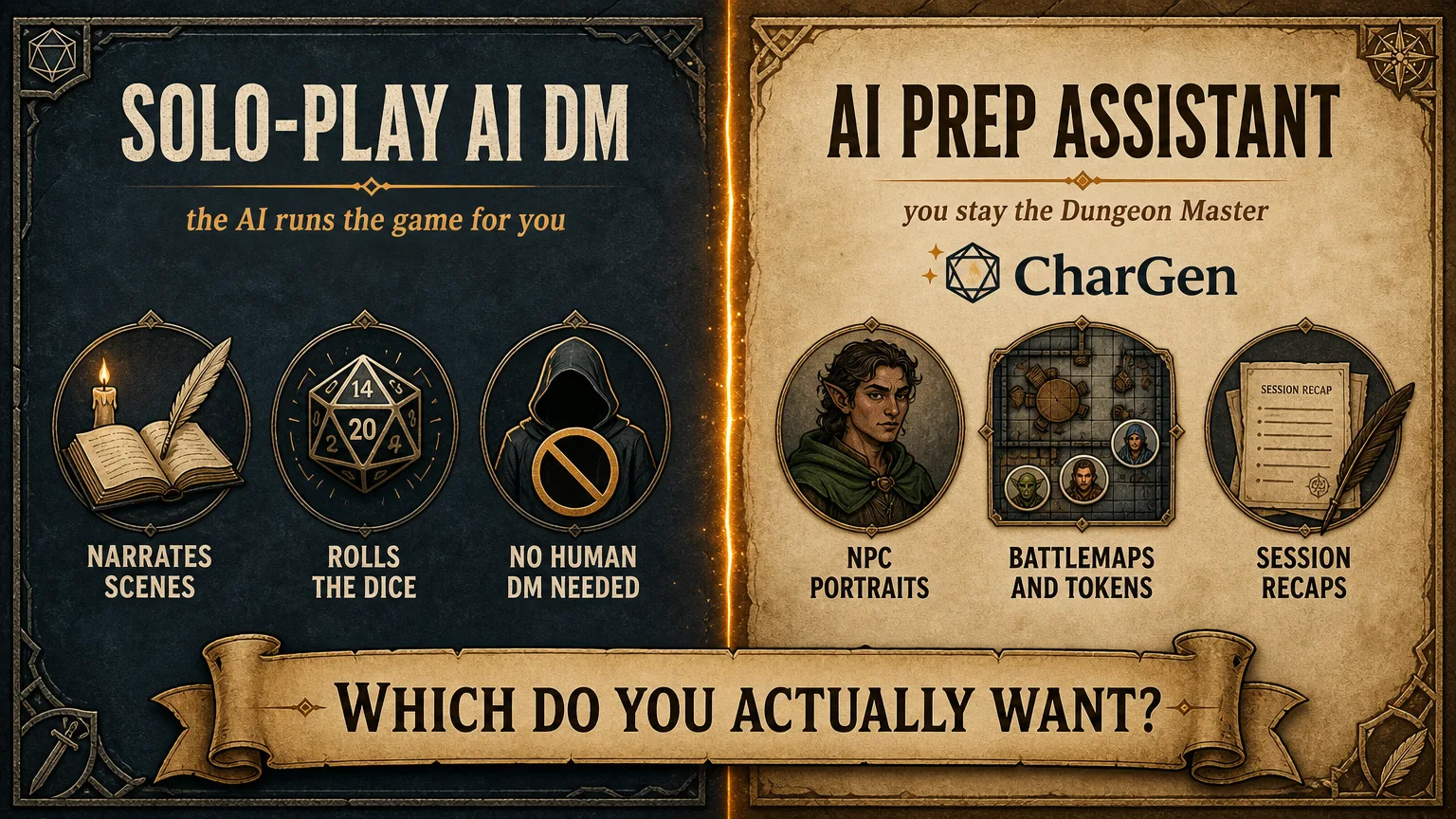
The first camp is the solo-play AI DM. The AI runs the game for you. It narrates the scene, plays the NPCs, adjudicates the dice, and reacts to whatever you type. No human at the head of the table. This is what you want if you have no group, your group cancelled again, you fancy a solo session at midnight, or you want to test a plot before you inflict it on real players. The serious names here in 2026 are AI Dungeon, Friends and Fables, RoleForge, AI Realm, and the various solo SRD bots people build on top of ChatGPT and Claude. They sell themselves on one promise above all others: persistent memory across months of play, so the campaign does not forget who you are between sessions.
The second camp is the AI prep assistant. The AI accelerates your prep, then gets out of the way. It generates NPCs, portraits, battlemaps, tokens, dungeons, loot, and recaps that you carry into a game you run yourself. You stay the DM. This is the lane CharGen lives in, alongside Dungeon Alchemist for maps, Tabletop Arc and Archivist for campaign memory, ScriptoriumGM for structured prep, and LitRPG Adventures for bulk text generation. The promise here is different: faster Wednesday nights, not a robot in the chair.
So which do you actually want? Honest verdict, most people reading a "best ai dungeon master tools" list are not trying to fire themselves as DM. They have a group. They love running the game. What they hate is the four hours of admin on the Tuesday before. If that is you, a solo-play AI DM solves the wrong problem. You do not need something to run the table, you need something to stop your prep eating the week. That is a prep assistant, and CharGen is the fastest visual one I have used.
The flip side, and I will be straight about it, CharGen will not run a game for you. If you genuinely have no group and you want to play tonight with nobody else in the room, do not download CharGen and feel let down. Go and try AI Dungeon or Friends and Fables, they are built for exactly that. CharGen is a prep accelerator, not a DM-replacement, and pretending otherwise would just waste your evening. The two categories are friends, not rivals. Plenty of solo players use a prep tool to build the cast and maps, then feed them into a solo-play engine to actually play.
A 2026 quick-pick comparison: solo-play AI DMs vs prep tools
This is the table I wish the search results gave me up front. I have split it by category so you can see at a glance whether a tool runs the game or helps you prep it, then matched each one to the job it is genuinely best at. Prices are the public 2026 figures at the time of writing, so check the tool's own pricing page before you commit, because the solo-play apps in particular keep shifting their plans.
| Tool | Category | Best for | Price / free tier |
|---|---|---|---|
| CharGen | Prep assistant | Visual prep stack: NPC portraits, battlemaps, tokens, recaps in one place | Free tier, paid plans for heavier image use |
| AI Dungeon | Solo-play AI DM | Freeform interactive fiction, no rules, go-anywhere stories | Free Wanderer tier; paid from $14.99/mo |
| RoleForge | Solo-play AI DM | Persistent worlds, real dice, hand-drawn maps (still in alpha) | Free during alpha, no limits |
| Friends and Fables | Solo-play AI DM | Solo or duo 5e play with tactical combat and battlemaps | Free 25 turns/day; paid from ~$19.95/mo |
| Tabletop Arc | Prep assistant | Structured campaign canon and continuity ledger | Free generators; ~30 min/mo transcription free |
| Archivist | Prep assistant | Searchable campaign memory and recap continuity | Free 30-day trial; paid from $10/mo |
| ScriptoriumGM | Prep assistant | Adventure and session-structure prep | Free tier with paid upgrades |
| Dungeon Alchemist | Prep assistant | Fast 3D battlemaps you can export to a VTT | One-time purchase (no subscription) |
| LitRPG Adventures | Prep assistant | Bulk text generation: NPCs, quests, items at volume | Subscription (lifetime option historically offered) |
| ChatGPT / Claude | Either, with effort | Ad-hoc brainstorming, dialogue, or a DIY solo bot | Free tier; paid from ~$20/mo |
If you want the prep-side picks broken out in more detail, I keep a running list in Top 10 AI Tools Every Dungeon Master Needs, and if your specific pain is fights rather than faces, the best D&D encounter generators post covers that lane. For player-facing art, the character art generator is the prep tool I reach for most. On the solo-play side, I put AI Realm, StoryRoll, and AIDungeonMaster.ai through their own dedicated AI Dungeon Master apps comparison, including which ones are actually live versus still waitlist-gated.
The thing worth noticing in that table is the memory column under the surface. Every solo-play engine is fighting the same enemy, the context window. AI Dungeon's well-known weakness is that its memory is conversational, so a long campaign slowly forgets its own past. RoleForge and Friends and Fables make persistent state a headline feature precisely because that is the hard part. On the prep side, memory is a different shape: Archivist and Tabletop Arc store campaign canon as structured data so it survives past session fifteen, while ChatGPT keeps nothing between chats unless you hand-feed it every time. CharGen's RPG Session Notes sits on the prep side of that line, keeping NPC state changes linked to your campaign rather than relying on a chat history that scrolls away.
What AI models does AI Dungeon run in 2026?
AI Dungeon is the name that comes up most when people search for an ai dungeon master, so it deserves more than one row in a table. Its model list changed a lot during 2026, and the old "it runs GPT-3" answer is now wrong. Here is the current shape of it, taken from AI Dungeon's own model documentation.
The free Wanderer tier gives you five story models. Dynamic Small switches automatically between several small models. Wayfarer Small 2 is a 12B in-house finetune tuned for combat, injury and harsh consequences. Madness is a 12B finetune aimed at darker material. Fable is an 8B Llama 3 finetune built by a community creator for roleplay. DeepSeek V4 Flash is a mixture-of-experts model that is quick in dialogue-heavy scenes.
Paid tiers add the larger options. Muse (12B) and Hearthfire (24B, a Mistral Small 3.2 finetune) handle quiet atmospheric scenes. Harbinger (24B) is the newer branch of the Wayfarer line. Equinox (31B) is a Gemma 4 finetune tuned for second-person scene continuation. Nova (70B) and Wayfarer Large (70B) are both Llama 3.3 finetunes. At the top sit DeepSeek V4 Pro, GLM 5.1, Hermes 3 405B, and the experimental Atlas and Raven variants.
Two things stand out in that list. There is no OpenAI model on it any more, anywhere. AI Dungeon started on GPT-3 and has since moved to open-weight bases plus its own finetunes. And the in-house models are described by behaviour, not just by size. Wayfarer is tuned for consequences. Hearthfire is tuned for slice-of-life. That is a genuine design decision, and it is why the "which model should I pick" argument never ends.
The number that matters more than the model name
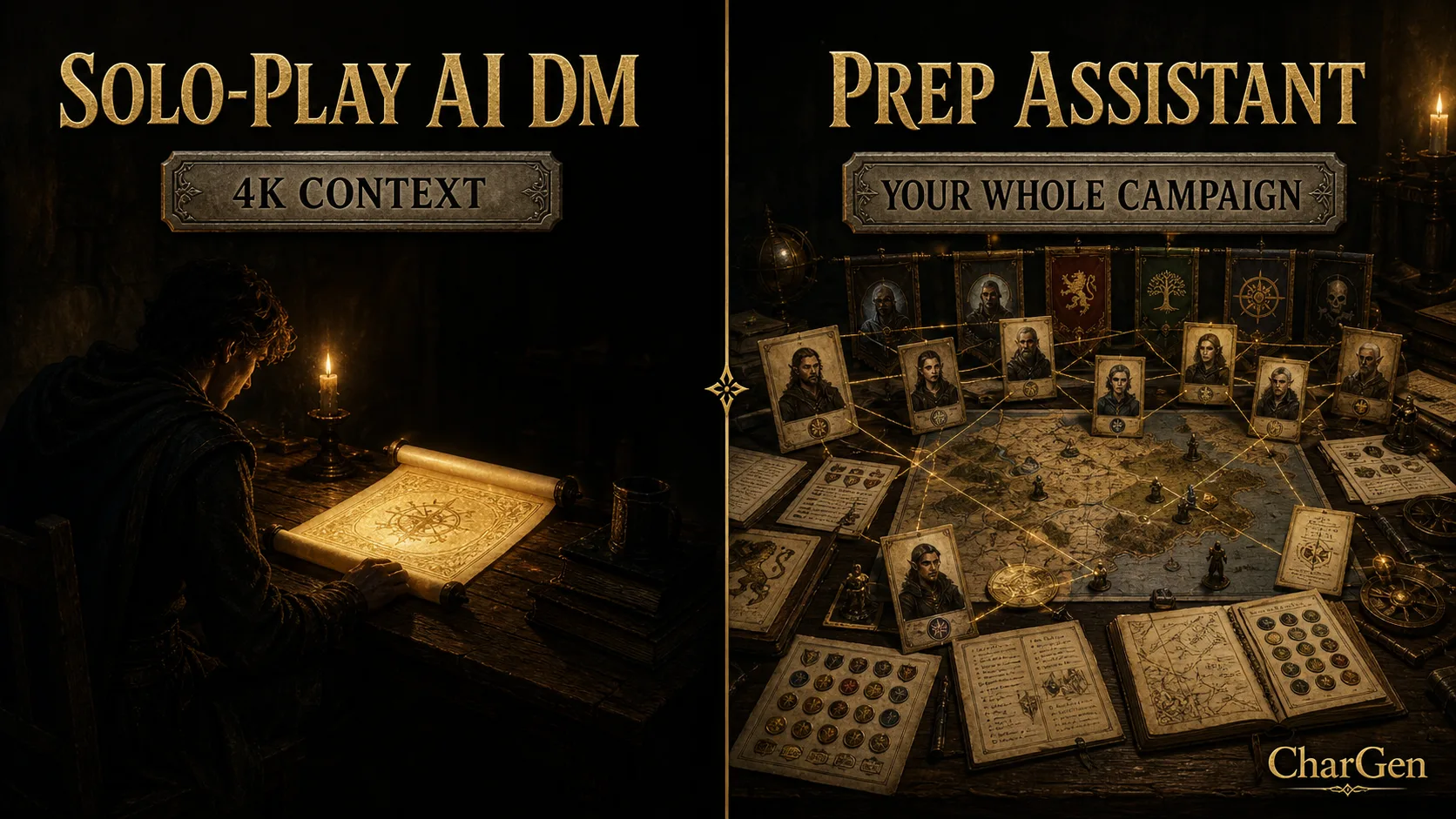
Model choice is the fun argument. Context size is the one that decides whether your campaign holds together. AI Dungeon publishes it per tier, so you can compare it directly.
| Tier | Monthly price | Story context | Memory Bank |
|---|---|---|---|
| Wanderer | Free | Up to 4k tokens | 25 memories |
| Journey | $14.99 | Up to 8k tokens | 100 memories |
| Legend | $29.99 | Up to 16k tokens | 200 memories |
| Mythic | $49.99 | Up to 32k tokens | 400 memories |
| Ultimate | $99.99 | Up to 32k tokens | 800 memories |
Those are the published figures at the time of writing. Check the memberships page before you pay, because the tiers move.
4,000 tokens is roughly 3,000 words. On the free tier, that is the total amount of campaign the model can hold in front of it at once. Everything older has to be compressed into 25 Memory Bank entries or it is gone. That is not a bug in AI Dungeon, it is the honest arithmetic of running a story inside a context window. It is also exactly the ceiling I described further up: the failure mode of a long AI-run campaign is continuity, not prose.
If you are looking for AI Dungeon alternatives
The searches for alternatives usually come from one of two complaints, and they point at different replacements.
If the complaint is memory, that a campaign forgets itself after a few weeks, the fix is a solo-play engine that stores state as structured data rather than as chat history. RoleForge and Friends and Fables both make persistent state a headline feature for that reason. Friends and Fables also runs actual 5e rules and tactical combat, which AI Dungeon deliberately does not.
If the complaint is rules, that freeform fiction is not the game you wanted, then no solo-play engine is really the answer. You wanted D&D, and D&D needs adjudication. Get a group, run it yourself, and use a prep tool to cut the preparation time. That is the lane below.
One more honest note. AI Dungeon is not competing with CharGen and I am not going to pretend it is. It runs stories. CharGen builds prep material for games you run. If you try to use one for the other job you will be disappointed by both.
The best AI tools for D&D 5e campaign prep, specifically
Most roundups answer "AI for tabletop" in general. 5e prep has a narrower shape than that, and the tools that fit it are not the same ones a Call of Cthulhu keeper or a PbtA group would pick. So here is the 5e-specific answer, sorted by the prep job rather than by the vendor.
Statblocks and encounters. You need CR maths that survives contact with a real party. Generic chat models are poor at this and will hand you a CR 5 monster with CR 9 damage output. Use a generator that knows the 5e maths, then sanity-check the damage per round against your party's average hit points. I cover the options in the best D&D encounter generators post.
Recurring NPCs. 5e campaigns live or die on the cast the party keeps meeting. The job here is not "write me an NPC", it is "keep this NPC consistent for nine months". You want portraits, a short statblock, and a record of what changed each session, stored together. That is the NPC Generator plus session notes, not a fresh chat window each week.
Tokens for the VTT. If you play on Roll20 or Foundry you need circular, transparent, correctly-sized tokens, in batches. Portrait generators will not give you this. Token Maker does it directly, and I wrote up the batch workflow in how to make D&D tokens.
Battlemaps. Two honest routes. Dungeon Alchemist if you want 3D maps you control and export, for a one-time purchase. A battlemap generator if you want something usable in a minute and you are happy to adjust it.
Session recaps. The highest-value and least glamorous one. A recap tool that links events back to campaign entities beats a tool that only summarises text, because the second kind loses the who-changed-what layer. Archivist and RPG Session Notes both do the linked version.
Rules lookups. Do not use a general AI model for this. It will confidently give you a 3.5e rule, a homebrew rule, or a rule it invented. Use the SRD or D&D Beyond. This is the one prep job I would keep AI away from entirely.
The pattern across all six: AI is good at generating prep material you then judge, and bad at anything where being confidently wrong costs you a ruling at the table.
Which AI platforms help you organise a long-term campaign?
Running a campaign for six sessions is a content problem. Running one for sixty is an organisation problem, and almost no AI tool is built for the second. This is the question I get asked most by DMs two years into a game, so it is worth answering separately from the tool list.
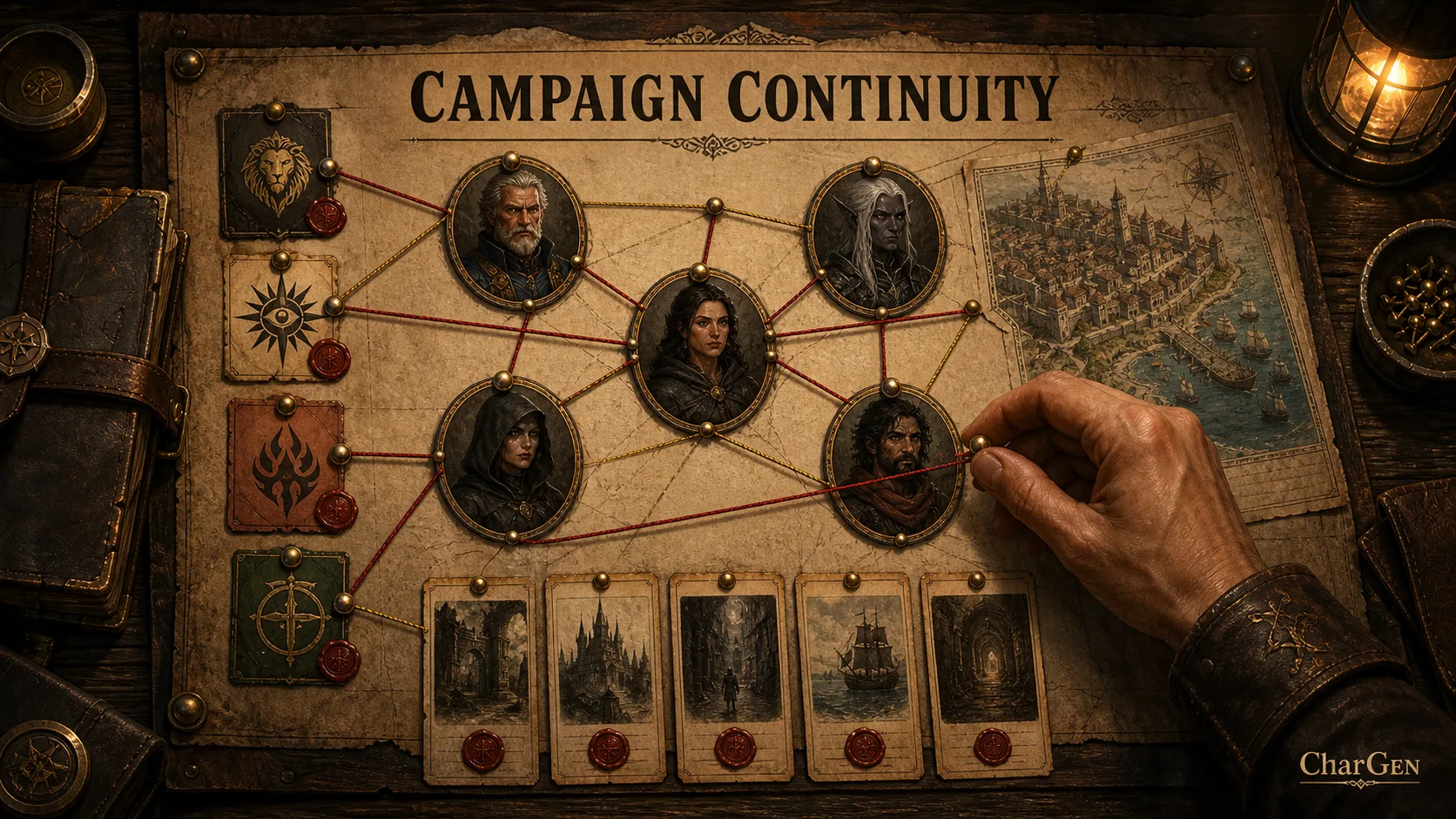
Three things break in a long campaign, and they break in this order.
Session one: the cast blurs. By session twenty you have forty named NPCs and you can only remember eight. The rest become "the guard captain" and the players notice. The fix is storing NPCs as entities with a portrait and a state, not as lines in a document. Anything that gives each NPC a stable identity works here.
Session thirty: the timeline drifts. Someone asks when the treaty was signed and you have three contradictory answers across your notes. The fix is dated session records that link to the entities involved, so the timeline is derived from what happened rather than remembered.
Session fifty: the threads rot. Half your plot hooks are dead, two are secretly resolved, and one is load-bearing for the finale. The fix is a hook or quest ledger with a status on each entry, reviewed every few sessions.
For the platforms themselves, the split is straightforward. Archivist and Tabletop Arc are built around campaign memory and searchable continuity, and they are the right pick if recap drift is your main pain. ScriptoriumGM is stronger on structuring adventures than on tracking a long history. CharGen sits on the entity side: NPCs, factions, settlements and quests are stored as linked records in a linked campaign records, so a session recap can point at the same NPC you generated eleven months ago. General chat models are the weakest option here by a wide margin, because they keep nothing between conversations unless you paste it in again every time.
The honest summary: no AI platform will organise your campaign for you. What the good ones do is make the organised version cheap enough that you actually keep it up. A continuity system you abandon in month three is worse than a notebook you maintain.
How I would build a sane 2026 DM stack
Most DMs do not need five subscriptions and a manifesto. They need one stack that matches the job.
Here is the setup I would actually recommend.
If you run weekly D&D or Pathfinder
Use CharGen as the core.
Start with RPG Session Notes for campaign memory, use NPC Generator and Monster Generator for prep, generate only the art that players will actually see, then push recurring faces through Token Maker. Add Midjourney only if you want occasional chapter art with more flair than a standard session needs.
If you run online and need tokens constantly
Keep the art lane boring on purpose.
Use stable portrait prompts, front-facing or three-quarter crops, one border family, and a hard reroll cap. The post I keep pointing people to here is How to Make DnD Tokens Fast for Roll20 and Foundry, because token readability beats cosmetic fuss every single time. For the tool choice itself, I tested and ranked every free option, CharGen included, in my best free D&D token generator guide.
If your real pain is recap drift
Start from notes, not art.
Use RPG Session Notes first, then move to visuals once the memory layer is correct. If you want a campaign-specific continuity layer beyond your own files, Archivist is useful after that.
If you only need one dramatic visual per arc
Use Midjourney or ChatGPT Images for the hero piece, then stop.
Do not drag your whole campaign into a high-flair image workflow if what you really need is one reveal image and six clean NPC cards.
My honest ranking after testing these again
This is the order I would recommend for a working DM, not an AI hobbyist.
- CharGen
- ChatGPT Images
- Midjourney V7
- Archivist
- ElevenLabs
Why CharGen stays on top is simple. It is the only one in this group that genuinely helps with the overlap between ai session notes d&d, ai npc portrait generator, dnd session recap generator, and ai rpg art generator. Most competitors are good at one slice. CharGen is the one I can use to move from prep notes to entities to visuals to tokens without dropping campaign context on the floor.
If you want the shortest practical recommendation I can give, do this:
- use CharGen for weekly prep
- use ChatGPT Images for prop edits
- use Midjourney for chapter art
- use Archivist for campaign memory and recap continuity
- use voice generation sparingly, if at all
That stack covers nearly everything a busy DM actually needs.
FAQ
What is an AI dungeon master?
An AI dungeon master is software that uses a language model to either run a tabletop game for you or help you prepare one. There are two kinds. A solo-play AI DM narrates scenes, plays NPCs, and adjudicates dice so you can play with no human at the table. An AI prep assistant generates the cast, maps, tokens, and recaps you bring to a game you run yourself. They solve different problems, so decide which one you actually need before you pick a tool.
Is there a free AI dungeon master?
Yes, several. RoleForge is free during its alpha with no limits. Friends and Fables gives you 25 turns a day on its free plan, and AI Dungeon has a free Wanderer tier with usage caps. On the prep side, CharGen has a free tier, Tabletop Arc has free generators, and ChatGPT's free model can act as a rough solo bot if you do the setup yourself. None of the free tiers are unlimited, so expect to hit a wall if you play or prep heavily.
Can AI run a full D&D game?
It can run a session or two convincingly, then it tends to wobble. The solo-play engines have got much better in 2026, but the recurring failure mode is continuity rather than prose. Over a long campaign the model forgets who holds the amulet, contradicts an earlier ruling, or invents a faction that never existed. It also never says no, which quietly removes the stakes. For a one-off solo evening it is genuinely fun. For a months-long campaign with real players, I still keep a human in the chair and use AI for prep instead.
AI dungeon master vs AI prep tools: what is the difference?
A solo-play AI DM replaces the person running the game, the AI does the narrating and adjudicating. An AI prep tool replaces the boring prep work, you still run the game. If your problem is "I have no group", you want a solo-play AI DM like AI Dungeon or Friends and Fables. If your problem is "I love DMing but prep eats my week", you want a prep assistant like CharGen, where NPCs, battlemaps, and tokens live in one place.
Does an AI DM remember my campaign?
That is the hard part, and it depends on the tool. Solo-play engines run on a context window, so older events fall out of memory as the campaign grows. AI Dungeon's memory is conversational and degrades over long play, which is why RoleForge and Friends and Fables make persistent state a headline feature. Prep tools handle memory differently: Archivist and Tabletop Arc store campaign canon as structured data so it survives past session fifteen, and CharGen's RPG Session Notes keeps NPC state changes linked to your campaign rather than to a chat log that scrolls away.
What is the best AI dungeon master tool overall in 2026?
For actual weekly campaign prep, I would pick CharGen. It is not because it wins every single image contest. It is because it handles more of the real DM workflow in one place.
Which AI tool is best for D&D session notes?
For campaign-facing recap work, I would start with RPG Session Notes. If you want a purpose-built campaign memory system with searchable recap context, Archivist is a strong secondary layer.
Which AI tool is best for fantasy scene art?
Midjourney V7 is still excellent when I want one dramatic scene image with strong composition and atmosphere. I just would not use it as my entire campaign system.
Do I need separate tools for tokens and portraits?
Usually, yes. A portrait that looks good full size can still fail as a token. That is why I like running portraits through Token Maker instead of assuming the original crop will hold up.
Should I use AI during the session or only for prep?
Only for prep and post-session admin, in my view. Generated NPC art, statblocks, maps, and recap summaries all get reviewed by you before players ever see them. Live rulings, pacing, and reading the table are different jobs, and models are still bad at all three. AI before the session, your judgement during it.
Is it worth using AI for every part of a campaign?
No. That is usually where the prep starts feeling flat. I use AI for admin pressure, asset generation, and occasional media support. I still want the campaign voice, choices, and emotional turns to stay mine.
What I would do tonight
If your current prep process feels slow, start by fixing one pain point rather than rebuilding everything. If your notes are messy, begin with RPG Session Notes. If your NPCs blur together, begin with NPC Generator and Token Maker. If you are still unsure which image model survives your prompt habits, use a paid Arena A/B test before you burn time on rerolls.
If you want the whole workflow in one place, make an account and run one recurring NPC from notes to portrait to token to recap linkage. That one test tells you more than any landing page ever will.
And if the line you keep landing on is "I want to keep DMing, I just want to prep faster", you do not need a robot to take your chair. You need the prep stack in one tab. The RPG Workshop puts NPC generation, battlemaps, and token making in the same place, so you can build Wednesday's cast and maps without bouncing between five apps. Start there, keep the table yours, and let the admin be the thing the AI handles.
If you would rather start smaller than a whole workshop, generate one NPC first and see whether the output survives your standards. That takes about a minute and it is the cheapest test of any tool on this page.
Generate your first NPC portraitSources
- OpenAI, "Introducing GPT-Image-1.5", 16 December 2025
- Midjourney Docs, Version 7 model page
- D&D Beyond forums linking the 2026 D&D roadmap, 3 March 2026
- Archivist AI, product overview and pricing
- OpenAI, "Introducing ChatGPT Images 2.0", 21 April 2026
- Midjourney, V8.1 Alpha update, 30 April 2026
- ENNIE Awards, "Revised Policy on Generative AI Usage"
- AI Dungeon Help, "AI Models and their Differences"
- AI Dungeon Help, "Memberships & Benefits"
Image credits
All images in this post were created for CharGen with WaveSpeed Google Nano Banana 2.
The prep desk image in the prep versus play section was added in the June 2026 update and generated with WaveSpeed GPT-Image-2.