
Pathfinder Hazard Generator for Better PF2e Traps
Use a pathfinder hazard generator to build PF2e traps and set-piece hazards with better clues, counterplay, and room-by-room prep.
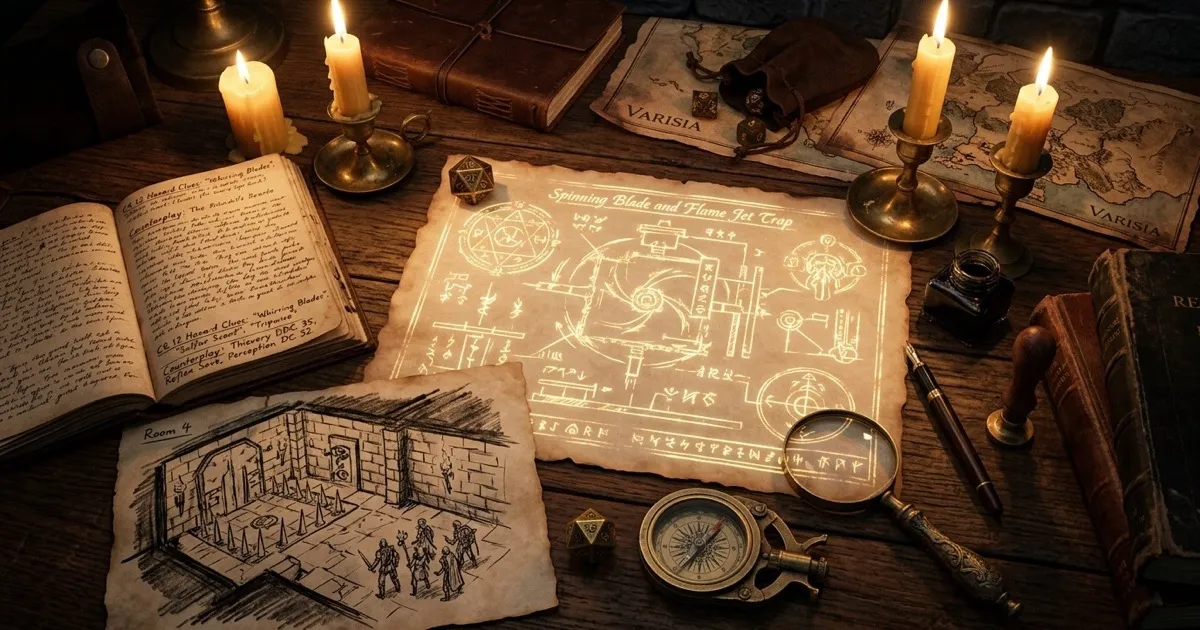
A pathfinder hazard generator only became useful to me once I stopped treating hazards as surprise damage parcels and started treating them as encounter pieces. That change matters because PF2e hazards can be brilliant when they give players clues, pressure, and a few ways to respond. They can also be a complete drag when the whole room turns into one person rolling Thievery while everybody else waits for their turn to be disappointed.
The timing is good for this topic as well. CharGen just shipped its new Hazard Generator, and the feature is not a throwaway trap toy. The form is built around actual hazard structure, including Quick Prompt, Hazard Level, Game System, Hazard Type, Complexity, Environment, Theme, Disable Requirement, and Additional Details. In other words, it is trying to help with the same problem I keep seeing in PF2e circles: hazards are fun in theory, fiddly in practice, and easy to overcook.
That frustration is not imaginary. Archives of Nethys lays out the official hazard rules and the hazard format very clearly, but a lot of tables still struggle with execution. A recent March 2026 thread on r/Pathfinder2e about environmental hazards had the exact complaint I hear from GMs all the time: they want hazards that feel tense, not sluggish. Fair. Nobody wants a room gimmick that sucks the oxygen out of session time.
Search intent around pathfinder hazard generator is fairly practical. Most people looking it up want one of four things:
- a fast way to build a trap or ward that feels like it belongs in the room
- a
pf2e hazard generatorthat produces something close to usable structure - help making complex hazards less annoying to run
- ideas for environmental hazards that do more than ping hit points
That is the job I am solving here. Not lore theatre, not abstract design advice, just a workflow I would actually use before tonight's session.
Why most PF2e hazards fall flat
Bad hazards usually fail in one of three places.
The first problem is weak fiction. The room has a pressure plate, some darts fire, everybody shrugs, and the corridor might as well have been empty. You can get away with that once in a low-level tomb. You cannot build a memorable dungeon out of it.
The second problem is narrow counterplay. One character has the right skill, one character maybe has a crowbar, and the rest of the table stares at the ceiling. That is why I keep side-eyeing hazard write-ups that look clever on paper but offer only one sensible answer in play.
The third problem is encounter isolation. A lot of GMs, me included when I first switched over, run complex hazards as if they must fill the whole scene by themselves. Sometimes that works. More often, the hazard wants friends. A cultist trying to finish a rite while the ward pulses every round is a real scene. A glowing pillar in an empty room can feel like paperwork with initiative.
Community advice on this point is surprisingly consistent. Older Pathfinder 2e discussion around complex hazards keeps landing on the same idea: use them as pressure inside a broader encounter, not as the entire meal. I agree. Once I started thinking of hazards as lair pressure, room pressure, and timing pressure, my sessions got better fast.
What the CharGen Hazard Generator gets right
I like the generator because it nudges me towards the questions that actually matter at the table.
The empty-state copy is blunt about the job: traps, wards, and cursed set-pieces with clues, counterplay, and effects. That wording matters because it pushes you away from generic trap spam and towards hazards with identity.
The fields also map neatly to the parts of PF2e hazard design that I usually forget under time pressure:
| Field | Why I use it | What it improves |
|---|---|---|
Quick Prompt | Establishes the room idea fast | Stops me from designing a stat block with no scene |
Hazard Level | Forces an immediate threat target | Prevents accidental overtuning |
Game System | Keeps the frame honest | Useful if I want PF2e-first output |
Hazard Type | Mechanical, magical, environmental, haunting, and so on | Gives the hazard a clearer role |
Complexity | Simple or Complex | Helps me decide whether this is a trigger or an encounter engine |
Environment | Anchors the room | Makes details feel placed, not pasted on |
Theme | Adds narrative identity | Keeps hazards from blurring together |
Disable Requirement | Forces me to think about counterplay | Avoids the dreaded “guess what the GM meant” design |
Additional Details | Holds encounter context | Excellent for factions, boss rooms, and weird twists |
That list might look basic, but it is exactly the sort of basic that saves prep time. If I have those decisions written down before generation, the result is usually half-sensible already.
My workflow for building hazards players actually interact with
I use four passes. Nothing fancy. The order does the heavy lifting.
1. Start with the room problem, not the stat block
I begin with Quick Prompt, Environment, and Theme.
That is the part where I define what the room is trying to do to the party. Not numerically. Dramatically.
One recent example from my notes:
Shrine vestibule ward that punishes oathbreakers with blinding ash and slams the bronze doors shut
Then I filled the rest like this:
Hazard Level:5Game System:Pathfinder 2EHazard Type:MagicalComplexity:ComplexEnvironment:TempleTheme:Ancient WardingDisable Requirement:Religion or Thievery, expertAdditional Details:Visible prayer chains, cracked censer smoke, hazard should worsen if the idol is attacked directly
That is enough to produce a hazard with a real point of view. It tells me what the players notice, what the room protects, what skills might matter, and what sort of pressure the hazard should create.
By contrast, a prompt like dangerous magic trap in a shrine gives me nothing to stage with.
2. Decide if the hazard is simple or complex before you get attached
This is the fork that saves the most pain.
If the hazard is only there to punish rash movement, reveal the room's tone, or tax attention for a moment, I keep it Simple. Good examples are hidden pits, collapsing awnings, poisoned locks, runes, and brittle floors.
If the hazard needs to reshape the fight over several rounds, I make it Complex. Good examples are ritual braziers, flooding chambers, screaming idol wards, animated mirror halls, and unstable weather effects that keep changing the board.
I do not promote a hazard to Complex just because the room is important. A short, brutal simple hazard can be perfect if the scene already has enough going on.
My rule is blunt:
- simple hazard if the room needs one sharp bite
- complex hazard if the room needs ongoing pressure and tactical decisions
That distinction keeps me from turning every trap into an event encounter.
3. Build at least two readable clues before the trigger
PF2e hazard rules already push you towards detection, discovery, and disable logic. Good. I still have to make the clue work in the fiction.
So I always ask for two visible or audible clues in Additional Details. One obvious, one subtle.
For the shrine ward above, I wanted:
- drifting ash moving against the air flow
- prayer chains trembling before anyone touched the idol
For an environmental river-cavern hazard I wrote last week, the clue pair was:
- unnatural ripples that moved upstream
- chalk-white bones caught in the grating under the bridge
Those details matter because players interact with clues, not with the raw word Trigger.
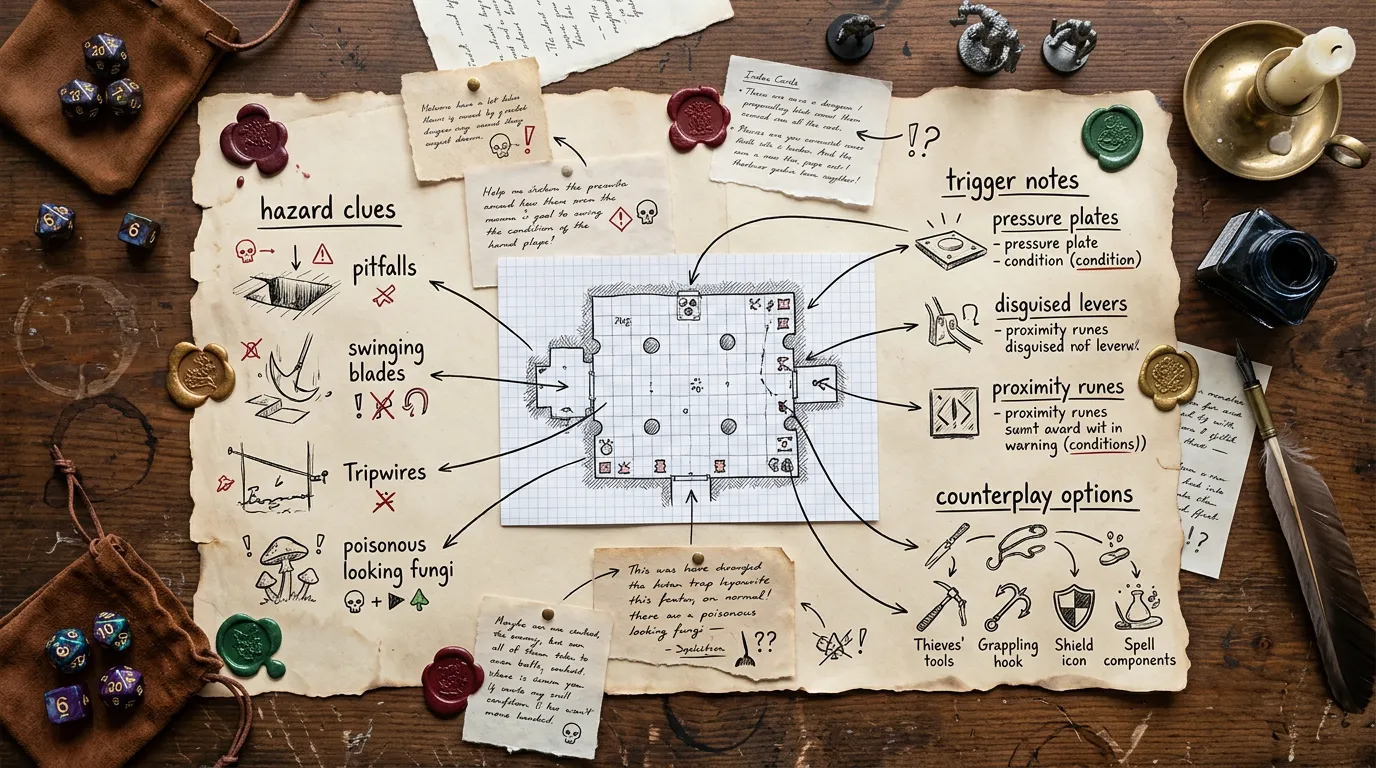
One honest weakness in many trap articles is that they skip this entirely. They tell you how much damage to roll, then forget that discovery is half the fun.
4. Give three kinds of counterplay if the scene is important
This is the step that stops a complex hazard from becoming a rogue tax.
On important hazards I try to support three lanes:
- the obvious skill lane
- a rough physical lane
- a situational or magical lane
Concrete example, I built a drowned archive hazard for a lighthouse vault:
Try the Free Hazard Generator- skill lane:
Thieveryto jam the brass flood valves - physical lane: Athletics to wrench loose a seized gear housing
- magical lane: cold or water control to stabilise pressure long enough to cross
Not every lane has to be equally efficient. It just needs to give the table something to do. If the barbarian can hold the valve gate, the cleric can calm the haunt-saturated water, and the rogue can do the precise bit, the hazard suddenly feels collaborative instead of exclusive.
That is where a generator helps. When the output gives me disable text, countermeasures, trigger logic, and variants in one pass, I can spend my prep time tuning the room rather than assembling raw format.
A practical CharGen setup I would use tonight
Here is a full setup that worked nicely for me when I wanted a boss-room hazard without making the encounter feel bloated.
Example: Ash oath ward in a ruined chapel
I started in Hazard Generator with:
Quick Prompt:A warded idol that blinds intruders with sacred ash and locks the chapel doorsHazard Level:6Hazard Type:MagicalComplexity:ComplexEnvironment:TempleTheme:HolyDisable Requirement:expert Religion or ThieveryAdditional Details:Hazard should telegraph itself with heat shimmer and chain movement, should work well alongside one elite cult acolyte, and should have a weakened variant for a damaged idol
From there I used the output to build the room around three beats:
- The idol pulses, chains tighten, and the doors seal.
- Ash bursts create sight pressure and force movement.
- The acolyte uses the ward as cover while the party decides whether to break the idol, calm the ward, or outmanoeuvre the room.
At that point I can pair the hazard with Monster Generator if I want a linked encounter, or connect it to Loot Generator if the ward protects a relic worth stealing. If I need the full chamber first, I build the room in Dungeon Generator and then fit the hazard into the layout instead of pretending the room exists in a vacuum.
That last part is where CharGen has a real advantage over a plain text document. The generator is not only producing a hazard sheet. It sits next to the tools I would use immediately afterwards.
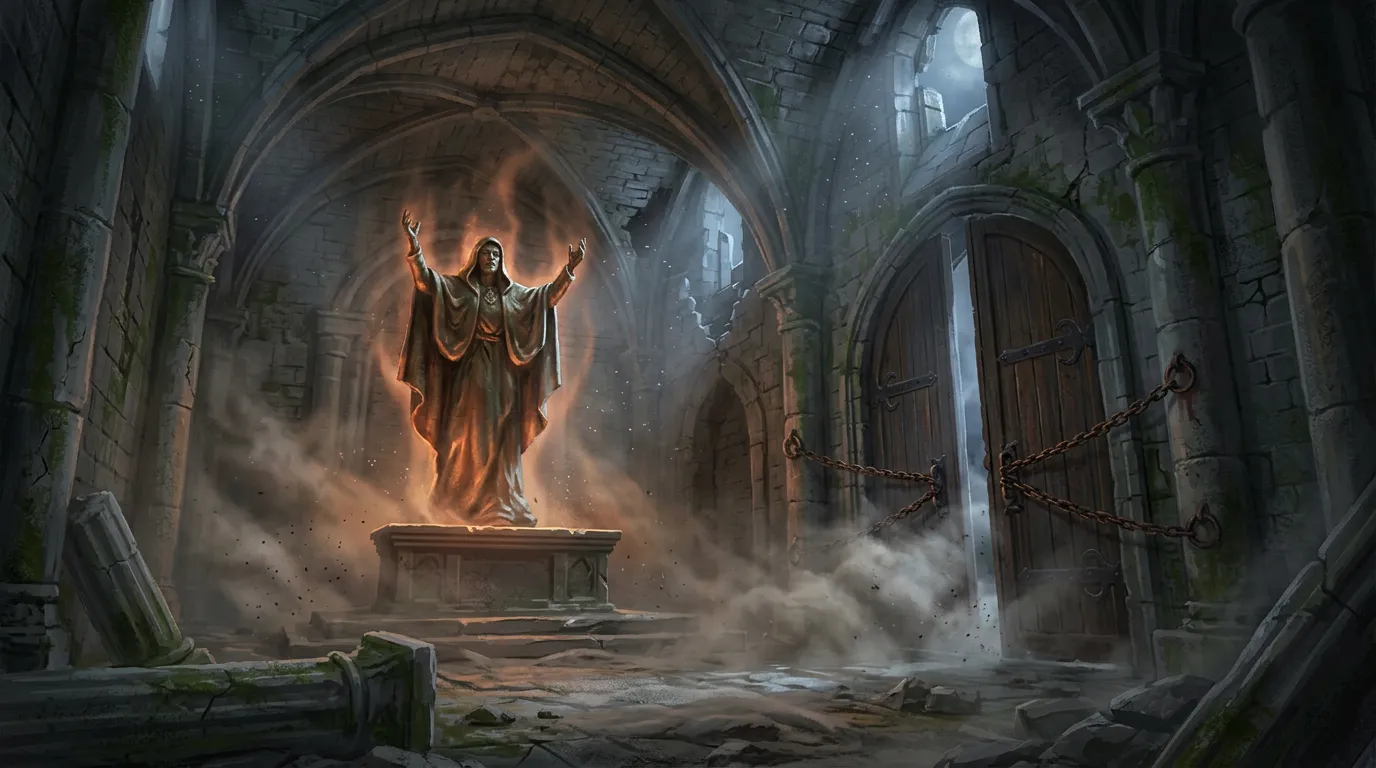
If you have read my guide on fast one-shot prep with CharGen's Dungeon Generator, the logic is similar. Lock the scene idea first, then generate only what improves actual play.
How I keep hazards from slowing the session down
Hazards go bad when I get indulgent.
So I keep a short checklist beside the output:
- can the players spot at least one clue before full activation?
- can more than one character contribute once it starts?
- does the room change meaningfully if the hazard survives three rounds?
- is there a reason this hazard exists here, beyond “dungeon room needs trap”?
If I cannot answer yes to at least three of those, I trim the design.
Another useful filter is timing. I ask whether the hazard wants 30 seconds of table attention, 3 minutes, or 15. A simple corridor pit should not demand the same emotional bandwidth as a final vault ward.
One more thing, I do not make every hazard lethal. Some of my favourite ones are humiliating, loud, separating, or messy rather than murderous.
Examples that worked better than pure damage:
- a noble archive ward that stamps intruders with glowing legal sigils visible for hours
- a fungus-bloom vent that fills armour seams with itchy spores and wrecks stealth
- a bridge shrine that swings censers to break line formation rather than to drop huge damage
Players remember those because they change behaviour.
A 35-minute prep loop for PF2e hazards
If you want a repeatable routine, use this.
| Block | Time | What I do |
|---|---|---|
| Room brief | 6 minutes | Decide the room job, mood, and what the hazard protects or expresses |
| Generator pass | 8 minutes | Fill the CharGen hazard form with level, type, complexity, environment, theme, and disable lane |
| Counterplay tune | 9 minutes | Add two clue details and at least two extra interaction routes |
| Encounter link | 7 minutes | Pair with monster, loot, or room layout only if the scene needs it |
| GM trim | 5 minutes | Delete excess text, sharpen the trigger, and cap the number of moving parts |
I would much rather run one sharp hazard and one decent monster than one over-written mega-trap with three subsystems.
If you want another reference for linked encounters, my earlier post on building balanced fights with CharGen's Monster Generator is still useful, even though that guide is monster-first rather than hazard-first.
Common mistakes I keep fixing
Mistake: every hazard is a solo puzzle
Fix: pair major hazards with enemies, changing terrain, or a time objective. Complex hazards shine when they pressure a wider scene.
Mistake: the trigger is hidden, but the room has no mood
Fix: add one sensory clue and one physical clue. Players should feel the room is wrong before the trap resolves.
Mistake: only Thievery matters
Fix: write at least one rough alternative. Athletics, Religion, Arcana, crafting logic, brute force, or positioning tricks can all help depending on the room.
Mistake: every room is built to kill
Fix: use conditions, movement pressure, resource denial, noise, separation, or delayed consequences. Damage is only one tool.
Mistake: the output is too long to run smoothly
Fix: trim the generated text to what you will actually say or roll. Good generated prep still needs an editor.
That last point is worth saying plainly. I like generated tools most when they save me blank-page time, not when they try to become my GM voice.
FAQ: pathfinder hazard generator
Is this only useful for Pathfinder 2E?
No. The CharGen form is PF2e-first, which is helpful because the hazard structure is clear, but you can still tilt the output towards other fantasy systems by changing Game System and the details field.
What is the best use for a complex hazard in PF2e?
In my experience, it is best used as room pressure inside a wider encounter. A complex hazard can carry a whole scene, but it usually feels stronger when it is reinforcing enemies, a ritual, or a collapsing objective.
What should I put in Additional Details?
Use it for clues, alternative counterplay, room context, faction flavour, and any twist that changes the scene. It is the best field on the page if you already know what makes your encounter interesting.
How many hazards should a normal dungeon floor have?
Fewer than you think. I would rather run one memorable hazard every few rooms than pad a floor with repetitive trap checks.
My recommendation after testing the new feature
If you are the kind of GM who likes hazards in theory but keeps shelving them because prep turns fiddly, try the Hazard Generator. Keep the first pass short. Start with one room that deserves a hazard, not five rooms that merely tolerate one.
That is the practical win here. The tool gives me a fast route from room idea to usable hazard structure, then lets me branch into Dungeon Generator, Monster Generator, or Loot Generator without losing the scene in the process.
If you want the simplest possible test, build one Level 4 or 5 room hazard tonight. Give it two clues, three interaction lanes, and one clear reason to exist. If the room feels more alive after that, the workflow is doing its job. If you want to try it live, start at CharGen signup and open the generator from there.
Generate Pathfinder Hazards Free
Image credits:
- Images generated for this post with Google Nano Banana 2 via WaveSpeed for the CharGen blog workflow