Skip to content
CreatePricing
The Aegis Provost Marshal Cadre - AI-generated fantasy Faction

The Aegis Provost Marshal Cadre

The Cadre began in 812 AE after a forgotten quartermaster called Urrak the Ledger-Keeper exposed competing tax measures among the eastern watchtowers. Its first charter empowered small teams of civil officers to inspect military stores and settle disputes between fortresses and settlements. For centuries, the office remained modest, respected for impartiality and mocked for its obsession with seals. Its watershed moment came during the Ash-Tithe Rebellions. In 1157 TF, several frontier commanders demanded emergency grain, ore, labor, and Star-Sand from villages already suffering crop failure. The Cadre's then First Provost, Sarvok of the Sixth Furnace, ruled that the requisitions were unlawful. When the commanders ignored him, Sarvok ordered the seizure of three fortress ledgers and read their contents aloud before the villages. The Scaled Aegis branded the act sedition, but the revelation of falsified shortages forced the crown to recognize the Cadre's authority over military taxation. The victory transformed the institution. It gained courts, inspectors, surveillance offices, and the right to issue binding judgments during declared emergencies. By 1194 TF, the Cadre had become the civil enforcement arm of the Scaled Aegis. Its reputation reached its height during the Nine-Beacon Winter, when provosts kept evacuation routes open while military units fought the Draknaar advance. Its decline began with the 1181 TF Census of Ash, when records concerning deportations, confiscations, and missing prisoners were destroyed in an officially accidental archive fire. The Cadre emerged more powerful but less trusted. Today it stands between military necessity, commercial pressure, and growing demands for legal reform.

The Aegis Provost Marshal Cadre

Military police and civil judicial directorate · Lawful Neutral

The Aegis Provost Marshal Cadre

Measure the claim. Mark the truth. Hold the line.

TypeMilitary police and civil judi…
SizeMedium, approximately 460 acti…
InfluenceHigh within the Ironscale Marc…
WealthProsperous in official resourc…
AlignmentLawful Neutral
AgeFounded in 812 AE, though its…

Chronology

The Cadre began in 812 AE after a forgotten quartermaster called Urrak the Ledger-Keeper exposed competing tax measures among the eastern watchtowers. Its first charter empowered small teams of civil officers to inspect military stores and settle disputes between fortresses and settlements. For centuries, the office remained modest, respected for impartiality and mocked for its obsession with seals. Its watershed moment came during the Ash-Tithe Rebellions. In 1157 TF, several frontier commanders demanded emergency grain, ore, labor, and Star-Sand from villages already suffering crop failure. The Cadre's then First Provost, Sarvok of the Sixth Furnace, ruled that the requisitions were unlawful. When the commanders ignored him, Sarvok ordered the seizure of three fortress ledgers and read their contents aloud before the villages. The Scaled Aegis branded the act sedition, but the revelation of falsified shortages forced the crown to recognize the Cadre's authority over military taxation. The victory transformed the institution. It gained courts, inspectors, surveillance offices, and the right to issue binding judgments during declared emergencies. By 1194 TF, the Cadre had become the civil enforcement arm of the Scaled Aegis. Its reputation reached its height during the Nine-Beacon Winter, when provosts kept evacuation routes open while military units fought the Draknaar advance. Its decline began with the 1181 TF Census of Ash, when records concerning deportations, confiscations, and missing prisoners were destroyed in an officially accidental archive fire. The Cadre emerged more powerful but less trusted. Today it stands between military necessity, commercial pressure, and growing demands for legal reform.

Founder’s Story

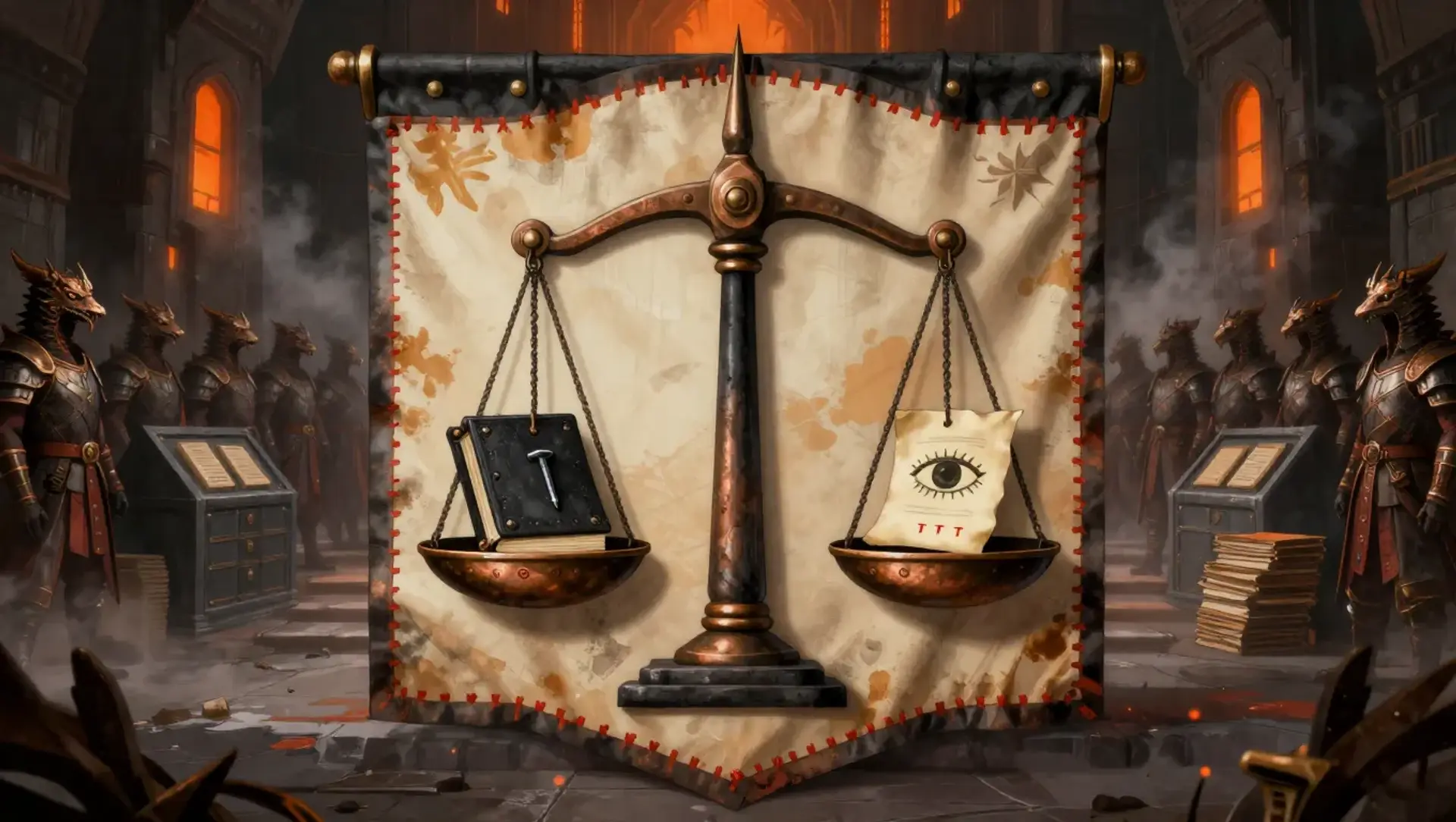
The Cadre claims to descend from Urrak the Ledger-Keeper, an otherwise forgotten quartermaster who served before the eastern fortresses were joined under one command. According to its sealed founding register, Urrak discovered that soldiers, merchants, and village elders all kept different measures for the same tax, allowing commanders to manufacture shortages and punish whoever they wished. Urrak carried one iron nail from each disputed watchtower to a central court and demanded a single frontier standard. The first provosts were appointed to enforce that standard, not to command troops. Outsiders later assumed the title meant a military prosecutor. In truth, the original provost was a keeper of limits, tasked with ensuring that no fortress, officer, or merchant house could invent law for itself.

The Mechanism of Intent

Public Goals
  • Protect Aethelgard's eastern settlements from infiltration and sabotage
  • Ensure taxes and tariffs are assessed according to law
  • Prevent military officers and merchants from exploiting civilians
  • Keep roads, customs gates, and fortress supply lines secure
  • Preserve accurate legal records
  • Provide swift judgment during wartime emergencies
  • Secret Goals
  • Recover the missing Census of Ash and determine who ordered its destruction.
  • Force the Scaled Aegis to accept civil oversight of military taxation.
  • Secure exclusive jurisdiction over all leyline-related crimes in the Ironscale Marches.
  • Use evidence of Cartel fraud to break the Cartels' control over frontier customs.
  • Identify whether the blank-page judgments come from a buried leyline intelligence or from a living conspirator.
  • Prepare a succession plan in case Qorjin is removed before the 1400 TF renewal.
  • Current Objectives
  • Restore the Cadre's authority over every customs gate and military road in the Ironscale Marches.
  • Determine who is manipulating corrupted leyline activity beneath the Scaled Aegis.
  • Prevent the theft or diversion of Star-Sand collected as frontier defense tax.
  • Identify genuine Draknaar agents without triggering another wave of collective arrests.
  • Secure a permanent legal mandate before the 1400 TF Dawn Compact Renewal.
  • Silence or recruit officers who have discovered the Cadre's oldest records were altered.
  • Long-Term Vision

    To create a permanent, codified frontier judiciary that can restrain military commanders, regulate trade fairly, and preserve Aethelgard's security without relying on collective punishment. The Cadre's more authoritarian members envision something different, a state within the state that controls movement, taxation, intelligence, and emergency law across every border province.

    StructureCentralized directorate with regional courts, mobile enforcement columns, customs offices, and an internal records hierarchy
    SuccessionWhen the First Provost dies or is removed, the four Ash Circuit Marshals submit sealed nominations. The Bench Spire reviews the candidates' legal records, the Scaled Aegis reviews their military reliability, and senior Witness-Keepers verify whether any nomination contains altered evidence. The final appointment requires a majority of the Imperial-aligned sovereign authorities recognized by Aethelgard, though in practice the Scaled Aegis can force an interim appointment during a crisis. If the process fails, the most senior Writ Captain assumes command for thirteen days, a period known as the Empty Seal.

    Leadership

    Qorjin First Provost of the Nail

    Controlled, penetrating, and unexpectedly protective of ordinary witnesses. Qorjin speaks plainly, dislikes theatrical cruelty, and believes a law that cannot restrain its own enforcers is merely another weapon.

    Qorjin First Provost of the Nail

    Quiet, severe, and difficult to intimidate. Qorjin listens through long silences, remembers every contradiction, and treats compassion as a form of discipline rather than softness.

    Mavrek Draal Ash Circuit Marshal of the Great Basalt Basins

    Polished, charming, and relentlessly practical. He can make extortion sound like bookkeeping and believes institutions survive only when they control their own money.

    Orua Senkhal Writ Captain of the eastern furnace towns

    Patient and observant, with a talent for making frightened witnesses speak. Orua dislikes grand speeches and prefers small acts that create precedents.

    Tzarkh Vuld Writ Captain of the frontier watchtowers

    Blunt, energetic, and physically imposing. He considers hesitation a luxury paid for by civilians and regards legal nuance as a weapon used by clever traitors.

    Ilyomara Senior Witness-Keeper

    Warm in private and almost unnervingly formal in court. She collects damaged documents, memorizes erased passages, and refuses to accept that a missing record is the same as an innocent absence.

    Beshkar from Cinder-Reach Junior Seal Inspector

    Nervous, clever, and eager to prove himself. Beshkar falsified one customs report to save his siblings from debt seizure and now fears every honest investigation.

    Visual sheet

    Turn The Aegis Provost Marshal Cadre into a sheet

    A high-res, share-ready sheet you can post or print.

    Gallery

    No images yet. Click to add.

    Relationships