Skip to content
CreatePricing
Ironscale Ordnance Directorate - AI-generated fantasy Faction

Ironscale Ordnance Directorate

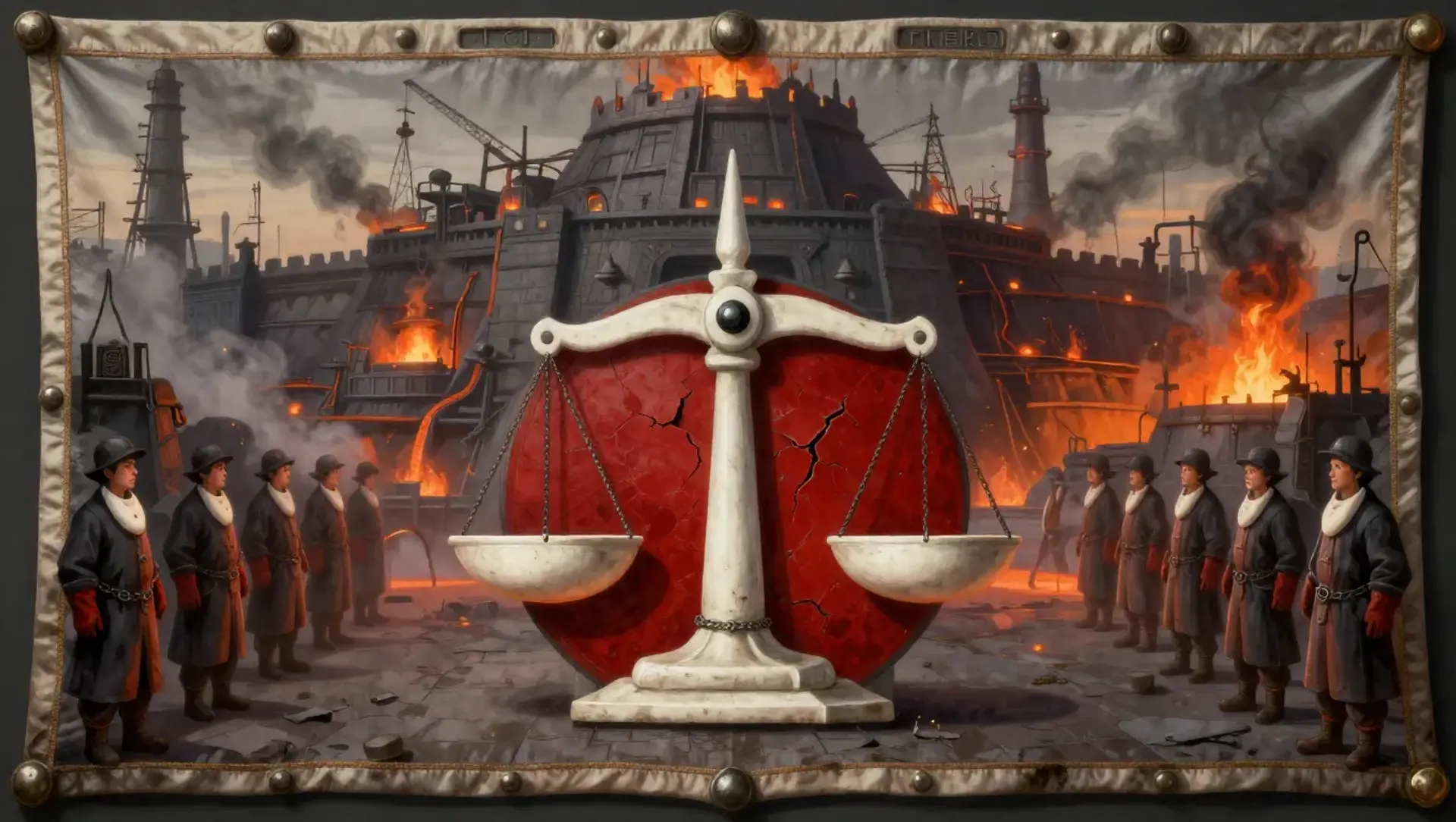
The Directorate's early decades were defined by standardization. It introduced common mold dimensions, numbered alloy grades, and inspection marks that allowed commanders to request replacement parts without examining every item individually. Its greatest triumph came during the Third March Muster, when a coordinated delivery of compatible armor and siege fittings allowed Aethelgard forces to hold a broken basalt pass for eleven days. Its watershed moment was the Furnacefall of 1032 TF. A pressure fault ruptured the central casting hall at Slag-Grit Basin, flooding three terraces with molten slag and killing more than a hundred workers. The Directorate claimed the event resulted from deliberate tampering by foreign agents. Survivors insisted that senior auditors had ignored warnings to meet a royal quota. The dispute led to the present system of sealed records, rotating inspectors, and harsh penalties for unauthorized furnace changes. During the consolidation of military contracts in the last century, the Directorate became inseparable from the Five-Fold Hierarchy. It gained authority over private foundries, then over fuel allocation, then over the definition of acceptable military workmanship. Its standards saved lives on the frontier, yet its bureaucracy also strangled independent craft traditions and made entire settlements dependent on official approval. Today, the Directorate stands between Aethelgard's armies and collapse, while quietly fearing that its own buried foundations are failing.

Ironscale Ordnance Directorate

State Industrial Bureau and Military Manufacturing Guild · Lawful Neutral

Ironscale Ordnance Directorate

A measured edge holds the line.

TypeState Industrial Bureau and Mi…
SizeMedium, approximately 370 dire…
InfluenceHigh within the Ironscale Marc…
WealthVery High, with substantial co…
AlignmentLawful Neutral
AgeFounded in 700 AE, with its mo…

Chronology

The Directorate's early decades were defined by standardization. It introduced common mold dimensions, numbered alloy grades, and inspection marks that allowed commanders to request replacement parts without examining every item individually. Its greatest triumph came during the Third March Muster, when a coordinated delivery of compatible armor and siege fittings allowed Aethelgard forces to hold a broken basalt pass for eleven days. Its watershed moment was the Furnacefall of 1032 TF. A pressure fault ruptured the central casting hall at Slag-Grit Basin, flooding three terraces with molten slag and killing more than a hundred workers. The Directorate claimed the event resulted from deliberate tampering by foreign agents. Survivors insisted that senior auditors had ignored warnings to meet a royal quota. The dispute led to the present system of sealed records, rotating inspectors, and harsh penalties for unauthorized furnace changes. During the consolidation of military contracts in the last century, the Directorate became inseparable from the Five-Fold Hierarchy. It gained authority over private foundries, then over fuel allocation, then over the definition of acceptable military workmanship. Its standards saved lives on the frontier, yet its bureaucracy also strangled independent craft traditions and made entire settlements dependent on official approval. Today, the Directorate stands between Aethelgard's armies and collapse, while quietly fearing that its own buried foundations are failing.

Founder’s Story

The Directorate began after a frontier disaster in 700 AE, when three rival foundries supplied armor of incompatible thickness to the Ironscale Marches. A Draknaar assault exploited the weakness. Survivors carried mismatched shields, warped spearheads, and breastplates that split at the rivets. In response, the first military inspectors were appointed to record ore quality, furnace temperature, alloy composition, and finished weight. Their charter was written on a single iron plate because no parchment was trusted near the calderas.

The Mechanism of Intent

Public Goals
  • Protect Aethelgard's soldiers through reliable equipment
  • Prevent waste and corruption in military production
  • Keep the Ironscale Marches supplied against Draknaar aggression
  • Ensure that every weapon and armor piece meets legion specifications
  • Preserve the realm's industrial independence
  • Secret Goals
  • Determine whether the corrupted alloy pattern is spreading from the subterranean heat channels beneath Slag-Grit Basin.
  • Keep the connection between the Furnacefall and the Vault of the First Ember hidden until a defensible containment plan exists.
  • Control the distribution of all military-grade Star-Sand before rival factions can weaponize the approaching crisis.
  • Identify a successor capable of preserving the Directorate without repeating its founding cover-up.
  • Force the Five-Fold Hierarchy to recognize technical mastery as a legitimate basis for authority, even if the Directorate must create a crisis to achieve it.
  • Current Objectives
  • Meet the next military metallurgy quota before the Draknaar border season intensifies
  • Investigate repeated purity failures at Slag-Grit Basin without revealing the deeper cause
  • Secure all fuel channels feeding the Marches' frontier furnaces
  • Identify whoever is altering casting records and redirecting Star-Sand
  • Prepare a contingency arsenal for possible unrest connected to the Scale-Breakers
  • Long-Term Vision

    Aethelgard supplied by one interoperable military-industrial system, with safe and uniform equipment reaching every garrison before the 1400 TF political crisis. Balorix's private version of this vision is a centralized war authority capable of overriding local rulers during emergencies.

    StructureCentralized state bureau with guild privileges and military enforcement
    SuccessionThe sitting general names three candidates from among the Crown Casters and Casting Auditors. Each candidate must complete a public audit, survive a closed examination by military and temple representatives, and present a production plan for the next campaign season. The Five-Fold Hierarchy confirms the appointment, but the Directorate's inspectors can reject a candidate by producing documented evidence of falsification, unsafe practice, or divided loyalty.

    Leadership

    Balorix Scale-Shield General of the Ironscale Ordnance Directorate

    Disciplined, paternal, and intimidating without raising his voice. Balorix values competence above rank, but has convinced himself that only authoritarian control can protect ordinary workers and soldiers.

    General Balorix Scale-Shield Supreme Director

    Controlled, severe, and unfailingly courteous. He treats every conversation as a logistics problem and remembers the name of every officer who died because of defective equipment.

    Ketz Vorga Chief Casting Auditor

    Blunt, tireless, and suspicious of ceremony. Ketz can identify a bad alloy by sound alone and openly challenges any order that risks workers.

    Gorzh of the Lower Terraces Senior Furnace Clerk

    Patient, dry-witted, and socially invisible by choice. Gorzh collects favors through repair work and knows which records have been quietly rewritten.

    Tarkel Rusk Border Supply Marshal

    Angular, charismatic, and impatient. Tarkel believes the hierarchy must be broken, but fears what foreign enemies would do if Aethelgard weakened during reform.

    Brenk Keeper of Sealed Records

    Quiet, watchful, and technically brilliant. Brenk speaks rarely because he records everything, including conversations that could condemn the Directorate.

    Visual sheet

    Turn Ironscale Ordnance Directorate into a sheet

    A high-res, share-ready sheet you can post or print.

    Gallery

    No images yet. Click to add.

    Relationships