Skip to content
CreatePricing
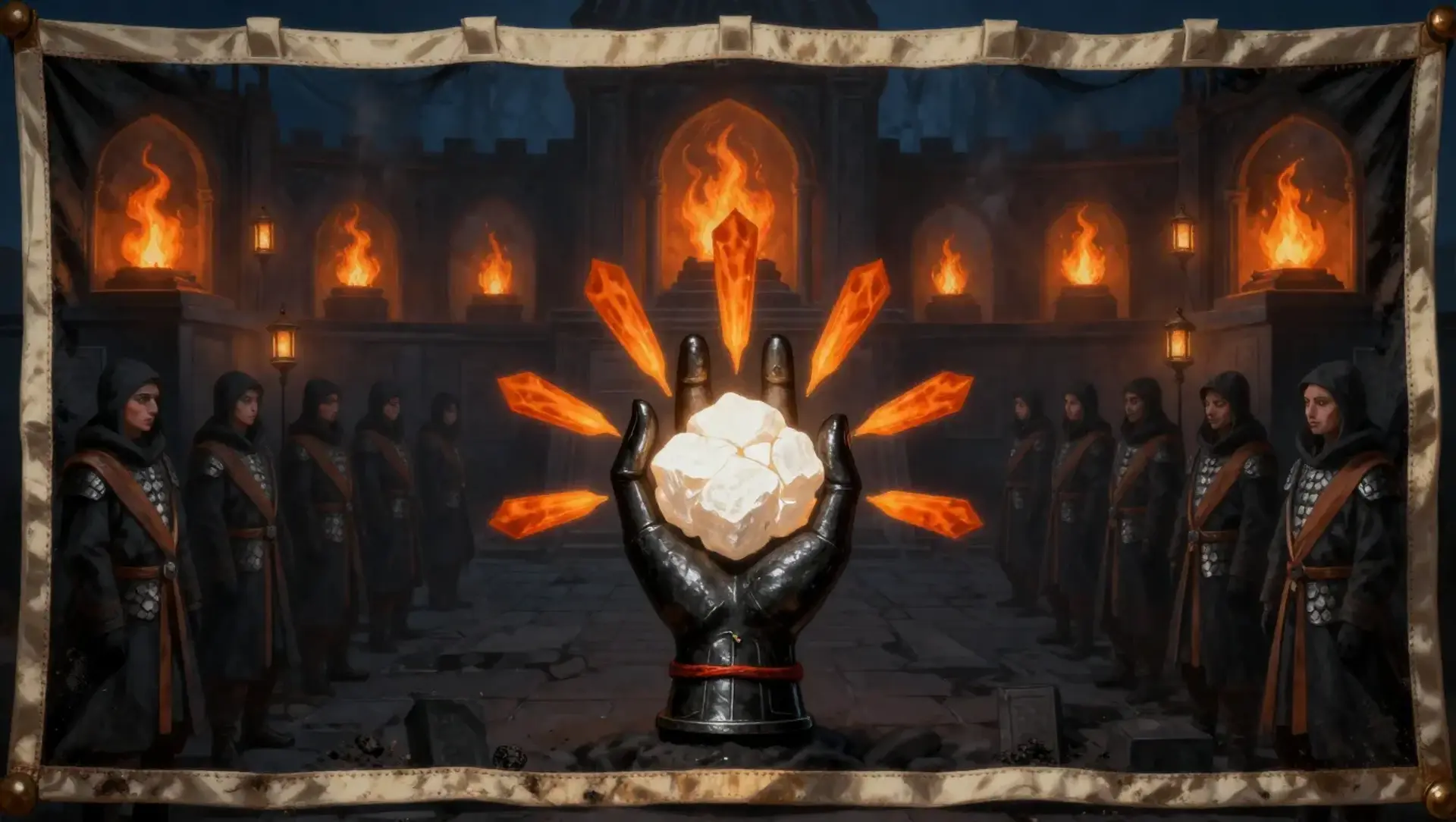
The Ember Votaries - AI-generated fantasy Faction

The Ember Votaries

For its first two centuries, the Ember Votaries were respected as a necessary border custom. They kept lamps burning over mass graves, carried wounded soldiers from isolated watchtowers, and recorded the names of common infantry who would otherwise vanish from official histories. Their power expanded after the Marches suffered three harsh winters and a string of unexplained signal fires. The Votaries opened communal kitchens and became indispensable to garrison life. Their sermons grew sharper as Draknaar increased patrols across the strait. In 731 TF, the Seven-Night Alarm transformed the order. A false invasion warning became a real cross-border assault after Votary-led troops attacked a ceasefire party, and the resulting bloodshed made reconciliation politically poisonous. The order’s reputation reached its height during the Furnace Siege of 884 TF, when Votary chaplains organized ration lines, carried messages through bombardment, and held a breached shrine until relief arrived. Their triumph made them heroes of the Marches and gave them access to military planning. Their greatest setback came in 1038 TF, when investigators proved that several senior preachers had forged border omens to maintain donations and recruitment during a quiet decade. The crown stripped the order of direct command over two garrisons, but permitted it to retain the memorial vaults. That compromise preserved the Votaries while teaching them to hide their political work behind charity. In the current era, the approach of the 1400 TF Dawn Compact Renewal has made them bolder. They present themselves as guardians of readiness, yet their inner councils increasingly speak of purification, inevitability, and the need to make peace impossible before peace makes them irrelevant.

The Ember Votaries

Militant religious order and apocalyptic faith · Lawful Neutral

The Ember Votaries

A Named Dead Is Never Burned Away.

TypeMilitant religious order and a…
SizeMedium, approximately 550 full…
InfluenceStrong in the Ironscale Marche…
WealthModerate and widely distribute…
AlignmentLawful Neutral
AgeFounded 612 TF, after the Ash-…

Chronology

For its first two centuries, the Ember Votaries were respected as a necessary border custom. They kept lamps burning over mass graves, carried wounded soldiers from isolated watchtowers, and recorded the names of common infantry who would otherwise vanish from official histories. Their power expanded after the Marches suffered three harsh winters and a string of unexplained signal fires. The Votaries opened communal kitchens and became indispensable to garrison life. Their sermons grew sharper as Draknaar increased patrols across the strait. In 731 TF, the Seven-Night Alarm transformed the order. A false invasion warning became a real cross-border assault after Votary-led troops attacked a ceasefire party, and the resulting bloodshed made reconciliation politically poisonous. The order’s reputation reached its height during the Furnace Siege of 884 TF, when Votary chaplains organized ration lines, carried messages through bombardment, and held a breached shrine until relief arrived. Their triumph made them heroes of the Marches and gave them access to military planning. Their greatest setback came in 1038 TF, when investigators proved that several senior preachers had forged border omens to maintain donations and recruitment during a quiet decade. The crown stripped the order of direct command over two garrisons, but permitted it to retain the memorial vaults. That compromise preserved the Votaries while teaching them to hide their political work behind charity. In the current era, the approach of the 1400 TF Dawn Compact Renewal has made them bolder. They present themselves as guardians of readiness, yet their inner councils increasingly speak of purification, inevitability, and the need to make peace impossible before peace makes them irrelevant.

Founder’s Story

The Ember Votaries began after the Ash-Toll Massacre, when a Draknaar raiding force crossed the strait during a winter ashfall and destroyed a convoy carrying soldiers’ families, shrine oil, and memorial tablets. A furnace keeper named Heshan gathered the survivors beneath a collapsed toll arch. They had no temple, no banner, and only one lamp that still burned. Heshan divided the lamp’s wick among the survivors, declaring that each person would carry a portion of the same fire until the dead received justice. The first Votaries were not priests. They were mourners, camp cooks, armorers, and wounded soldiers who believed the official response had been too slow and too cautious. Their first vows were practical: never let a border death go unnamed, never allow a garrison to lack fire, and never mistake an enemy’s silence for peace. Over the next century, those vows hardened into doctrine. The watershed moment came in 731 TF, during the Seven-Night Alarm, when a false report of a Draknaar landing sent three March garrisons into panic. Votary preachers kept the troops from fleeing, but their leaders also ordered a retaliatory attack that killed negotiators carrying a ceasefire message. The crown condemned the action, while frightened soldiers hailed it as proof that hesitation invited slaughter. Since then, the order has treated every crisis as confirmation of its prophecy. It evolved from a decentralized network of memorial keepers into a disciplined religious militia, funded by veterans, shrine offerings, emergency levies, and quiet support from officers who value its influence over recruits.

The Mechanism of Intent

Public Goals
  • Ensure that every fallen border guard is named, buried, and remembered
  • Protect the Ironscale Marches from Draknaar aggression
  • Keep garrisons supplied, disciplined, and spiritually prepared
  • Preserve sacred fire rites and the memorial traditions of Aethelgard
  • Demand accountability from officers who waste soldiers’ lives
  • Prevent foreign powers from exploiting Aethelgard’s grief or weakness
  • Secret Goals
  • Trigger a controlled border crisis that will unite the Marches under emergency religious authority
  • Recover and reunite the seven founding coals with the damaged binding lattice
  • Replace the current diplomatic policy with a permanent holy mobilization charter
  • Ensure the order survives even if Aethelgard’s caste system collapses
  • Identify whether the blue shrine flames are the voice of the Unbound Ember and, if so, decide whether to obey it
  • Destroy evidence that the first sacred coal came from the prison beneath the capital
  • Current Objectives
  • Place a Votary shrine keeper in every major legion barracks and every fortified crossing of the strait
  • Secure legal authority over all martyr memorial vaults in the Ironscale Marches
  • Force the Five Great Wyrm-Temples to recognize the Coming Kindling as an official prophetic doctrine
  • Expose or manufacture evidence of a coordinated Draknaar invasion before the next Dawn Compact debate
  • Recover the Bellows Reliquary, an old war relic taken during the Ash-Toll Massacre
  • Prevent the Scale-Breakers from gaining influence among young soldiers and shrine dependents
  • Long-Term Vision

    Aethelgard should become a permanently mobilized sacred state, united by a single doctrine of vigilance and shielded from foreign influence. In the vision of the most extreme Votaries, every settlement would maintain a state shrine, every citizen would serve a term of border duty, and the ancient fire beneath the capital would be bound to the nation through a living chain of oath-takers.

    StructureDecentralized shrine network governed by a militant ecclesiastical council, with attached memorial houses, recruit cloisters, armed veteran companies, and family support circles.
    SuccessionThe First Candle is chosen by the Ash Council after the previous holder dies, resigns, or is formally deposed. Candidates must have served as a War-Chaplain or Coal Marshal and must complete the Vigil of Seven Shadows in the central chapel. The Five Great Wyrm-Temples may issue a doctrinal objection, but cannot select the successor. In practice, succession depends on control of the memorial archives, the armed Ember Guard, and the loyalty of the March families. The current First Candle has quietly encouraged three possible successors, each representing the Shield School, the Red Sermon, or the Quiet Hearth.

    Leadership

    Shava The First Candle

    Calm, compassionate, and severe when crossed. She can sit with a grieving child for an hour without speaking, then deliver a speech that sends an entire barracks to its feet. Her greatest weakness is that she confuses control with protection.

    Sesha Vard Coal Marshal of the eastern shrine road

    Measured, observant, and difficult to provoke. She remembers every casualty under her care and speaks softly enough that recruits lean closer to hear her.

    Thomel Brasa War-Chaplain and chief public preacher

    Charismatic, warm in private, and frighteningly patient. He comforts grieving families with genuine tenderness, then uses their pain to build political pressure.

    Rumi Hearth Keeper and keeper of the largest martyr archive

    Blunt, practical, and quietly funny. She distrusts grand speeches, hoards dried fruit for recruits, and can identify a soldier’s unit by the stitching on a sleeve.

    Oren of Furnace Row Master of recruit discipline

    Earnest, clever, and ashamed of how much he wants authority. He is a gifted organizer who has begun copying restricted sermons into a private notebook.

    Sheshan Kori Ash Council member overseeing doctrine

    Austere, scholarly, and physically fearless. She treats doctrine as a structure that must bear weight, not as a weapon to be waved in anger.

    Gevan Junior shrine artisan and potential whistleblower

    Nervous in crowds but stubborn under pressure. He is an excellent lamp maker, an unreliable liar, and a dangerous witness because he knows where the old records are buried.

    Visual sheet

    Turn The Ember Votaries into a sheet

    A high-res, share-ready sheet you can post or print.

    Gallery

    No images yet. Click to add.

    Relationships