Skip to content
CreatePricing
House of the High Wall - AI-generated fantasy Faction

House of the High Wall

The House first gained influence after the Flood Years of 1495 to 1499, when its seven founding families rebuilt Kuduswe's roads and monumental enclosures while the royal court argued over ritual precedence. Their public reputation became one of competence, austerity, and civic sacrifice. In 1532, the House funded the first continuous jungle road to the western salt flats, gaining control of customs and military movement. In 1571, a fire destroyed the royal archive. The House claimed the blaze was caused by alchemical negligence, but its own agents had removed genealogical records that threatened several noble claims to land. In 1628, King Halveth attempted to dissolve the House's road monopolies. He was forced to retreat after provincial governors refused to obey his orders. The House began planning a permanent seizure of power. The watershed moment came in 1659 during the Night of Seven Seals. Every palace gate was locked, loyal guards were replaced by House retainers, and seven sealed decrees appeared in the city before dawn. The king and most of his family were declared too ill to rule. The House placed a young royal cousin on the throne as a ceremonial sovereign and quietly assumed control of the kingdom. For eleven years, the conspiracy has survived through ritual, intimidation, forged documents, and the visible usefulness of its public works.

House of the High Wall

Aristocratic ruling conspiracy · Lawful Evil

House of the High Wall

A wall remembers what a crown forgets.

TypeAristocratic ruling conspiracy
SizeApproximately 1,066 formal mem…
InfluenceNational
WealthExtremely wealthy in land, inf…
AlignmentLawful Evil
AgeThe House is 164 years old. It…

Chronology

The House first gained influence after the Flood Years of 1495 to 1499, when its seven founding families rebuilt Kuduswe's roads and monumental enclosures while the royal court argued over ritual precedence. Their public reputation became one of competence, austerity, and civic sacrifice. In 1532, the House funded the first continuous jungle road to the western salt flats, gaining control of customs and military movement. In 1571, a fire destroyed the royal archive. The House claimed the blaze was caused by alchemical negligence, but its own agents had removed genealogical records that threatened several noble claims to land. In 1628, King Halveth attempted to dissolve the House's road monopolies. He was forced to retreat after provincial governors refused to obey his orders. The House began planning a permanent seizure of power. The watershed moment came in 1659 during the Night of Seven Seals. Every palace gate was locked, loyal guards were replaced by House retainers, and seven sealed decrees appeared in the city before dawn. The king and most of his family were declared too ill to rule. The House placed a young royal cousin on the throne as a ceremonial sovereign and quietly assumed control of the kingdom. For eleven years, the conspiracy has survived through ritual, intimidation, forged documents, and the visible usefulness of its public works.

Founder’s Story

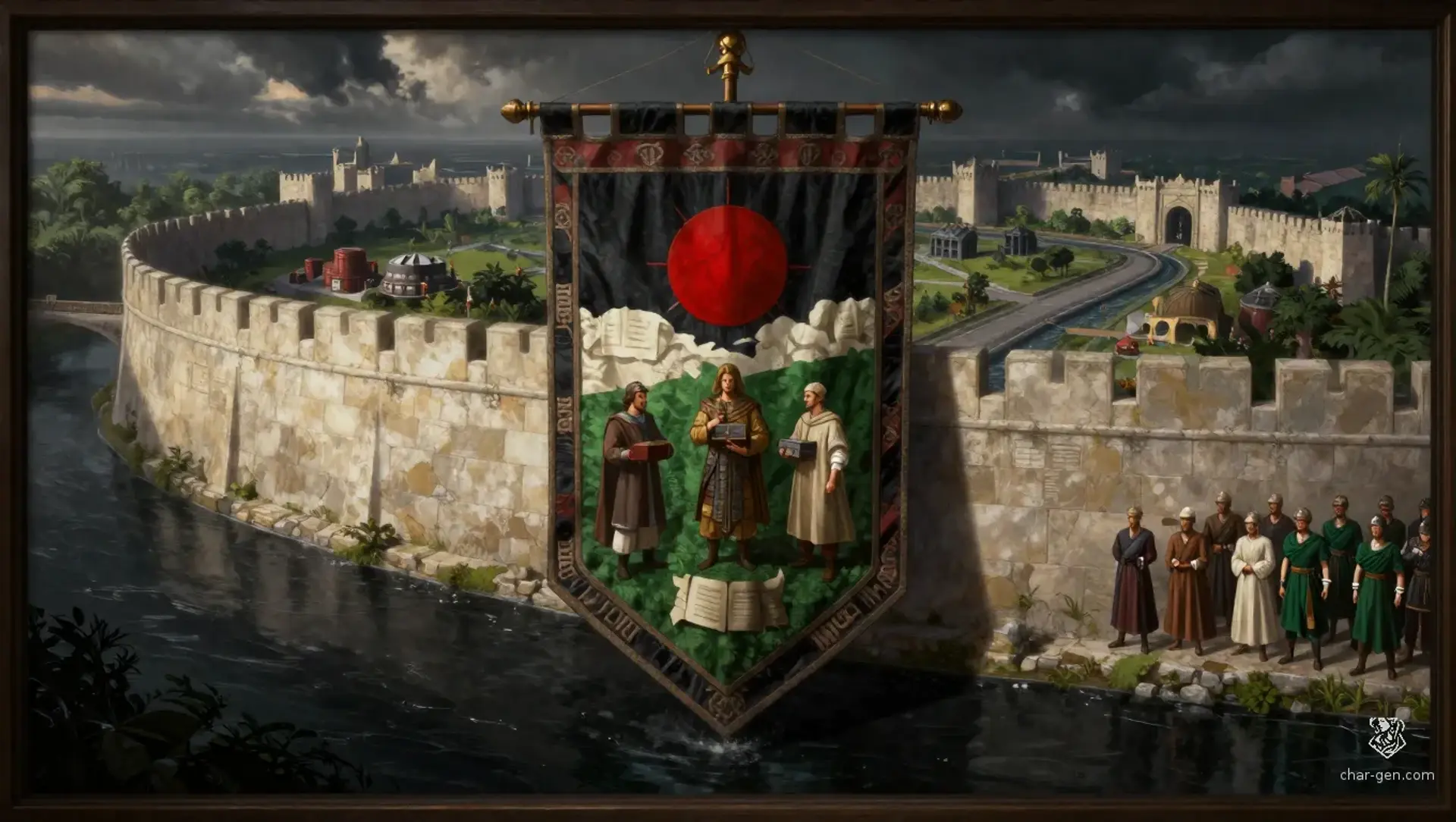
The House began as a practical coalition of seven noble families responsible for maintaining Kuduswe's palace terraces, jungle roads, flood channels, and ceremonial walls. In 1495, a season of monsoon floods destroyed three districts and exposed how badly the royal court had neglected the city's foundations. The seven families pooled labor, stone, engineers, and armed retainers. Their success restored trade and made them indispensable. The name House of the High Wall comes from a mistranslated inscription on an ancient enclosure. The original phrase meant something closer to 'wall that holds back the returning water,' but later nobles interpreted it as a title of rank.

The Mechanism of Intent

Public Goals
  • Keep the roads safe and open to commerce.
  • Protect Kuduswe from floods, jungle predators, banditry, and foreign invasion.
  • Preserve the dignity of the crown during a period of royal illness.
  • Expand monumental construction as a symbol of national unity.
  • Standardize law, taxation, and road maintenance across the kingdom.
  • Secret Goals
  • Erase every independent record of the Night of Seven Seals.
  • Bind the ancient foundations to the House through bloodline, oath, and construction.
  • Control the education of noble children so that the coup becomes accepted history.
  • Force the river families into a single charter subordinate to the House.
  • Arrange a crisis that makes the ceremonial monarchy appear incapable of ruling.
  • Current Objectives
  • Keep the deposed royal family alive and publicly visible enough to preserve the illusion of lawful succession.
  • Complete the High Wall Circuit, a chain of monumental enclosures intended to divide the capital into defensible districts.
  • Find and destroy the original succession charter that proves the throne was seized illegally.
  • Identify the cause of nocturnal movement within the oldest palace foundations.
  • Break the independence of the river pilots before they become a national political force.
  • Replace provincial governors with House-blooded administrators over the next five years.
  • Long-Term Vision

    A perfectly administered kingdom in which every road, gate, granary, temple enclosure, and palace archive is controlled by a hereditary civic aristocracy. The House imagines a nation free from succession wars, banditry, and famine, but its vision requires permanent surveillance, restricted movement, and the destruction of independent power.

    StructureInterlocking noble houses governed by a secretive civic council
    SuccessionThe First Mason is elected by the Seven Courses, usually through private bargaining and marriage alliances. A candidate must control at least three major civic systems and receive five of the seven seals. If the council deadlocks, the oldest surviving royal signet is used as the deciding symbol, a fact known only to the Keeper of Seals. The current succession crisis centers on whether the next First Mason should preserve the hidden monarchy or end the deception.

    Leadership

    Seth Varo First Mason of the High Wall

    Measured, paternal, and relentlessly pragmatic. Seth can be generous to individuals while supporting policies that ruin whole communities. He believes history judges results, not methods.

    Seth Varo First Mason of the palace and public regent

    Precise, patient, and almost painfully courteous. He remembers every slight and never raises his voice. He believes cruelty is acceptable only when it prevents greater disorder.

    Nima of Uruq Keeper of Seals and director of internal security

    Direct, watchful, and charismatic in small rooms. She can make threats sound like practical advice. Her private fear is that peace would leave her without purpose.

    Pell Master of Foundations

    Blunt, restless, and fascinated by mechanisms. He dislikes courtly behavior and often forgets that his discoveries can ruin lives.

    Ceryn Pellach Wall Steward of the southern granaries

    Warm, observant, and excellent at making others underestimate her. She is not certain whether reform or revolution would save more lives.

    Tavren Captain of the Palace Gate Factors

    Dry-humored, disciplined, and deeply superstitious about old stonework. He hates the House's conspiracy but fears civil war more.

    Myr Eith Senior archive examiner

    Soft-spoken, detached, and unnervingly good at appearing harmless. She records conversations in coded embroidery patterns.

    Visual sheet

    Turn House of the High Wall into a sheet

    A high-res, share-ready sheet you can post or print.

    Gallery

    No images yet. Click to add.

    Relationships