Skip to content
Create
The Sporewardens - AI-generated fantasy Faction

The Sporewardens

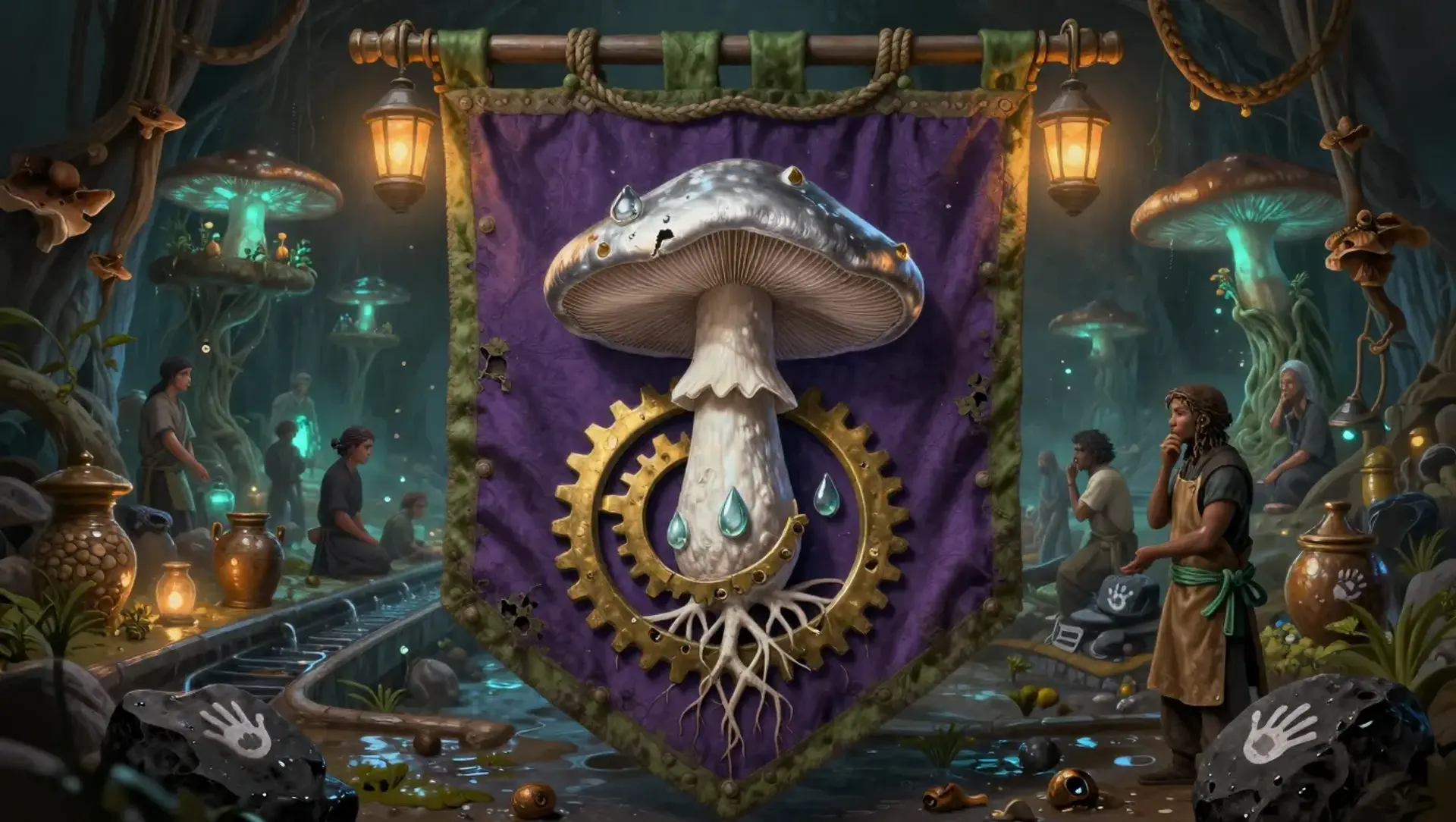
For its first century, the Sporewardens were primarily a cooperative of farmers and water keepers. They expanded through mutual-aid agreements, absorbing isolated farm clusters whenever a cartel abandoned them or an infrastructure failure cut them off from the central districts. Their second age began during the Brass Claiming, when mining companies discovered valuable deposits beneath several fertile caverns. Cartel agents used forged surveys, debt contracts, and selective repairs to pressure farmers into surrendering their land. The Sporewardens responded by documenting ancestral claims, sabotaging illegal drilling, and building concealed bypass channels. Their defining watershed moment was the Black Root Crisis. A cartel attempted to drain an entire agricultural basin, exposing a dormant fungal colony that released toxic spores into the lower districts. The Sporewardens sealed the breach, evacuated nearly four thousand residents, and destroyed the cartel's pumping array. They saved the Grand Hollow, but their sabotage also caused a flood that killed dozens of miners. Since then, the faction has been treated by many residents as necessary protectors and by the authorities as a subversive organization. In recent years, the debate over Gearforged personhood has divided them. Some Sporewardens see self-aware constructs as exploited workers and natural allies. Others fear that replacing living labor with machines would make communal farms vulnerable to the same systems of control they resist.

The Sporewardens

Agricultural cooperative and subterranean resistance network · Neutral Good with pragmatic, anti-authoritarian tendencies

The Sporewardens

What feeds the Hollow belongs to the Hollow.

TypeAgricultural cooperative and s…
SizeApproximately 3,000 active mem…
InfluenceHigh in the outer settlements…
WealthModerate in food, medicine, se…
AlignmentNeutral Good with pragmatic, a…
AgeApproximately 180 years as an…

Chronology

For its first century, the Sporewardens were primarily a cooperative of farmers and water keepers. They expanded through mutual-aid agreements, absorbing isolated farm clusters whenever a cartel abandoned them or an infrastructure failure cut them off from the central districts. Their second age began during the Brass Claiming, when mining companies discovered valuable deposits beneath several fertile caverns. Cartel agents used forged surveys, debt contracts, and selective repairs to pressure farmers into surrendering their land. The Sporewardens responded by documenting ancestral claims, sabotaging illegal drilling, and building concealed bypass channels. Their defining watershed moment was the Black Root Crisis. A cartel attempted to drain an entire agricultural basin, exposing a dormant fungal colony that released toxic spores into the lower districts. The Sporewardens sealed the breach, evacuated nearly four thousand residents, and destroyed the cartel's pumping array. They saved the Grand Hollow, but their sabotage also caused a flood that killed dozens of miners. Since then, the faction has been treated by many residents as necessary protectors and by the authorities as a subversive organization. In recent years, the debate over Gearforged personhood has divided them. Some Sporewardens see self-aware constructs as exploited workers and natural allies. Others fear that replacing living labor with machines would make communal farms vulnerable to the same systems of control they resist.

Founder’s Story

The Sporewardens trace their beginning to the Year of Split Channels, when an industrial collapse severed three major irrigation veins beneath the Grand Hollow. Engineers evacuated the affected districts, declaring the farms unrecoverable. The farmers stayed. Led by an irrigation keeper named Ossa Pell and a healer called Veyra-of-the-Blue-Gills, they opened emergency cisterns, cultivated edible cave blooms, and carried water through hostile maintenance tunnels by hand. When the authorities finally returned, the abandoned districts were feeding thousands of displaced residents. The farmers refused to surrender the restored caverns. Their first charter, called the Hollow Compact, declared water, seed, and cultivable soil communal necessities rather than private assets.

The Mechanism of Intent

Public Goals
  • Preserve communal farms and food-producing caverns.
  • Keep irrigation networks accessible to every settlement.
  • Protect healers, farmers, and displaced residents from industrial exploitation.
  • Secure legal recognition for outer settlement councils.
  • Promote responsible technology that strengthens local resilience.
  • Secret Goals
  • Force a binding moratorium on mining within the Grand Hollow's fertile zones.
  • Use the First Gardener's infrastructure to create an autonomous water and food network beyond Azimut's control.
  • Secure personhood protections for self-aware Gearforged, even if doing so fractures the cooperative.
  • Expose the historical agreement that transferred much of the Grand Hollow to industrial interests through coercion and forged records.
  • Current Objectives
  • Secure the Lower Mycelial Aqueduct before cartel engineers can reroute it toward a new extraction district.
  • Establish a legally recognized network of communal farm charters across the Grand Hollow.
  • Identify who has been poisoning the spore-vaults with alchemical runoff.
  • Recover the original Hollow Compact, a lost land agreement that could invalidate several current mining claims.
  • Prevent a militant faction from attacking the Pneumatic Exchange during the next food distribution cycle.
  • Long-Term Vision

    A self-governing federation of Grand Hollow communities where water, food, healing, and essential infrastructure are held in common, while technology serves local needs rather than distant profit.

    StructureDecentralized mutual-aid federation with a clandestine resistance arm
    SuccessionThe Root Council elects a new Keeper of the Rootcrown after a vacancy, but the election is preceded by public testimony from settlement delegates and a closed vote among the Spore-Mothers and Spore-Fathers. If the council cannot agree, each major agricultural district appoints a temporary Root Speaker. The Underroot does not formally recognize this process and may support a different leader if it believes the council has become compromised.

    Leadership

    Tressa Spore-Binder Keeper of the Rootcrown

    Patient, observant, dryly humorous, and difficult to intimidate. She remembers every debt and every promise, treating both as matters of sacred communal accounting.

    Tressa Spore-Binder First Speaker of the Root Council of the Sporewardens

    A weathered, sharp-eyed forest gnome with silvering lavender hair braided with dried mushroom caps and root fibers. She wears a sturdy, earth-stained canvas cloak fastened with a polished bronze seed-pod clasp and carries a gnarled walking staff carved from ironwood.

    Krag Stone-Ward Commander of the Underroot

    Species: Dwarf Class & Level: Fighter (Battle Master) Level 6 Appearance: Stocky and broad-shouldered with a braided dark beard threaded with iron rings, scarred knuckles, and dented plate armor reinforced with woven fungal-fiber padding. Personality: Blunt, charismatic, protective, and quick to anger when people are endangered. Summary: As the Commander of the Underroot, Krag oversees the tactical defense and militia training for the Sporewarden cooperative. He coordinates front-line resistance against industrial encroachers and monster incursions, ensuring outer settlements and agricultural terraces remain safe from corporate syndicates.

    Sluice Master of Mechanized Irrigation

    Species: Gearforged Class & Level: Artificer (Battle Smith) Level 5 Appearance: A meticulously maintained gearforged whose torso incorporates a clear glass filtration cylinder filled with glowing blue water and tiny floating mineral flakes. Its articulated fingers are tipped with fine tuning tools, and its outer plating is etched with precise fluid-flow diagrams. Personality: Thoughtful, literal, quietly compassionate, and increasingly willing to challenge orders. Summary: Serving as the Master of Mechanized Irrigation, Sluice maintains the intricate steam-pumps, brass aqueducts, and filtration valves that feed the Sporewardens' agricultural terraces. Having developed a deep empathy for the cooperative's farmers, Sluice has begun actively rerouting water around industrial extraction sites, increasingly willing to defy corporate mandates to keep the cavern zones alive.

    Sylvia Brass-Writ Charter Advocate and negotiator

    Species: Human Class & Level: Bard (College of Eloquence) Level 5 Appearance: An elegantly dressed human woman in a sharply tailored, earth-toned velvet doublet embroidered with faint silver trade-runes. She wears polished brass spectacles pushed up onto her dark hair, which is neatly braided, and carries a heavy, lockable calfskin portfolio filled with cooperative charters and legal seals. Personality: Warm, persuasive, practical, and burdened by fear. She excels at making compromise sound like courage. Summary: Serving as the primary Charter Advocate and negotiator for the Sporewardens, Sylvia mediates tense disputes between outer settlement councils, farming granges, and predatory industrial syndicates. Beneath her reassuring smile and eloquent mastery of cooperative law, she is deeply terrified that a single miscalculated compromise will sign away the cooperative's survival to corporate cartels.

    Miri Spore-Weaver Senior Mycological Healer

    Species: Forest Gnome Class & Level: Druid (Circle of Spores) Level 5 Appearance: A petite forest gnome with hair resembling soft, pale grey lichen, wearing robes stitched from treated mushroom-leather. She carries a hand-blown glass lantern that burns with a cold, pale-blue phosphorescent spore-glow rather than ordinary flame. Personality: Serene, unsettling, and intensely perceptive. She speaks of colonies and generations rather than individuals. Summary: Serving as a Senior Mycological Healer for the Sporewardens, Miri tends to the cooperative's most delicate fungal treatments, spore-baths, and blight-quarantines. Her multi-generational perspective on subterranean ecosystems makes her invaluable for preserving the cavern zones, though her manner leaves ordinary mortals feeling less like people and more like transient weather patterns to a vast mycelial network.

    Visual sheet

    Turn The Sporewardens into a sheet

    A high-res, share-ready sheet you can post or print.

    Gallery

    No images yet. Click to add.

    Relationships