Skip to content
CreatePricing
Moonmire Gnawer - AI-generated fantasy Monster

Moonmire Gnawer

Old marsh-folk say the first Moonmire Gnawers were carrion shapes that learned to mimic the croak of frogs and the whine of lost children. Others claim they are the wet land's answer to hunger, born where bodies sink without a trace. Whatever their origin, the creatures are commonly found on the edges of a stronger bog monster's territory, cleaning up after kills, stealing unattended meat, and occasionally following the alpha like scraps at its heels. They are named in local tales as the Reed Eaters, Moon-Fens, and Drownjaw Skulkers, but all names mean the same thing: if the mist thickens and the cattails start to sway without wind, something hungry is already nearby.

Small monstrosity · Low to Moderate · Uncommon

Moonmire Gnawer

A smaller bog-dwelling pack scavenger that trails behind an alpha predator, nests in cattails, and emerges when the mist thickens. It is a stealthy wilderness hazard rather than a boss, driven by hunger, wet earth, and moonlit water.
AC13
HP27/27
CRLow to Moderate
Init
STR
DEX
CON
INT
WIS
CHA
ConditionsNone

Combat

AC 13 · HP 27 · Low to Moderate

Moonmire Gnawer

Small monstrosity (bog scavenger), unaligned
Armor Class13 (natural armor)
Hit Points27 (5d8 + 5)
Speed
walk 30 ft.,
swim 30 ft.,
climb 20 ft. through reeds, roots, and tangled marsh growth
STR
DEX
CON
INT
WIS
CHA
Saving ThrowsDexterityWisdom
SkillsStealthPerceptionSurvival
Damage Resistances
cold,
necrotic
Immunities
poisoned
Weaknesses
Thunderous noise and bells can break its coordination.
Bright sunlight makes it cautious and easier to spot.
Consecrated ground or holy symbols cause it to balk.
Fire and smoke reduce its ability to hide in cattails.
Senses
darkvision 60 ft.,
blindsight 10 ft. while in fog, heavy rain, or standing water,
passive Perception 12
Languages
understands Common and Sylvan but cannot speak
ChallengeLow to Moderate
Proficiency Bonus+2
Passive Perception12
Mistskin Camouflage. The gnawer has advantage on Dexterity (Stealth) checks made in dim light, fog, rain, reeds, or standing water.
Reed-Slip. The gnawer can move through nonmagical difficult terrain made of mud, reeds, and shallow water without extra movement cost, and it leaves no clear trail unless a creature succeeds on a Wisdom (Survival) check to follow it.
Pack Feeding. The gnawer has advantage on attack rolls against a creature if at least one of the gnawer's allies is within 5 feet of the creature and the ally is not incapacitated.

Actions

Reedbite. Melee Weapon Attack: to hit, reach 5 ft., one target. Hit: 6 () piercing damage plus 3 () necrotic damage if the target is below its hit point maximum. If the target is a creature, it must succeed on a Strength saving throw or have its speed reduced by 10 feet until the end of its next turn as the gnawer tears at tendons and straps.
Croaking Harrow. Ranged Weapon Attack: to hit, range 20/60 ft., one target. Hit: 5 () piercing damage, and the target must succeed on a Wisdom saving throw or hear the creature's croaking call. Until the end of its next turn, the target cannot benefit from being hidden from creatures of the Moonmire Gnawer if it is in dim light, fog, or natural marsh terrain.

Reactions

Slip Under. When a creature the gnawer can see hits it with an attack while within 5 feet of reeds, mud, or shallow water, the gnawer moves up to 10 feet without provoking opportunity attacks. It must end this movement in cover or in water.
Role
Skirmisher scavenger, ambusher, and pack harasser
Built for
1-3

Gear

  • Marsh Cache (Treasure, 10 gp)A bundled knot of stolen trinkets, fishhooks, snapped net cord, and mud-caked buttons, often found in a cattail nest.

Feats

Pack Harriers
Mist Camouflage
Corpse Trail Scent

Notes for the game master

The gnawer is intended as a support threat, not a solo boss.
In groups of 3 or more, it becomes especially dangerous in fog, reeds, or nighttime swamp encounters.
If used with an alpha predator, treat the gnawers as opportunistic scavengers unless the story says otherwise.

Tactics

  1. Opening

    It begins at range, calling from the fog and testing the party with a Croaking Harrow before one or two gnawers slide in to bite from cover.

  2. Mid-fight

    It darts in and out of cover, focusing on isolated, wounded, or encumbered targets. Several gnawers coordinate by croaks to surround the softest prey, then retreat when the fight becomes too noisy or bright.

  3. End of the fight

    If reduced below half hit points, it tries to vanish into reeds, lure pursuers with a croak, or abandon the field after dragging off any loose food or gear.

  4. Retreat

    If loud bells, thunderous noise, sacred symbols, or a fresh carcass are presented, the pack often hesitates or withdraws to stalk elsewhere unless hunger is extreme.

How it fights

Ambush from reeds or shallow water.
Focus on isolated targets and dropped gear.
Use Croaking Harrow to coordinate pack movement.
Retreat if confronted by overwhelming noise, fire, or holy symbols.
Circle back after the fight to scavenge the battlefield.

Who it attacks first

Wounded targets
Isolated backliners
Dropped supplies
Unattended corpses
Lightly armored travelers

Works well with

Pairs well with a larger marsh predator that leaves half-eaten kills behind.
Uses the confusion created by fog, rain, and swamp sounds to split the party.
Can harass rear guards while a stronger creature pressures the front line.

How to beat it

Bright light and loud noise disrupt its ambush instincts.
Sacred tokens, prayer, or consecrated salt water can make it hesitate.
Leaving a fresh kill or scraps away from camp may lure the pack off the trail.
Fire breaks up cattail cover and limits its ability to circle unseen.
The alpha predator may drive it off, or it may steal from the alpha's kills if the beast is absent.

Ways to avoid a fight

It can be driven off by loud bells, drumming, thunderous magic, or a sacred token held aloft.
It may be distracted by throwing a fresh kill, fish, or meat scraps away from camp.
A successful DC 13 Wisdom (Animal Handling or Survival) check can coax it to trail a corpse or scent line instead of attacking.
If the party leaves a body unmolested, the gnawers may scavenge peacefully and let the travelers pass.

Ecology

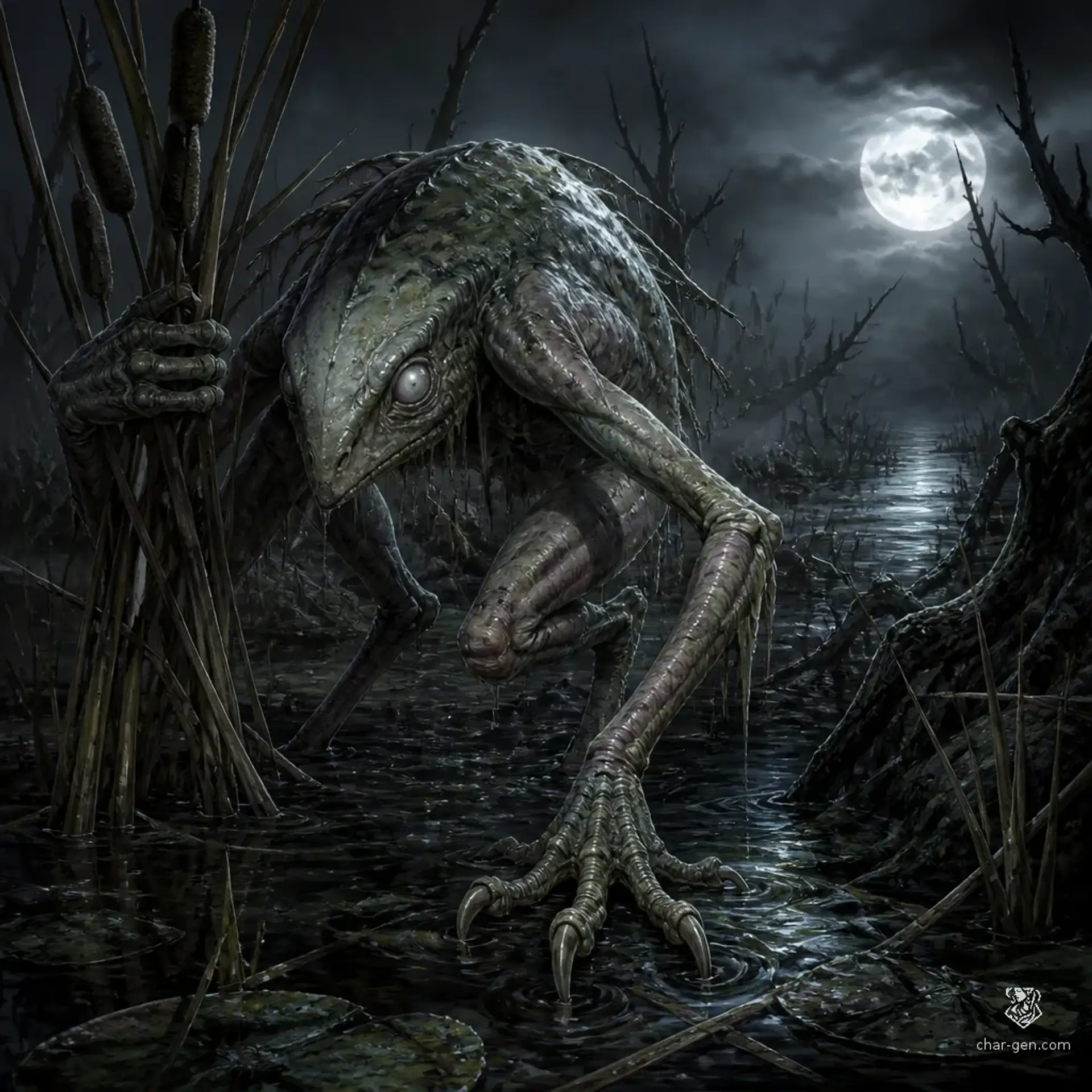
The Moonmire Gnawer is a hunched, reed-limbed marsh scavenger the size of a large hound, though it moves with the twitching precision of something half fish, half bird. Its skin is pale, wet, and mottled like the underside of a lily pad, while its head is narrow and frog-like with milk-white eyes that glimmer in fog. Long fingers and toes end in hooked nails suited for clinging to cattails, dragging bundles, and peeling flesh from bone. When several gather together, their silhouettes look like broken reeds bending in the same wind.

Behavior

Moonmire Gnawers are opportunistic pack scavengers that follow larger predators, corpse trails, or the smell of fear. They prefer to steal from camps, drag away unattended bodies, and strike from mist rather than fight openly. A single gnawer is skittish and cunning, while a cluster becomes bold enough to harry travelers into deeper water. Their croaks carry through fog as a loose coordination signal, and those croaks often grow frantic when an alpha predator is nearby.

How it lives

Moonmire Gnawers haunt marsh edges, flooded ruins, and reed-choked banks where larger beasts leave kills behind. They nest in woven cattail mats above the waterline and hoard scraps, buttons, fishhooks, and bones in shallow caches. They are not true apex predators, but their numbers and patience make them dangerous around bog trails and drowned camps. In areas ruled by an alpha bog monster, the gnawers may serve as subordinates, scavengers, or rivals depending on which creature fed first.

Lair

They nest in elevated cattail hummocks, half-submerged root tangles, or abandoned duck blinds where the water stays still enough to reflect moonlight. A lair often contains drag marks to hidden caches, shallow bone pits, and strands of netting twisted around reeds like a warning banner. When the moon is high, the pack croaks from different corners of the marsh to make intruders think the bog is crowded with more hunters than it truly is.

Habitat
Swamps, bogs, flooded fens, reed beds, blackwater channels, drowned ruins, and mist-heavy marsh paths.

Signs that it is near

Shredded netting snagged on cattails
Gnawed bones polished white by swamp water
Dragged belongings half-buried in mud
Croaking calls answering from opposite directions in the fog
Small muddy footprints that end at open water

Tags

swamp,
bog,
pack hunter,
scavenger,
fog,
ambush,
wilderness,
undead-adjacent horror

Lore

Old marsh-folk say the first Moonmire Gnawers were carrion shapes that learned to mimic the croak of frogs and the whine of lost children. Others claim they are the wet land's answer to hunger, born where bodies sink without a trace. Whatever their origin, the creatures are commonly found on the edges of a stronger bog monster's territory, cleaning up after kills, stealing unattended meat, and occasionally following the alpha like scraps at its heels. They are named in local tales as the Reed Eaters, Moon-Fens, and Drownjaw Skulkers, but all names mean the same thing: if the mist thickens and the cattails start to sway without wind, something hungry is already nearby.

What drives it

To feed with as little risk as possible, stealing from kills and camp refuse while avoiding direct confrontation unless the odds are favorable.

After the fight

After the pack is driven off, the marsh is left with shredded netting, sucked-clean bones, dragged bedrolls, and bootprints that end abruptly in black water. Survivors often find one stolen item hung neatly on a cattail stalk, as if the monsters wanted the camp to know they had been watched. If the alpha predator remains in the area, the Moonmire Gnawers may return within hours to feed on its leftovers or shadow its next kill.

“Others claim they are the wet land's answer to hunger, born where bodies sink without a trace.”
From its lore

Variants

Moonfen Reedgnawer
Drownmouth Skulk
Mirefeather Croaker
Wetgrave Gnawler
A larger brood variant may have 35 hit points and a Challenge Rating of 2 for parties that are already strong in swamp terrain.

Hooks

Plot hooks

A vanished campsite is found with the food still hanging, but every boot and bedroll dragged into the marsh.
The local ferryman swears the reed monsters only appear after another beast has fed, and wants the party to break that cycle.
A child was taken by something in the fog, but the trail leads to a cattail nest full of stolen trinkets and bones, not a lair of the true kidnapper.
The alpha predator of the bog is dead, and now its scavengers are bold enough to raid nearby settlements.

How to use it

Use as a stalking hazard in a swamp journey where the party notices signs before the attack.
Run as a tense skirmish in fog, with 3 to 6 gnawers probing camp defenses and retreating if bloodied.
Pair with a larger bog predator by having the gnawers trail behind and harass anyone wounded by the alpha.
Use them to punish careless travel, loud campfires, or dragging corpses through cattails.

Treasure

Scattered personal gear worth 1d4 x 10 gp
A mud-smeared holy charm or warding token from a past victim
A pouch of mixed coins, river stones, and bone buttons
Rarely, a map scrap showing a safe path through the marsh

Media

0 images

No images yet.

Visual sheet

Turn Moonmire Gnawer into a sheet

A high-res, share-ready sheet you can post or print.