Skip to content
CreatePricing
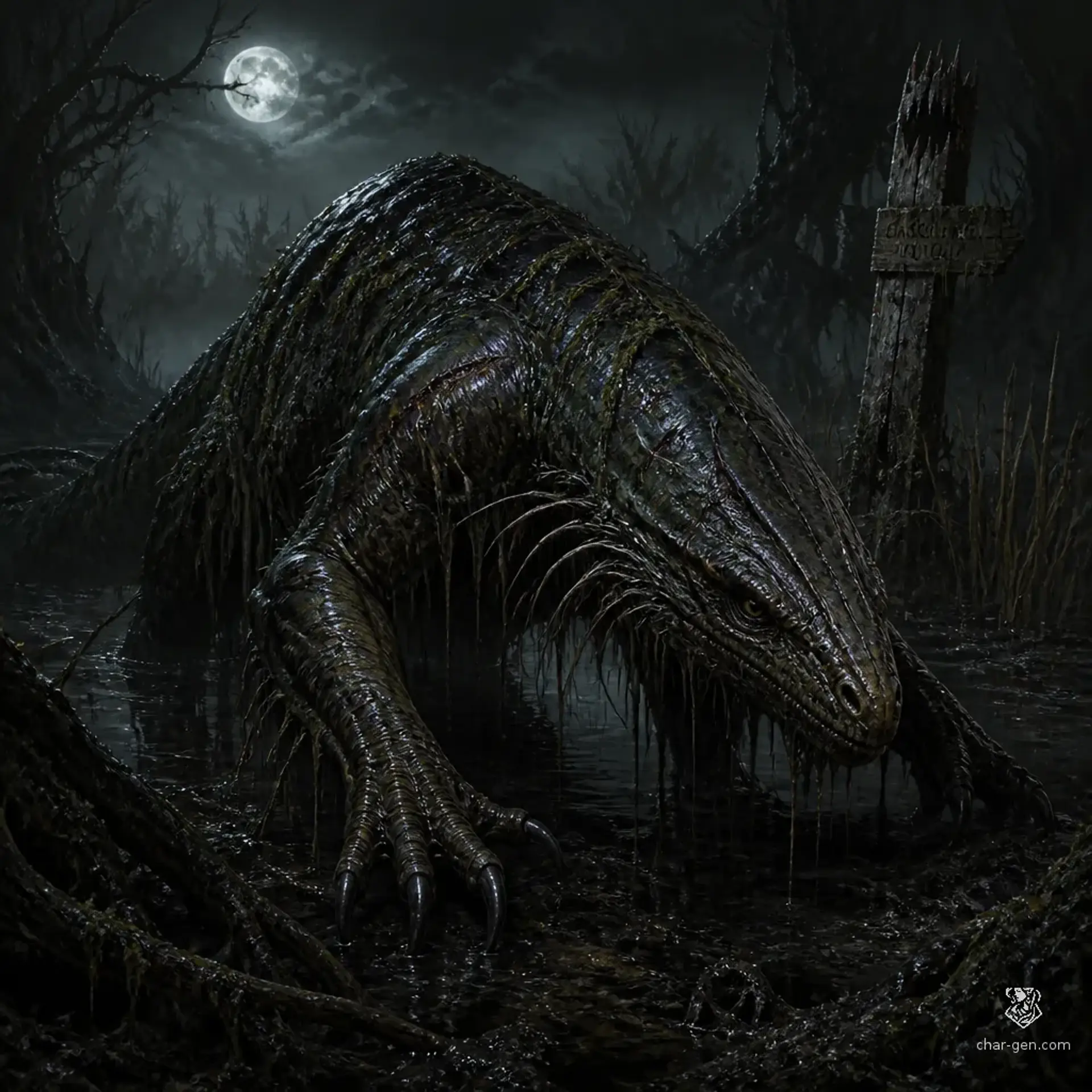
Mireclaw Stalker - AI-generated fantasy Monster

Mireclaw Stalker

Locals say the bog keeps one eye on the old road, and the mireclaw is that eye given teeth. Old route markers, broken fence posts, and warning trees often bear the same deep rakes, suggesting the creature has patrolled the corridor for years, perhaps longer. Hunters who survived it claimed the beast learned the rhythm of boots, cart wheels, and torch crackle, striking only when the marsh itself muffled the sound of escape.

Large monstrosity · Moderate · uncommon

Mireclaw Stalker

A swamp-born ambush predator that haunts the abandoned road and the bog routes around it, using reeds, mud, and black water to defend a nesting ground tied to the wider marsh ecosystem.
AC15
HP102/102
CRModerate
Init
STR
DEX
CON
INT
WIS
CHA
ConditionsNone

Combat

AC 15 · HP 102 · Moderate

Mireclaw Stalker

Large monstrosity, unaligned
Armor Class15 (natural armor)
Hit Points102 (12d10 + 36)
Speed
30 ft., swim 40 ft.
STR
DEX
CON
INT
WIS
CHA
Saving ThrowsDexterityConstitutionWisdom
SkillsPerceptionStealthSurvival
Damage Resistances
cold damage while in swamp water or mud,
nonmagical bludgeoning, piercing, and slashing damage from attacks made against it while submerged in water or mud
Immunities
prone caused by difficult terrain while in swamp water or mud
Weaknesses
Bright flame disorients it if held steadily in its line of sight, giving it disadvantage on attack rolls until the start of its next turn.
Bells and high noise break its stealth and prevent it from taking the Hide action until its next turn.
Dry ground reduces its speed to 20 ft. and prevents Mud Slip.
Salt scattered in a visible line makes it wary and can be used to negotiate or delay pursuit.
Senses
darkvision 60 ft.,
tremorsense 30 ft. while in mud or shallow water,
passive Perception 14
Languages
understands Common but cannot speak,
understands Sylvan but cannot speak
ChallengeModerate
Proficiency Bonus+3
Bog Camouflage. The mireclaw has advantage on Dexterity (Stealth) checks made in swamp, marsh, reed beds, mud, or water.
Amphibious. The mireclaw can breathe air and water.
Ambush Predator. The mireclaw has advantage on initiative rolls if it is hidden at the start of combat.
Prey Drag. A creature grappled by the mireclaw is dragged 10 feet closer to the nearest water, mud, or reed cover at the start of the mireclaw's turn, if possible.

Actions

Multiattack. Mireclaw makes one Claw attack and one Bite attack. If both attacks hit the same creature, the target must succeed on a Strength saving throw or be grappled (escape ). While grappled in this way, the target is also restrained if the mireclaw is in water or mud at least 1 foot deep.
Claw. Melee Weapon Attack: to hit, reach 5 ft., one target. Hit: 10 () slashing damage.
Bite. Melee Weapon Attack: to hit, reach 5 ft., one target. Hit: 11 () piercing damage, and the target is pulled up to 10 feet straight toward the mireclaw if it is Large or smaller.
Mire-Hiss. The mireclaw releases a low, reed-rattling hiss. Each creature of the mireclaw's choice within 15 feet that can hear it must succeed on a Wisdom saving throw or be frightened until the end of the creature's next turn. A creature that succeeds is immune to this Mire-Hiss for 24 hours.
Mud Slip. The mireclaw submerges in mud or black water and can move up to half its speed without provoking opportunity attacks. Until the start of its next turn, it has advantage on Dexterity (Stealth) checks made to hide in swamp terrain.

Reactions

Reed-Shadow Reposition. When a creature the mireclaw can see hits it with a melee attack while standing on dry ground, the mireclaw can move up to 10 feet without provoking opportunity attacks. If it ends this movement in mud, water, or reeds, it gains half cover until the start of its next turn.
Role
territorial ambusher
Built for
4-6

Gear

  • Bone and trinket pile (treasure, varies)The mireclaw's claws and teeth are part of its body, but trophies from prior kills may be found in its den.

Feats

Amphibious stealth
Reed camouflage
Territorial intimidation
Prey drag
Swamp ambush

Notes for the game master

The mireclaw is designed as a swamp-route predator that can be used alone or as part of a bog ecosystem tied to other regional threats.
It is strongest in marsh terrain and notably weaker on dry ground or against environmental deterrents like bright flame, bells, or salt.
If the party chooses diplomacy, place tribute at the edge of the water and back away slowly; the creature values distance and boundaries more than authority.

Tactics

  1. Opening

    The mireclaw watches from reeds, then strikes from surprise if possible, opening with a grapple attempt on the noisiest intruder or the one carrying fire.

  2. Mid-fight

    It focuses on one target at a time, dragging victims into mud or water where allies struggle to reach them. It keeps using Mire-Hiss to scatter clustered foes and punishes noisy or flaming characters first.

  3. End of the fight

    If bloodied and cornered on dry ground, the mireclaw breaks line of sight and tries to flee back into water or toward a nest channel, preferring survival over a hopeless stand.

  4. Retreat

    It withdraws if reduced below one-third hit points and no offspring, den, or food cache is at risk. It may also accept an offering of fresh meat, bells, or salted provisions and retreat without a fight if the party leaves the territory immediately.

How it fights

Hide in reeds until prey commits to the road or reaches a narrow causeway.
Target torchbearers, spellcasters using fire, and creatures making the most noise.
Drag isolated victims into water to break formation and line of sight.
Use the terrain, not brute force, unless defending the nest directly.

Who it attacks first

Noisy creatures
Torchbearers
Wounded isolated targets
Anyone approaching the den or nesting ground

Works well with

Pairs well with a second swamp monster that hunts by sound, scent, or water disturbance, making the old road feel actively defended by the bog itself.
Local NPC warnings can foreshadow the beast's territory, and its claw marks can point toward the lair of the other regional threat.

How to beat it

Bright flame and loud bells disrupt its approach and make it easier to spot in reeds.
Dry ground limits its ability to grapple and restrain, and it cannot use Mud Slip while fully out of swamp terrain.
Salt scattered across a threshold, camp perimeter, or trail can deter it for one night if the creature can smell or see it clearly.
If the party identifies and respects its den or feeding channel, leaving tribute can avoid bloodshed entirely.

Ways to avoid a fight

Offer fresh meat, fish, or carrion at the edge of its territory.
Use bells, incense, or bright lanterns to signal peaceful passage and keep distance.
Track its claw marks to find the den and parley from outside the nesting ground.
Lure it away from the road with noise or decoy prey if needed.
Set salted lines around a camp to create a temporary boundary it is reluctant to cross.

Ecology

The mireclaw is a sleek swamp predator with a low, catlike body, a wedge-shaped skull, and long forelimbs ending in hooked black claws. Its hide is dark olive with oil-slick bands that vanish under water, and its sides are fringed with fine reedlike whiskers that barely disturb the surface when it moves. When it rises from the bog, mud sheets off its back in ropes, exposing scarred hide marked by old claw-gouges from rival beasts and hunters alike.

Behavior

Territorial and watchful rather than mindlessly violent, the mireclaw claims a feeding channel, nesting barrow, or hidden den near the old road. It marks trees with deep clawed rakes, drags prey into black water, and reacts aggressively to loud voices, torches, and firelight. It can be bargained with through offerings if the characters show they are not hunting its young, stealing its food, or disturbing the bog's deeper nest routes.

How it lives

The mireclaw hunts fish, marsh deer, carrion, and anything careless enough to travel the old route after dark. It nests in a hidden pocket of raised root and reed, often close to the same channels that support other bog predators and the warnings of local NPCs. Where one mireclaw hunts, frogs vanish, minnows boil the water, and beetles gather in thick humming clouds over disturbed mud.

Lair

Its lair is a submerged den beneath tangled roots, with a narrow air pocket, a hidden dry shelf for nesting, and a drowned path leading toward the old road. The entrance is usually concealed by reeds or a fallen log and ringed with claw marks on nearby trees.

Habitat
Marshes, peat bogs, flooded ruins, reed beds, black water channels, and the abandoned road cutting through the swamp.

Signs that it is near

Deep claw marks carved into warning trees and road posts.
Half-eaten animals dragged into water and left beneath reed mats.
Bubble trails and sudden stillness in black pools.
Mud ridges shaped like a body sliding low through the marsh.
Torch smoke and loud voices drawing an immediate, distant hiss from the reeds.

Tags

swamp,
bog,
predator,
ambush,
territorial,
reptilian,
stealth,
regional threat

Lore

Locals say the bog keeps one eye on the old road, and the mireclaw is that eye given teeth. Old route markers, broken fence posts, and warning trees often bear the same deep rakes, suggesting the creature has patrolled the corridor for years, perhaps longer. Hunters who survived it claimed the beast learned the rhythm of boots, cart wheels, and torch crackle, striking only when the marsh itself muffled the sound of escape.

What drives it

Protect its territory, protect its nest, and remove anything that threatens the safety of its feeding channels and offspring.

After the fight

If the creature is driven off rather than killed, it may return after a day to stalk the same route unless its nesting ground is discovered and disturbed. Trails of dragged reeds, broken branches, and half-buried bones can lead characters to its den. A successful show of respect, such as leaving salted meat, bells, or a small bright lantern on the old road, can convince it to avoid the party for several nights. If slain near the abandoned route, scavengers and frogs quickly gather, and the bog grows strangely quiet for a time, making travel easier but more eerie.

Variants

Bog-born alpha: increase hit points to 136 and Challenge to 6; its Mire-Hiss becomes a 20-foot cone.
Nest guardian: reduce speed to 20 ft. and add one reaction to defend the den, granting advantage on one grapple attempt per round.
Old road veteran: it learns the party's routines and no longer grants surprise after the first encounter, but it leaves more obvious warning marks.

Hooks

Plot hooks

The NPC's warnings point to a section of road where the ground is always churned up, and the party must learn whether the threat is the mireclaw or something worse.
The beast's claw marks on the route markers match a separate set of tracks leading to the second monster's hunting ground, revealing a shared bog ecosystem.
A missing traveler may still be alive in the mireclaw's den, trapped but not yet eaten.
The party can earn safe passage by proving a rival predator has moved into the mireclaw's territory and offering aid against it.

How to use it

Ambush predator for travel scenes along the abandoned route.
Territorial guardian of a hidden causeway, old bridge, or bog shrine.
Stealth encounter where the party can track claw marks and traces of dragged prey to the den.
Negotiation encounter if the characters offer food, bells, or a way to lure a rival creature away.

Treasure

1d4 polished river-stones worth 5 gp each
A bone charm or warning token from the abandoned route
A half-drowned pouch containing 25 gp and a cracked signet ring
In the den, a nest of roots may hide a minor swamp trinket or potion

Media

0 images

No images yet.

Visual sheet

Turn Mireclaw Stalker into a sheet

A high-res, share-ready sheet you can post or print.