Cargo and Crown
Stakes Control of the stable rift lanes will decide whether the shards become a shared civilization or isolated fortresses.
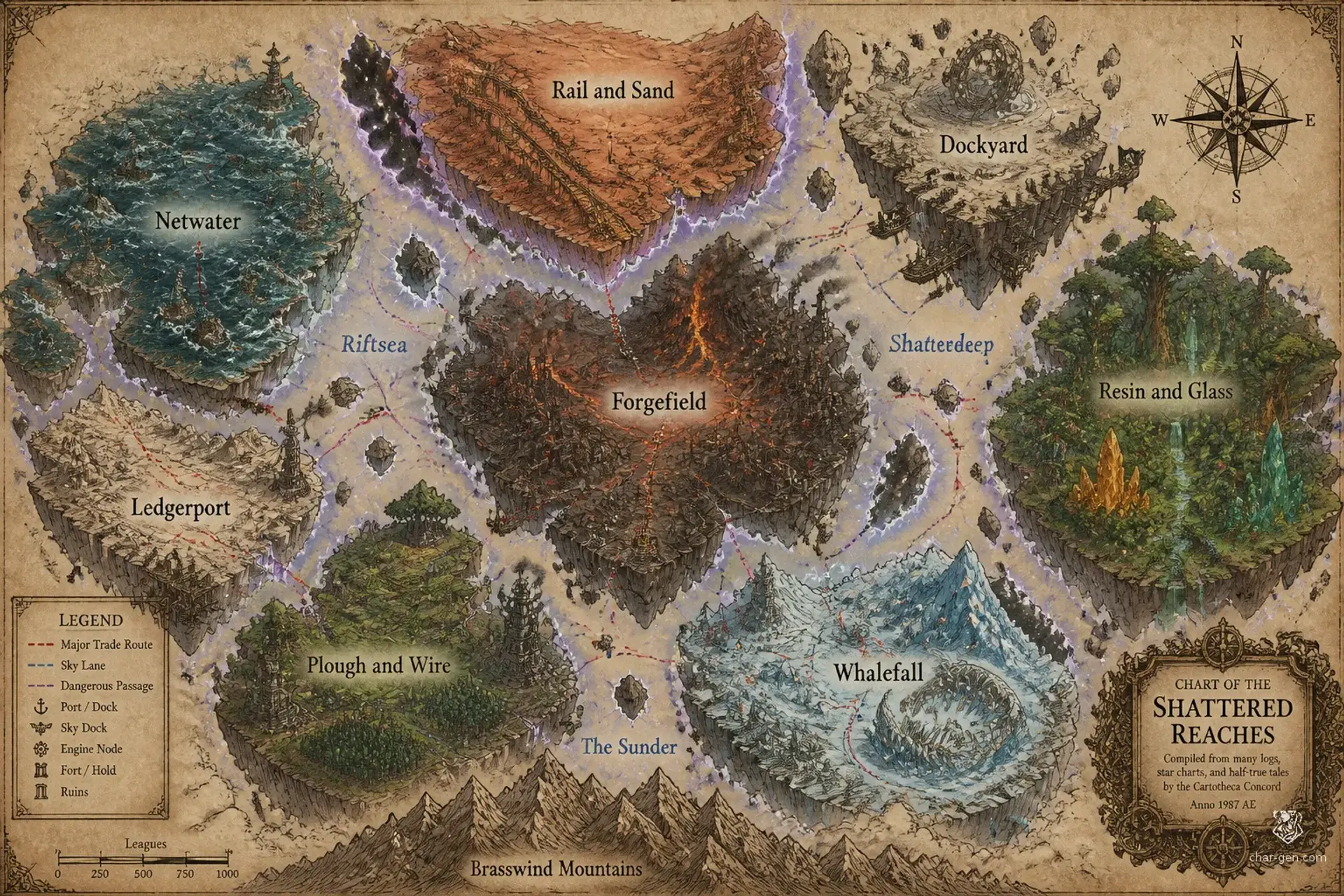
World Atlas·Shattered·A broken world still runs on promises, engines, and the price of passage.
Commercial gateway and political capital · Wind-scoured salt flats
Hook
A customs city survives by taxing every vessel that crosses its single reliable rift.
Trade and Tangle is a shattered planet held together by a web of spatial rifts. Its floating regions carry different climates, cultures, and fragments of old civilization, while fleets cross the void for food, fuel, relics, and labor. High magic powers futuristic machines, but every journey risks a misaligned gate or a sudden change in gravity. The central question is practical and bitter: rebuild the world, or profit from its pieces?
Themes
Form · Shattered
The planet broke into eight major inhabited shards and countless minor fragments, each retaining its own gravity, atmosphere, and weather.
Traversal
Travel occurs by gravitic ships, tether bridges, and spatial rifts; routes shift with shard drift, and every crossing requires a tuned destination token.
Shattered
Magic
High
Technology
Futuristic
Death & Souls
First Era
Survey
Second Era
Forge and Farm
Third Era
The Break
Current Era
Freight and War
Cargo and Crown
Control of the stable rift lanes will decide whether the shards become a shared civilization or isolated fortresses.
The Salvage War
Ancient engines beneath the shards may repair the world, destroy it, or give one faction command of every crossing.
Monopolize inter-shard commerce and restore a centralized government under its own charter.
Control unstable routes, sell passage to anyone, and keep the old world from being rebuilt.
Recover pre-Break machinery and use it to stabilize every shard through disciplined arcane engineering.
Protect local autonomy, expose exploitative contracts, and share navigation knowledge freely.
Stakes Control of the stable rift lanes will decide whether the shards become a shared civilization or isolated fortresses.
Stakes Ancient engines beneath the shards may repair the world, destroy it, or give one faction command of every crossing.
The planet was whole, and arcane engineers mapped stable routes through the upper atmosphere before learning that space itself could be folded.
Settlers built engines, skyports, and spellworks around the rift network, joining rival industries into uneasy city-states.
A failed attempt to power every rift at once shattered the planet into floating regions and scattered its people across the void.
Mercenary fleets, salvage guilds, and old governments compete to control the remaining routes while the shards slowly drift apart.
A freight convoy vanishes between two familiar rifts, leaving behind cargo that remembers a future war.
A mercenary pirate offers the party a map to a shard that appears on no surviving survey.
A dying rift begins linking random homes across the planet, forcing enemies to shelter together.
A buried engine can reunite two shards, but its activation would erase every soul anchored to them.
A ninth shard was removed from every official map, not destroyed.
Discovery · Navigation crystals occasionally display a ninth destination when exposed to living blood.
Impact · The missing shard contains the original rift engine and proof that the Break was deliberately caused.
The Far Lantern is an artificial soul archive built before the planet shattered.
Discovery · Ghosts across several regions repeat the same final sentence in different languages.
Impact · The dead are not merely trapped; they are being used as a distributed computing network by an ancient machine.
The planet is not drifting apart, but being pulled toward a planned alignment.
Discovery · Rift failures briefly reveal identical landmarks in different regions.
Impact · The shards are slowly converging toward a second Break, and repairing the old network may accelerate it.