The Dungeon Question
Stakes Whether dungeons should be sealed, conquered, or destroyed before their growth reshapes civilization.
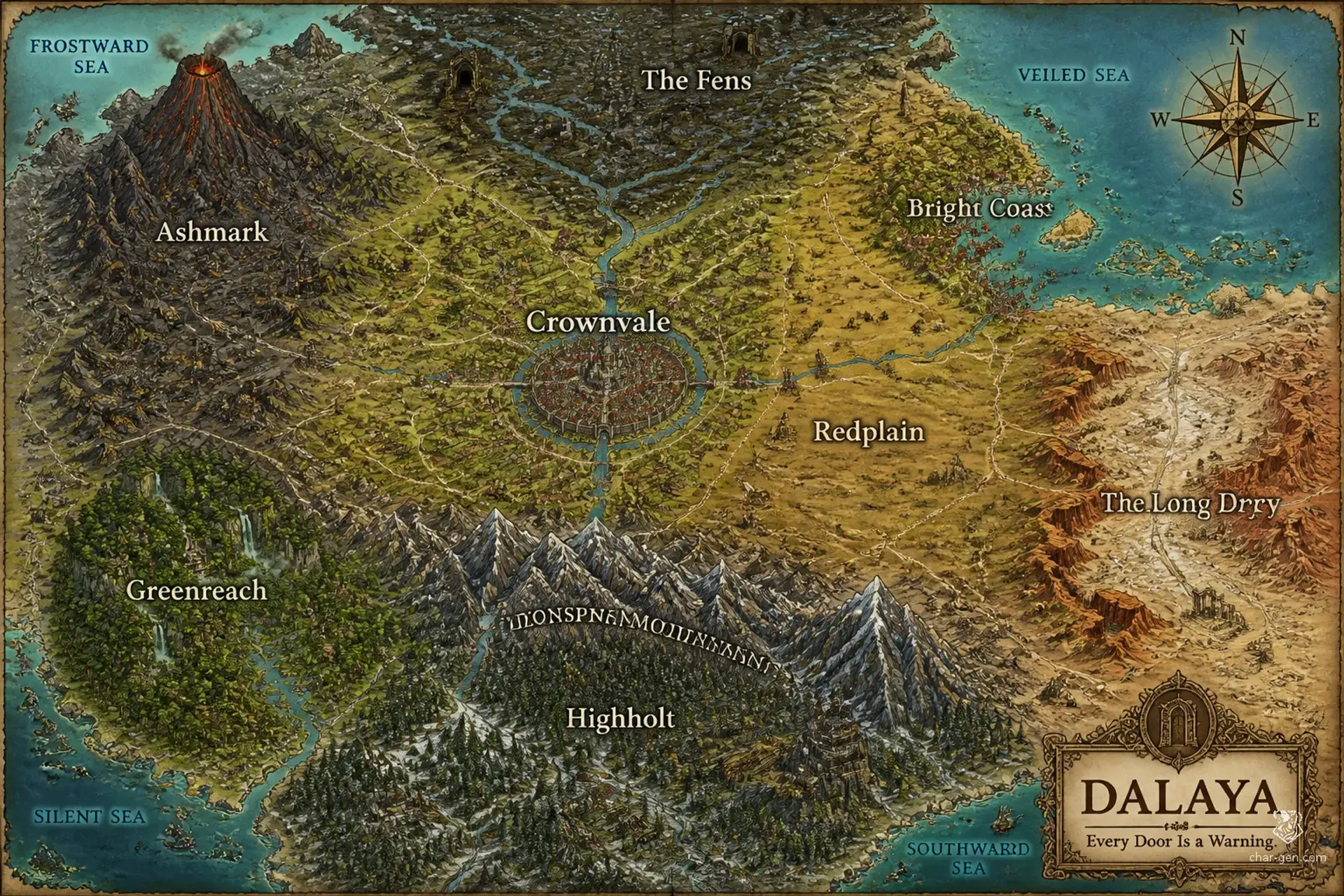
World Atlas·Sphere·Every door is a warning, and every warning has a deadline.
Political heart and home of the Warden Compact. · River valleys and walled farmlands
Hook
The capital's permanent dungeon has ten public levels, but a newly opened eleventh level is sending polite letters to officials.
Dalaya is a prosperous sphere of kingdoms, city leagues, and frontier holds built around one dangerous certainty: magical dungeons appear anywhere. Each dungeon grows when neglected, and a dungeon break sends its inhabitants into the surrounding lands. Major factions maintain permanent dungeons beneath their capitals, each descending at least ten levels into older and stranger realms. Adventurers are prized as necessary workers, feared as treasure hunters, and blamed whenever a sealed door opens again.
Themes
Form · Sphere
Dalaya is a living sphere with broad continents, deep oceans, and magical pressure building beneath its crust.
Traversal
Travel follows roads, rivers, sea lanes, and mountain passes, while dungeon corridors sometimes connect distant regions through unstable shortcuts.

Sphere

Magic
Mythic
Technology
Medieval

Death & Souls
First Age
The Quiet World
Second Age
The Breaking Years
Third Age
The Warden Age
The Dungeon Question
Whether dungeons should be sealed, conquered, or destroyed before their growth reshapes civilization.
The Capital Depths
Who controls the permanent dungeons beneath the capitals and the mythic power sleeping at their lowest levels.
The Wardens want every dungeon monitored, mapped, and cleared before it can break.
The Five Courts compete to expand their influence through relics recovered from their permanent capital dungeons.
The Deep Choir believes dungeon breaks are the world's natural renewal and secretly encourages them.
The Free Delvers defend the right to enter dungeons without licenses, taxes, or noble claims.
Stakes Whether dungeons should be sealed, conquered, or destroyed before their growth reshapes civilization.
Stakes Who controls the permanent dungeons beneath the capitals and the mythic power sleeping at their lowest levels.
Dalaya was stable until the first dungeons began appearing without warning in wild places, beneath roads, and inside settled towns.
Early kingdoms learned that neglected dungeons burst open, releasing monsters and changing the land around them.
Modern nations built dungeon corps, warning towers, and capital vaults while competing to control the strongest dungeon sites.
A dungeon appears beneath a crowded market, and its first monsters are wearing the uniforms of a dead army.
A permanent capital dungeon begins losing levels from the bottom upward, exposing tunnels that lead beneath the city foundations.
A frontier village refuses evacuation after a dungeon break because the released creatures are protecting its people from something worse.
A royal expedition discovers that several new dungeons appeared on the same night in places connected by an ancient road.
The first dungeons were created by ancient rulers who tried to store excess magic beneath the world.
Discovery · A permanent dungeon's lowest surviving inscription is found behind a royal seal.
Impact · Dungeons may not be random appearances but deliberate attempts by Dalaya itself to correct a buried imbalance.
Some dungeon breaks are coordinated by an intelligence that lives below the lowest levels.
Discovery · Several dungeon breaks leave behind identical black keys that do not fit any known door.
Impact · The keys could unite distant dungeons into one vast complex and trigger a continent-wide break.
Permanent dungeons distort time, and their deepest levels contain fragments of possible futures.
Discovery · A soul recovered from a dungeon guardian remembers dying in a city that has not yet been built.
Impact · The capital factions may be defending against future dungeon breaks rather than present ones.