The Grave Tithe
Stakes The living must surrender bodies, labor, or land to contain the dead, and rebellion may unleash a second plague.
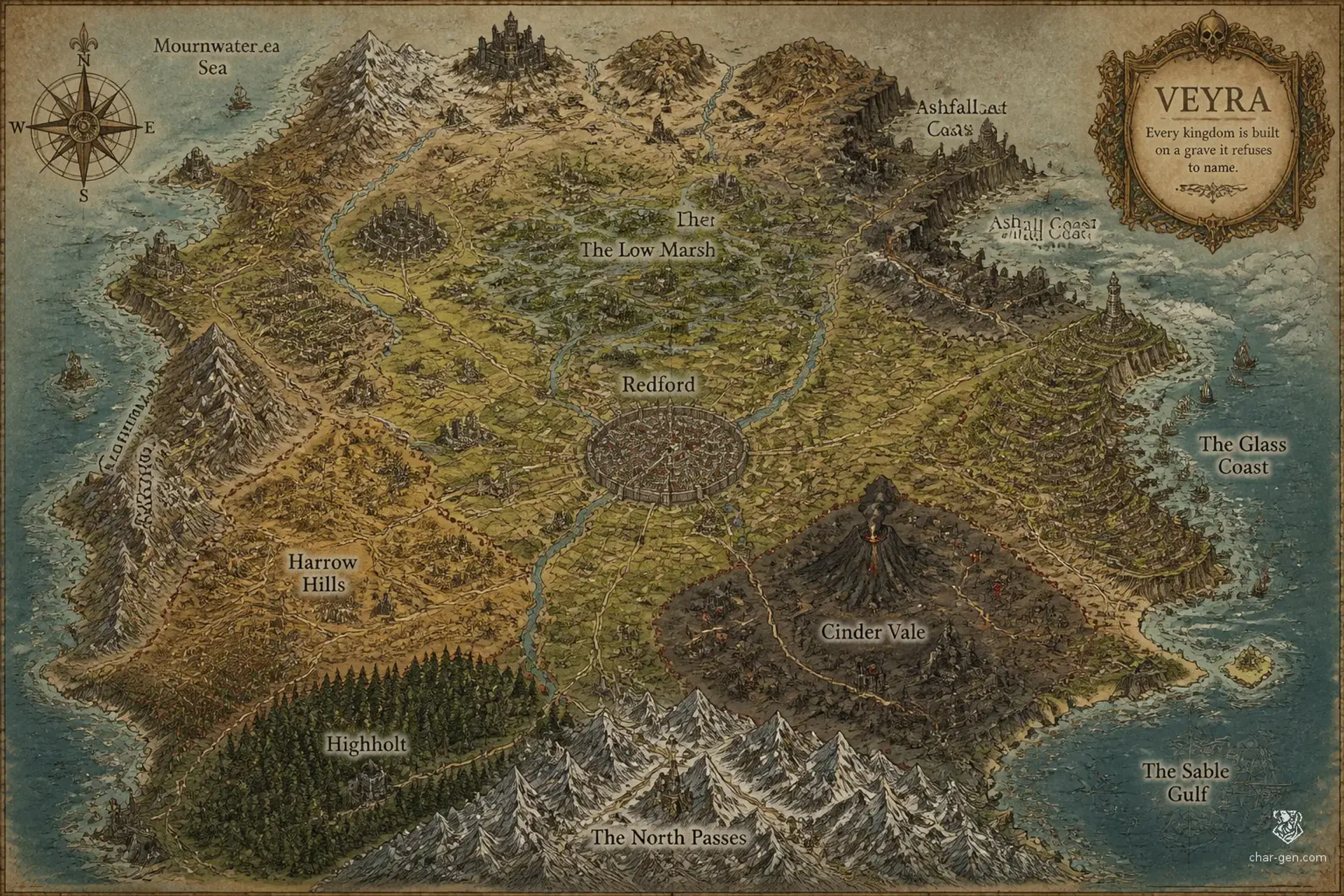
World Atlas·Sphere·Every kingdom is built on a grave it refuses to name.
Commercial and political heartland · River plain and walled farmland
Hook
A prosperous city prints cheap warding manuals while its oldest cemetery begins moving underground.
Veyra is a hard, fertile world still living with the consequences of one shared mistake: generations ago, rulers tried to make death useful. The attempt failed, poisoning fields and binding some dead to the world. Magic is now ordinary, but so are warded cemeteries, corpse taxes, and arguments over whose ancestors caused the ruin. Merchant cities, starving villages, and old military roads form a tense web where every journey crosses history and danger.
Themes
Form · Sphere
Veyra is a spherical planet of one broad settled continent, surrounded by cold seas and scattered island chains.
Traversal
Travel follows rivers, paved imperial roads, mountain passes, and coastal shipping lanes, with warded camps needed near old graves.

Sphere

Magic
Common

Technology
Renaissance

Death & Souls
First Age
The Green Crown
Second Age
The Red Years
Third Age
The Black Harvest
Current Age
The Long Reckoning
The Grave Tithe
The living must surrender bodies, labor, or land to contain the dead, and rebellion may unleash a second plague.
The River War
Control of the main river decides who eats, who trades, and who can fund armies against the restless dead.
The Compact wants stable borders, reliable taxes, and strict control of corpse handling, even if villages must be sacrificed.
The Ash Priests seek to contain restless souls through ritual, confession, and public punishment of those who disturb the dead.
The Ledger Houses want open trade and control of the river ports, while quietly buying relics from forbidden graves.
The Free Holds defend local rule and refuse the Crown Compact's corpse taxes, sheltering smugglers, deserters, and outlawed mages.
Stakes The living must surrender bodies, labor, or land to contain the dead, and rebellion may unleash a second plague.
Stakes Control of the main river decides who eats, who trades, and who can fund armies against the restless dead.
Old kingdoms cleared forests, raised stone roads, and bound common magic into farming, trade, and war.
Rival crowns fought for control of fertile rivers, while famine, plague, and mercenary armies hollowed out the countryside.
A failed attempt to command the dead poisoned the soil and left every grave a possible doorway.
Survivors rebuild under hard rulers as the dead grow restless and every region argues over who must pay for the old crime.
A sealed mass grave has opened beneath a busy market, and its dead demand the return of stolen names.
A printer discovers a forbidden map showing where the Black Harvest began, but three powers want it destroyed.
A noble family hires the party to escort its dead heir home before rivals learn the corpse is still speaking.
Ash storms are spreading beyond the old battlefields, forcing enemies to defend a town together.
The Black Harvest was not an accident; it was a deliberate attempt to create obedient soldiers from the honored dead.
Discovery · Old burial records contradict every royal history and name a living dynasty as the original architects.
Impact · The Crown Compact may be founded on a lie, making its laws and claims to authority vulnerable.
Thousands of commoners were sacrificed to power the ritual, and their spirits still recognize one another.
Discovery · Certain ghosts refuse burial unless shown a small iron token stamped with a laborer's mark.
Impact · The souls of the dead may be organized around an unfinished revolt rather than random grief.
The Black Harvest is slowly moving toward the sea, following hidden tunnels built beneath ancient roads.
Discovery · Ash storms form perfect circles over places where no battle is recorded.
Impact · The curse is spreading through buried evidence, not merely through old battlefields.