The Road Claim
Stakes Who controls safe travel, taxation, and the ruins that connect the recovering world.
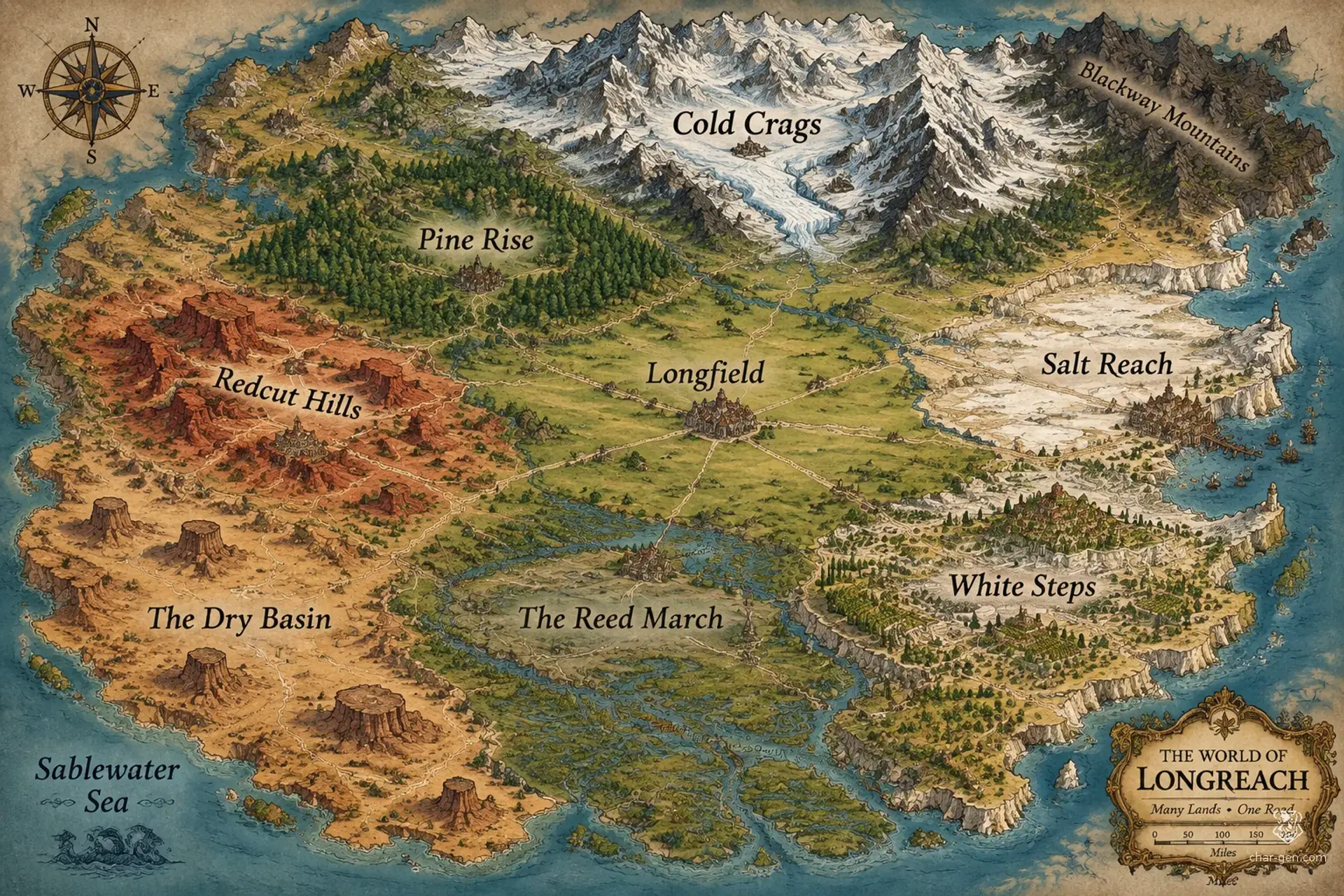
World Atlas·Sphere·Every road remembers who walked it, and some remember where they should have gone.
Political and commercial crossroads · Grassland and low rolling fields
Hook
A newly settled market town stands beside a road that changes its destination each dawn.
Longreach is a wide, fertile world shaped by roads that remember every journey. Centuries ago, a plague emptied whole valleys, and the surviving towns now compete to reclaim fields, mines, and abandoned keeps. Magic is common enough to mend a roof or ward a wolf, but old roads carry stronger powers and stranger dangers. Caravans, local lords, raiders, priests, and newly settled farmers all argue over who has the right to use them.
Themes
Form · Sphere
Longreach is a spherical world of broad continents, shallow seas, inland rivers, and one dominant network of ancient roads crossing its settled lands.
Traversal
Travel follows roads, rivers, coastal ships, mountain passes, and magical waymarks; roads that remember travelers can shorten journeys when their rules are respected.

Sphere

Magic
Common

Technology
Medieval

Death & Souls
First Era
The Reed Age
Second Era
The High Road Age
Third Era
The Red Plague Age
Current Era
The Open Hand Age
The Road Claim
Who controls safe travel, taxation, and the ruins that connect the recovering world.
The Empty Fields
Whether abandoned lands become farms and towns or remain forbidden ground for a dangerous faith.
Secure every major road, collect tolls, and restore royal authority over the abandoned districts.
Keep travel open without submitting to rulers, while quietly controlling the most profitable routes.
Recover their lost holdings and drive outsiders from lands they believe were stolen during the plague.
Turn grief over the plague into a religion that promises immunity through obedience and shared burial rites.
Stakes Who controls safe travel, taxation, and the ruins that connect the recovering world.
Stakes Whether abandoned lands become farms and towns or remain forbidden ground for a dangerous faith.
Settlers followed the great rivers, cleared reed beds, and built the first roads, walls, and market towns.
Trade roads linked distant peoples, while common magic became a craft taught by guilds, temples, and village wise folk.
A wasting sickness spread through the roads, leaving abandoned districts, embittered survivors, and strict laws around travel and burial.
The plague has waned, but its empty lands invite settlers, raiders, monsters, and ambitious rulers competing to claim what was lost.
A road begins leading travelers to a vanished town that appears only during the red quarter of the Hearth Moon.
A plague shrine is distributing clean water, but every grateful village soon forgets one member of its own history.
A caravan guild hires the party to reopen a pass where the road itself has begun rejecting travelers who carry royal seals.
Settlers uncover a buried mile marker that points toward a living city beneath the fields.
Longreach's roads were not made for trade alone; they were designed to bind the world's dangerous magic beneath the ground.
Discovery · Road markers in distant regions bear the same hidden tally beneath their official inscriptions.
Impact · The roads were built as one immense magical instrument, and someone is learning how to play it.
The plague cult's founder died centuries ago, but its voice continues through shared dreams.
Discovery · Plague survivors in separate villages remember the same stranger giving them identical instructions.
Impact · The Red Choir may be guided by a surviving intelligence that can inhabit memories rather than bodies.
The plague did not merely kill people; it damaged the boundary that carries souls away.
Discovery · Fresh crops grow in fields that should still be sterile, while nearby ghosts become unable to speak.
Impact · The Quiet Below is weakening, and the living may soon have to bargain directly with the dead.