
The Sunken Baths of the Sirocco Veil
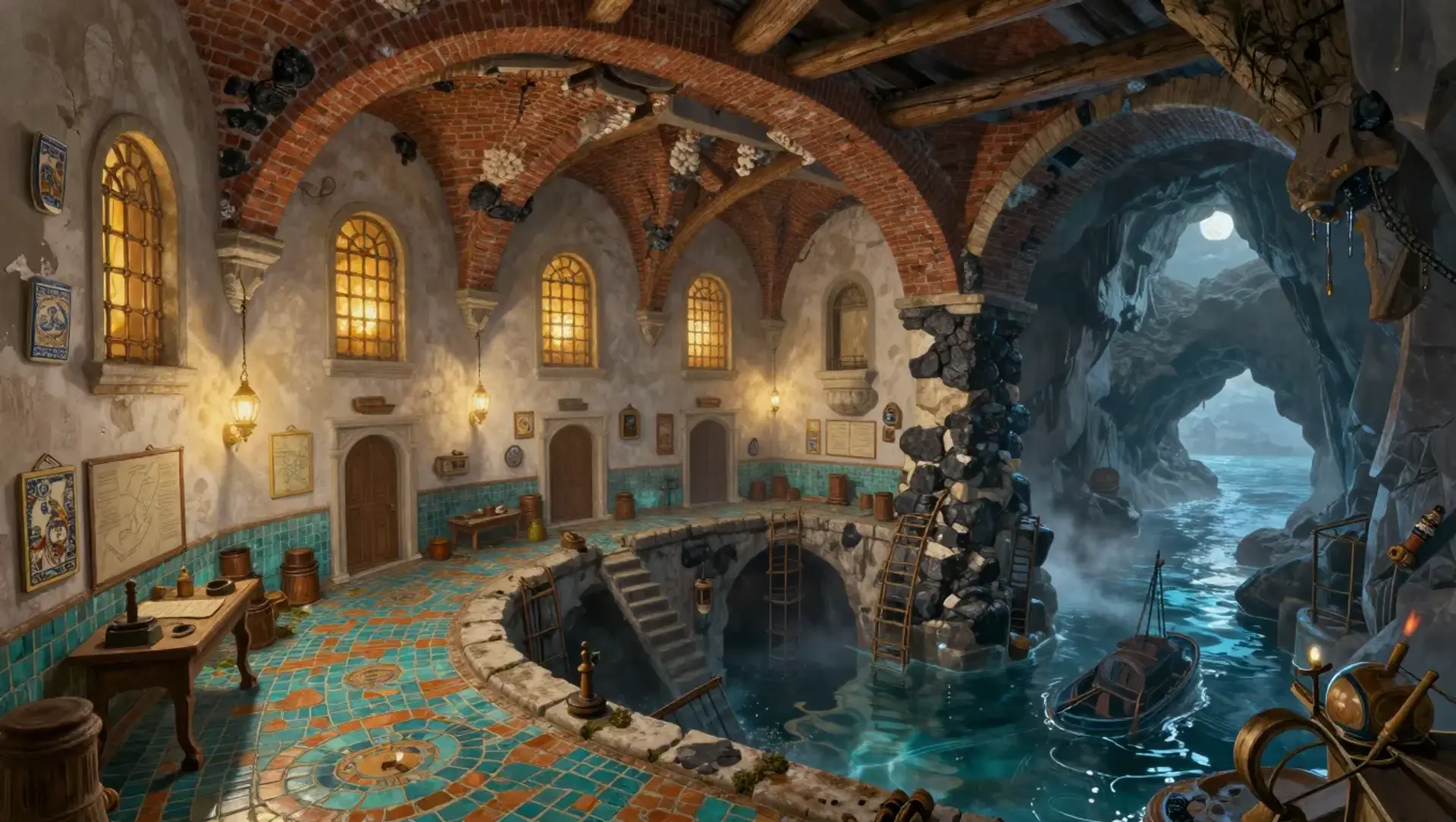
The Sunken Baths of the Sirocco Veil occupy the ruins of an ancient cliffside bathhouse near Qasr al-Miraj. At street level, the complex operates as a respected charity clinic for sailors, laborers, travelers, and the poor. Its tiled treatment rooms, shaded courtyards, and public dispensary provide a credible reason for strangers to arrive at all hours. Beneath the clinic, sealed stairwells descend into map rooms, document presses, flooded cisterns, hidden maritime berths, and an inland escape tunnel extending for miles beneath the coastal roads. The headquarters is both sanctuary and working command center. Veil agents coordinate smuggling runs, arrange safe passage, forge permits, shelter witnesses, and negotiate with dock crews, caravan leaders, sympathetic officials, and rival underworld figures. Its careful maintenance is part of its security. Leaks are repaired before they spread, every skiff is inspected after use, and even the oldest brickwork is marked with discreet signs indicating which passages remain sound. Visitors encounter kindness first, bureaucracy second, and danger only when they threaten the people under the Veil’s protection.
The Sunken Baths of the Sirocco Veil
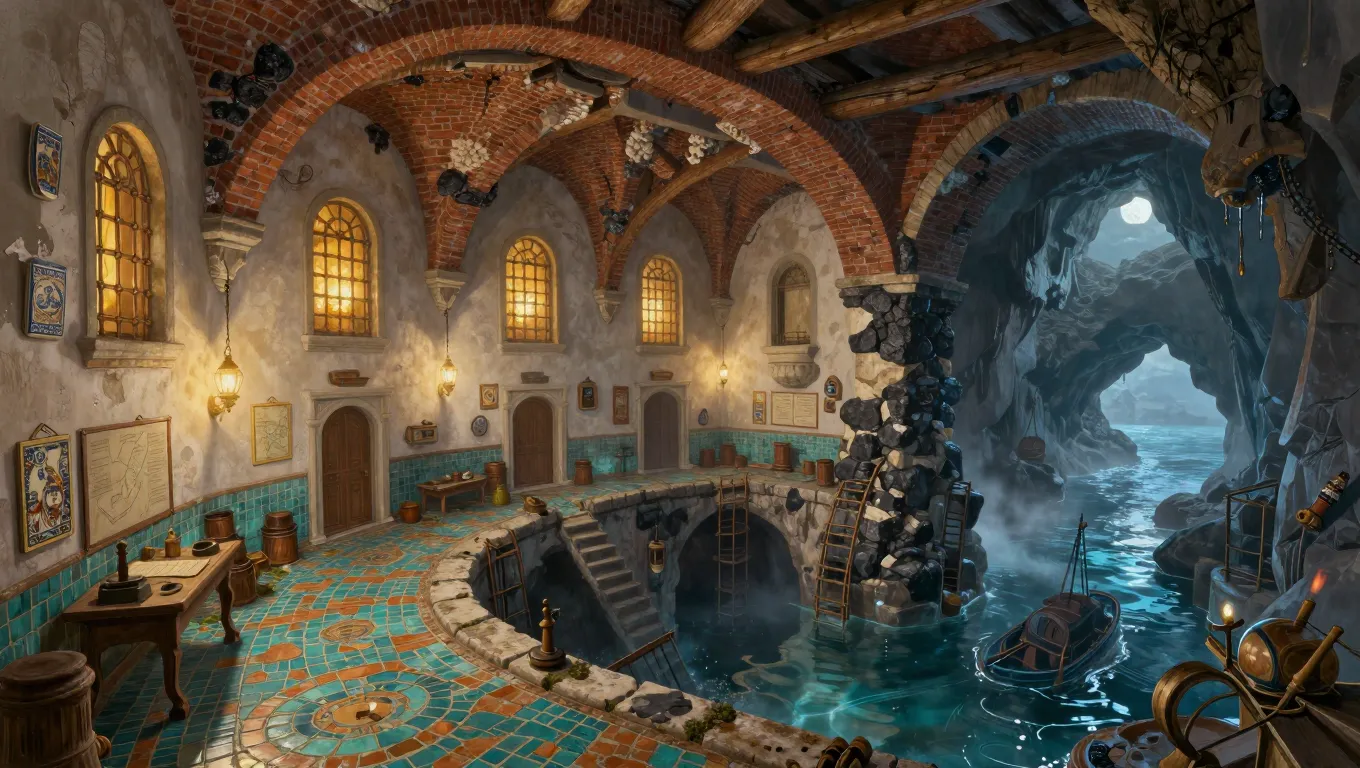
The upper clinic smells of boiled herbs, clean linen, sea salt, and lamp oil. Voices remain gentle even when the wards are crowded, and the clink of ceramic bowls blends with the distant surf. Below, the air grows cool and wet. Water drips through brick joints, chains knock softly against mooring rings, and hidden machinery turns with a low metallic grind. Deeper still, the scent of brine gives way to damp earth, stale smoke, and the mineral tang of the inland dark.
The Sunken Baths of the Sirocco Veil occupy the ruins of an ancient cliffside bathhouse near Qasr al-Miraj. At street level, the complex operates as a respected charity clinic for sailors, laborers, travelers, and the poor. Its tiled treatment rooms, shaded courtyards, and public dispensary provide a credible reason for strangers to arrive at all hours. Beneath the clinic, sealed stairwells descend into map rooms, document presses, flooded cisterns, hidden maritime berths, and an inland escape tunnel extending for miles beneath the coastal roads. The headquarters is both sanctuary and working command center. Veil agents coordinate smuggling runs, arrange safe passage, forge permits, shelter witnesses, and negotiate with dock crews, caravan leaders, sympathetic officials, and rival underworld figures. Its careful maintenance is part of its security. Leaks are repaired before they spread, every skiff is inspected after use, and even the oldest brickwork is marked with discreet signs indicating which passages remain sound. Visitors encounter kindness first, bureaucracy second, and danger only when they threaten the people under the Veil’s protection.
Morana is intensely controlled, strategically brilliant, and fiercely protective of subordinates in ways she refuses to describe as affection. She is generous with dangerous information when strangers prove principled, yet miserly with praise toward the people closest to her. In public, she is austere and exacting. In private, especially when exhausted, she reveals a dry humor and an almost domestic attentiveness, checking whether people have eaten, mending torn straps, and pretending these acts are merely efficiency. Her deepest tension is that she distrusts unregulated compassion while longing for someone to show her mercy without asking permission.
History
Operational Records and Forgery
The Veil’s operational records are divided among three locked map rooms. The first holds coastal currents, harbor depths, and tide schedules. The second contains desert caravan routes, coded safehouse marks, and names of sympathetic magistrates. The third houses blank permits, seal blocks, diplomatic stationery, and a hand press capable of producing convincing travel papers. Documents are never stored by subject alone. Each packet is split between rooms, so a captured clerk cannot expose an entire operation.
Safehouse Protocols
The sanctuary receives fugitives, injured agents, escaped indentured laborers, and witnesses who cannot safely reach the Sultanate’s courts. New arrivals are treated at the clinic, questioned by two separate handlers, and assigned a temporary identity drawn from sealed household registers. The Sirocco Veil provides food, clothing, medicine, and a route onward, but every guest owes one future favor unless the owner grants an exception. Those who endanger the sanctuary are confined in a quiet holding room beneath the old bath boilers.
Maritime Smuggling Network
The flooded lower cisterns connect to three maritime berths, each concealed behind a stone sluice gate. One berth serves shallow-draft skiffs, another accommodates low-profile dhows, and the third is reserved for emergencies. Tide-operated counterweights open the gates without visible machinery from the sea. Cargo is moved through wicker floats and sealed clay drums, allowing smugglers to pass medicine, letters, weapons, or people without bringing vessels into the public harbor.
Emergency Routes and Defenses
The inland tunnel is maintained as a living escape route rather than a forgotten passage. Lamps are mounted behind blue ceramic plates, freshwater niches are carved into the walls, and numbered doors lead to food caches, listening posts, and concealed exits. The tunnel forks repeatedly, with false branches ending in collapse traps or flooded pockets. A trusted guide can reach the first inland station in several hours, while an unprepared pursuer may wander underground until thirst and rising water force a return.
Denizens
Morana is intensely controlled, strategically brilliant, and fiercely protective of subordinates in ways she refuses to describe as affection. She is generous with dangerous information when strangers prove principled, yet miserly with praise toward the people closest to her. In public, she is austere and exacting. In private, especially when exhausted, she reveals a dry humor and an almost domestic attentiveness, checking whether people have eaten, mending torn straps, and pretending these acts are merely efficiency. Her deepest tension is that she distrusts unregulated compassion while longing for someone to show her mercy without asking permission.
A former battlefield surgeon who runs the public clinic with calm authority. She remembers every patient’s face, refuses unnecessary cruelty, and can identify a disguised agent by the way they hold their injured arm. Her compassion is genuine, though she quietly decides which visitors deserve the Veil’s deeper protection.
A patient, sharp-eyed cartographer who oversees the map rooms and schedules every coastal run. He speaks softly, keeps several contradictory route books, and never travels without a brass tide compass inherited from his vanished brother.
A broad-shouldered Tidewarden from the southern docks who commands the maritime berths. He maintains the skiffs, supervises loading crews, and settles disputes with a stare that often prevents violence before it begins. His loyalty is firm, but he distrusts anyone connected to imperial customs offices.
A young gnome printer from Azimut who joined the Veil after fleeing a debt contract. She can reproduce handwriting, seals, and official formatting with unnerving accuracy. Her greatest weakness is curiosity, especially when confronted with documents connected to the Imperial High Council.
An aging former caravan guard who lives near the inland tunnel’s first station. He knows the safe route by memory, including which doors are trapped, which wells have failed, and which stretches are now occupied by creatures driven from the deep roads.
Rumors & Plot Hooks
- 1.A sealed chamber beneath the oldest cistern contains records proving that a prominent Verulan noble house profited from both sides of the War of Seven Salt-Marches.
- 2.One of the clinic’s patients is secretly an imperial informant, but no one knows whether they are spying on the Veil or feeding false reports to protect it.
- 3.The inland tunnel reaches an abandoned aquifer palace beneath the desert, where the Veil once hid an entire village during the Red Quarantine.
- 4.A brass tide compass in the map rooms points toward the nearest active elemental leak rather than north.
- 5.The third maritime berth has been locked for seven years because something in the lower sea-caves learned to imitate the voices of arriving sailors.
- 6.Mariam al-Sirocco possesses a private list of officials willing to cooperate with the Veil, but she has never revealed whether the list is genuine or a trap for corrupt magistrates.
- 7.Several forged Imperial documents have recently returned to the baths bearing seals that the Sirocco Veil never carved.
- 8.The clinic’s memorial wall includes a blank tile that changes position whenever someone sheltered by the Veil dies before reaching safety.
Classified Entry
The Sunken Baths were built over a dormant elemental aquifer connected to Verulana’s wider network of unstable water sources. The Veil’s founders discovered that the aquifer can be used to carry sound, images, and short whispered messages across great distances when treated with powdered Star-Sand and sealed in specific ceramic chambers. Mariam has kept this discovery hidden from the Sultanate, the Sirocco Veil’s rivals, and the Imperial High Council. The network currently uses it to warn distant safehouses of raids and political arrests. The aquifer is becoming unstable. Its water has begun flowing against the tide, and voices from far inland have started answering messages that no one sent. If the pressure rises, the lower baths may flood with elemental water, rupture the coastal cliff, or open a passage into a hostile planar pocket. Mariam suspects that someone is deliberately tampering with the aquifer, using the Veil’s own communication system to map the network and identify every sanctuary connected to it.
Turn The Sunken Baths of the Sirocco Veil into a sheet
A high-res, share-ready sheet you can post or print.