
The Green Banner Hall
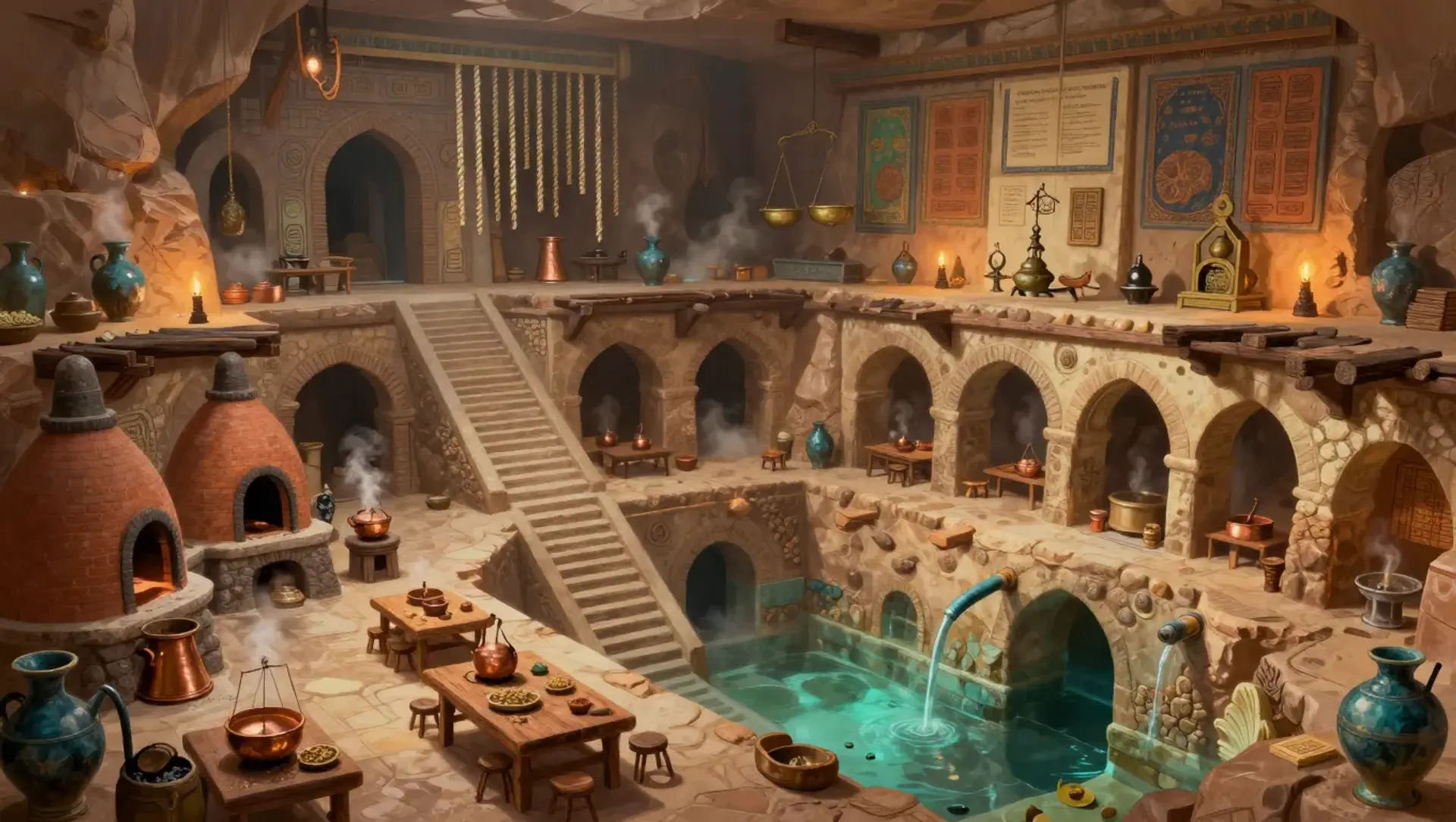
The Green Banner Hall is a grand, multi-tier subterranean stronghold carved into the oldest bedrock terrace wall above the Crown Oasis. It serves as the underground headquarters of the Nine Furrows federation and the principal organizing center of the Green Banner Compact. Visitors enter through the Hearth-Kitchen, where volunteers distribute lentil porridge, flatbread, dates, and clean water to the displaced and weary. From there, broad ramps descend toward offices, workshops, guard posts, seed vaults, hidden cisterns, and the silt-water reservoirs beneath the terrace. Above the lower levels, the Hall of Measures rises through a high vaulted chamber where water allotments, labor tallies, genealogical claims, and canal agreements are preserved in clay, cord, paint, and carved stone. The complex feels less like a palace than a buried town that has learned how to defend itself.
The Green Banner Hall
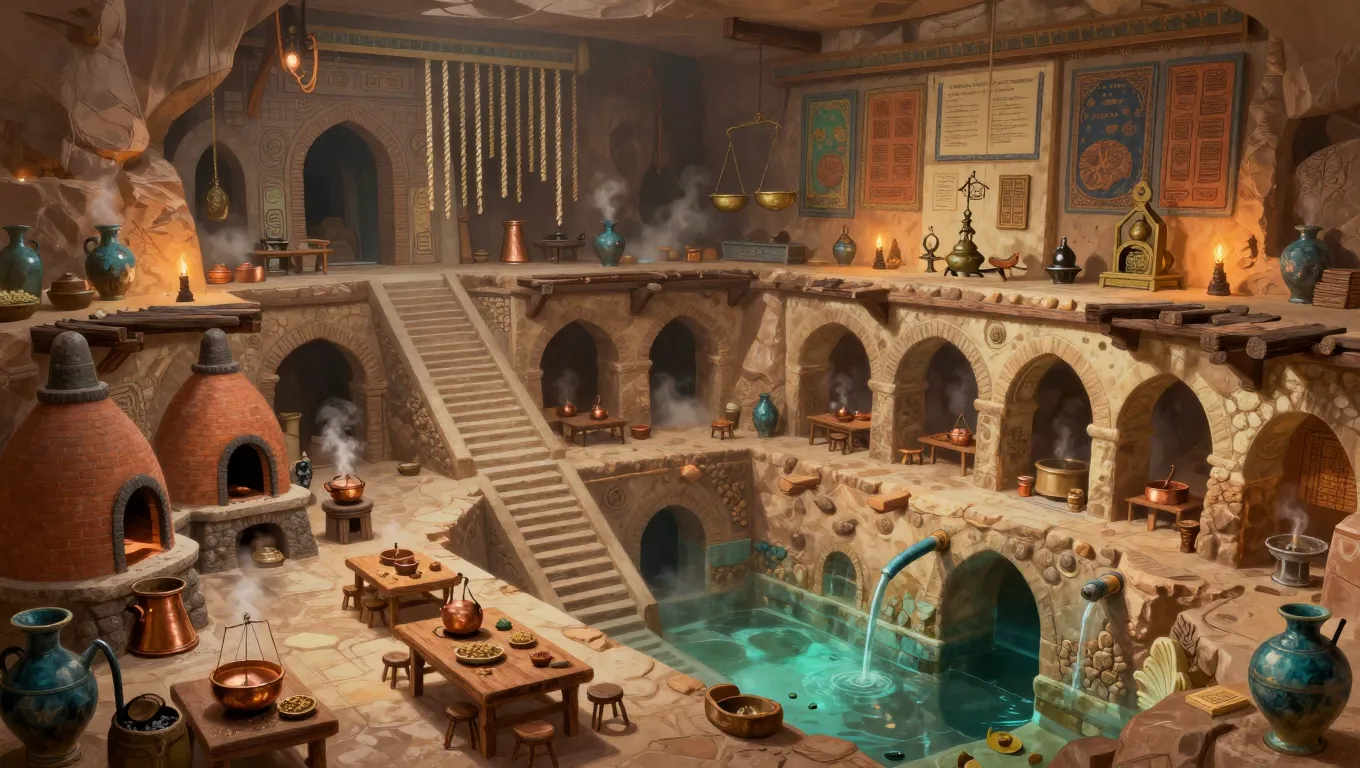
Warm steam rolls through the entrance halls, carrying the scent of lentils, toasted cumin, yeast, and woodsmoke. Beyond the kitchen, the air cools against damp stone, and the murmur of petitioners blends with the tap of styluses on clay and the soft knock of beads sliding along quipu cords. Water trickles through ceramic channels beneath the floors. Lanternlight glows across painted tablets, bronze scales, and worn steps polished by generations of desperate feet. Even in quiet hours, the stronghold feels awake, listening, measuring, and preparing to move.
The Green Banner Hall is a grand, multi-tier subterranean stronghold carved into the oldest bedrock terrace wall above the Crown Oasis. It serves as the underground headquarters of the Nine Furrows federation and the principal organizing center of the Green Banner Compact. Visitors enter through the Hearth-Kitchen, where volunteers distribute lentil porridge, flatbread, dates, and clean water to the displaced and weary. From there, broad ramps descend toward offices, workshops, guard posts, seed vaults, hidden cisterns, and the silt-water reservoirs beneath the terrace. Above the lower levels, the Hall of Measures rises through a high vaulted chamber where water allotments, labor tallies, genealogical claims, and canal agreements are preserved in clay, cord, paint, and carved stone. The complex feels less like a palace than a buried town that has learned how to defend itself.
Practical, protective, suspicious of concentrated authority, and fiercely committed to the principle that food, water, and records must remain accountable to the people who depend on them.
History
Administration and Membership
The Hall operates as both a political office and a practical service network. Delegates from the Nine Furrows federation meet in the upper galleries, while canal wardens, seed keepers, terrace foremen, and village advocates conduct daily business below. Membership requires a witnessed pledge to maintain communal records, protect displaced families, and refuse private control of shared water. The Green Banner Compact funds the Hall through assessed grain, labor, and voluntary donations rather than fixed taxes.
Active Contracts
The Green Banner Hall maintains contracts with canal crews, caravan guards, potters, millers, midwives, and independent water diviners throughout the Crown Oasis. Current work includes repairing three neglected feeder canals, resettling families displaced by a collapsed reservoir, and tracing missing shipments of drought-resistant seed. The Hall also offers discreet employment to adventurers willing to escort negotiators, recover stolen records, or expose forged water claims without endangering local communities.
Defenses and Security
The Hall's defenses are designed to delay, confuse, and document rather than slaughter. Kitchen volunteers can seal the public entrance behind ironwood shutters, while signal cords alert every tier to an intrusion. False record rooms, flooded stairwells, counterweighted stone doors, and hidden observation slots divide the complex into defensible sections. Veteran terrace guards use the vaults as fallback positions, supported by clay sentries molded from the old countinghouse foundations. An imperial audit raid would meet barricaded kitchens, scattered civilians, contradictory records, and a dozen escape routes before reaching the central archive.
Restricted Records
Below the Hall of Measures lies the Foundational Archive, a restricted collection containing pre-Sultanate grain tallies, the first canal-sharing agreements, early surveys of the Crown Oasis aquifers, and fragments of treaties predating the current royal dynasty. Its most valuable holdings are not written in a single script. Some are pressed into clay, some woven into dyed cords, and others encoded in painted ceramic markers whose arrangement maps ancient water rights. The archive's deepest chamber contains a sealed stone cylinder known as the First Furrow Record, whose contents could either legitimize the Green Banner Compact or shatter its fragile alliance with the Sultanate.
Denizens
Practical, protective, suspicious of concentrated authority, and fiercely committed to the principle that food, water, and records must remain accountable to the people who depend on them.
A broad-shouldered human woman with silver threaded through her black hair, Mother Sira oversees the kitchen, the entrance volunteers, and the Hall's emergency stores. She speaks gently to the hungry and sharply to anyone who wastes food. Her network of cooks and delivery runners functions as the building's most reliable intelligence service.
A meticulous Verulanan genasi with amber eyes and damp skin that glitters like wet quartz, Dalan maintains the Hall's water ledgers and can identify forged records by ink, clay composition, or cord fiber. He distrusts grand speeches but will risk his life for a correctly measured canal allotment.
An aging human terrace captain with a broken nose and a permanent limp, Yusef commands the Hall's volunteer defenders. He trains millers, shepherds, laborers, and scribes to hold doors, protect civilians, and retreat in good order. He has never called himself a revolutionary, though the Sultanate's magistrates use the word for him.
A young dragonborn archivist with clay dust beneath her claws, Tava can read five regional scripts and remember the arrangement of every tablet in the Foundational Archive. Her calm manner hides a fierce willingness to alter records when she believes a document was created through coercion.
A water genasi negotiator appointed by the Green Banner Compact, Salima maintains fragile ties with Crown officials, merchant houses, and rival agrarian coalitions. She dresses plainly, listens longer than anyone expects, and keeps three escape plans for every meeting.
Rumors & Plot Hooks
- 1.An imperial auditor entered through the Hearth-Kitchen three months ago and never found the records he came to seize. Some say he was persuaded to join the Compact. Others say he is still hidden beneath the cisterns.
- 2.The oldest silt-water cistern contains a submerged door that opens only when the Crown Oasis suffers a severe drought.
- 3.A sealed treaty in the Deep Vaults proves that the first Sultan promised the terrace villages permanent control of their feeder canals.
- 4.One of the nine founding pillars has begun to sweat brackish water, and the Compact fears it marks a deliberate poisoning of the aquifer.
- 5.The Hall's countinghouse bell rings once at midnight whenever someone lies during a public petition.
- 6.A faction within the Nine Furrows federation intends to replace the Sultanate's water bureaucracy with a council based entirely inside the Green Banner Hall.
- 7.A stolen foundational treaty was carried out through the Lantern Walk, but the thief left behind a fragment of black glass etched with an imperial seal.
Classified Entry
The Foundational Archive is built over a pre-Sultanate pressure chamber that regulates one of the Crown Oasis's oldest leyline aquifers. The chamber is still active, but its control mechanism has been altered by generations of record keepers who embedded legal formulae into the stone seals. The Hall's leaders know that the ancient water rights are physically tied to the aquifer's stability. If the First Furrow Record is removed, destroyed, or publicly invalidated, the chamber will begin shifting its flow, causing wells to fail across the valley. The stolen treaty is not merely political evidence. It is one of the three documents required to safely recalibrate the chamber, and someone inside the Green Banner Compact has already begun forging a replacement.
Turn The Green Banner Hall into a sheet
A high-res, share-ready sheet you can post or print.