
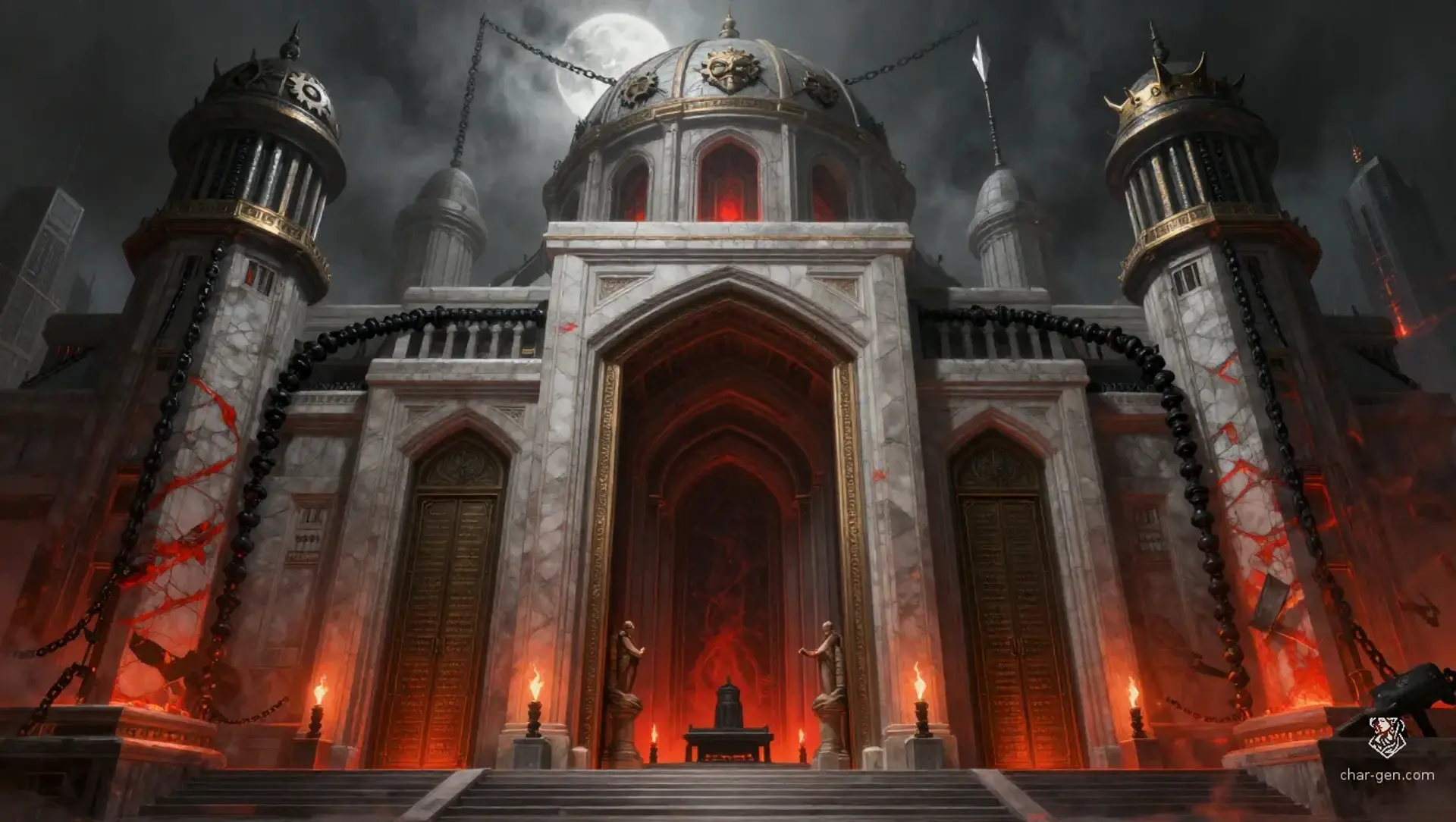
The High Furnace
The High Furnace dominates the heart of Velundra, rising above the surrounding districts like a crowned citadel. Its name came from the foundry crews who forged the temple’s immense iron skeleton, though the title has become an ironic boast: the building now claims to be the furnace in which all law, wealth, war, progress, and artistic expression are refined. Five great sanctuaries surround a central nave, each dedicated to one of the arch devils revered by the Dominion of Veythrak. At the far end stands the Throne Altar, an elevated dais of black stone where the high priest delivers decrees before an audience of clergy, officials, soldiers, merchants, and chained petitioners.
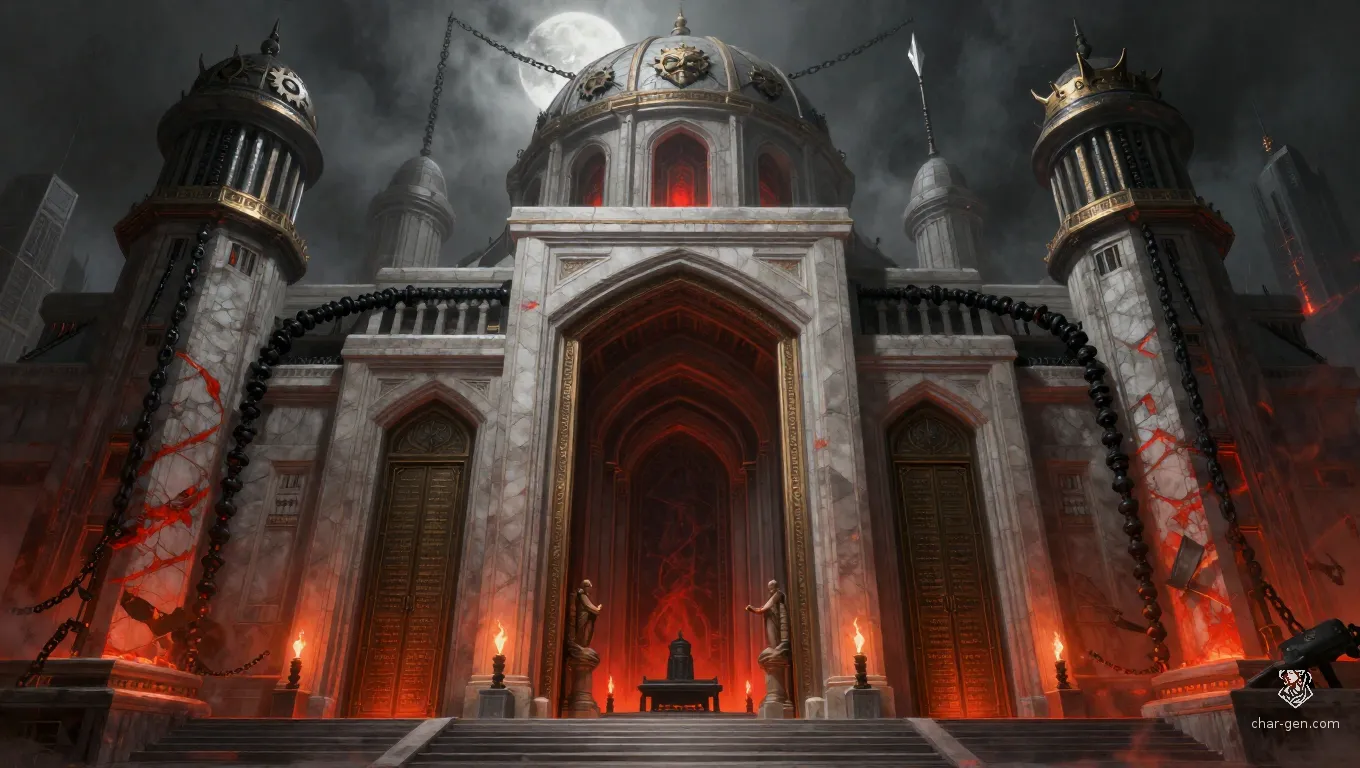
The High Furnace
The temple is pristine, disciplined, and unnervingly calm. Incense scented with hot metal and bitter myrrh hangs beneath the dome. Choirs chant in low, layered voices while scribes scratch constantly across parchment. Every footstep echoes several seconds longer than it should. The air near the relics is warm, and faint red light pulses beneath the floor as if the entire structure has a heartbeat. Worshippers speak softly, guards never remove their gloves, and even the wealthiest nobles bow their heads when passing the central altar.
The High Furnace dominates the heart of Velundra, rising above the surrounding districts like a crowned citadel. Its name came from the foundry crews who forged the temple’s immense iron skeleton, though the title has become an ironic boast: the building now claims to be the furnace in which all law, wealth, war, progress, and artistic expression are refined. Five great sanctuaries surround a central nave, each dedicated to one of the arch devils revered by the Dominion of Veythrak. At the far end stands the Throne Altar, an elevated dais of black stone where the high priest delivers decrees before an audience of clergy, officials, soldiers, merchants, and chained petitioners.
Controlled, paternal, and relentlessly practical. Kharzun can appear merciful when mercy serves order, and he genuinely admires competence even in enemies. He treats faith as a tool for shaping society rather than a source of comfort. Beneath his calm manner is a deep fear that the five arch devils are no longer united in their support of the Dominion.
History
Divine Services
The temple’s services are arranged around five sanctioned devotions. Mordafain receives oaths, judgments, and acts of submission. Amaron receives petitions concerning invention, industry, bureaucracy, and military logistics. Banzuth receives contracts, debts, inheritance claims, and offerings of precious metal. Maaroc receives battle vows, weapons, and funerary rites for soldiers. Phaerion receives performances, proclamations, paintings, denunciations, and public confessions. The high clergy insists that all five are facets of one truth: power must be claimed, shaped, purchased, enforced, and displayed.
Sacred Relics
The innermost reliquary holds five relics beneath separate iron canopies. Mordafain’s Chain is a length of black links that grows warm when someone breaks a sworn promise. Amaron’s Gear is a fist-sized brass wheel that turns without being touched and occasionally produces blueprints in Infernal script. Banzuth’s Coin is a dark-gold disk that always returns to the hand of its rightful owner, though ownership is determined by a spoken legal claim. Maaroc’s Spearhead is said to have pierced a celestial standard. Phaerion’s Mask changes its expression to reflect the strongest emotion in the room. None of the relics can be removed without the consent of all five arch devils.
Clergy and Rites
The temple is served by oath-priests, contract scribes, battle confessors, forge-chaplains, masked advocates, and infernal musicians. Advancement requires a public act that benefits the Dominion of Veythrak and a private sacrifice that proves the candidate values duty above affection. Senior clergy carry hooked staffs, sign documents in their own blood, and wear five small seals arranged around the throat. Visitors may request blessings, legal arbitration, military absolution, or a formal audience with a priest of one of the five devotions.
Civic Authority
The Grand Furnace is not merely a place of worship. It is also a political court, treasury, registry, and ceremonial theater. The city’s rulers are crowned beneath the central dome, while defeated generals are made to kneel before the Spearhead of Maaroc. Major trade agreements are signed under Banzuth’s canopy, and new civic laws are read aloud from Phaerion’s balcony. Any public figure who refuses to appear at the temple can be branded an enemy of the Dominion, regardless of their actual faith.
Denizens
Controlled, paternal, and relentlessly practical. Kharzun can appear merciful when mercy serves order, and he genuinely admires competence even in enemies. He treats faith as a tool for shaping society rather than a source of comfort. Beneath his calm manner is a deep fear that the five arch devils are no longer united in their support of the Dominion.
A tall hobgoblin with a clipped voice and a scar across his scalp, Kharzun has served as high priest for twenty-three years. He is courteous, patient, and utterly convinced that cruelty is acceptable when applied with proper procedure. He rarely threatens anyone directly. Instead, he explains the consequences of disobedience as though reading from an account book. Kharzun seeks adventurers capable of recovering a stolen relic without embarrassing the temple, but he intends to bind them to the service with a contract hidden inside the mission’s written terms.
A yuan-ti pureblood whose name is spoken with three different pronunciations by rival factions, Zawadi oversees the Chain Hall and all major contracts. She is elegant, warm in conversation, and incapable of accepting an agreement without testing its weakest clause. Zawadi believes Banzuth’s worship should replace all other devotions in the temple, but she lacks the military support to make that ambition public. She may aid outsiders who can expose financial corruption among the temple’s senior priests.
A broad-shouldered dwarf with a black iron jaw guard, Brother Odrik commands the temple’s armed clergy. His robes are immaculate, but his gauntlets are permanently stained with old blood. He respects directness, courage, and anyone willing to admit fear before battle. Odrik has been ordered to arrest a group of celestial spies within Velundra, though he suspects the alleged spies are actually innocent dissidents planted by a rival priest.
A human woman with a dancer’s posture and a deliberately uneven cadence, Sefara directs the Mask Gallery and all major religious performances. She believes Phaerion’s doctrine is strongest when it reveals uncomfortable truths, making her increasingly dangerous to the temple’s political leadership. Sefara hides coded criticism of the Dominion in hymns, pageants, and public murals. She could become an ally to the party, though she is more interested in turning them into symbols than in keeping them alive.
A quiet tiefling archivist with copper eyes and ink-stained fingertips, Malchior maintains the sealed records beneath the temple. He is neither loyal nor rebellious. He simply wants to preserve every truth until he can understand which ones matter. Malchior knows that the temple’s foundations contain a buried sixth chamber, omitted from every official plan. He has not entered it because the door bears no lock, only a question he cannot answer.
Rumors & Plot Hooks
- 1.The five relics have begun reacting to one another, and the priests are concealing a growing conflict between the arch devils.
- 2.A choir member vanished during a midnight hymn and returned three days later with no shadow and a perfect memory of events that have not happened yet.
- 3.The temple’s lower vaults contain the original civic charter of Velundra, proving that the city was promised to a power older than the Dominion of Veythrak.
- 4.The High Furnace burns without fuel because a bound fire elemental is chained beneath the central altar. The creature is said to know the true name of every high priest.
- 5.One of the statues in the Fivefold Nave turns its head whenever someone lies before the altar, but the priests replace witnesses who notice it.
- 6.A hidden gallery allows Phaerion’s clergy to observe every major public square in Velundra through enchanted portraits.
Classified Entry
The High Furnace was built over the remains of an older temple dedicated to a forgotten sixth power known only in the sealed records as the Witness Below. The five arch devils did not destroy this entity. They imprisoned it beneath the central altar and used its presence to stabilize the relics, wards, and prophetic machinery of the temple. The Witness Below does not seek freedom in the ordinary sense. It wants the city to acknowledge that every oath, debt, command, battle, and artistic declaration has been observed. If the party reaches the sixth chamber, the Witness will offer them an impossible bargain: it can reveal the hidden weakness of any one arch devil, but doing so will erase one cherished memory from every person in Velundra.
Turn The High Furnace into a sheet
A high-res, share-ready sheet you can post or print.