
Sol-Kharash Citadel
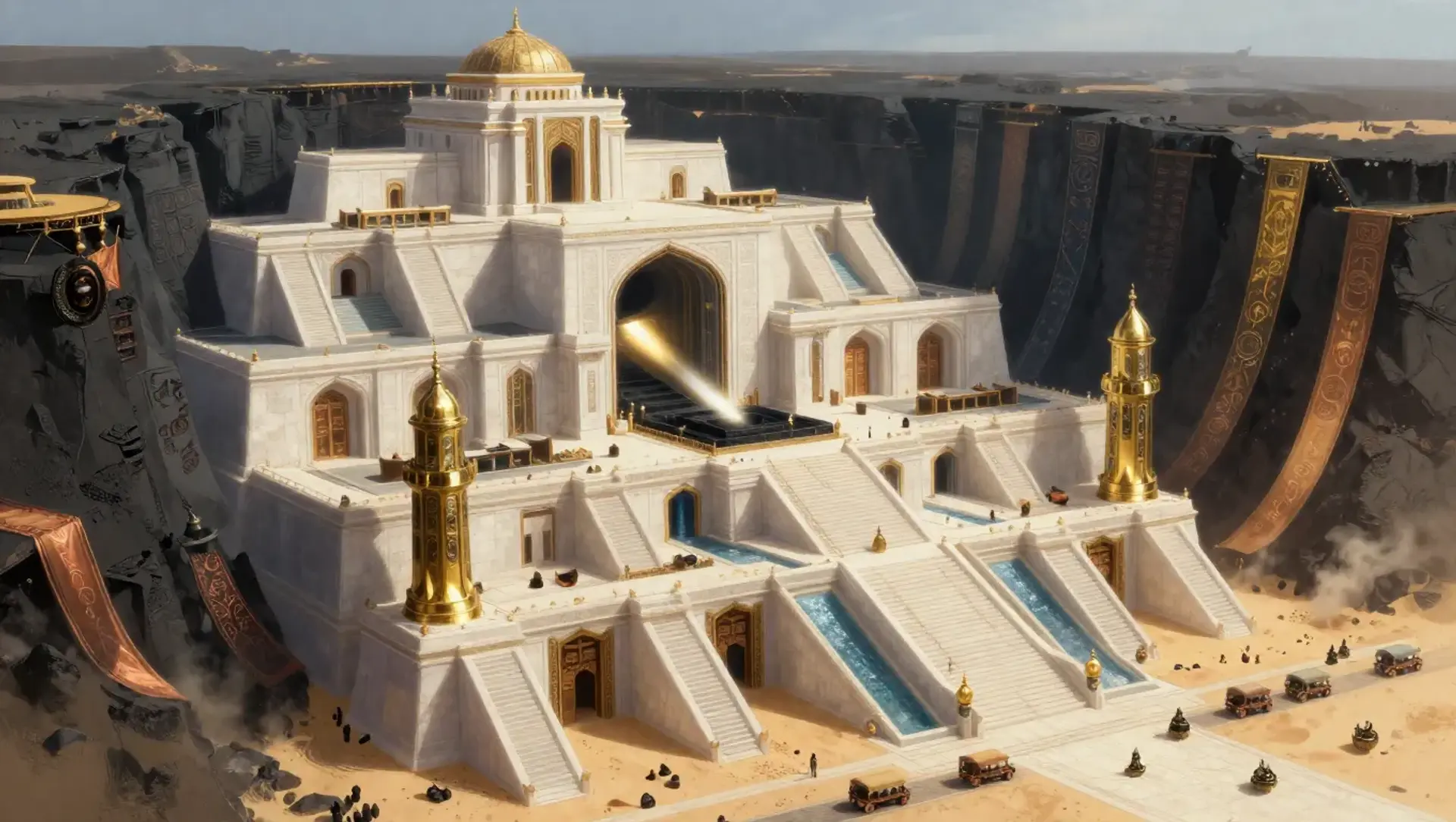
Sol-Kharash Citadel is the gleaming political and spiritual seat of House Austra-Cleth, carved into the highest terrace above Sol-Kharash’s busiest caravan crossing. Its name comes from the pale vertical scar cut through the black caldera wall during its founding, a monumental excavation that exposed a vein of white mineral stone. Five ascending courts lead from the public gate to the household palace, the shrine terraces, the archive halls, and the final judicial chamber beneath a massive open oculus. Brilliant plaster makes the citadel glow against the basalt, while angled brass mirrors crown its towers and direct harsh sunlight into the central court. Below, the archive complex descends deep into cool bedrock, where sealed records, shrine contracts, and judgments survive behind layers of warding. Visitors enter beneath banners, pass through measured pools of shade, and emerge into a court where the House decides who may own, trade, worship, testify, or remain.
Sol-Kharash Citadel
Heat presses against the citadel like a living weight. Sunlight flashes from brass mirrors and white walls, leaving bright spots in the eyes, while shaded corridors carry the cooler smells of wet stone, lamp oil, parchment, and bitter incense. Sand grates beneath sandals in the public galleries, bronze chains click behind archive doors, and distant caravan bells drift upward from the crossing below. The building feels immaculate, wealthy, and watchful, a place where every footstep seems recorded and every silence seems deliberate.
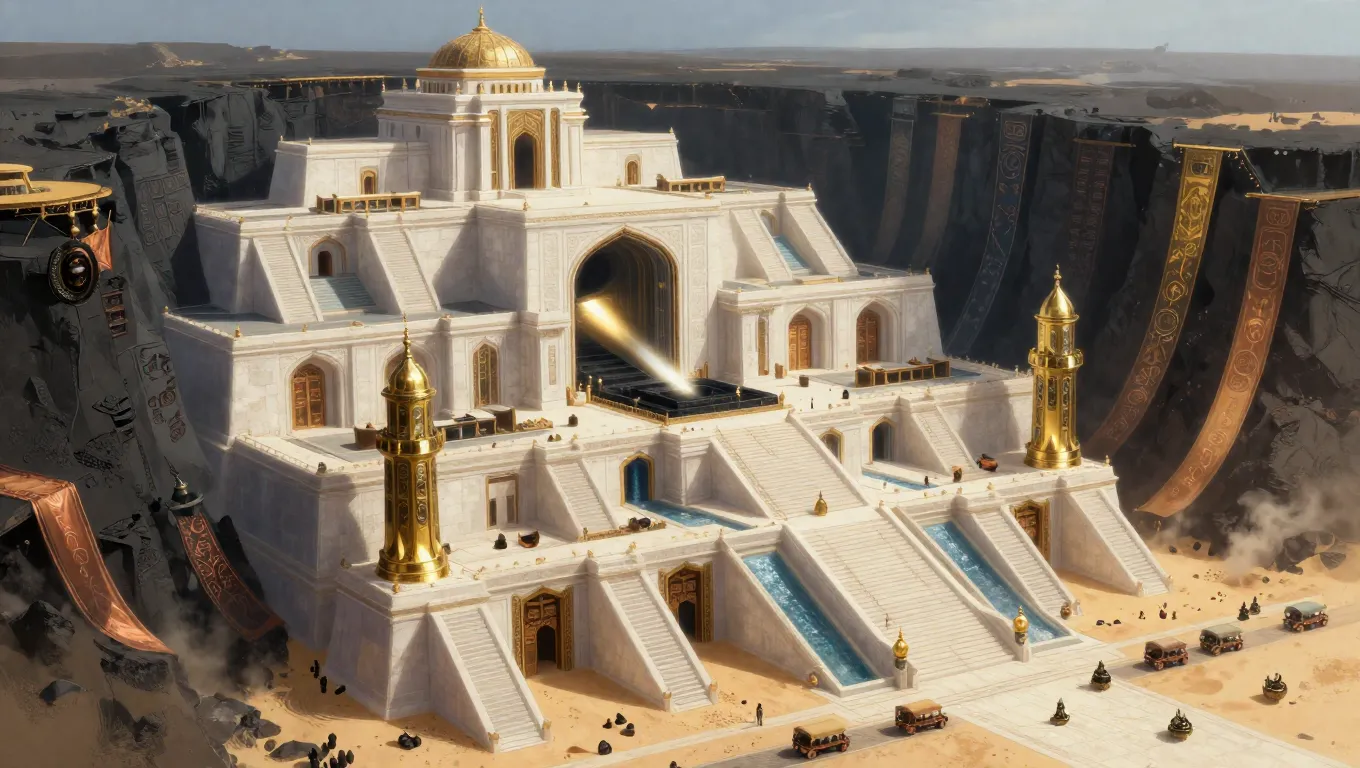
Sol-Kharash Citadel is the gleaming political and spiritual seat of House Austra-Cleth, carved into the highest terrace above Sol-Kharash’s busiest caravan crossing. Its name comes from the pale vertical scar cut through the black caldera wall during its founding, a monumental excavation that exposed a vein of white mineral stone. Five ascending courts lead from the public gate to the household palace, the shrine terraces, the archive halls, and the final judicial chamber beneath a massive open oculus. Brilliant plaster makes the citadel glow against the basalt, while angled brass mirrors crown its towers and direct harsh sunlight into the central court. Below, the archive complex descends deep into cool bedrock, where sealed records, shrine contracts, and judgments survive behind layers of warding. Visitors enter beneath banners, pass through measured pools of shade, and emerge into a court where the House decides who may own, trade, worship, testify, or remain.
Publicly gracious, ceremonious, and devoted to order. In private, the House is suspicious, calculating, and deeply afraid that its authority rests on records no one has independently verified.
History
The Deep Records
The upper archive contains tax rolls, shrine charters, caravan treaties, bloodline records, court precedents, and sealed judgments dating back to the Seven-Road Famine. The public stacks are arranged by road and season, while the restricted vaults hold records that could invalidate noble claims, expose fraudulent labor contracts, or prove that an imperial decree was altered before reaching Draknaar. Archive clerks work behind latticed brass screens, copying documents with mineral inks that resist heat, water, and magical fading. At the lowest level, a circular vault preserves original compacts inside crystal cases watched by bound solar sentinels.
The Sun Court
The central Hall of Judgment is built around a vast open oculus. At noon, a concentrated shaft of sunlight falls upon a black basalt dais where petitioners, accused criminals, and rival caravan masters must stand. Magistrates sit behind white stone screens, cool and unseen, while brass mirrors direct additional light toward anyone who gives false testimony under oath. Trials involving House law, shrine rights, caravan debts, or violations of solar law may draw hundreds of witnesses into the surrounding galleries. At the final verdict, a bronze gong is struck once for acquittal, twice for judgment, and three times for confiscation.
Rites of the High Sun
The shrine complex honors the solar traditions upheld by House Austra-Cleth, with services beginning before dawn and ending after the last heat leaves the escarpment. Priests burn cedar resin, bitter saffron, and lamp oil in tall copper censers. Petitioners may seek purification, witness protection, marriage recognition, contract blessing, or absolution for breaking a sworn obligation. The most important rite occurs during the highest sun, when the senior priest opens the roof shutters and lets direct light pass through a faceted glass lens onto the altar stone. The rite is said to reveal whether a ruler has kept faith with the roads.
Fortress Measures
The citadel is protected by six concentric gates, each designed to delay a different kind of assault. The outer gates can be sealed against cavalry, the middle gates can flood approach galleries with blinding reflected light, and the inner gates contain glyphs that suppress teleportation and planar travel. Brass mirrors on the towers can focus sunlight into scorching lines across the escarpment, though their use risks damaging nearby homes and caravan yards. The archive vaults are warded against fire, excavation, scrying, and possession. A hidden stair allows senior members of House Austra-Cleth to reach the judicial hall without crossing the public terraces.
Denizens
Publicly gracious, ceremonious, and devoted to order. In private, the House is suspicious, calculating, and deeply afraid that its authority rests on records no one has independently verified.
Species: Brass Dragonborn (Veteran legal scholar and senior magistrate) Class & Level: Wizard (Abjuration / Chronurgy) 15 / Cleric (Order Domain) 3 Appearance: An impeccably tailored brass dragonborn female in her late fifties with fine, highly polished scales the warm color of burnished copper, sharp amber eyes behind delicate rectangular wire-frame spectacles, and long horns bound back in a tight, geometric bronze sheath. She wears immaculate, dust-repellent robes of stiff white silk trimmed with heavy gold bullion thread, a stiff judicial collar stiffened with brass boning, and carries a heavy, iron-bound register of imperial statutes. Personality: Exceptionally clipped in her speech, formal, and rigorously composed, her pristine demeanor and rigid adherence to protocol conceal a formidable, razor-sharp legal intellect. She maintains an outward conviction that House Austra-Cleth's laws must remain absolute and unquestionable; however, driven by quiet conscience, she has begun secretly investigating whether the theocracy's oldest, most draconian precedents were forged entirely out of temporary emergency panic during the ancient Great Famine rather than eternal divine mandate. Descriptive Summary: Operating from the high-columned appellant chambers of the Sol-Kharash Citadel, Magistrate Sira presides over the highest-tier legal appeals across the Sun-Drenched Basalt Steppes. While Arch-Prelate Varis issues sweeping decrees and First Archivist Vespera guards the historical paper trail, Sira parses the literal text of the law. Her internal struggle between her lifelong devotion to order and her growing suspicion that the legal code is built on historical falsehoods makes her a dangerous, deeply influential figure within the courts.
Species: Human (Methodical, soft-spoken historical preservationist) Class & Level: Wizard (Divination) 13 / Rogue (Inquisitive) 4 Appearance: A slight, quiet human man in his late forties with pale, subterranean skin, soft gray eyes behind wire-rimmed spectacles, and ink-stained fingertips. He wears a faded, grease-spotted scholar's tunic of heavy gray wool, a leather apron filled with bone-handled scalpels and bone-folding knives, and sensible, soft-soled leather shoes designed for silent movement through stone stacks. Personality: Exceptionally soft-spoken, infinitely careful with his hands, and possessed of an unsettling, photographic memory for every name, land grant, and decree officially expunged from the theocracy's public records. He rarely engages in political debates, but his ability to identify the precise origin, era, and author of a historical document purely by analyzing its mineral-based ink, sewing thread, or trapped dust residue makes him an invaluable archive fixture who knows more forbidden history than any magistrate. Descriptive Summary: Operating from the deepest, lightless sub-basement levels beneath the Sol-Kharash Citadel, Keeper Corin maintains the dark underside of the House Austra-Cleth archives. While First Archivist Vespera controls the active lineage vaults and Magistrate Sira reviews current statutes, Corin preserves the fragile, suppressed documents that the theocracy tried desperately to erase. His quiet defiance and encyclopedic knowledge of expunged history make him a silent custodian of forgotten truths.
Species: Gold Dragonborn (Veteran religious prelate and senior solar liturgist) Class & Level: Cleric (Light Domain) 15 / Paladin (Oath of Devotion) 3 Appearance: A distinguished, heavily built gold dragonborn in his early sixties with luminous, sun-kissed metallic scales, deep amber eyes, and broad horns swept back from his brow. He wears immaculate, flowing vestments of brilliant white silk embroidered with fiery gold threads, a heavy polished copper pectoral disk bearing the sunburst sigil of the steppes, and a precision magnifying copper lens mounted on a delicate brass monocle frame over his right eye. Personality: Exceptionally deliberate, speaking in long, rhythmic, measured phrases that evoke the steady passage of the sun across the sky. His public sermons passionately praise absolute clarity of judgment, unyielding truth, and the divine order of the theocracy. However, beneath his pious pulpit presence lies a quiet, calculated subversion: he has repeatedly utilized complex liturgical technicalities, mandatory purification fasts, and calendar disputes to indefinitely delay trials involving indentured laborers and debt-bound commoners. Descriptive Summary: Operating from the towering, sun-bleached shrines and administrative altars of Sol-Kharash, Senior Priest Kaelen anchors the spiritual bureaucracy of House Austra-Cleth. While Arch-Prelate Varis commands the supreme courts and Confessor Malakor hunts ideological subversion, Kaelen uses the church's own religious calendar as a shield to protect vulnerable workers from immediate punishment. His outward devotion masks a weary pragmatist who uses holy law to buy time for the oppressed.
Species: Dwarf (Master builder and subterranean engineer) Class & Level: Fighter (Battle Master) 14 / Artificer (Armorer / Battle Smith) 4 Appearance: A powerfully built, broad-shouldered dwarf in her mid-fifties with a determined square jaw, braided iron-gray hair woven with metallic wire, and sharp steel-gray eyes. She wears a soot-stained leather work harness over heavy canvas robes, reinforced iron-plated gauntlets permanently blackened by forge coal, and carries a heavy, rune-etched surveyor's hammer tucked into her utility belt. Personality: Angular, intensely pragmatic, and completely devoid of small talk. She communicates in clipped, direct sentences, treating engineering problems with absolute mechanical seriousness. While fiercely loyal to the operational stability of the citadel, her decades of tunneling and reinforcing the basalt escarpment have given her a deep, undocumented understanding of the fortress's anatomy: she knows precisely which modern defensive walls were built directly on top of older, forgotten pre-theocracy foundations and hidden subterranean vaults. Descriptive Summary: Operating from the roaring geothermal engine rooms and basalt work-tunnels deep beneath the Sol-Kharash Citadel, Master Thora maintains the vital life-support systems of the capital. While Arch-Prelate Varis commands the courts and Marshal Vorrak drills the guards, Thora keeps the cooling channels flowing, the massive rooftop brass mirrors aligned, and the heavy pneumatic gates functioning. Her mastery over stone and steel makes her an indispensable pillar of the fortification—and a silent keeper of the structural secrets buried beneath the rock.
Species: Brass Dragonborn (Talented young orator and court messenger) Class & Level: Bard (College of Valor) 12 / Rogue (Scout) 4 Appearance: A sleek, athletic young brass dragonborn in his mid-twenties with finely polished, copper-bright scales, sharp amber eyes, and clean, swept-back horns. He wears a tailored, high-collared tabard of crisp white and gold bearing the sunburst heraldry of House Austra-Cleth, highly polished leather boots, and carries a ceremonial brass-bound megaphone staff etched with amplification runes. Personality: Outwardly brimming with theatrical devotion, absolute loyalty, and unwavering enthusiasm for House Austra-Cleth during every public proclamation. However, behind his dazzling, booming performance lies a sharp, observational survivalist: while standing watch at the busy public gates, he has quietly and meticulously memorized every private sally port, hidden alleyway, and secret noble entrance utilized by high officials seeking to slip in and out of the citadel unnoticed. Descriptive Summary: Operating from the grand archways and entry plazas of the Sol-Kharash Citadel, Kaelen serves as the official sonic bridge between the ruling house and the bustling citizenry of the steppes. While Arch-Prelate Varis decrees laws and Marshal Vorrak commands the guards, Kaelen projects the voice of authority across open stone plazas. His pristine public persona completely masks his quiet mental map of the citadel's secret vulnerabilities, making him an accidental keeper of backdoor secrets in a city built on absolute transparency.
Rumors & Plot Hooks
- 1.The sealed Twin Wells contain a surviving witness from the Seven-Road Famine, preserved by an ancient solar rite.
- 2.A magistrate has been replacing unfavorable judgments with flawless copies bearing the same ink and seal.
- 3.The brass mirrors can burn a creature’s shadow into the stone, allowing the House to track it across the Steppes.
- 4.One of the deepest archive doors opens only during a lunar mana surge influenced by Poreseta.
- 5.A hidden chamber beneath the shrine contains the original emergency decree that established solar law.
- 6.The House has begun preparing a private tribunal for envoys connected to the approaching Dawn Compact Renewal.
Classified Entry
Sol-Kharash Citadel was built over a buried pre-House court whose foundation predates the Seven-Road Famine. Its surviving inscriptions reveal that the first Austra-Cleth shrine families did not save the region during the famine. They engineered the shortages, seized the spring gates, and used emergency law to turn temporary control into hereditary rule. The oldest archive vault contains the unaltered testimony, but the records are protected by a solar intelligence that will expose the truth only if a claimant from both founding shrine lines stands together beneath the oculus.
Turn Sol-Kharash Citadel into a sheet
A high-res, share-ready sheet you can post or print.