
The Last Lantern
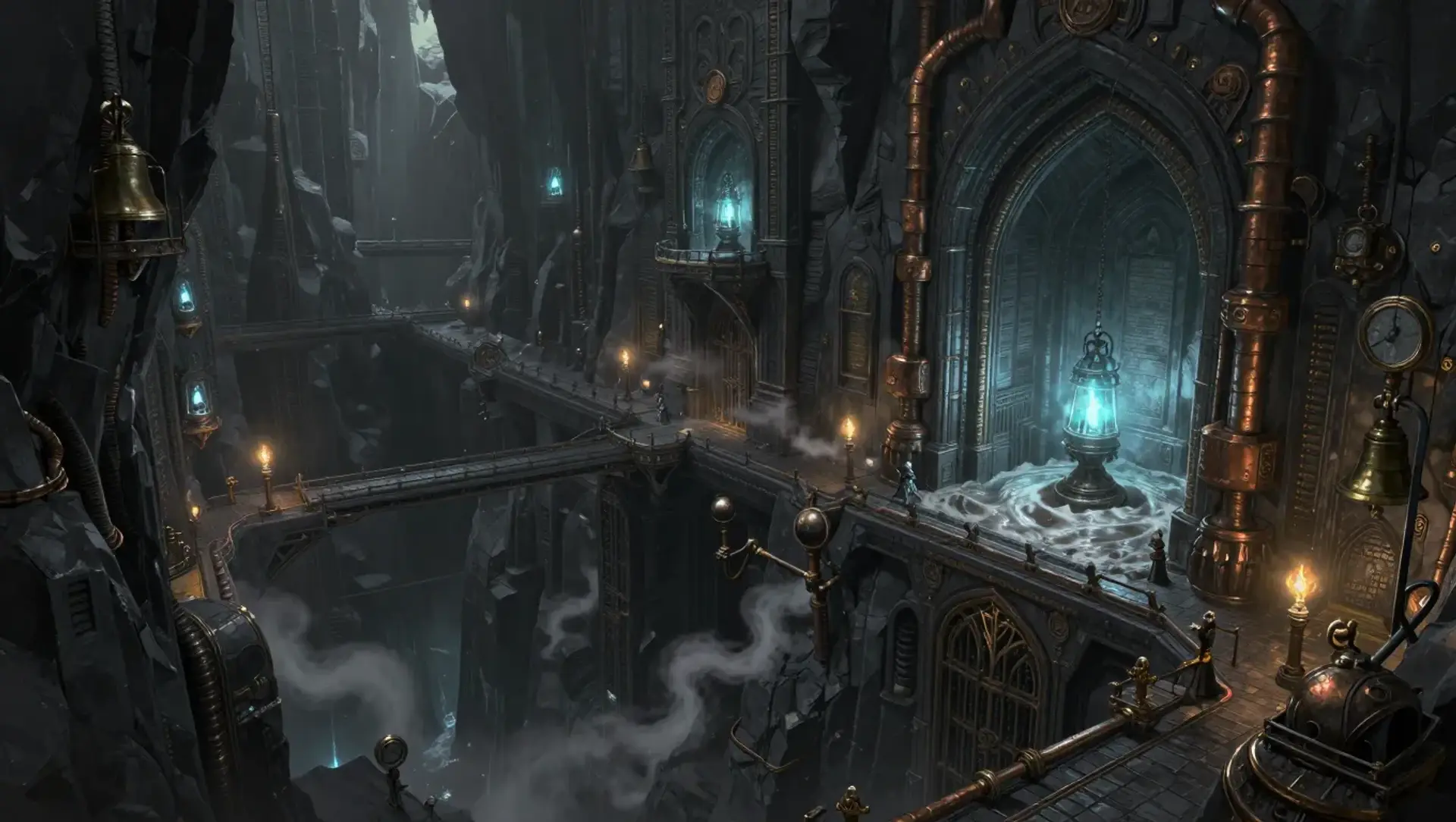
The Last Lantern clings to a sheer basalt cliff above the Agscapeviw Fracture, the final sanctioned stronghold before the Kharbal Holdfasts give way to the uncharted underground abyss. Nearly four hundred soldiers, quarantine wardens, seismic signalers, healers, engineers, and memorial priests live within its layered halls. Narrow bridges connect the main galleries to watch platforms, supply lifts, and sealed observation chambers overlooking the chasm. Hissing geothermal pipes warm the bastion, their copper surfaces glowing faintly in the dark. The outpost is built to endure collapse, invasion, and contamination, but its greatest strength is discipline. Every bell has a purpose, every door has a seal, and every expedition beyond the last marker is logged as though it might be the final one.
The Last Lantern
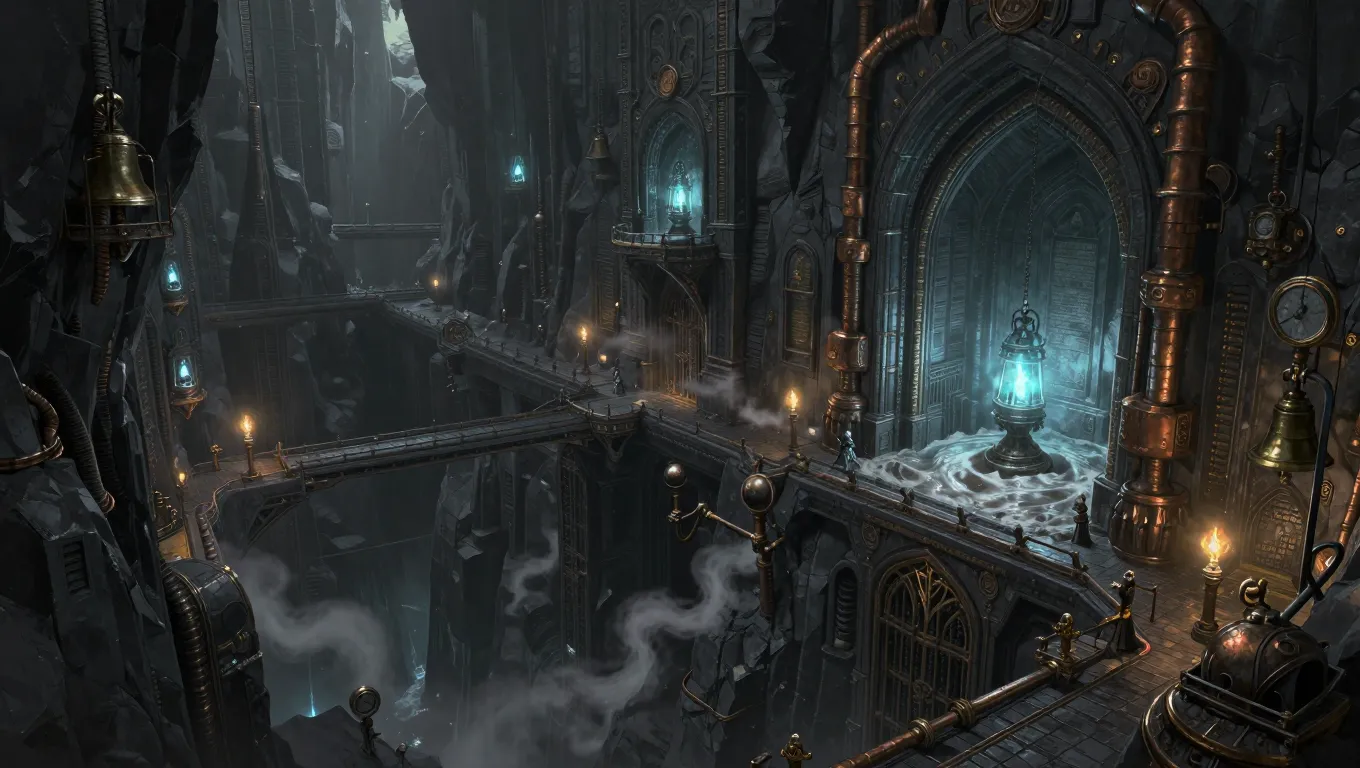
The redoubt feels secure without ever feeling safe. Warm steam beads on the walls, lamp oil burns with a steady blue-gold glow, and the floor trembles beneath every conversation. The air tastes of iron, bitter root, and mineral dust. Bronze bells answer one another through the corridors, sometimes with a deliberate warning and sometimes with a faint ringing no one can explain. Soldiers speak quietly near the quarantine doors, while shrine attendants whisper prayers into the rising geothermal haze. Beneath it all, a deep vibration moves through the stone like something enormous turning in its sleep.
The Last Lantern clings to a sheer basalt cliff above the Agscapeviw Fracture, the final sanctioned stronghold before the Kharbal Holdfasts give way to the uncharted underground abyss. Nearly four hundred soldiers, quarantine wardens, seismic signalers, healers, engineers, and memorial priests live within its layered halls. Narrow bridges connect the main galleries to watch platforms, supply lifts, and sealed observation chambers overlooking the chasm. Hissing geothermal pipes warm the bastion, their copper surfaces glowing faintly in the dark. The outpost is built to endure collapse, invasion, and contamination, but its greatest strength is discipline. Every bell has a purpose, every door has a seal, and every expedition beyond the last marker is logged as though it might be the final one.
The station's collective authority is stern, methodical, and intensely protective of the Holdfasts. Its officers value containment over comfort, records over reputation, and survival over glory. They distrust imperial agents and outsiders who treat the Agscapeviw Fracture as a source of treasure rather than a living danger.
History
Quarantine Protocols
The Last Lantern operates under a three-stage quarantine protocol. The outer wards receive miners, scouts, and wounded patrols for examination. The middle wards hold anyone exposed to fracture mist, parasitic growths, or unexplained memory loss. The inner wards are sealed behind rune-banded iron doors and reserved for patients whose bodies or minds show signs of Agscapeviw contamination. Each chamber contains a stone drain, a copper speaking tube, and a narrow observation slit. Geothermal pipes keep the rooms warm, but the air carries the sharp smell of vinegar, bitterroot, and hot metal.
Command and Defense
The command post overlooks the main descent through a reinforced basalt gallery. A relief map of the lower frontier covers one wall, marked with bronze pins, colored cords, and fresh cracks scratched into the stone each morning. Seismic signalers monitor the tuned bells and pressure gauges while officers coordinate patrols, supply trains, and emergency collapses. During an alert, shutters close over the observation galleries, bridge chains retract, and every resident reports to an assigned defensive station.
Shrine Rites
The Shrine of the Star-Sand Flame stands at the heart of the redoubt, where three corridors meet beneath a vaulted chamber of black stone. Odran Deep-Bell's original iron lantern hangs above a circular basin filled with silver-gray Star-Sand. Its cold flame gives no heat, yet it paints every face in pale blue light and makes the surrounding metal hum softly. Memorial tablets bear the names of wardens lost beyond the last sanctioned marker. Priests tend the flame, receive oaths, bless departing patrols, and perform the Lantern Watch for those who may not return.
Frontier Stores and Records
The Last Lantern maintains a standing supply of climbing gear, sealed rations, restorative teas, mining tools, alchemical disinfectants, and replacement signal bells. The Deep Wardens may requisition equipment for missions into the Agscapeviw Fracture, but every item must be recorded upon return. The outpost also holds a modest archive of seismic charts, quarantine reports, and testimony from survivors of lower-fault expeditions. Several ledgers are chained to the command desk because previous commanders discovered that pages had been removed during moments of panic.
Denizens
The station's collective authority is stern, methodical, and intensely protective of the Holdfasts. Its officers value containment over comfort, records over reputation, and survival over glory. They distrust imperial agents and outsiders who treat the Agscapeviw Fracture as a source of treasure rather than a living danger.
A broad-shouldered dwarf with a silver beard braided around brass signal keys. He treats every decision as a matter of measured duty, but his sleepless eyes reveal that he expects the fortress to fall within his lifetime. He is fiercely protective of the quarantine wards and will not permit outside authorities to remove a patient without proof of safety.
A calm human physician with scarred hands and a talent for recognizing magical contamination by smell. She keeps detailed notes on every patient and refuses to accept that the fracture sickness is merely biological. She believes the symptoms are caused by a leyline influence that is learning how to imitate disease.
A young Basalt-Born signaler who can distinguish ordinary rockfall from deliberate movement beneath the stone. He has mapped several bell tones that no other station has recorded. He is eager to prove himself, yet increasingly afraid that the unknown rhythm is answering the fortress's alarms.
An elderly priest of the Star-Sand Flame whose robes are darkened by years of lamp smoke. He believes the shrine flame is not simply a sacred light, but a containment device bound to the old leyline network. He welcomes honest questions and becomes immovable when anyone proposes extinguishing it.
A former Deep Warden captain recovering in the inner quarantine wards after returning alone from a failed descent. Her body shows no obvious corruption, but she insists that the fracture has begun using the voices of the dead. She may know the location of a lost lower gate, though speaking about it causes the bells near her room to ring.
Rumors & Plot Hooks
- 1.A bell in the lowest junction rings every night at the same hour, though the corridor beneath it was sealed decades ago.
- 2.The Star-Sand Flame has begun casting a second shadow, one that points toward the deepest descent instead of away from the lantern.
- 3.A quarantine patient recovered from fracture sickness after whispering a name that appears nowhere in the Deep Ledger.
- 4.Obsidian Tribunal agents once bribed a signaler to falsify tremor reports and open a route beneath the station.
- 5.The Last Span has been found unlatched after every major quake, as if something below keeps testing the bridge.
- 6.The old memorial tablets include names from expeditions that officially never existed.
- 7.A vein of pure Star-Sand lies beneath the shrine, but removing it would weaken the flame and expose the fortress to the abyss.
Classified Entry
The Last Lantern was built over a dormant leyline vent connected to the Agscapeviw Fracture. Odran Deep-Bell did not create the Star-Sand Flame, he bound it to the vent using his own life force and the names of the first wardens who died during the binding. The flame has been containing a slow pulse of leyline corruption for centuries. Recently, that pulse has begun to change. The contamination in the quarantine wards is not spreading outward from the fracture, it is being drawn toward the shrine. Someone or something below is calling the corrupted patients through the stone, and the command post's official records conceal that three senior commanders already heard the answering voice before they died.
Turn The Last Lantern into a sheet
A high-res, share-ready sheet you can post or print.