
Hatchery Cave
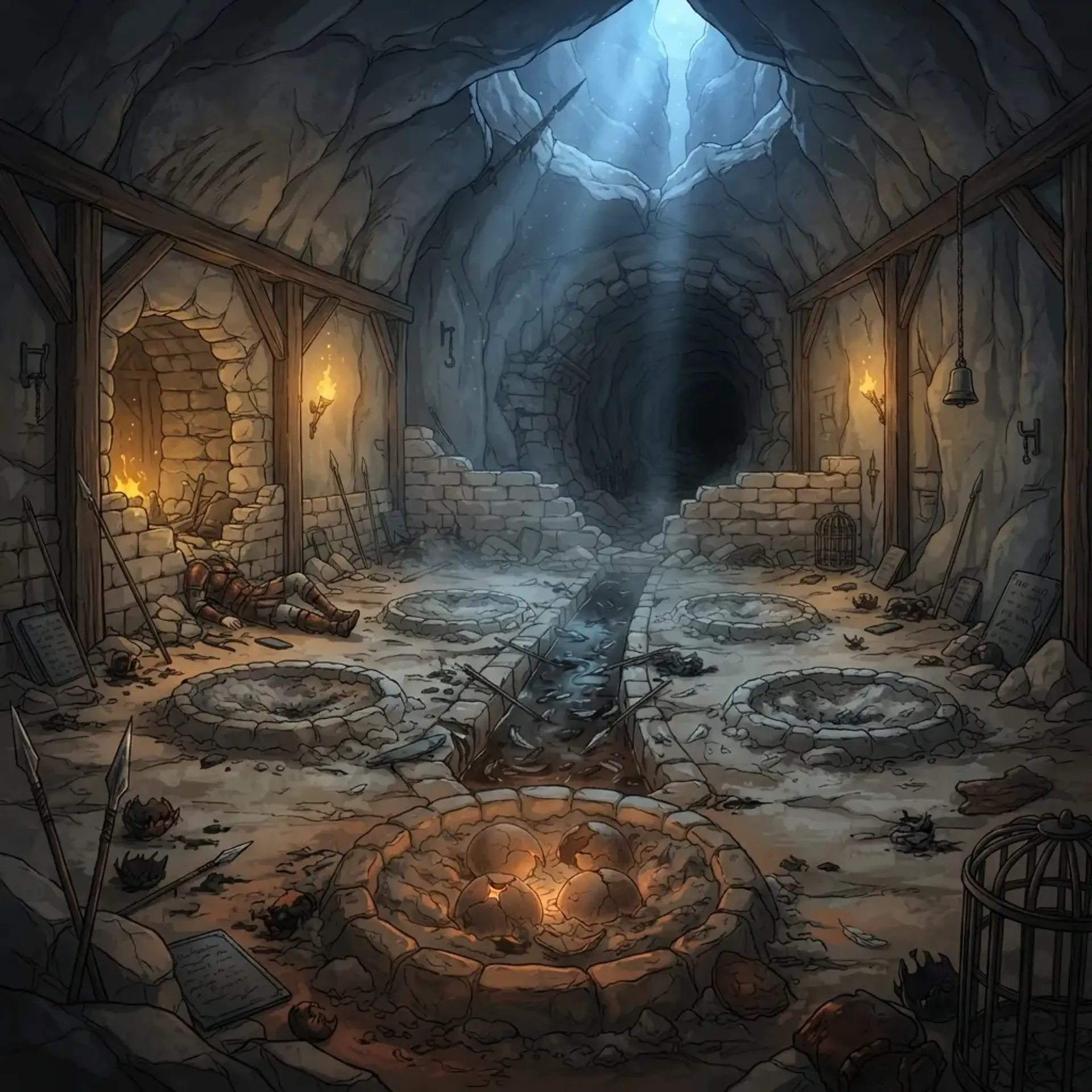
Hatchery Cave is a guarded cavern hidden beneath the Cultist Camp, where the cult raised the young of its planned army. The party finds the remains of a desperate battle scattered across the chambers: broken spears, blackened egg shells, dead guards, and bodies dragged toward the lower tunnel. Crude walls divide the cave into feeding rooms, guard stations, and nesting pits. A faint warmth persists beneath the largest pit, suggesting that the cult's final brood was not completely destroyed.
Hatchery Cave
Hot, damp, and close. The air carries the sour smell of wet stone, old blood, ash, and rotting feed. Every sound travels through the tunnels, turning a dropped weapon or whispered warning into a threat from somewhere deeper. The cave is quiet now, but the silence feels watched.
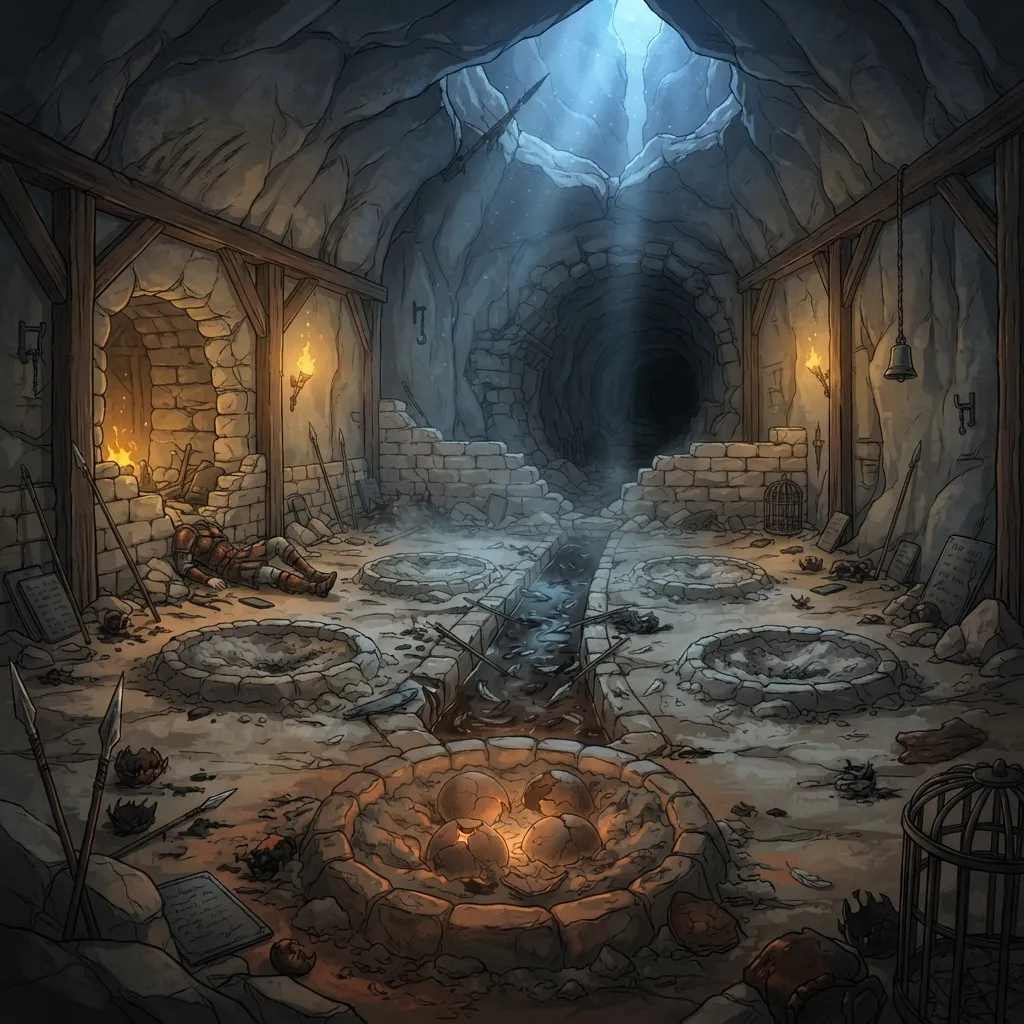
Hatchery Cave is a guarded cavern hidden beneath the Cultist Camp, where the cult raised the young of its planned army. The party finds the remains of a desperate battle scattered across the chambers: broken spears, blackened egg shells, dead guards, and bodies dragged toward the lower tunnel. Crude walls divide the cave into feeding rooms, guard stations, and nesting pits. A faint warmth persists beneath the largest pit, suggesting that the cult's final brood was not completely destroyed.
Strict, methodical, and quietly exhausted. She treated the hatchlings as a work assignment rather than sacred beings, though prolonged exposure had made her superstitious about the largest egg. Her final actions suggest a mixture of duty, fear, and a desperate attempt to keep the brood from escaping.
History
Nesting Chambers
The upper chamber held six rough nesting pits lined with ash, shredded cloth, and animal hair. Most are empty now, but one still contains warm, leathery fragments that twitch when disturbed. The pits were arranged around a central drain so spilled fluids could be washed toward the lower tunnels.
Guard Posts
The hatchery was protected by three simple measures: a barred inner gate, a bell cord strung through the guard niche, and a clay seal placed across the main passage. The seal bears the thumbprint of Sazka, the camp's former egg keeper. Breaking it was meant to warn the soldiers above, though the skirmish has left the bell rope cut and the gate hanging open.
Hatchery Records
The cult kept ledgers on slate tablets rather than paper. Each tablet recorded the number of eggs, feeding dates, shell color, and the names of guards assigned to the cave. Several tablets survived beneath a collapsed shelf. The final entries stop abruptly after the words, “The largest one has begun to answer.”
Culling Niche
A narrow lower tunnel leads to a sealed stone niche used for culling failed hatchlings. Inside are cracked shells, rusted hooks, and a small bronze knife made by the camp's former metalworkers. The niche is not large enough for an adult to stand comfortably, but something has recently scraped its ceiling from within.
Denizens
Strict, methodical, and quietly exhausted. She treated the hatchlings as a work assignment rather than sacred beings, though prolonged exposure had made her superstitious about the largest egg. Her final actions suggest a mixture of duty, fear, and a desperate attempt to keep the brood from escaping.
Sazka was the cult's senior egg keeper, responsible for feeding, sorting, and culling the hatchlings. She died defending the inner gate and still wears a ring of clay keys around her wrist. Her notes reveal that she had begun to fear the largest egg and considered fleeing before the battle.
Kett served as the final guard captain of the hatchery. His body lies near the main nesting pit beneath a snapped spear. He was a practical soldier rather than a true believer, and his blood-marked tally stick records that several guards deserted before the party arrived.
Shu-of-the-Kilns was a former quarry worker forced to reinforce the cave for the cult. He survived the battle by hiding behind a fallen brace and can be found if the party searches the upper rubble. Frightened and dehydrated, he knows the route to the sealed culling niche and remembers hearing a voice beneath the largest pit.
Rumors & Plot Hooks
- 1.The cult did not create the hatchlings. It found the first egg in the lowest quarry chamber and built the hatchery around it.
- 2.One guard fled into the lower tunnel during the battle and may still be alive behind the collapse.
- 3.The largest egg could imitate voices heard through the cave walls.
- 4.The cult planned to release the young creatures during its next attack, but the hatchery records say the brood was developing too quickly.
- 5.The bronze knife can cut the clay seal on the culling niche without triggering the old warning charm.
Classified Entry
The largest nesting pit is not empty. Beneath the ash and broken shells rests a living juvenile creature that has learned to remain motionless when footsteps approach. It is weak, hungry, and not yet fully formed, but it can repeat short phrases spoken nearby. The cult believed it would become the commander of the hatchery brood. If left undisturbed, it will eventually crawl through the drainage channel and emerge beneath the camp.
Turn Hatchery Cave into a sheet
A high-res, share-ready sheet you can post or print.