
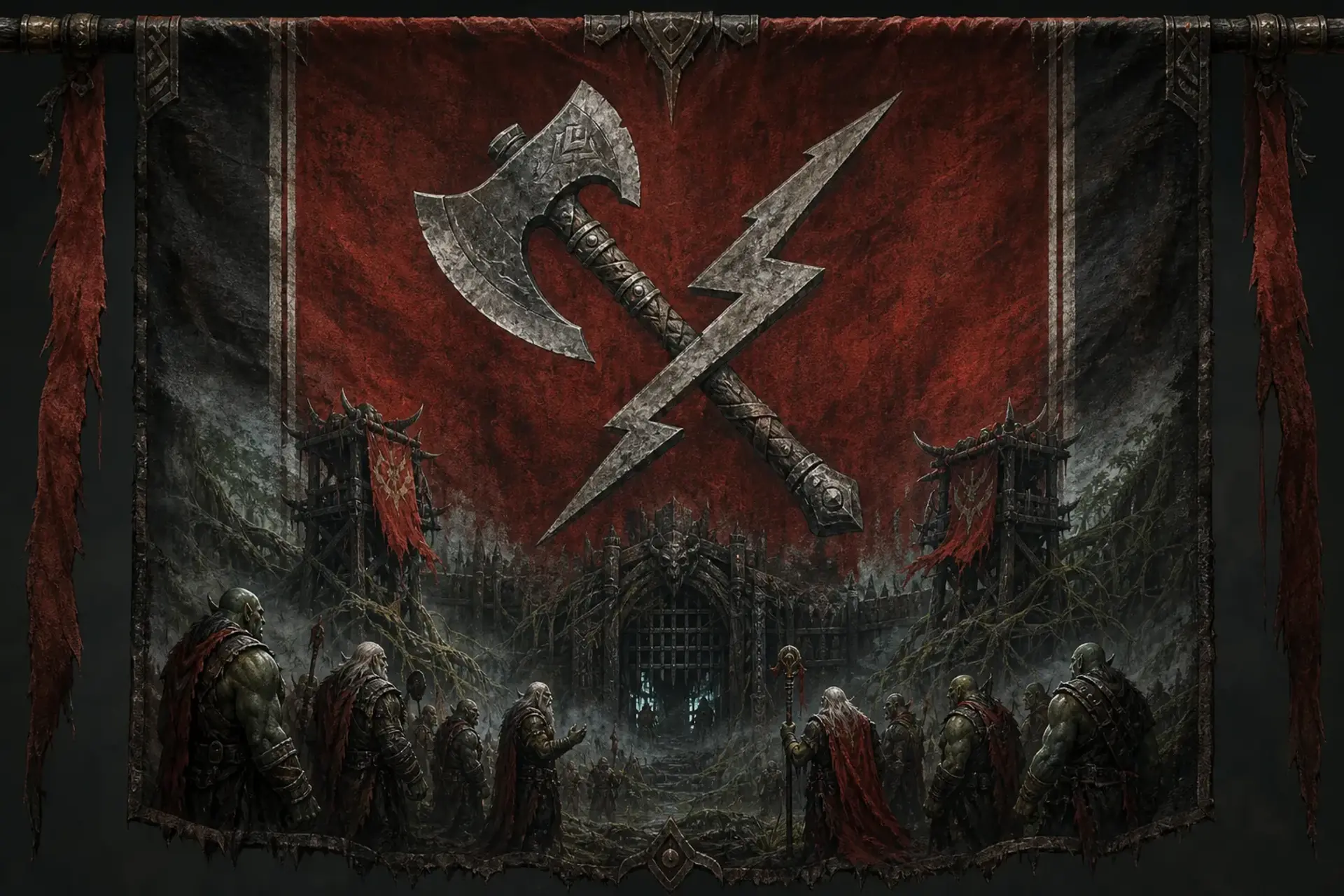
Thunder Axe Tribe, Roll 7
The Thunder Axe Tribe controlled part of the Suss Forest in the era of the ancient orc civilization. Its stronghold served more than a military purpose: it was a place of judgment, healing, confinement, and commerce in captives. Draak served as priest, judge, healer, and warden, a concentration of offices that made him both a caretaker and an agent of coercive authority. The defining crisis began when a patrol captured a powerful fey being and bound it in cold iron. The captive was taken to the tribe's prison and slave market. Whether the capture was ordered, opportunistic, or provoked is not known. The tribe refused to release the prisoner. That decision became the watershed moment associated with the tribe: its refusal helped unleash the corruption that destroyed the ancient orc civilization. The tribe's earlier successes may have made the decision seem defensible. It controlled forest ground, maintained its own order, and held captives as a source of labor, leverage, and wealth. But its institutions offered no safe way to distinguish a dangerous prisoner from a force whose confinement threatened everyone. The tribe's fall, the prison's fate, and the end of its people remain open questions. In a later age, Draak manifested through Bubu Sh'Bunka when she picked up the Ancient Shackles, identifying the ruins as the tribe's prison and slave market.
Thunder Axe Tribe, Roll 7
- Type
- Ancient orc tribe with…
- Size
- 250 members
- Reach
- Historically substantial…
- Base
- Suss Forest
Overview
The Thunder Axe Tribe controlled part of the Suss Forest in the era of the ancient orc civilization. Its stronghold served more than a military purpose: it was a place of judgment, healing, confinement, and commerce in captives. Draak served as priest, judge, healer, and warden, a concentration of offices that made him both a caretaker and an agent of coercive authority. The defining crisis began when a patrol captured a powerful fey being and bound it in cold iron. The captive was taken to the tribe's prison and slave market. Whether the capture was ordered, opportunistic, or provoked is not known. The tribe refused to release the prisoner. That decision became the watershed moment associated with the tribe: its refusal helped unleash the corruption that destroyed the ancient orc civilization. The tribe's earlier successes may have made the decision seem defensible. It controlled forest ground, maintained its own order, and held captives as a source of labor, leverage, and wealth. But its institutions offered no safe way to distinguish a dangerous prisoner from a force whose confinement threatened everyone. The tribe's fall, the prison's fate, and the end of its people remain open questions. In a later age, Draak manifested through Bubu Sh'Bunka when she picked up the Ancient Shackles, identifying the ruins as the tribe's prison and slave market.
How it began
The tribe's surviving account says its ancestors entered the Suss Forest as a scattered people and held ground by defending a narrow route through the trees. The details are uncertain, and Draak's testimony does not identify a single founder. Its later identity formed around a practical bargain: warriors guarded the territory, elders set the terms of justice, and priests tended the sick and watched the prison. The Thunder Axe name became a mark of authority as much as a name for a people.
How to know them
Oxide red, Charcoal, Pale iron
- A crossed axe and fork of lightning
- Pale iron bands associated with custody
- Red marks used to identify tribal property or jurisdiction
Standing
What they say they want
What they are doing now
Where it leads
The tribe's historical vision is not recorded. Its actions suggest it sought to maintain control of its forest territory, preserve its own laws, and retain the power to decide who could be held within its prison. The consequences of its refusal show how that vision could become self-destructive.
How others see them
Accounts of the tribe are filtered through its ruin and Draak's testimony. It may be remembered as a disciplined people who kept order in a dangerous forest, but the prison and slave market make that reputation difficult to separate from oppression.
People
5 ranks
War-chief
Unknown. Do not treat a reconstructed motive as established fact.
- War-chief1 member
Led defense, raids, and negotiations with outsiders. The war-chief could not safely ignore the judgment of the elders or the prison warden.
- Elders' circle5 members
Set tribal law, settled major disputes, and advised on questions of captivity, tribute, and war. Decisions were likely shaped by custom and argument rather than a single ruler's command.
- Wardens and keepers3 members
Guarded the prison, maintained restraints, recorded custody, and oversaw captives brought to the market. Draak held several of these duties at once.
- Draak Priest, judge, healer, and prison warden
- Hearth-speakers20 members
Handled healing, ritual, mediation, and the transmission of tribal memory among households.
- Warriors, households, and dependents240 members
Sustained the settlement, defended territory, gathered food, and supported the tribe's trades and ceremonies. These estimates are a system-agnostic reconstruction, not a confirmed census.
Other key members
- Bubu Sh'Bunka Later witness and medium for Draak's manifestation
How they are organised
- Historically, membership likely followed kinship, adoption, or incorporation into the tribe, but exact customs are unknown.
- Service to the settlement and recognition of tribal law may have been expected.
- No living recruitment practice is known.
Relations
5 factionsThe tribe relied on neighboring orc communities for trade, marriage ties, and mutual defense. Some supported its right to hold captives; others withdrew when the fey prisoner was kept.
Operations
What they do
How they do it
Services for hire
- Captive custody and saleHistorically exchanged for labor, goods, or political leverage; exact terms unknownThe tribe's prison and slave market held and transferred captives.
- Healing and ritesUnknownDraak served as a healer as well as priest, judge, and warden. The tribe's healing rites and limits are not recorded.
What they can do
What they have
Where they are weak
Territory
Headquarters
Suss ForestA forest stronghold whose most infamous section was a prison and slave market. The chambers were built to hold captives and valuables, with a guarded enclosure where the Ancient Shackles could be used. Its present condition is unknown. The ruins may have been swallowed by the forest, damaged by the corruption, or altered by later occupants.
Lands they hold
Outposts
- Forest patrol stationsWithin the Suss Forest; exact site unknownWatch routes, identify intruders, and protect the tribe's territorial claims.
Secrets
Plot hooks
4 hooks- 1The Warden's Unfinished HearingPersonal, investigativeReward: A clearer memory from Draak, or a personal connection to the prisoner's historyA character who touches the Ancient Shackles experiences fragments of a prison hearing. Draak asks them to find out whether the tribe ever considered releasing the captive. The fragments conflict, and each may be true from a different witness's point of view.
- 2The Scraped LedgerLocal, exploration and investigationReward: Historical evidence, access to a sealed ruin, or leverage with interested partiesA newly uncovered chamber beneath the ruins contains a record of the fey captive's transfer. Several marks have been deliberately scraped away. Recovering the missing names could identify the people who profited from the sale, or reveal that a later power altered the evidence.
- 3What the Iron HeldRegional, moral and supernaturalReward: A dangerous alliance, a way to contain the corruption, or knowledge of its originA surviving fey presence claims that the corruption was not an accident but the intended consequence of an oath broken by the tribe. Draak disputes the account. The party must decide whether to seek corroboration, destroy the shackles, or use them to contact the presence.
- 4A Law Made from RuinsCampaign-scale, politicalReward: Public vindication for victims, political influence, or a chance to prevent a new atrocitySomeone is using the tribe's legacy to justify a modern prison or slave market, arguing that the Thunder Axe custom was necessary for survival. The party can expose the historical truth, but the evidence may also implicate respected descendants or allies.
Work they offer
What gets in the way
Rumours
Connections
Media
0 imagesNo images yet.
Turn Thunder Axe Tribe, Roll 7 into a sheet
A high-res, share-ready sheet you can post or print.