
Iron-Gate
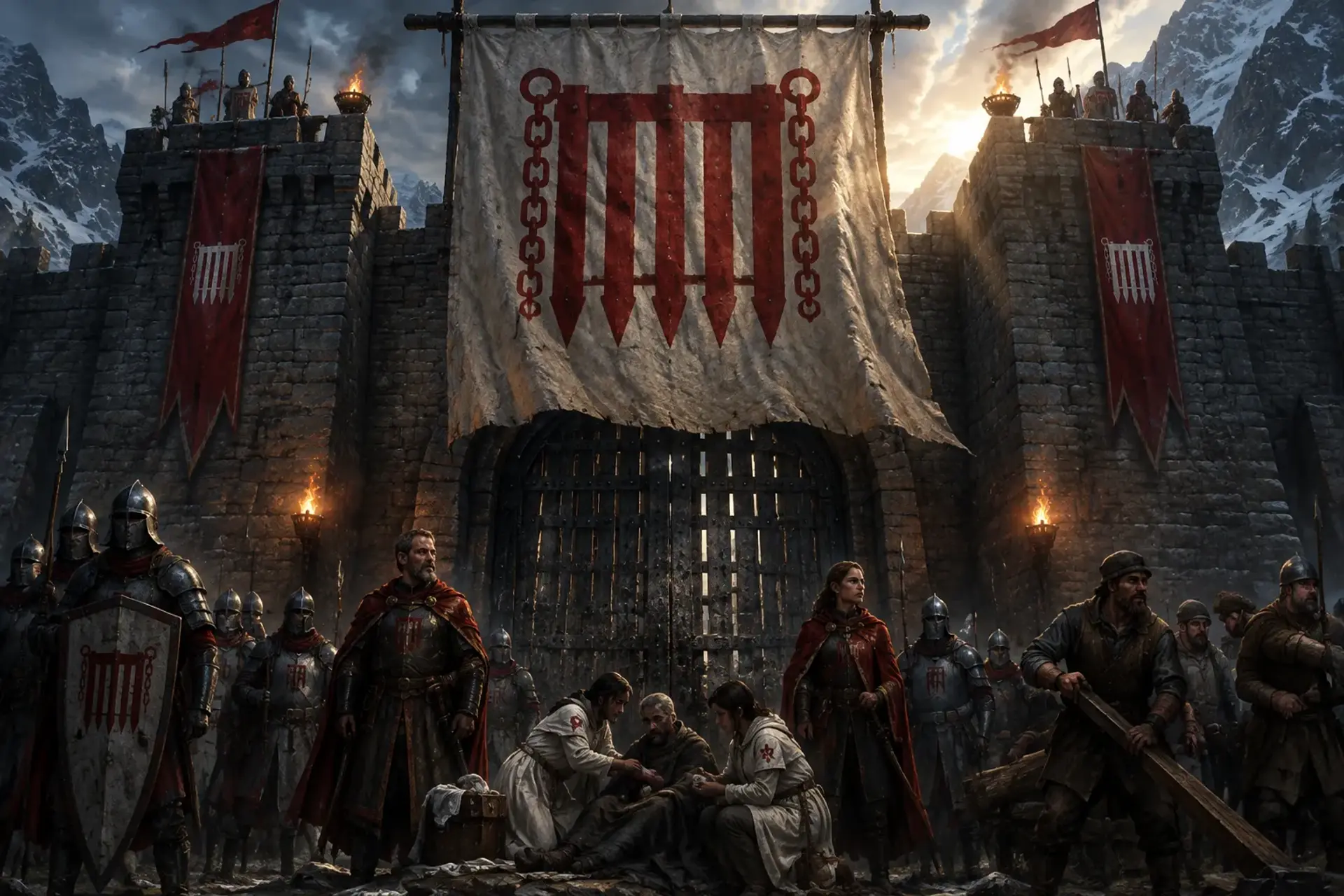
Iron-Gate began as a wartime compact among mercenary companies and adventurers fighting the troll invasion of the Scarred Lands in 1400 a.c. Its first decades were less a single army than a mutual-defense agreement: companies kept their own traditions but shared scouts, signals, a common emergency fund, and a promise to reinforce threatened settlements. Its watershed moment came when the founding force held the pass-gate long enough for civilians to flee. The victory made the compact famous, and the battered gate became its enduring emblem. After the war, Lisgardo granted the compact stewardship of several frontier fortresses in exchange for maintaining garrisons. The guild converted a temporary alliance into a standing institution, developed written contracts and common training, and began offering guards and bodyguards to merchants and nobles. Over generations, its proven reliability attracted the other four Free Merchant-City states. The guild's fleet grew to protect northern sea trade, while its army became a mobile force able to reinforce distant holdings. The Stone-Under Clan joined through a long partnership in rebuilding the frontier forts. The Bright-Quench Enclave followed, drawn by steady orders and access to military workshops. The guild's battle healers and medics grew from the grim lesson that a protected road is useless if its wounded are abandoned. Today Iron-Gate is a national power, not merely a company of hired blades. Its success rests on professional standards and dependable logistics, but the very scale that makes it effective has made it hard for the Northlands to govern without it.
Iron-Gate
- Type
- Trade Consortium
- Size
- 8,700 members
- Reach
- National
- Base
- The Scarred Lands, within Lisgardo's territory
Overview
Iron-Gate began as a wartime compact among mercenary companies and adventurers fighting the troll invasion of the Scarred Lands in 1400 a.c. Its first decades were less a single army than a mutual-defense agreement: companies kept their own traditions but shared scouts, signals, a common emergency fund, and a promise to reinforce threatened settlements. Its watershed moment came when the founding force held the pass-gate long enough for civilians to flee. The victory made the compact famous, and the battered gate became its enduring emblem. After the war, Lisgardo granted the compact stewardship of several frontier fortresses in exchange for maintaining garrisons. The guild converted a temporary alliance into a standing institution, developed written contracts and common training, and began offering guards and bodyguards to merchants and nobles. Over generations, its proven reliability attracted the other four Free Merchant-City states. The guild's fleet grew to protect northern sea trade, while its army became a mobile force able to reinforce distant holdings. The Stone-Under Clan joined through a long partnership in rebuilding the frontier forts. The Bright-Quench Enclave followed, drawn by steady orders and access to military workshops. The guild's battle healers and medics grew from the grim lesson that a protected road is useless if its wounded are abandoned. Today Iron-Gate is a national power, not merely a company of hired blades. Its success rests on professional standards and dependable logistics, but the very scale that makes it effective has made it hard for the Northlands to govern without it.
How it began
In 1400 a.c., a troll army poured into the Scarred Lands, the north-westernmost territory of the Northlands under Lisgardo's control. Lisgardo hired mercenary companies, while adventurers, local defenders, and desperate settlers joined the fighting. The companies initially competed for pay and credit, but a series of lost outposts forced them to coordinate. At the defense of a narrow stone pass, a mixed force held a damaged gate long enough for civilians to escape and reinforcements to arrive. The surviving captains swore to maintain a common roster, share warning signals, and answer calls to defend the Northlands. They called their compact Iron-Gate. The name came from the iron-bound gate at the pass, which had been battered nearly off its hinges but never fell.
How to know them
Iron gray, Gate-bar red, Undyed linen
- The closed iron portcullis emblem
- A small gate-bar token carried by sworn members as proof of membership
- Five stitched red bars on gray field banners, one for each city-state in the founding compact
Standing
What they say they want
What they are doing now
Where it leads
Iron-Gate publicly envisions a Northlands where roads, ports, and settlements are secure enough for trade and ordinary life to flourish. Its leadership wants a durable network of defended fortresses, trained local forces, medical support, and shared warning systems. Some leaders go further: they imagine the five city-states bound by a standing defense compact in which Iron-Gate becomes the permanent military backbone, a vision that could keep the region safe or make the guild its unelected ruler.
How others see them
Among merchants, Iron-Gate is regarded as dependable, well-equipped, and expensive. Many travelers feel safer when they see its gray-and-red patrols. City officials value its discipline but worry about its independence. Some ordinary residents see professional guards who will intervene when a local watch cannot; others see an occupying force with better weapons, deeper purses, and lawyers who can argue that nearly any action was authorized.
People
6 ranks
First Marshal
Measured and courteous, with the habit of treating every conversation like a negotiation. He is generous with praise, stingy with promises, and genuinely protective of his soldiers.
- First Marshal1 member
Leads the guild, represents it before the five city-states, and commands the army and fleet in a declared emergency. Major changes to the charter require the approval of the Contract Table.
- Contract Table9 members
A council of senior officers and trade stewards. It approves major contracts, rates, deployments, and appointments. Seats are allocated among field command, fleet command, medical service, the fortress builders, the weapon-makers, and the five city-state compact.
- Banner-Captains24 members
Command regional companies, fortress garrisons, or naval squadrons. They submit accounts and readiness reports to the Contract Table and compete for prestige, recruits, and lucrative assignments.
- Company Officers110 members
Lead patrols, bodyguard details, convoy escorts, training cadres, and field-medical teams. They may negotiate minor contract adjustments but cannot change a client's core terms.
- Sworn Hands6,800 members
Professional guards, soldiers, sailors, scouts, medics, healers, armorers, quartermasters, and support staff. They are full members with voting rights in local company matters.
- Attached Workers and Probationers1,900 members
Apprentices, porters, cooks, clerks, trainees, and short-term specialists. They receive protection and training but do not yet hold full membership.
Other key members
- Aino Vask Chief of the battle-healer corps and a voting voice on the Contract Table
- Ketu Banner-Captain of the northern fleet
- Mikko Stone-Under Master of fortifications and representative of the dwarven clan
- Salla Bright-Quench Senior forge steward and representative of the gnome enclave
- Tarek Chief contract auditor and likely successor candidate
How they are organised
- Applicants must pass an assessment appropriate to their intended role, such as physical readiness, medical competence, craft skill, navigation, or clerical accuracy.
- Applicants must disclose prior service, debts, and conflicts of interest relevant to guild contracts.
- Members swear to honor written contract terms, protect civilians when those terms and local law permit, and report abuses by fellow members.
- Full membership requires a probationary period serving alongside a sworn member and an endorsement from a company officer.
- The guild accepts noncombatants and specialists; not every member is required to fight.
Relations
10 factionsThe five Free Merchant-City states rely on Iron-Gate for city watches, convoy protection, and the defense of their shared trade routes. Each city also fears that the guild's services have become impossible to replace.
Operations
What they do
How they do it
Services for hire
- Caravan EscortNegotiated by route, duration, threat, and number of guards; premium rates apply to remote or politically sensitive assignments.Armed escorts for merchant caravans, vulnerable travelers, and high-value cargo moving through the Northlands.
- Bodyguard DetailHigh, with retainers, risk level, travel, and required confidentiality affecting the price.Close protection for merchants, nobles, envoys, witnesses, and other clients. Contracts define whether the protectors may use force, detain attackers, or cross jurisdictional boundaries.
- Guard and Watch CompanySet by the city contract; private deployments are priced separately.Professional patrols and gate security in places where Iron-Gate has been granted authority. Local law and the written contract determine the limits of that authority.
- Sea-Lane ProtectionBased on distance, expected danger, number of ships, and length of voyage.Naval escort and patrol for merchant vessels, including warning signals, convoy coordination, and emergency rescue where feasible.
- Military TrainingDepends on the subject, duration, instructor, and whether training weapons and facilities are included.Paid instruction in formation discipline, watch procedures, convoy security, basic battlefield medicine, and other practical military skills. Rules and terminology are adapted to the client's world and training needs.
- Field Medical ServiceAvailable by contract, with additional charges for travel and specialized supplies.Battle healers and medics accompany military and security assignments. Their exact scope of care is negotiated in advance, but the guild's medical officers may refuse orders that require abandoning a person they can reasonably save.
- Fortress StewardshipLong-term lease or stewardship agreement approved by the Contract Table and relevant city-state.Fortress inspection, garrisoning, repair coordination, and emergency defense, often involving Stone-Under builders and guild engineers.
What they can do
What they have
Where they are weak
Territory
Headquarters
The Scarred Lands, within Lisgardo's territoryThe guild's central command occupies a sprawling fortress and contract hall built around the old pass-gate where its founding compact was sworn. Its walls hold an armory, a field hospital, a court for contract disputes, training yards, map rooms, and a harbor office for fleet dispatch. The oldest gate is preserved in the inner yard, battered and blackened, though later generations have replaced its original ironwork.
Lands they hold
Outposts
- The Pass GateThe Scarred Lands frontierThe founding fortress and key western defense post, maintained as a garrison, supply depot, and memorial to the first compact.
- The Salt StepsA harbor serving northern sea tradeA fleet dispatch office and repair quay named for the white salt crust left on its waterfront stairs.
- The Split RockA fortified road junction between merchant territoriesA patrol station and caravan muster point named for a huge cleft boulder beside the old road.
Secrets
Plot hooks
5 hooks- 1The Ledger of the Left BehindLow to moderateReward: A favor from the battle-healer corps, medical supplies, or access to a medic's testimonyPersonal: A wounded Iron-Gate medic asks the characters to deliver a sealed ledger to Aino Vask before a company officer can destroy it. The ledger records care denied to injured guards under a cost-cutting contract, but it also contains private medical details that could harm patients if made public.
- 2Who Owns the Street?ModerateReward: Payment from the town, improved standing with either force, or evidence for a contract hearingLocal: A town watch asks the party to investigate a series of arrests made by an Iron-Gate patrol. The patrol claims it acted under its city contract; the town council says the contract never gave it authority to seize local residents. The dispute may be a misunderstanding, a forged amendment, or deliberate overreach.
- 3The Road Knows Your NameHighReward: A substantial contract fee, access to guild transport, or political leverage with a city-stateRegional: Convoys on two separate routes have been ambushed at times that suggest their schedules were leaked. The guild hires the characters to trace the leak, while a city-state quietly offers a second reward for evidence that would discredit the Contract Table.
- 4Signal from the Pass GateHigh to extremeReward: A major alliance, command of a temporary field mission, or access to a fortress and its storesCampaign-scale: A fortress sends an old warning signal from the Scarred Lands, then falls silent. Orvo wants an immediate relief force, while the Contract Table demands proof before diverting troops from city protection. The party must discover whether the threat is a troll resurgence, a false signal, or a covert attempt to pull Iron-Gate into a war.
- 5Orders in a False HandModerate to highReward: A naval passage, a fleet escort, or a chance to influence the next five-city compactSocial and political: Ketu's fleet intercepts a ship carrying forged Iron-Gate orders and weapons intended for a private force. The evidence points toward a city official, but the official may be acting to break the guild's monopoly or may be preparing for a genuine invasion.
Work they offer
What gets in the way
Rumours
Media
0 imagesNo images yet.
Turn Iron-Gate into a sheet
A high-res, share-ready sheet you can post or print.