
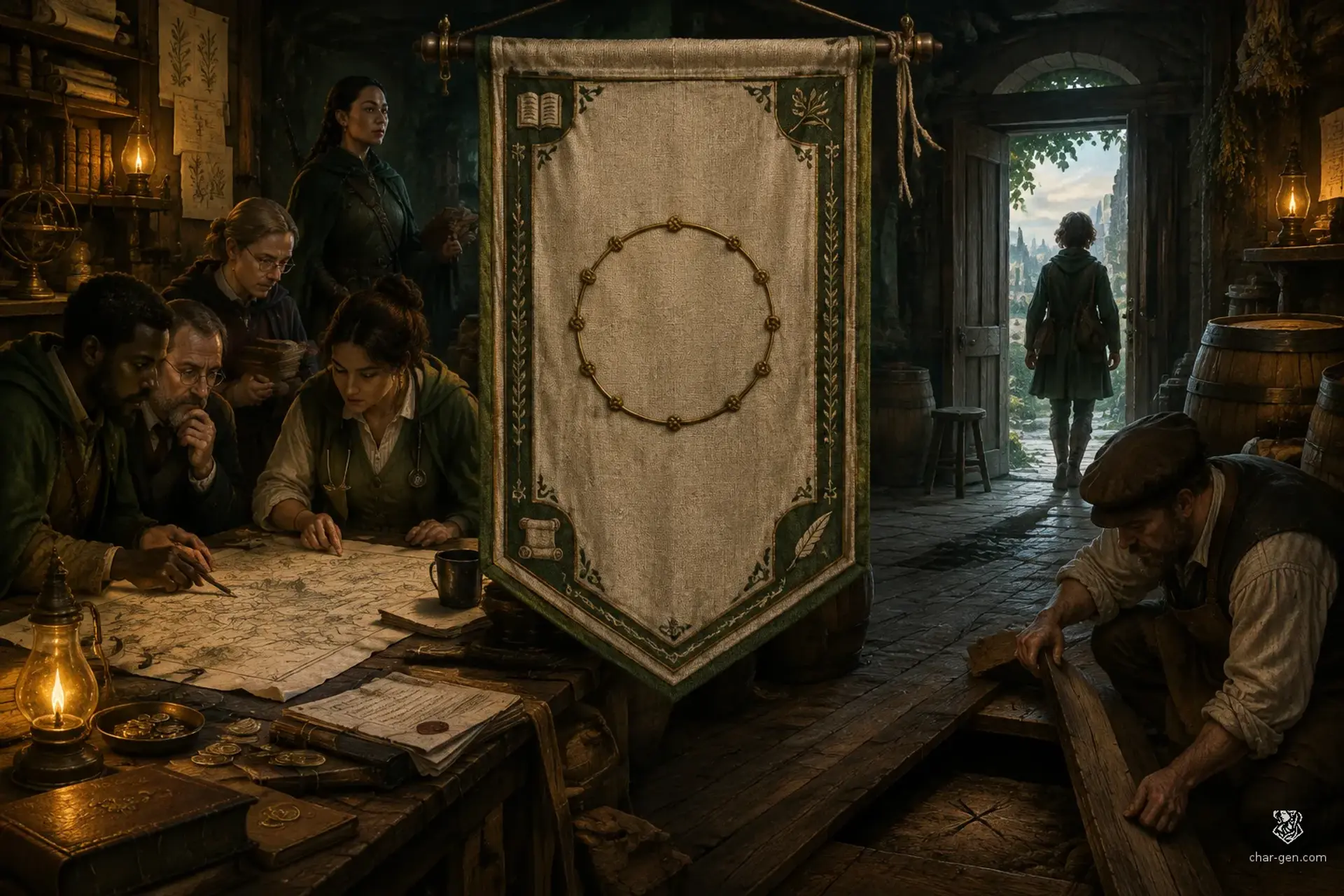
The Ninth Line
For its first generation, the Ninth Line concentrated on identity records and discreet escorts. Its first major success came when it proved that a supposed heir raised at court was a fever orphan adopted by a grieving royal aunt. The discovery prevented a succession crisis, but the faction suppressed the evidence until the child had been safely placed outside court, earning both gratitude and a lasting reputation for meddling. The watershed moment came 63 years ago during the Bell Stair Conspiracy. A group of courtiers tried to seize three young heirs in one night and force the council to recognize a pliable cousin. The Ninth Line split: one half evacuated the children, while the other forged orders that delayed the conspirators' guards. The plan worked, but an innocent household was raided and two members died. In the aftermath, the society adopted its present rule that no child may be moved without either the child's assent, if old enough to give it, or agreement from three Linekeepers. It also divided its network into cells so a captured member could not expose the whole organization. Since then, the faction has survived two royal marriages, a border war, a famine, and one peaceful transfer of power. Its influence grew through careful favors rather than force. It helped preserve the succession after the king's only acknowledged daughter vanished at sea, but never established whether she drowned or escaped. Today, its old habits of secrecy protect the throne and threaten to turn the protectors into an unelected court of their own.
The Ninth Line
- Type
- Secret Society
- Size
- 38 members
- Reach
- National
- Base
- The royal capital, with no fixed public address
Overview
For its first generation, the Ninth Line concentrated on identity records and discreet escorts. Its first major success came when it proved that a supposed heir raised at court was a fever orphan adopted by a grieving royal aunt. The discovery prevented a succession crisis, but the faction suppressed the evidence until the child had been safely placed outside court, earning both gratitude and a lasting reputation for meddling. The watershed moment came 63 years ago during the Bell Stair Conspiracy. A group of courtiers tried to seize three young heirs in one night and force the council to recognize a pliable cousin. The Ninth Line split: one half evacuated the children, while the other forged orders that delayed the conspirators' guards. The plan worked, but an innocent household was raided and two members died. In the aftermath, the society adopted its present rule that no child may be moved without either the child's assent, if old enough to give it, or agreement from three Linekeepers. It also divided its network into cells so a captured member could not expose the whole organization. Since then, the faction has survived two royal marriages, a border war, a famine, and one peaceful transfer of power. Its influence grew through careful favors rather than force. It helped preserve the succession after the king's only acknowledged daughter vanished at sea, but never established whether she drowned or escaped. Today, its old habits of secrecy protect the throne and threaten to turn the protectors into an unelected court of their own.
How it began
The Ninth Line began during the Ash Winter, when a fever and a palace fire struck the royal household within the same fortnight. The king's acknowledged heirs were separated during the evacuation, and frightened officials began inventing replacements to keep the court functioning. A palace survey clerk named Aulani, whose name came from the persistent nettle patch outside her family's rented rooms, noticed that the household lists no longer matched the names of the children she had helped carry from the palace. She recruited a midwife, a retired guard, and two record keepers to establish which children were truly of the royal bloodline and to keep them alive without making them political trophies. They hid the children among ordinary households, using a surveyor's ninth boundary mark as their recognition sign. When the fever ended, the surviving heirs returned under their own names. The group never disbanded.
How to know them
Unbleached linen, Dull brass, Deep green
- A brass line with nine knots
- A plain linen thread tied once around a document corner
- A small, unmarked brass washer used as a discreet recognition token
Standing
What they say they want
What they are doing now
Where it leads
A kingdom in which royal heirs can be identified and protected without being owned by the court, the faction, or their own bloodline. The Ninth Line has no agreed plan for achieving this. Some members imagine a transparent succession law; others believe secrecy is the only thing that has kept the dynasty intact.
How others see them
Most common people have never heard of the Ninth Line. Among palace staff, it is a half-serious rumor about unusually capable servants who appear during emergencies. A few nobles regard it as an old family superstition. People who have been quietly helped remember it as a promise kept, though they may never learn who kept it.
People
5 ranks
First Keeper
Measured and compassionate, but capable of chilling decisiveness when a child is in immediate danger. She dislikes being treated as a saint and fears that secrecy has made her too comfortable with deciding what others may know.
- First Keeper1 member
Coordinates emergencies, authorizes the use of the archive, and represents the faction in its rare dealings with outside allies. The First Keeper cannot order a royal heir to accept protection.
- Linekeepers4 members
Each oversees one duty: records, safehouses, escorts, or court intelligence. They vote on major actions, and three votes are required for an extraction or disclosure of lineage evidence.
- Markers9 members
Experienced field agents who verify identity, arrange routes, and train new members. Each Marker is responsible for a small circle of trusted contacts.
- Hands18 members
The working members: clerks, healers, couriers, guards, tutors, and household servants. Most know only the people and procedures necessary for their assignments.
- Uncounted6 members
Retired members and outside witnesses who hold sealed instructions. They are not full agents and may refuse any request without penalty.
Other key members
- Kett Raut Linekeeper of Records
- Zguri Linekeeper of Safehouses
- Tarmo Vesk Linekeeper of Escorts
- Gvel Marker and potential successor
How they are organised
- Demonstrated judgment and reliability under pressure
- Ability to keep confidence without mistaking secrecy for virtue
- No requirement of noble birth, religious affiliation, or loyalty to a particular royal claimant
- A candidate must agree that protecting an heir does not mean forcing that heir to rule
- Members disclose relevant conflicts of interest to their Linekeeper
Relations
6 factionsA discreet partnership: the Lantern Court provides legal access to birth, marriage, and death records, while the Ninth Line warns it when a royal identity may be in danger. Their cooperation is strained by the Court's insistence on keeping records public.
Operations
What they do
How they do it
Services for hire
- Quiet PassageA favor of comparable risk, or a sworn promise of future assistanceA temporary identity, safe lodging, and a vetted route for someone in danger. The faction will not guarantee that the person will be hidden indefinitely.
- Lineage InquiryAccess to a trustworthy witness or record in return; coin is accepted only from outsidersA discreet check of a royal genealogy, household record, or claim of kinship. The faction reports what it can verify and marks uncertainty plainly.
- Household WatchNo fixed cost; the person seeking help must consent to the planShort-term protection for a threatened heir or household member, including observation, warnings, and extraction if danger becomes immediate.
What they can do
What they have
Where they are weak
Territory
Headquarters
The royal capital, with no fixed public addressThe faction has no permanent headquarters. Its principal archive occupies a pair of rented rooms above a cooper's yard in the capital, entered through a hatch disguised as a storage loft. The rooms hold copied family records, maps of old royal residences, coded correspondence, and a small shrine to no particular deity. The address changes whenever a member suspects surveillance. The original ninth-line survey mark is scratched beneath a floorboard.
Lands they hold
Outposts
- Third Roll LoftA rented loft near the capital's eastern registry quarterA temporary records station used to compare civic rolls against royal household copies. Its name comes from the third tax-roll district where the rooms were first rented.
- Nettle GateA rural road several days from the capitalA concealed rest stop maintained by local healers. The nettles growing through its fence are deliberately left untouched as a familiar landmark.
- Eighth MarkerA disused store room adjoining an old royal hunting lodgeA cache for winter clothing, clean papers, and emergency funds. The name preserves the military map designation of the building.
Secrets
Plot hooks
4 hooks- 1The Errand That Wasn'tLow to moderate, with social and investigative challengesReward: Safe passage, a trusted contact, and a moral choice with lasting consequencesA Hand asks the characters to escort a frightened adolescent across town. The youth claims to be an ordinary servant, but the pursuers call them by a royal title. The characters must decide what to tell the child and whether to trust the people asking for help.
- 2Ink Against BloodModerate, involving investigation, negotiation, or infiltrationReward: Access to royal records, faction favor, and evidence that could alter the successionA provincial registry has produced a convincing birth record for a claimant who should not exist. The Ninth Line needs the party to retrieve the original ledger before the Second Roll Office confiscates it. The ledger may prove either a fraud or the faction's own worst secret.
- 3The Heir Who Said NoHigh, centered on competing loyalties and a public court crisisReward: An alliance with one side of the faction, plus the princess's trust or resentmentPrincess Ilyana wants to leave court and refuses to be smuggled like a parcel. The First Keeper asks the party to negotiate a safe departure, while a Linekeeper separately hires them to prevent it. Both sides believe they are protecting her.
- 4The Ninth KnotCampaign-scale, with political, investigative, and potentially military consequencesReward: A change in the kingdom's government, a lasting faction alliance, or a dangerous public scandalA sealed document could resolve the kingdom's succession dispute, but opening it may expose that the faction hid the truth for generations. The characters must find the missing witness, protect them from the Compact, and decide whether the document should reach the crown, the public, or no one.
Work they offer
What gets in the way
Rumours
Media
0 imagesNo images yet.
Turn The Ninth Line into a sheet
A high-res, share-ready sheet you can post or print.