
Grand Theatre Company
For its first decade, the troupe toured small settlements, performing versions of its original antiwar play. Its early success came from adapting each show to the audience, which made the Company beloved by common audiences and suspect to authorities. Twenty-nine years after its founding, the Company performed The Trial of the Empty Chair in a provincial capital. The play told the story of a murdered tax collector but used the names and details of a current royal inquiry. Officials ordered the theatre seized and arrested two actors. That night, the audience refused to leave the square until the prisoners were released. The event, remembered within the Company as the Night of the Unfinished Bow, became its watershed moment: the Company learned that an audience could protect performers, but also that art could place bystanders in danger. Afterward, the Company adopted a rule requiring the Three Calls to review politically dangerous scripts and assess who might suffer if a performance caused a backlash. The rule did not settle the question. Some members believe restraint is a duty; others call it a polite name for fear. The Company later survived a fire at the Grand Stage, an expensive and largely unsuccessful attempt to rebuild it, and a decade of patronage from a foreign court that tried to turn its plays into propaganda. In recent years, short tours and copied scripts have given the Company a worldwide reputation. Its actual membership remains small, while friendly local performers and former apprentices carry its stories onward.
Grand Theatre Company
- Type
- Guild
- Size
- 32 members
- Reach
- Global
- Base
- The unnamed river port where the troupe first sheltered during the war
Overview
For its first decade, the troupe toured small settlements, performing versions of its original antiwar play. Its early success came from adapting each show to the audience, which made the Company beloved by common audiences and suspect to authorities. Twenty-nine years after its founding, the Company performed The Trial of the Empty Chair in a provincial capital. The play told the story of a murdered tax collector but used the names and details of a current royal inquiry. Officials ordered the theatre seized and arrested two actors. That night, the audience refused to leave the square until the prisoners were released. The event, remembered within the Company as the Night of the Unfinished Bow, became its watershed moment: the Company learned that an audience could protect performers, but also that art could place bystanders in danger. Afterward, the Company adopted a rule requiring the Three Calls to review politically dangerous scripts and assess who might suffer if a performance caused a backlash. The rule did not settle the question. Some members believe restraint is a duty; others call it a polite name for fear. The Company later survived a fire at the Grand Stage, an expensive and largely unsuccessful attempt to rebuild it, and a decade of patronage from a foreign court that tried to turn its plays into propaganda. In recent years, short tours and copied scripts have given the Company a worldwide reputation. Its actual membership remains small, while friendly local performers and former apprentices carry its stories onward.
How it began
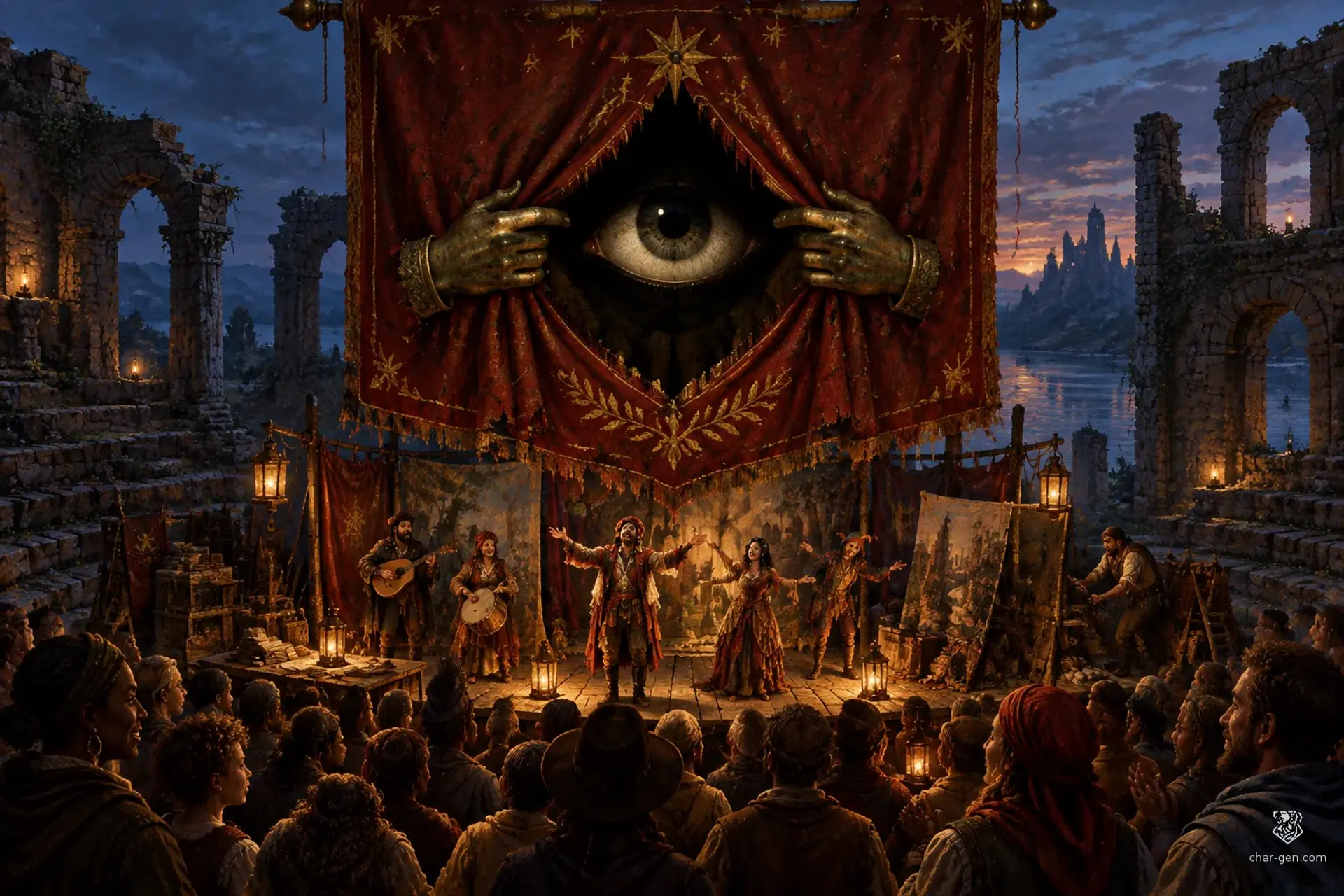
The Grand Theatre Company began with seven players stranded in the river port where the Grand Stage stood, after war closed the roads behind them. The Stage was a roofless stone amphitheatre, famous for its size and infamous for being too expensive to maintain. During a harsh winter, the players performed there for refugees in exchange for food, blankets, and help repairing the seats. Their first production, The Empty Throne, mocked both sides of the war without naming either. Soldiers came to arrest them, but the audience joined the chorus loudly enough to hide the performers' escape through the old drainage passage. The players decided that a stage could be more than a place to entertain: it could be a place where people heard what they could not safely say elsewhere. They took the name of the Grand Stage as a promise to keep its doors open in spirit, even when they had to perform on a cart, a barn floor, or a palace balcony.
How to know them
Oxblood red, Old ivory, Dull brass
- The brass hands holding a curtain open
- A single eye in the dark beyond the stage
- A loose red thread tied around a performer’s wrist before a dangerous show
Standing
What they say they want
What they are doing now
Where it leads
A world where no ruler, guild, or faith can claim a monopoly on public stories, and where every town has at least one place people may gather to speak through performance. The Company hopes to achieve this by teaching local troupes, not by expanding its own membership into a large institution.
How others see them
To ordinary audiences, the Company is a welcome burst of music, laughter, and difficult truths. To many rulers, it is a small but troublesome troupe whose jokes can turn into protests. Wealthy patrons regard it as prestigious but unreliable because it refuses exclusive contracts. Its reputation travels much farther than its modest membership.
People
5 ranks
Keeper of the Curtain
Patient, perceptive, and warm in private. In public she is composed to the point of seeming evasive. She dislikes heroic sacrifices when a quieter solution is possible.
- Keeper of the Curtain1 member
The elected artistic and diplomatic head of the Company. The Keeper chooses tours, negotiates patronage, and may veto a performance that would endanger the troupe.
- The Three Calls3 members
A council of stage manager, treasurer, and script keeper. They approve budgets and tours by majority vote, and can challenge the Keeper's decision at a full company meeting.
- Principals9 members
Experienced performers and craftspeople who lead productions, train apprentices, and vote on major changes to the Company's charter.
- Players12 members
Actors, musicians, builders, costumers, and illusionists who perform the work and keep the travelling company operating.
- Learners7 members
Apprentices and probationary members who study several roles before choosing a specialty. They may speak in council but do not vote until accepted as Players.
Other key members
- Brask Dren Script keeper and likely successor
- Izel Treasurer and negotiator
- Tazik of the Reed Coast Principal actor and informal leader of the reformers
- Clasp Stage manager and potential informant
How they are organised
- Demonstrate a practical skill needed by a production, or show a willingness to learn several.
- Complete a full tour as a Learner without abandoning a fellow member in danger.
- Agree that no performance will expose a vulnerable person without review by the Three Calls.
- Take the Company oath to share credit, disclose serious hazards, and leave a place better than it was found.
Relations
8 factionsThe Company performs at no charge in their wards and carries letters, medicine, and news between distant houses. The Sisters value its discretion, though they disapprove of its occasional use of illusion magic.
Operations
What they do
How they do it
Services for hire
- A Night on the BoardsA modest fee, lodging, and a safe place for the troupe to rehearseA short performance tailored to a local celebration, memorial, or civic gathering.
- The Open RehearsalMaterials, meals, and an agreement not to claim ownership of the students' workPractical instruction in acting, stagecraft, music, and audience management for a small local troupe.
- The Quiet CallA favor in kind, confidentiality, and a careful review of the requestA discreet introduction to a performer, venue keeper, or former apprentice in another region.
What they can do
What they have
Where they are weak
Territory
Headquarters
The unnamed river port where the troupe first sheltered during the warThe Grand Stage is a weatherworn amphitheatre in the Company's founding city. Its lower benches are cracked, its roof is long gone, and its dressing rooms have been patched together from old storage chambers. A trapdoor beneath the stage leads to a dry cistern, used as a costume store, archive, and emergency refuge. The Company owns the building but not the surrounding district, and local officials periodically dispute its tax status.
Lands they hold
Outposts
- The Lantern RoomAn unnamed northern port where former apprentices maintain a rehearsal loft above a cooper's yardA meeting place for local performers, a safe stop for the Company's messengers, and a discreet venue for readings.
- The Reed CartA market town on the central trade roadA rented storehouse for scenery, costumes, and a collapsible platform used by local collaborators.
- The Salt HouseA coastal city known for its seasonal festivalsA costume and prop store that also provides temporary shelter to performers fleeing censorship or violence.
Secrets
Plot hooks
5 hooks- 1The Missing SleeveLow, personal scaleReward: A favor from the troupe, access to its contacts, or a choice of a useful costume disguiseA Learner asks the characters to recover a stolen costume trunk before tonight's show. Hidden in its lining is a coded testimony that names a local official as the planner of a recent disappearance. The characters can return the trunk, expose the official, or learn who paid to steal it.
- 2The Night's RehearsalModerate, local scaleReward: Allied performers, local goodwill, or evidence against the censorThe Company is due to perform a banned play in a crowded square. The authorities plan to arrest the cast, while a local faction intends to provoke violence in the audience. The characters must find the instigator, protect the crowd, or help the Company revise the performance without betraying its point.
- 3Under the Empty SeatsHigh, faction scaleReward: A powerful secret, the Company's trust, or leverage over its leadershipBrask discovers a new verse in the script keeper's archive that appears to be written in the hand of the Company's founder. It points to a sealed chamber beneath the Grand Stage. Sesh wants the chamber opened quietly; Tazik wants the discovery made public. The chamber may contain the missing page, or a record of the founders' bargain.
- 4A Crown for the CurtainHigh, regional scaleReward: Patronage, political influence, or a lasting alliance with one internal factionA ruler offers to restore the Grand Stage in exchange for a season of plays praising the crown. The offer could save the building and its archive, but a rival has planted evidence that the Company already accepted. The characters must investigate the forgery and help the faction decide whether survival is worth the price.
- 5The Play That Travels AloneVery high, campaign scaleReward: A broad network of contacts, the identity of the leak, or the support of the Company's reformersCopies of an uncensored script have appeared across distant cities, each containing details from a confidential witness account. Someone in the Company's network is leaking names. The party must trace the copies across borders before victims are targeted, while deciding whether to expose the leak or protect the source.
Work they offer
What gets in the way
Rumours
Media
0 imagesNo images yet.
Turn Grand Theatre Company into a sheet
A high-res, share-ready sheet you can post or print.