
Umbral Shepherds
The first Shepherd camps were shelters on the unlit roads, built by Iven Rusk and other keepers of travelers after the last dawn failed. For decades, they were a scattered network of guides, healers, and food hoarders. As supplies dwindled, some camps began charging for shelter and taking control of wells and storehouses. The movement's first great triumph came when its guides led a winter convoy through the unmarked passes to feed three besieged towns. That rescue made the Shepherds famous and gave them access to regional rulers. The watershed moment came during the Sable Quiet, when the order promised to protect the settlement of Bellmere, named for the ringing sound of its old harbor chains in the wind. A rival army approached, and the local Road-Keeper sealed the refuge gates to prevent an attack from following the crowd inside. Hundreds were left outside in the cold. The cult's chroniclers call the event a necessary sacrifice; survivors call it betrayal. The Shepherds then used the disaster to seize the settlement's stores, arguing that only strict control could prevent another famine. In the following generations, the order spread across borders by offering escorts, shelter, and night watches. Its success depended on a contradiction: it genuinely saved people from immediate dangers while deliberately keeping communities isolated and dependent. A failed ritual at Long Rime, a pass named for the season-long frost that settles there, destroyed an outpost and many of the cult's records. The present leadership has rebuilt the network, but disputes over what the lost records contained still divide the Hearth Circle.
Umbral Shepherds
- Type
- Cult
- Size
- 584 members
- Reach
- Continental
- Base
- Sootfall, a market settlement named for the persistent smell of soot from its charcoal kilns. The name predates the cult and refers to the settlement, not the faction.
Overview
The first Shepherd camps were shelters on the unlit roads, built by Iven Rusk and other keepers of travelers after the last dawn failed. For decades, they were a scattered network of guides, healers, and food hoarders. As supplies dwindled, some camps began charging for shelter and taking control of wells and storehouses. The movement's first great triumph came when its guides led a winter convoy through the unmarked passes to feed three besieged towns. That rescue made the Shepherds famous and gave them access to regional rulers. The watershed moment came during the Sable Quiet, when the order promised to protect the settlement of Bellmere, named for the ringing sound of its old harbor chains in the wind. A rival army approached, and the local Road-Keeper sealed the refuge gates to prevent an attack from following the crowd inside. Hundreds were left outside in the cold. The cult's chroniclers call the event a necessary sacrifice; survivors call it betrayal. The Shepherds then used the disaster to seize the settlement's stores, arguing that only strict control could prevent another famine. In the following generations, the order spread across borders by offering escorts, shelter, and night watches. Its success depended on a contradiction: it genuinely saved people from immediate dangers while deliberately keeping communities isolated and dependent. A failed ritual at Long Rime, a pass named for the season-long frost that settles there, destroyed an outpost and many of the cult's records. The present leadership has rebuilt the network, but disputes over what the lost records contained still divide the Hearth Circle.
How it began
The Shepherds teach that their first guide was a nameless herder who heard an answering bell beneath the snow during the first year without dawn. No trustworthy record confirms this story. The movement can be traced to Iven Rusk, a keeper of stranded travelers who began organizing night watches after the sky stopped brightening. Iven's companions used the smell of burned juniper to find their hidden camps in blizzards; later converts adopted the scent as a sign of sanctuary. Their name, the Umbral Shepherds, came from the low, hollow sound of a handbell they rang to guide refugees through the unlit roads. The founding account calls that sound a summons from the dark. More prosaic witnesses say it was simply a useful signal.
How to know them
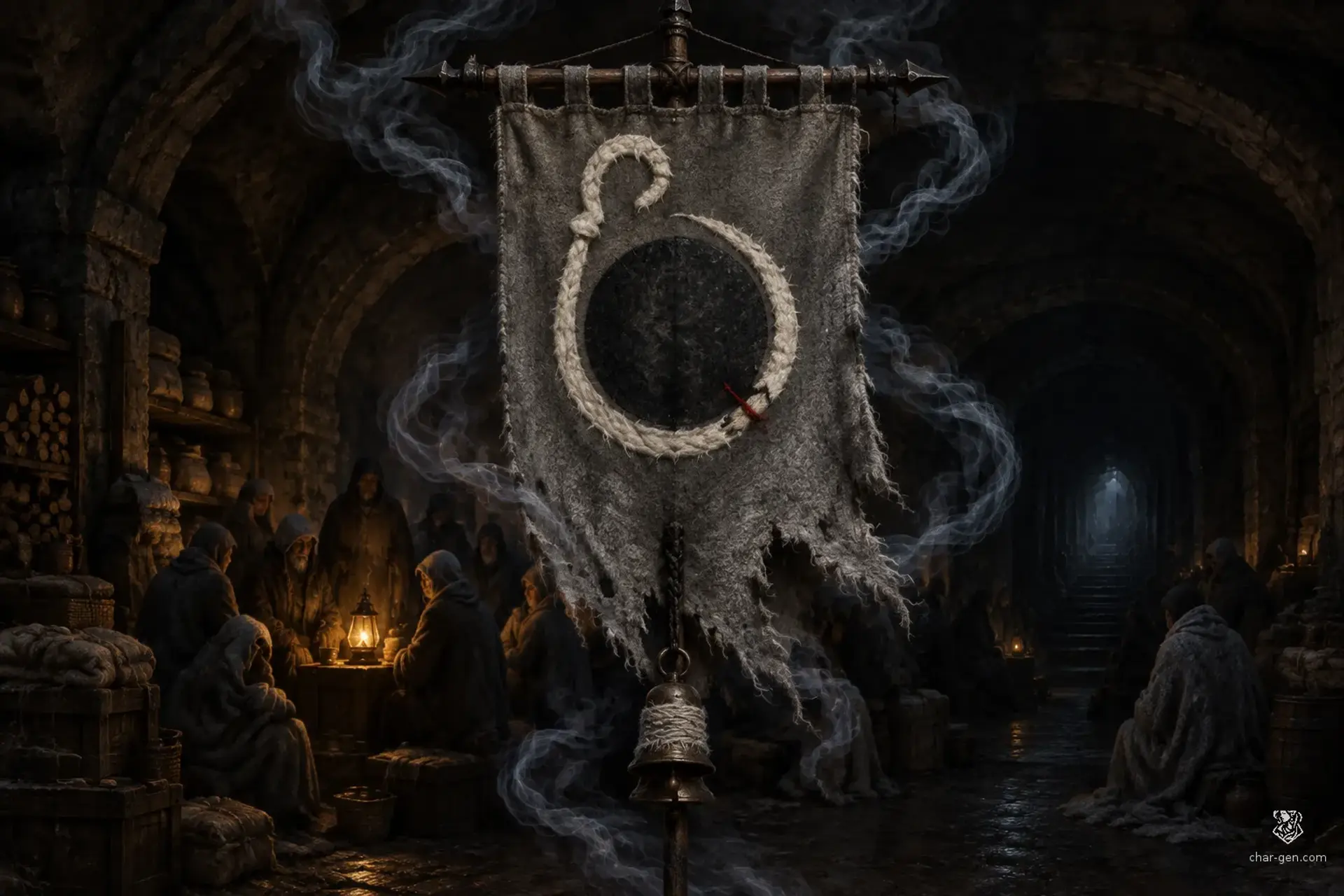
Lamb-wool gray, Dried-blood brown, Lampblack
- A bent shepherd's crook around a dark disc
- A single red thread sewn inside the left cuff
- A handbell with its clapper wrapped in wool
Standing
What they say they want
What they are doing now
Where it leads
A continent where no settlement is abandoned to the dark, with the Shepherds recognized as the only authority capable of managing the night. Some members imagine this as a temporary emergency order that will dissolve when the sky changes. The leadership's plans suggest it expects to retain power afterward.
How others see them
To communities the Shepherds have helped, they are grim but dependable guides who arrive when official authorities do not. To rulers and merchants, they are an alarming power that can close roads, conceal people, and mobilize hungry settlements. Their reputation varies sharply from one valley to the next.
People
5 ranks
First Bell
Warm in public, exacting in private, and genuinely attentive to the fears of ordinary members. He is not a theatrical fanatic; he considers coercion a tool and himself a necessary custodian.
- First Bell1 member
The public leader and final voice on doctrine, major alliances, and continental operations. In principle, the First Bell answers to a council; in practice, the council can only remove them by unanimous vote.
- Hearth Circle7 members
Senior officers who oversee recruitment, supplies, intelligence, ritual practice, discipline, and regional expansion. They deliberate in private and often conceal disagreements from the lower ranks.
- Road-Keepers26 members
Regional organizers who control safehouses, patrol routes, and local agreements. Their authority depends on the trust of nearby cells and the food they can provide.
- Bellwardens112 members
Cell leaders, guides, guards, and recruiters. A Bellwarden usually knows only a few contacts outside their region.
- Kindled438 members
Initiates, camp workers, informants, patrol members, and dependent families. Not all are willing devotees; the cult counts coerced laborers and protected refugees in its public totals.
Other key members
- Mara Venn Road-Keeper of the northern routes and a likely successor
- Seshai Keeper of confessions and internal intelligence
- Oren Dask Senior Bellwarden responsible for training guides
- Aulene of Long Rime Archivist and custodian of fragments from the Ashen Calendar
How they are organised
- Applicants must spend one night on watch without a private light, under the supervision of a Bellwarden.
- New members must contribute a useful skill, a reliable route, or a store of supplies. Those with nothing material to offer are sometimes pressured to provide information instead.
- Members swear not to abandon a person under their protection without making a deliberate attempt to hand them to safety.
- Advancement requires a sponsor and a public account of one fear the applicant believes the cult can help them master.
Relations
7 factionsA loose alliance of salt-port smugglers who supply lamp oil, sealed passage, and forged travel papers. They believe they are buying protection from a dangerous sect, not helping it spread.
Operations
What they do
How they do it
Services for hire
- Night PassageA contribution of food, medicine, useful information, or a future favorA guide leads a small group through a difficult route using memorized landmarks and sound signals.
- Hearth StayA written obligation, usually payable in labor or suppliesA traveler can sleep, eat, and receive basic care at a hidden shelter. The cult records who receives help and what they can offer in return.
- Quiet IntroductionA substantial favor or a sensitive piece of informationA Road-Keeper arranges a discreet meeting with a local cell, a smuggler, or a person seeking to disappear.
What they can do
What they have
Where they are weak
Territory
Headquarters
Sootfall, a market settlement named for the persistent smell of soot from its charcoal kilns. The name predates the cult and refers to the settlement, not the faction.A disused chain of storage vaults below Sootfall, reached through a collapsed smokehouse and a shaft screened with frozen hides. The rooms hold a communal kitchen, a records chamber, sleeping niches, and a deep cistern. The central hall is lit by carefully rationed lamps; its walls are stained with the juniper smoke that gave the place its name.
Lands they hold
Outposts
- Rime StepThe wind-scoured pass above Long RimeA small waystation for guides, used to watch the pass and shelter travelers during sudden storms. Its name comes from the lasting frost on its steps.
- The Crooked ChimeA derelict tollhouse near the northern borderA signal post named for the uneven clang of its salvaged warning bell. It relays messages between distant cells.
- Dask's CellarBelow the collapsed quay at BellmereNamed for a forgotten toll-keeper called Dask, whose duties vanished when the old quay was abandoned. Used for storing records and negotiating with smugglers.
Secrets
Plot hooks
4 hooks- 1The Empty BowlPersonal, low to moderateReward: A rescued contact, supplies, and proof of local extortionA Kindled member asks the characters to find her missing sibling, last seen carrying food to a Shepherd shelter. The local Bellwarden insists the sibling defected; the records suggest they discovered a hidden cache.
- 2No Bread at the WatchfireLocal, moderateReward: Food stores, local allies, or leverage over a Road-KeeperA village that depends on the Shepherds' patrols has stopped receiving food. The Road-Keeper claims bandits took the last shipment, but the trail leads to a cult storehouse and a dispute between two senior officers.
- 3The Calendar LeafRegional, moderate to highReward: A dangerous piece of historical evidence and a possible path to the ritual apparatusA fragment of the Ashen Calendar is offered for sale in Sootfall. Several factions want it, and each believes it can reveal how to restore daylight. The fragment instead records a failed experiment and names the person who ordered it.
- 4A Bell for the Long NightCampaign-scale, highReward: Control over a major decision, access to cult records, or the favor of a national authorityThe First Bell asks the party to escort a ritual component across a hostile border. Aulene privately warns them that the rite may deepen the darkness. The component may be a tool, a trap, or the only chance to change the sky.
Work they offer
What gets in the way
Rumours
Connections
Media
0 imagesNo images yet.
Turn Umbral Shepherds into a sheet
A high-res, share-ready sheet you can post or print.