
Quay Council
The Council began as a compact among trades that had each failed Greyhook in a different way: harbor masters had overcharged during a shortage, storekeepers had hidden grain, and seawall wardens had delayed repairs while disputing responsibility. The compact made shared records and emergency stores central duties. Its reputation grew after it organized the repair of the north quay and kept food moving through two harsh winters. The defining watershed came during the Black Tide, a surge that struck while the harbor was crowded with vessels. Council leaders activated the concealed lower-gate flood mechanism to divert water from the port. The harbor survived; the lower ward took the surge. The Council called the loss an unforeseeable failure of old masonry and sealed the gate. In the years that followed, the Council expanded from a practical committee into Greyhook's civic government, collecting fees and rationing supplies in exchange for safety. A later inspection found mismatched gate marks and missing pages in the old flood register. Rather than reopen the question, the Council tightened control of keys, records, and public notices. Today its competence is real, its services matter, and its founding promise of shared accountability has become the very thing it fears.
Quay Council
- Type
- Civic government
- Size
- 140 members
- Reach
- High within Greyhook
- Base
- Greyhook
Overview
The Council began as a compact among trades that had each failed Greyhook in a different way: harbor masters had overcharged during a shortage, storekeepers had hidden grain, and seawall wardens had delayed repairs while disputing responsibility. The compact made shared records and emergency stores central duties. Its reputation grew after it organized the repair of the north quay and kept food moving through two harsh winters. The defining watershed came during the Black Tide, a surge that struck while the harbor was crowded with vessels. Council leaders activated the concealed lower-gate flood mechanism to divert water from the port. The harbor survived; the lower ward took the surge. The Council called the loss an unforeseeable failure of old masonry and sealed the gate. In the years that followed, the Council expanded from a practical committee into Greyhook's civic government, collecting fees and rationing supplies in exchange for safety. A later inspection found mismatched gate marks and missing pages in the old flood register. Rather than reopen the question, the Council tightened control of keys, records, and public notices. Today its competence is real, its services matter, and its founding promise of shared accountability has become the very thing it fears.
How it began
The Quay Council was formed after the Greyhook Surge, when a season of failed tides and damaged piers left the harbor without a reliable authority to set fees, ration grain, or coordinate repairs. Dock stewards, storehouse keepers, and seawall wardens met in a counting room above the quay and agreed that no single trade should control all three. Their first charter was practical: publish harbor charges, keep emergency food, and maintain the sea doors. For a generation, the arrangement worked. Then a later flood threatened both the lower ward and the port. The Council's predecessors secretly operated the lower gate mechanism to divert the surge away from the harbor basin. The maneuver saved ships and warehouses but flooded occupied streets. Officials claimed the deaths were unavoidable and sealed the maintenance records. The modern Council inherited both the keys and the lie.
How to know them
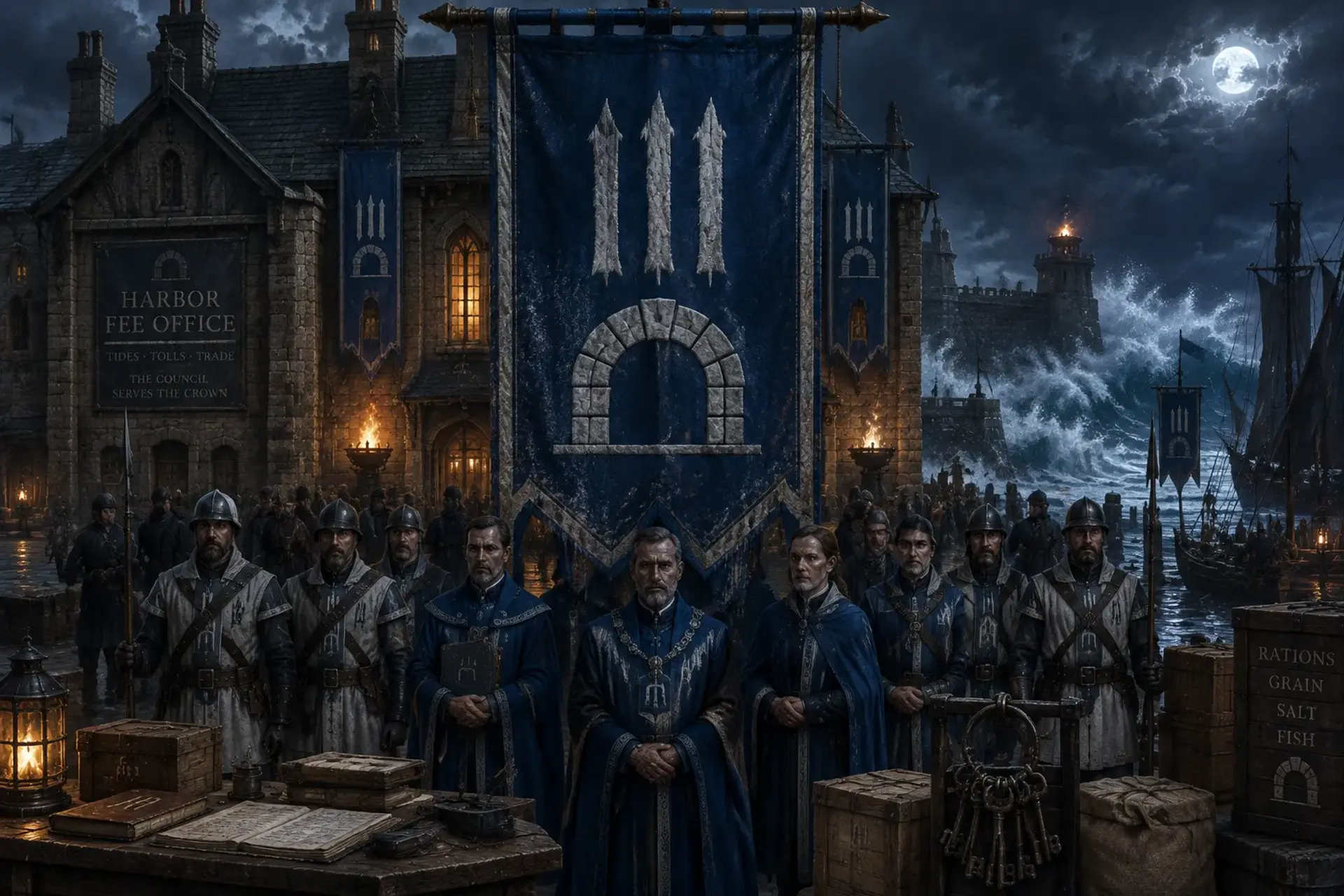
Dull blue, Salt white, Iron grey
- Three tally marks above a closed iron arch
- A ring of keys worn by the senior Door Warden
- Blue notices edged in salt white
Standing
What they say they want
What they are doing now
Where it leads
A Greyhook that can survive the sea through reliable stores, maintained walls, and shared civic duties. The Council's stated vision is collective safety. Its unspoken version is a port kept prosperous and governable, even if the lower ward remains expendable.
How others see them
To shipmasters and merchants, the Council is competent, predictable, and expensive. Many Greyhook residents rely on its ration system and appreciate its emergency response, even as they resent its paperwork and closed doors. In the lower ward, it is increasingly seen as a government that calls people a danger when they ask why the gate is sealed.
People
5 ranks
First Counter
Composed, attentive, and kind in small, personal ways. Under pressure she becomes more precise rather than more honest, and can mistake postponement for mercy.
- First Counter1 member
Chairs meetings, speaks for the Council, and coordinates emergency orders. The office cannot lawfully command the other members, but its holder controls the agenda and public announcements.
- Quay Seats6 members
Set harbor fees, authorize storehouse releases, and vote on civic orders. Seats are nominally divided among harbor, stores, seawall, and ward interests, though the lower ward's seat has been vacant for years.
- Counters14 members
Maintain ledgers, assess cargo, inspect ration claims, and prepare meeting papers. They are the Council's memory and its most vulnerable source of leaks.
- Door Wardens32 members
Guard the upper seawall doors, inspect hinges and locks, and hold the keys in rotation. They can delay an order by disputing whether its procedures have been followed.
- Harbor Hands90 members
Collect fees, move ration stores, post notices, and carry out daily civic work. Many are seasonal workers rather than loyal members.
Other key members
- Rusk Senior Counter and likely source of a leak
- Nima Sorn Door Warden and potential whistleblower
- Töm Stores Seat and keeper of emergency reserves
- Harel Vask Harbor Seat and political rival to the First Counter
How they are organised
- Hold a recognized civic duty in Greyhook, such as harbor work, storehouse service, or seawall maintenance.
- Swear to keep fee and ration records accurate, though the Council has repeatedly violated the spirit of this oath.
- Pass a practical examination appropriate to the member's role.
- Accept that emergency decisions may be confidential until the danger has passed.
Relations
8 factionsThe pilots depend on council charts, fee exemptions, and access to the upper seawall doors. They support the Council in public, though some quietly pass warnings to lower-ward families.
Operations
What they do
How they do it
Services for hire
- Harbor clearanceStandard harbor fee, with reductions for registered local vesselsCargo registration, berth assignment, and access to official tide notices.
- Ration issueEligibility review and a recorded household claimEmergency ration allotments from Council-controlled stores. Approval can be delayed if household records are disputed.
- Seawall passageCouncil authorization and a named guideSupervised access to portions of the upper seawall for repair, inspection, or emergency work.
- Quay arbitrationFee or civic service, depending on the disputeMediation of cargo, ration, and access disputes before they become open confrontations.
What they can do
What they have
Where they are weak
Territory
Headquarters
GreyhookThe Council meets in the old fee office above the inner quay. Its lower rooms hold fee ledgers, ration tallies, and a locked cabinet of copied seawall plans. A narrow stair leads to the key chamber, where each upper seawall key hangs on its own iron peg. The chamber is kept dry with a constant brazier, but salt blooms through the mortar whenever the tide rises.
Lands they hold
Outposts
- Fee OfficeAt the inner quayCollects harbor charges, registers cargo, and hosts Council meetings.
- Tally ShedBeside the main ration storesMaintains household lists and records the movement of emergency supplies.
- Door PostAlong the upper seawallHouses rotating Door Wardens and protects the upper seawall keys.
Secrets
Plot hooks
5 hooks- 1The Missing TallyLow to moderateReward: Pay, access to records, and a lasting contact among the clerksA Counter hires the characters to deliver a sealed ledger before the next Council meeting. The ledger contains a copied gate inspection entry, and both a Council loyalist and a lower-ward organizer are trying to intercept it.
- 2One Name LessModerateReward: Local trust, supplies, and evidence of political retaliationA lower-ward household is struck from the ration list after its eldest member publicly questions the flood warnings. The characters can investigate the clerk who altered the entry, negotiate with the Council, or help the family obtain food without drawing attention.
- 3Marks in SaltModerate to highReward: Technical knowledge of the seawall and a warden's reluctant confidenceNima Sorn asks the party to inspect a strange set of marks on an upper seawall door. The marks appear to match an old gate-tender notation, but opening the door could expose the investigators to a dangerous tide and make them suspects in a security breach.
- 4The Next Black TideHighReward: Lives saved, political leverage, and the choice of whether the truth becomes publicA coming storm forces the Council to choose between protecting the port and warning the lower ward in time to evacuate. The party must find a way to verify the mechanism, move people through hostile checkpoints, or force a decision before the tide turns.
- 5The Record That Came BackCampaign scaleReward: A major alliance, access to the complete history, or control over the timing of disclosureAn old flood record surfaces in a cargo lot outside Greyhook. It names a living official as the person who authorized the Black Tide diversion. The Council offers a reward for its quiet return, while the lower-ward assembly offers protection if the characters publish it.
Work they offer
What gets in the way
Rumours
Media
0 imagesNo images yet.
Turn Quay Council into a sheet
A high-res, share-ready sheet you can post or print.