
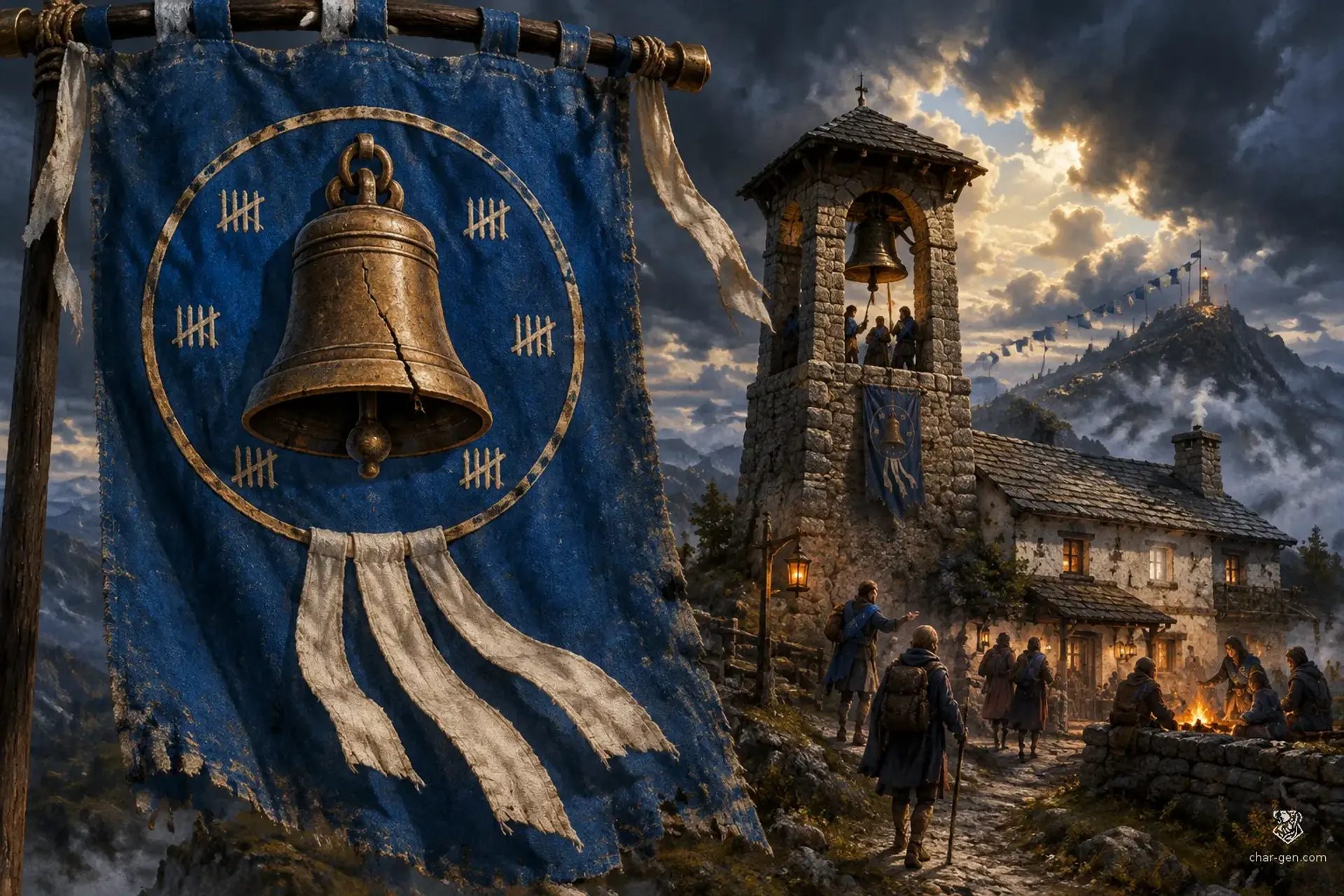
The Bell-Keepers
At first, the Bell-Keepers were a handful of survivors maintaining one tower and its refuge. They learned to use the survey marks along the mountain road as a crude signal chain, adding handbells at places where line of sight failed. Their first triumph was coordinating a rescue after a snow slide buried a caravan beyond the settlement's reach. Their first great setback came when a false alarm sent people into a ravine during a night storm; three died, and the Keepers began requiring a second signaler to verify planned alarms whenever time allowed. During the Ash Flood, they defied an order to preserve the grain store and rang the evacuation pattern. The choice saved lives and fixed their public identity as guardians of people rather than property. In the decades that followed, they became indispensable to The Last Bulwark, whose patrols relied on the warning chain and whose injured members found shelter in the tower. The relationship soured whenever the order took food under emergency authority without asking. The Keepers responded with increasingly exact accounts, first as a practical record and then as leverage. Today they are trusted by ordinary residents, tolerated by officials, and caught between a military ally that needs them and a community that expects them to resist being used.
The Bell-Keepers
- Type
- Settlement-based…
- Size
- 64 members
- Reach
- Strong within the…
- Base
- A market settlement beside a vulnerable mountain road, locally called the settlement rather than governed under a single consistent name.
Overview
At first, the Bell-Keepers were a handful of survivors maintaining one tower and its refuge. They learned to use the survey marks along the mountain road as a crude signal chain, adding handbells at places where line of sight failed. Their first triumph was coordinating a rescue after a snow slide buried a caravan beyond the settlement's reach. Their first great setback came when a false alarm sent people into a ravine during a night storm; three died, and the Keepers began requiring a second signaler to verify planned alarms whenever time allowed. During the Ash Flood, they defied an order to preserve the grain store and rang the evacuation pattern. The choice saved lives and fixed their public identity as guardians of people rather than property. In the decades that followed, they became indispensable to The Last Bulwark, whose patrols relied on the warning chain and whose injured members found shelter in the tower. The relationship soured whenever the order took food under emergency authority without asking. The Keepers responded with increasingly exact accounts, first as a practical record and then as leverage. Today they are trusted by ordinary residents, tolerated by officials, and caught between a military ally that needs them and a community that expects them to resist being used.
How it began
The Bell-Keepers began during the winter of the Split Road, when a landslide cut the settlement off from its nearest garrison and a fire consumed three storehouses. The only warning bell stood on a watch post above the road. Its keeper, an aging toll clerk, rang it until the tower's support beams caught fire, then carried the clapper down the hill so neighbors could keep sounding the alarm by hand. A handful of survivors organized the first watch, sheltering the injured in a counting house and using its old survey ledger to track food, blankets, and names. They adopted the name written beside the tower on that map: Bell Station 6. Over time, people shortened the name to the Bell-Keepers, while the original numbered mark remained on their records. The watershed moment came eleven years later, during the Ash Flood. The Keepers rang the evacuation pattern despite an order to protect the settlement's grain store first. The flood destroyed much of the store, but the warning saved hundreds of people. Since then, they have insisted that signals and shelter serve the living before property. Their standing rose, but so did the suspicion of authorities who believe the Keepers answer to no one.
How to know them
Weathered blue, Bell-bronze, Undyed linen
- A cracked bronze handbell, representing warning that admits its own limits.
- A strip of blue cloth tied to a refuge door, meaning that shelter is open.
- Six short tally marks beside a date, recalling the old survey designation for the original tower.
Standing
What they say they want
What they are doing now
Where it leads
A chain of locally governed warning stations where every settlement can raise an alarm, offer shelter, and account openly for emergency aid. The Bell-Keepers want preparedness to be a shared civic duty, not a service controlled by soldiers or landowners.
How others see them
To most residents, the Bell-Keepers are dependable, plain-spoken custodians who will ring the alarm even when doing so brings trouble. Travelers appreciate their refuge. Landholders call them meddlesome, and some soldiers consider their ledgers an insult. Their reputation rests on a simple promise: the bell is for danger, not for politics.
People
5 ranks
First Ringer
Patient, observant, and quietly forceful. Aven avoids grand speeches and lets documented facts do the work. Their restraint can look like indecision until a boundary is crossed.
- First Ringer1 member
Elected for a three-year term by the full signal roster. Coordinates the organization, negotiates with outside powers, and may not alter a warning pattern without another Keeper's recorded assent.
- Tower Hands5 members
Maintain the bells, ropes, roof signals, and night watch. Each is responsible for a different approach to the settlement and can order an immediate alarm when danger is visible.
- Ledger Keepers11 members
Track shelter capacity, stores, injuries, debt, and emergency requisitions. They certify the accounts and can challenge an unexplained withdrawal.
- Road Runners18 members
Carry messages, guide people to shelter, and verify reports from outlying roads. They often have more firsthand knowledge than the senior members.
- Lantern Neighbors29 members
Volunteer cooks, healers, porters, and household hosts. They are not always full members, but may vote on local shelter policy and elect the First Ringer.
Other key members
- Gela of Station 6 Senior Tower Hand and likely successor
- Brzhan Chief Ledger Keeper
- Narevi Road Runner coordinator
How they are organised
- Demonstrate willingness to answer a warning even when doing so is inconvenient or dangerous.
- Learn at least one signal pattern and the basic routes to the refuge.
- Agree not to use the bells for private feuds, commercial advantage, or political intimidation.
- Accept that records of shared stores and emergency decisions may be reviewed by other Keepers.
Relations
4 factionsThe settlement's bell-keepers shelter injured guardians, maintain warning signals, and pass on reliable reports of danger. Cooperation is strained when the order requisitions food without consent. The Keepers still answer the bells, but increasingly insist that every emergency levy be recorded and repaid.
Operations
What they do
How they do it
Services for hire
- Refuge and aidFree for immediate danger; later contributions are welcome but never demanded from the injured.A dry place to rest, basic food when available, and referral to volunteer care.
- Road messageA service to the network, a modest donation, or a favor agreed in advance.A trained runner carries a message along the road and confirms delivery when possible.
- Signal and safety instructionFree during a declared emergency; otherwise paid in labor or supplies.Instruction in common warning signals, safe evacuation routes, and basic emergency practice.
What they can do
What they have
Where they are weak
Territory
Headquarters
A market settlement beside a vulnerable mountain road, locally called the settlement rather than governed under a single consistent name.A stout bell tower joined to a low, limewashed refuge house. Its ground floor holds a public kitchen, a treatment room, and a tally wall listing current needs. The upper levels contain signal ropes, spare clappers, dry stores, and a narrow roof walk from which bells and flags can be observed. A painted mark on the oldest beam reads Station 6, the number on the founders' survey map.
Lands they hold
Outposts
- Marker 14A ridge above the eastern roadA staffed signal platform copied from a numbered point on an old military survey. It relays warnings toward the settlement and watches for landslides.
- The South Road ShelterA roadside shelter near a narrow passProvides a dry place for injured travelers and a station for runners. It is maintained by local volunteers rather than permanent staff.
Secrets
Plot hooks
5 hooks- 1The Missing SackPersonal to moderateReward: Trust, information, or a favor from either factionA player character is asked to carry a sealed ledger page to The Last Bulwark before the next emergency meeting. It shows an old requisition was never repaid, but also contains evidence that the Keepers falsified one line to protect a family.
- 2A Note Out of SeasonModerateReward: Access to the signal network and local alliesThe oldest bell rings a flood warning on a clear day. The Keepers cannot agree whether it was a mechanical fault, sabotage, or an unrecognized signal from beyond the road. The party must investigate before panic empties the settlement.
- 3An Emergency With No ConsentModerate to highReward: A formal alliance, supplies, or political leverageThe Last Bulwark requisitions the refuge's winter stores during a genuine crisis. The Keepers ask the party to witness negotiations and find a way to supply the guardians without leaving injured residents hungry.
- 4The Stolen SilenceHighReward: A useful codebook, a rescued contact, or the confidence of the Tower HandsA runner vanishes carrying a pattern book that could let an enemy imitate the warning signals. The party must recover it before a false alarm draws residents into danger or leaves an approach unwatched.
- 5What the Flood CarriedCampaign-scaleReward: A major reserve of supplies, a shift in regional power, or a damaging truthEvidence of the founders' hidden grain cache surfaces in a disputed stretch of land. Several parties claim a right to it, while the Keepers fear that proving its existence will destroy their reputation for honest accounting.
Work they offer
What gets in the way
Rumours
Media
0 imagesNo images yet.
Turn The Bell-Keepers into a sheet
A high-res, share-ready sheet you can post or print.