
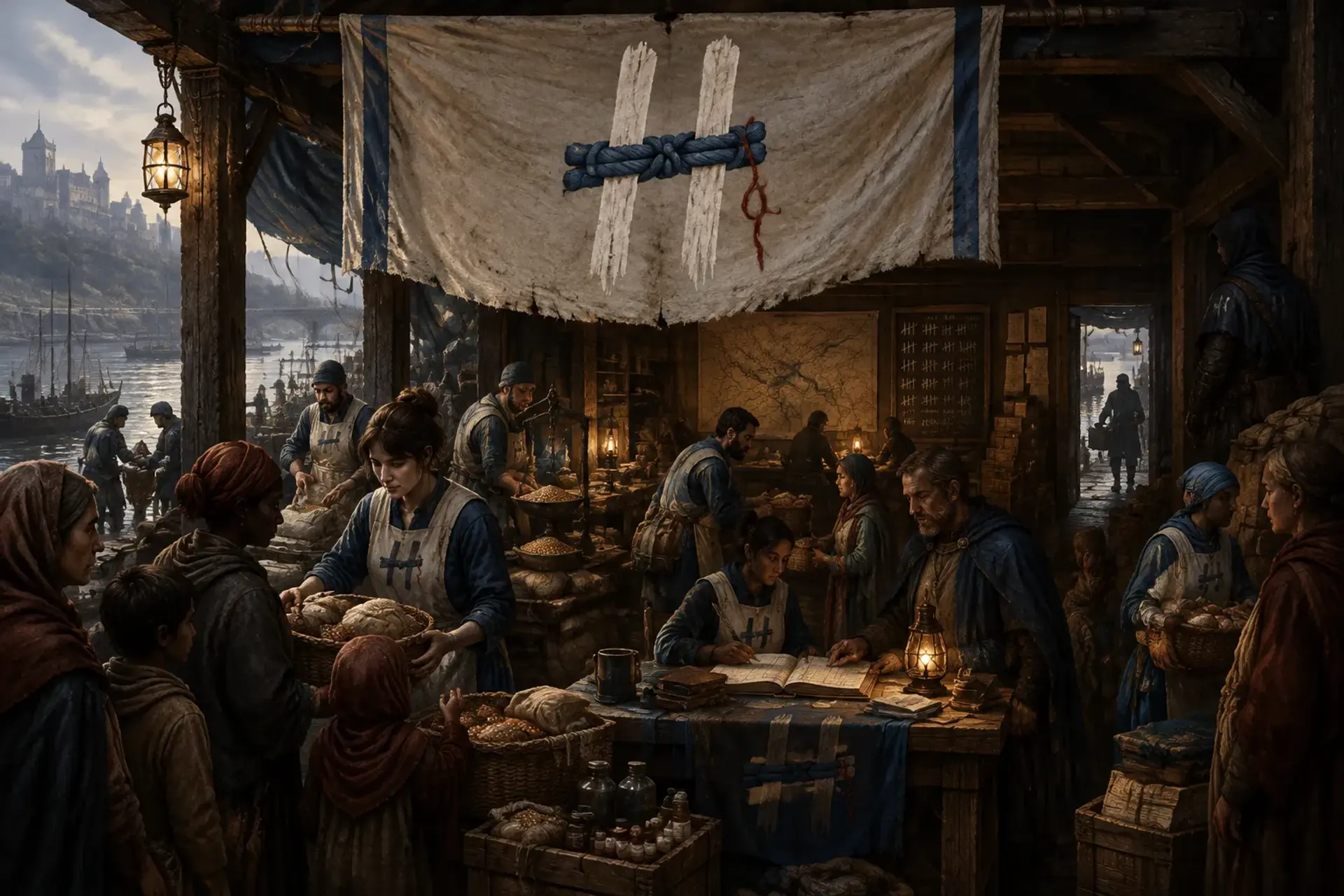
The Unbroken Measure
After the flood-year famine, the Measure grew from a small group of clerks and boat hands into a neighborhood relief network. During its first decade, it earned trust by keeping records ordinary officials neglected and by delivering food without requiring allegiance. Its first triumph was organizing a winter distribution that prevented a second famine after a late harvest. Its first major setback came when an informant sold a route list to smugglers, who robbed two relief barges and beat their crews. The faction responded by splitting its records among separate cells, a practice that still makes it difficult to coordinate. Its watershed moment was the Lantern Quay fire, twenty-nine years ago. A warehouse burned with its doors chained from the outside; the Measure broke in and rescued workers, then discovered that the stored grain had been diverted days earlier. Rather than publish its evidence, the leadership traded part of it for the release of prisoners and a guarantee of future access to emergency stores. That bargain saved lives, but it taught the faction that concealment could be as powerful as truth. In the years since, the Measure has expanded across the riverlands, built a quiet intelligence network, and begun to disagree over whether it remains a relief society or has become a shadow government.
The Unbroken Measure
- Type
- Mutual-aid network
- Size
- 233 members
- Reach
- Moderate locally
- Base
- A busy river-port settlement whose name the faction does not use in its own records
Overview
After the flood-year famine, the Measure grew from a small group of clerks and boat hands into a neighborhood relief network. During its first decade, it earned trust by keeping records ordinary officials neglected and by delivering food without requiring allegiance. Its first triumph was organizing a winter distribution that prevented a second famine after a late harvest. Its first major setback came when an informant sold a route list to smugglers, who robbed two relief barges and beat their crews. The faction responded by splitting its records among separate cells, a practice that still makes it difficult to coordinate. Its watershed moment was the Lantern Quay fire, twenty-nine years ago. A warehouse burned with its doors chained from the outside; the Measure broke in and rescued workers, then discovered that the stored grain had been diverted days earlier. Rather than publish its evidence, the leadership traded part of it for the release of prisoners and a guarantee of future access to emergency stores. That bargain saved lives, but it taught the faction that concealment could be as powerful as truth. In the years since, the Measure has expanded across the riverlands, built a quiet intelligence network, and begun to disagree over whether it remains a relief society or has become a shadow government.
How it began
The Measure began during the flood-year famine, when a bridge collapse cut off three districts from their usual grain supply. A clerk named Halwen Dorr watched officials argue over which neighborhood deserved the last marked wagons while people died waiting. Dorr and a handful of boat hands began keeping their own tally of who had received food, who had been missed, and which shipments had vanished. They distributed stores from a stranded barge and forged a few permits to get past the guards. Their first rule was simple: count what arrives, count what leaves, and write down who paid the cost. The name was an ironic boast. Their first tally was so incomplete that they could not even agree how many people they had fed.
How to know them
Dull blue, Bone white, Rust red
- Two white tally marks crossed by a blue cord
- A single loose rust-red stitch
- A small notch cut into the edge of a paper ration token
Standing
What they say they want
What they are doing now
Where it leads
A society where basic survival does not depend on the favor of officials or the wealth of merchants. The Measure's most ambitious members imagine a permanent public ledger of stores and distributions, overseen by ordinary residents. Whether such a system could exist without becoming another instrument of control remains unanswered.
How others see them
To working families, the Measure is often the group that arrives before help officially does. Merchants respect its accurate records but dislike its questions. Officials describe it as an intrusive, unlicensed network that mistakes rumor for authority. Many ordinary residents know its symbol without knowing its name.
People
5 ranks
First Counter
Measured, compassionate in private, and formidable in negotiation. She dislikes grand gestures and distrusts anyone who calls a sacrifice necessary without naming who will suffer it.
- The Three Counters3 members
Set policy, authorize high-risk operations, and settle disputes between local cells. Decisions require two votes; the third Counter can delay an order for one night by demanding a fresh tally of its likely costs.
- Routekeepers12 members
Maintain supply routes, safe houses, coded messages, and relationships with carriers. Each oversees several local circles but is expected to know only the minimum needed about other routes.
- Table Stewards48 members
Organize neighborhood relief, verify requests, record deliveries, recruit volunteers, and report suspicious shortages.
- Witnesses170 members
Trusted members who carry messages, observe markets, shelter people briefly, or assist in counting and distribution. They are not necessarily told the purpose of every task.
- The counted600 members
Residents who receive regular aid, contribute information or labor, or support the faction's public relief work. Most are not formal members and may not know the full organization exists.
Other key members
- Brant Senior Counter and public organizer
- Odel Vask Routekeeper and keeper of the hidden archive
- Sefu Table Steward and relief coordinator
- Yara Quill Counter and negotiator with civic officials
How they are organised
- Demonstrate reliability through repeated, modest acts of service.
- Accept that members may be asked to help people they dislike or disagree with.
- Keep confidential details about routes and recipients, but do not falsify a count to protect a superior.
- Agree to a witnessed review if accused of stealing, coercion, or abusing someone under the faction's protection.
Relations
6 factionsThe shrine's healers treat anyone brought to their doors, and the Measure keeps their supplies moving during shortages. The alliance frays whenever the faction diverts medicine for its own operations.
Operations
What they do
How they do it
Services for hire
- A counted shareA modest donation, a day of labor, or a reciprocal favorEmergency meals, basic supplies, and short-term shelter for people in immediate need.
- A second tallyReliable information, a useful introduction, or payment according to meansA discreet comparison of public records, shipping tallies, and witness accounts to identify where a shipment may have gone missing.
- A dry crossingA serious favor and the promise not to reveal the routeTemporary safe passage for a threatened witness or messenger. The Measure does not guarantee protection against a powerful pursuer.
What they can do
What they have
Where they are weak
Territory
Headquarters
A busy river-port settlement whose name the faction does not use in its own recordsA disused counting room below a public bathhouse, reached through a coal chute and two ordinary storage doors. Its walls are covered in washable charcoal maps and coded tally boards. A second exit leads to a drain passage, but it floods in heavy rain.
Lands they hold
Outposts
- The east-table storeA rented room behind a public kitchen in a market districtDistribute emergency meals and verify local requests.
- The upper weigh houseA shuttered weigh station near a frequently used ferry crossingPass messages and quietly compare cargo records.
- The dry cellarA small cellar below an unmarked riverside storehouseKeep medicines and important records above seasonal floodwater.
Secrets
Plot hooks
5 hooks- 1The Second LedgerLow; a social or street-level challenge with a choice about who should see the listReward: Aid, local contacts, and a favor from a neighborhood circleA Witness asks the characters to escort a sealed medicine chest across town. The official delivery papers are genuine, but the chest also contains a list of households marked for eviction.
- 2A Count Out of PlaceModerate; investigation, negotiation, and a time-sensitive searchReward: Payment, confidential information, and trust from one internal factionA Table Steward is accused of stealing relief funds. The records support the charge, but a second set of tallies suggests someone altered the dates. The characters must find the missing witness before the Measure's internal review becomes a public arrest.
- 3The Missing MeasureModerate to high; adaptable to travel, intrigue, or a dangerous confrontationReward: A choice of allies, access to hidden supply routes, or evidence against a powerful officialA river shipment disappears, and the Everfull Granary blames the Measure. The characters can follow the cargo, investigate the officials who certified it, or broker a truce with the river crews before a retaliatory raid.
- 4What the Fire CountedHigh; a regional political crisis with no clean outcomeReward: Major influence, a lasting alliance, or the chance to reshape the Measure's futureA copy of the Lantern Quay evidence surfaces. It could vindicate the Measure's old bargain, expose its leaders' concealment, and implicate a respected official. The Three Counters ask the party to retrieve it; an affected family asks them to publish it.
- 5The Cost of Being CountedVariable; centered on character values and community relationshipsReward: Community support, political leverage, or a new relationship with the faction's reformersA group of residents refuses the Measure's aid, claiming that its local circle has turned food deliveries into a system of surveillance. The allegation is true in part. The characters must decide whether to reform the circle, defend it from an opportunistic crackdown, or help recipients build another source of support.
Work they offer
What gets in the way
Rumours
Media
0 imagesNo images yet.
Turn The Unbroken Measure into a sheet
A high-res, share-ready sheet you can post or print.