
Do Not Ring
The network formed eighty-three years ago after a winter arrest sweep scattered families accused of hiding deserters. Its first members were a ferryman, a temple copyist, a midwife, and several children who knew how to cross the marsh without leaving a visible trail. In the first decade, they moved fugitives and carried testimony to distant courts. Their watershed moment came during the Salt Tax Rebellion. A clerk's ledger proved that tax collectors had been charging villages for salt that never arrived. The network carried copies of the ledger past the blockade, allowing the towns to coordinate a legal challenge and a food-sharing effort. The crown withdrew the tax, but also began treating unsanctioned couriers as conspirators. That victory made the faction famous in whispers and dangerous in practice. Over time, the network became less an emergency route and more a durable institution. It established codes, rotating safe houses, and rules against recording full identities. It has escorted escaped prisoners, carried plague warnings, and helped families avoid unjust conscription. It has also smuggled corrupt officials out of reach and sometimes accepted payment from people who did not deserve protection. Twenty-one years ago, a newly appointed Roadkeeper betrayed a route to save her own family. The resulting arrests destroyed an entire regional cell. The surviving leadership responded by splitting information into fragments, which made the faction harder to penetrate but slower to act. Today, younger members argue that the safeguards have become an excuse for indecision, while older members remember that one leak cost dozens of lives.
Do Not Ring
- Type
- Covert sanctuary and…
- Size
- 227 members
- Reach
- Moderate in river towns…
- Base
- The lockhouse stands outside the market town of Sedgecross, whose name recalls an old flood where a field of sedge trapped a rescue boat. Locals disagree about whether the boat was saved or lost.
Overview
The network formed eighty-three years ago after a winter arrest sweep scattered families accused of hiding deserters. Its first members were a ferryman, a temple copyist, a midwife, and several children who knew how to cross the marsh without leaving a visible trail. In the first decade, they moved fugitives and carried testimony to distant courts. Their watershed moment came during the Salt Tax Rebellion. A clerk's ledger proved that tax collectors had been charging villages for salt that never arrived. The network carried copies of the ledger past the blockade, allowing the towns to coordinate a legal challenge and a food-sharing effort. The crown withdrew the tax, but also began treating unsanctioned couriers as conspirators. That victory made the faction famous in whispers and dangerous in practice. Over time, the network became less an emergency route and more a durable institution. It established codes, rotating safe houses, and rules against recording full identities. It has escorted escaped prisoners, carried plague warnings, and helped families avoid unjust conscription. It has also smuggled corrupt officials out of reach and sometimes accepted payment from people who did not deserve protection. Twenty-one years ago, a newly appointed Roadkeeper betrayed a route to save her own family. The resulting arrests destroyed an entire regional cell. The surviving leadership responded by splitting information into fragments, which made the faction harder to penetrate but slower to act. Today, younger members argue that the safeguards have become an excuse for indecision, while older members remember that one leak cost dozens of lives.
How it began
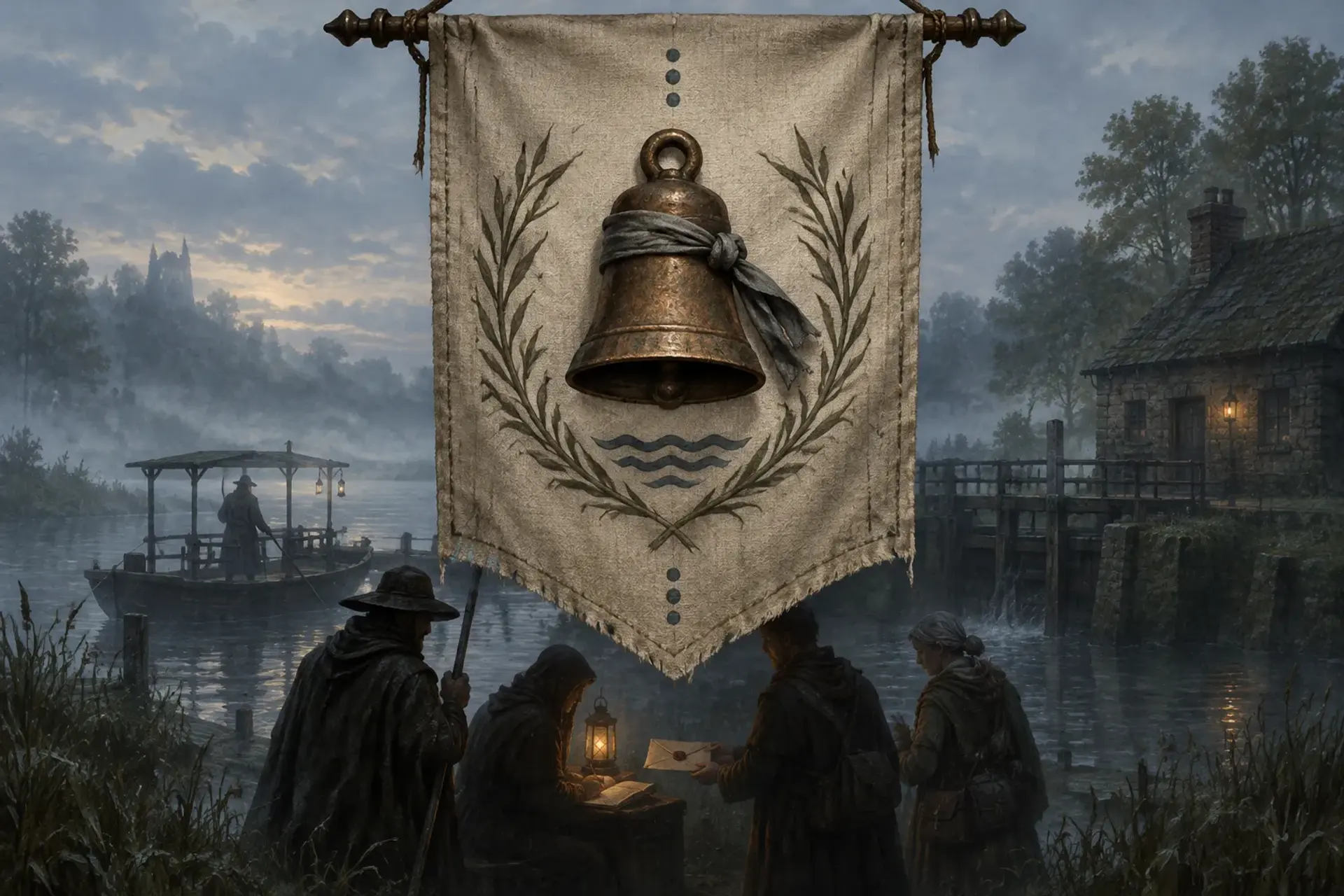
The faction's name began as a warning. During a winter arrest sweep, a bell was rung at a riverside meeting house to summon help. The signal also led the soldiers straight to the people hiding inside. Survivors thereafter told one another, 'Do not ring.' They kept the phrase as the network's name because replacing a warning felt like inviting the same mistake. The event is commonly misremembered as a planned alarm; it was an accident, and the bell-ringer was a frightened child.
How to know them
Smoke gray, Dull copper, Undyed linen
- A copper bell with no clapper
- A gray strip knotted once and tucked inside a sleeve
- A line of three dots in a travel ledger, meaning that a route has changed
Standing
What they say they want
What they are doing now
Where it leads
A world where a person's identity, testimony, and right to travel cannot be erased by a ruler's clerk. The faction disagrees on whether that future requires public reform, quiet resistance, or a permanent network beyond the reach of every state.
How others see them
Among riverfolk and displaced families, they are remembered as people who arrive when official help does not. Officials call them smugglers and agitators. Most townspeople have heard the name as a warning not to trust strangers who ask about ferries.
People
4 ranks
First Keeper of the Shut Bell
Measured, empathetic, and unnervingly calm when others panic. She prefers to offer people a choice, but will manipulate events if she believes the choice is false.
- The Shut Bell5 members
Five elected custodians set policy, authorize high-risk extractions, and decide which secrets may be shared. A decision normally needs three votes; a decision that exposes a whole route requires four.
- Roadkeepers18 members
Regional coordinators who maintain safe houses, settle local disputes, and decide which requests are credible. They can delay orders but cannot overrule the Shut Bell indefinitely.
- Mouths64 members
Couriers, translators, decoys, and message carriers. Their title is deliberately ironic: most never know the full message they carry.
- Hearths140 members
Host families, healers, guides, boat crews, and other trusted supporters. Many are not formally initiated and may not know the faction's name.
Other key members
- Siv Roadkeeper for the eastern crossings; likely successor to the current leader
- Olli Vask Senior route auditor and keeper of the oldest surviving codes
- Hessa Embedded copyist who alters travel and census records
- Tamm Organizer of Hearth families and dispute mediator
How they are organised
- Demonstrate restraint when offered sensitive information.
- Keep a promise to a vulnerable person when doing so carries a real cost.
- Accept that a member may be asked to carry only a fragment of a plan.
- Never demand that a Hearth family take in a guest; shelter must be offered freely.
Relations
8 factionsThe ferrymen hide sealed packets beneath their decks, while the faction warns them when dangerous waters or inspections are coming. Their arrangement is practical, not affectionate.
Operations
What they do
How they do it
Services for hire
- Quiet PassageA reciprocal favor, useful information, or a modest payment when the requester can afford itA discreet route to a nearby settlement, subject to a safety interview and available guides.
- Fragmented DispatchA credible account of what happened and a promise not to retaliate against the messengerDelivery of a sealed message through several couriers so no single carrier knows both sender and recipient.
- Borrowed HearthSupplies, local information, or a later act of assistanceTemporary shelter and basic care for a person in immediate danger. This is not a guarantee of permanent protection.
What they can do
What they have
Where they are weak
Territory
Headquarters
The lockhouse stands outside the market town of Sedgecross, whose name recalls an old flood where a field of sedge trapped a rescue boat. Locals disagree about whether the boat was saved or lost.There is no single headquarters. The closest thing is a crawlspace behind the flood gauges of a disused lockhouse, used only when routes fail. Its walls hold no maps, only removable slates listing safe beds, missing couriers, and names that must never be spoken aloud. The lockhouse is called the Second Bell because outsiders insist two bells rang on the night of the founding. Only one did.
Lands they hold
Outposts
- The Empty LandingA ferry landing near SedgecrossA warning name kept after a ferry once left without its passengers. It now serves as a meeting point only when the normal crossings are watched.
- The Mile of No NamesA shrine road in the southern hillsNamed for the day a procession of fugitives crossed without giving one another their identities. The place offers water, basic medicine, and a change of guides.
- The Bent LedgerA disused storehouse in the capital's river wardNamed for a tax ledger that was folded around a stolen key during a hurried escape. Couriers use it to exchange copied records.
Secrets
Plot hooks
5 hooks- 1The Letter That Must Not OpenLow to moderate; social choices, surveillance, and a short pursuitReward: A trusted contact, safe lodging, or a favor from a local RoadkeeperA Hearth family asks the characters to hide a young courier who has stolen a sealed letter. The courier says the letter names an innocent person as a traitor; Salla insists it must be delivered unopened.
- 2The Song with the Wrong VerseModerate; investigation with a risk of ambushReward: A map fragment and evidence about the route book leakA route song heard in a tavern contains the location of a safe house. The tune is spreading, and the characters must discover whether it was leaked deliberately, copied innocently, or planted by the Census Office.
- 3A Village Written OutHigh; regional travel, faction negotiation, and competing claimsReward: Political leverage, allies among displaced villagers, or access to hidden recordsA missing courier resurfaces with proof that a village was erased from the census. The party must decide whether to help Salla publish the evidence, deliver it to a rival court, or return it to the families named in it.
- 4No One Is Supposed to KnowHigh; infiltration, rescue, and a moral testReward: The Shut Bell's confidence and a consequential choice about the network's secretsSomeone has trapped several faction members inside the Second Bell lockhouse and is demanding the old route book. The book's location is a secret even from most Roadkeepers, and the characters may be asked to determine whether the trapped members are genuine or planted decoys.
- 5The First False PromiseCampaign-scale; requires investigation, negotiation, and decisions about public disclosureReward: A chance to reshape the faction's founding story and its future relationship with the crownThe party finds evidence that the magistrate who betrayed the first meeting house was the ancestor of a current ally. The full truth could fracture the faction just as it prepares to move dozens of threatened families.
Work they offer
What gets in the way
Rumours
Media
0 imagesNo images yet.
Turn Do Not Ring into a sheet
A high-res, share-ready sheet you can post or print.