
The Milemarkers' Association
The association's early promise was simple: keep measured routes open and make warnings common property. Its first decades were spent standardizing markers and negotiating with local landholders. During the Three Harvests of Mud, a succession of wet seasons erased tracks across the district. Roadwardens kept a chain of shelters supplied and guided grain carts along ridgelines, earning the association a lasting reputation for practical courage. Its defining watershed was the Ashcut Compact. A regional governor ordered the association to conceal a passable route so his troops could surprise a neighboring settlement. The Measure Council refused, published the route's condition, and helped civilians evacuate before the army arrived. The governor seized several chapter stores and imprisoned two roadwardens, but the public saw the association choose travelers over power. Afterward, its charter explicitly protected the right to report a route as it was, even when that report embarrassed a patron. Prosperity followed. Carriers and settlements paid dues for reliable surveys, while the association trained local stewards and built roadside shelters. Later, private toll companies offered generous contracts in exchange for exclusive route data. Some chapters accepted, and others called it a betrayal. The dispute never fully ended. Today the association is respected but divided: it wants safe, open passage, yet knows that information can be a weapon and that routes bring wealth to whoever controls them.
The Milemarkers' Association
- Type
- Independent route-keepers
- Size
- 574 members
- Reach
- Regional
- Base
- The Ashcut junction
Overview
The association's early promise was simple: keep measured routes open and make warnings common property. Its first decades were spent standardizing markers and negotiating with local landholders. During the Three Harvests of Mud, a succession of wet seasons erased tracks across the district. Roadwardens kept a chain of shelters supplied and guided grain carts along ridgelines, earning the association a lasting reputation for practical courage. Its defining watershed was the Ashcut Compact. A regional governor ordered the association to conceal a passable route so his troops could surprise a neighboring settlement. The Measure Council refused, published the route's condition, and helped civilians evacuate before the army arrived. The governor seized several chapter stores and imprisoned two roadwardens, but the public saw the association choose travelers over power. Afterward, its charter explicitly protected the right to report a route as it was, even when that report embarrassed a patron. Prosperity followed. Carriers and settlements paid dues for reliable surveys, while the association trained local stewards and built roadside shelters. Later, private toll companies offered generous contracts in exchange for exclusive route data. Some chapters accepted, and others called it a betrayal. The dispute never fully ended. Today the association is respected but divided: it wants safe, open passage, yet knows that information can be a weapon and that routes bring wealth to whoever controls them.
How it began
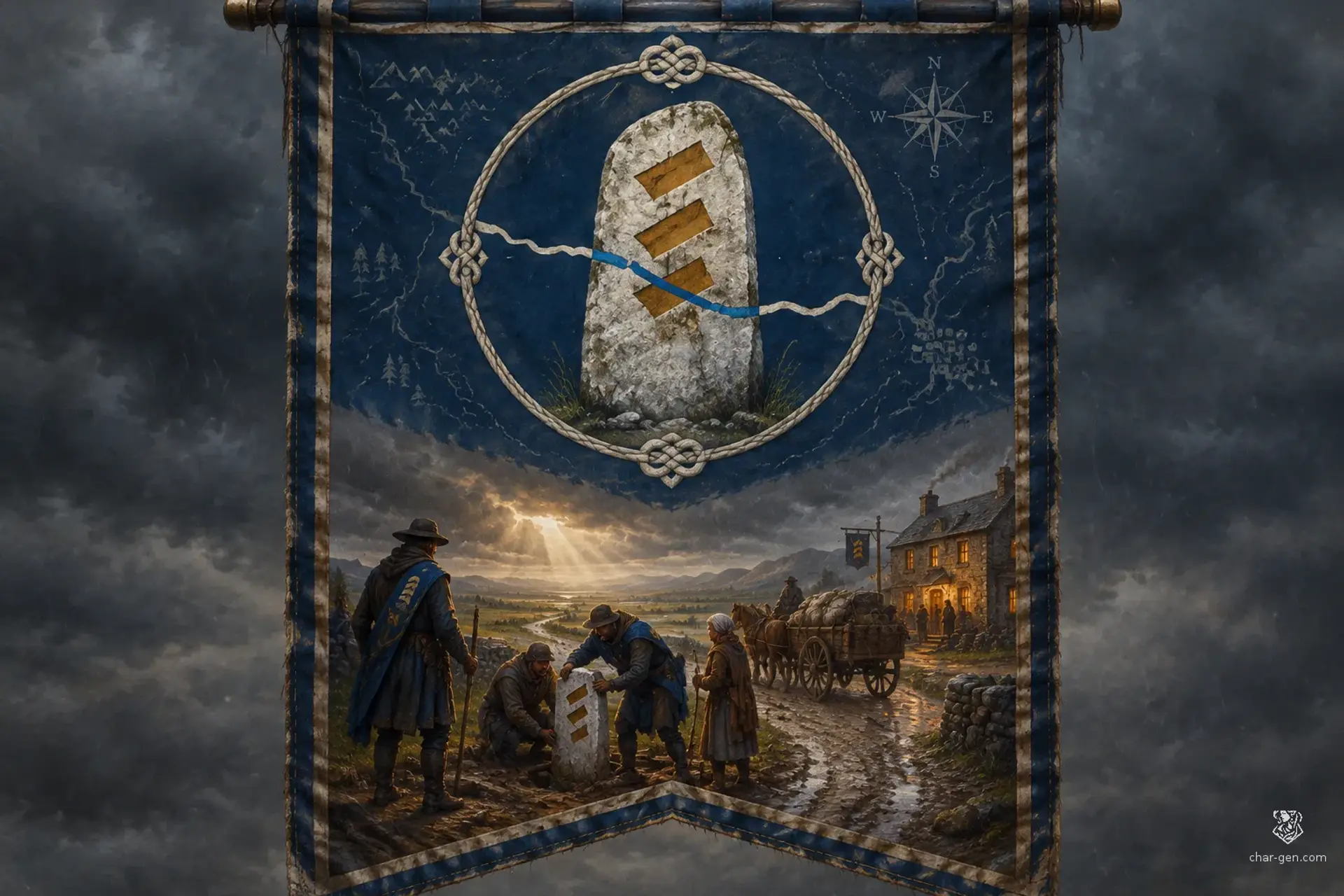
The association began after the Ashcut washout, when a river undermined the cut slope that gave the district its old name and buried a caravan road under mud and broken stone. Survivors found that every innkeeper, carrier, and local reeve held a different account of which tracks remained passable. Three survivors walked the routes together, marked reliable distances on standing stones, and swore to share warnings without selling them to a single lord. Their first markers were cut from the pale rubble cleared from the road. The association took its name from those markers and from the people who kept replacing them.
How to know them
Road-dust ochre, Rain-dark blue, Chalk white
- Three notches cut into a pale upright stone
- A chalk line crossed by a short blue stroke
- A knotted length of survey cord worn at the wrist
Standing
What they say they want
What they are doing now
Where it leads
A network of routes whose condition is known to all, whose upkeep is shared by those who use them, and whose safety cannot be withheld as a favor by a ruler or private company.
How others see them
Reliable, stubborn, and useful in a crisis. Many travelers trust the association's warnings more than official notices, while some merchants resent its power to discourage traffic by declaring a route unsafe.
People
5 ranks
First Marker of the Measure Council
Measured, dry-humored, and more compassionate than his formal manner suggests. He treats uncertainty as a duty to investigate, not as permission to guess.
- The Measure Council9 members
Sets shared standards, confirms route closures, settles disputes between chapters, and appoints the First Marker. Major decisions require six votes; emergency closures can be ordered by three councilors and reviewed later.
- First Markers38 members
Lead regional chapters, maintain relations with local authorities, and authorize changes to public route records.
- Roadwardens126 members
Inspect roads, replace markers, carry warnings, record hazards, and guide travelers through difficult passages.
- Milekeepers314 members
Maintain local mile stones, collect sworn travel accounts, arrange basic shelter, and report changes to a chapter.
- Probationers87 members
Learn route law, surveying, first aid, and dispute mediation while traveling under an established member.
Other key members
- Bera Roadwarden captain and likely successor
- Oruya of the Chalk Steps Surveyor, map custodian, and political rival to the senior leadership
- Drenn Keeper of the sealed route archive
- Mila Zoric Probationer and potential whistleblower
How they are organised
- Complete a witnessed journey of at least one hundred measured miles, or an equivalent service accepted by a chapter.
- Learn the association's marker code, hazard protocol, and rules for recording uncertainty.
- Provide a public reference from a traveler, settlement, or established member.
- Swear not to knowingly falsify a route report for private gain.
Relations
6 factionsThe association exchanges route reports and emergency shelter with the ferry families. The arrangement is useful but strained whenever the ferries raise tolls during a flood.
Operations
What they do
How they do it
Services for hire
- Route ReadingA small fee, a day's labor, or a useful travel accountThe chapter provides its latest verified route conditions, including known closures, water sources, and safe stopping points.
- Measured PassageNegotiated maintenance contributionA roadwarden guides a traveler through a hazardous stretch and helps arrange shelter with a member settlement.
- Marker DispatchFree for urgent warnings; otherwise, a modest copying feeThe association carries a sealed message to the next chapter and records when it was handed over.
What they can do
What they have
Where they are weak
Territory
Headquarters
The Ashcut junctionA long, low counting house built beside the junction of two maintained roads. Its public room is crowded with benches, route boards, weather tallies, and a wall of waxed map cases. A locked cellar holds retired markers, disputed surveys, and sealed testimony. The building's foundations reuse stones from the old Ashcut retaining wall.
Lands they hold
Outposts
- The Slate CutA wind-scoured pass where two old survey lines meetA staffed marker station and emergency shelter. Its name comes from the slate removed to widen the pass.
- Marn's ReachA low causeway through seasonally flooded groundStores rope, poles, and flood reports. The name is a worn corruption of an older local word for the raised crossing.
Secrets
Plot hooks
4 hooks- 1Stones Out of LineLow to moderate; investigation, travel, and a tense local negotiationReward: Association favor, safe passage, or a trusted route reportA probationer asks the characters to escort her to replace three stolen markers. The missing stones all point toward a private gate, but the thief may be trying to protect nearby villagers rather than conceal a crime.
- 2The Road That Is Not ClosedModerate; competing testimony, exploration, and political pressureReward: Payment, a route map, or support from either the chapter or the reeveA chapter's warning board declares a busy road unsafe, while the local reeve insists it is open. The characters must find out whether the danger is real, fabricated to divert trade, or caused by unexplained travelers using an old building along the road.
- 3The Sealed MeasureHigh; a regional investigation with factional consequencesReward: Access to the association's archives, a lasting alliance, or influence over the fate of the surveyThe copied gate survey is stolen from the archive. The characters can recover it, expose the council's concealment, or help decide who should receive the information. The Order of the Silver Dragon may become a partner if its routes are threatened, or an adversary if the survey risks exposing its activity.
- 4A Shorter Way Costs MoreModerate to high; negotiation, travel, and potentially sabotageReward: A permanent safehouse arrangement, political standing, or a share of a lawful route contractTwo chapters are close to fighting over a shortcut that would empty one settlement's market and save travelers several days. The characters must mediate, expose a manipulated survey, or help design a compromise before carriers begin blocking the route.
Work they offer
What gets in the way
Rumours
Media
0 imagesNo images yet.
Turn The Milemarkers' Association into a sheet
A high-res, share-ready sheet you can post or print.