
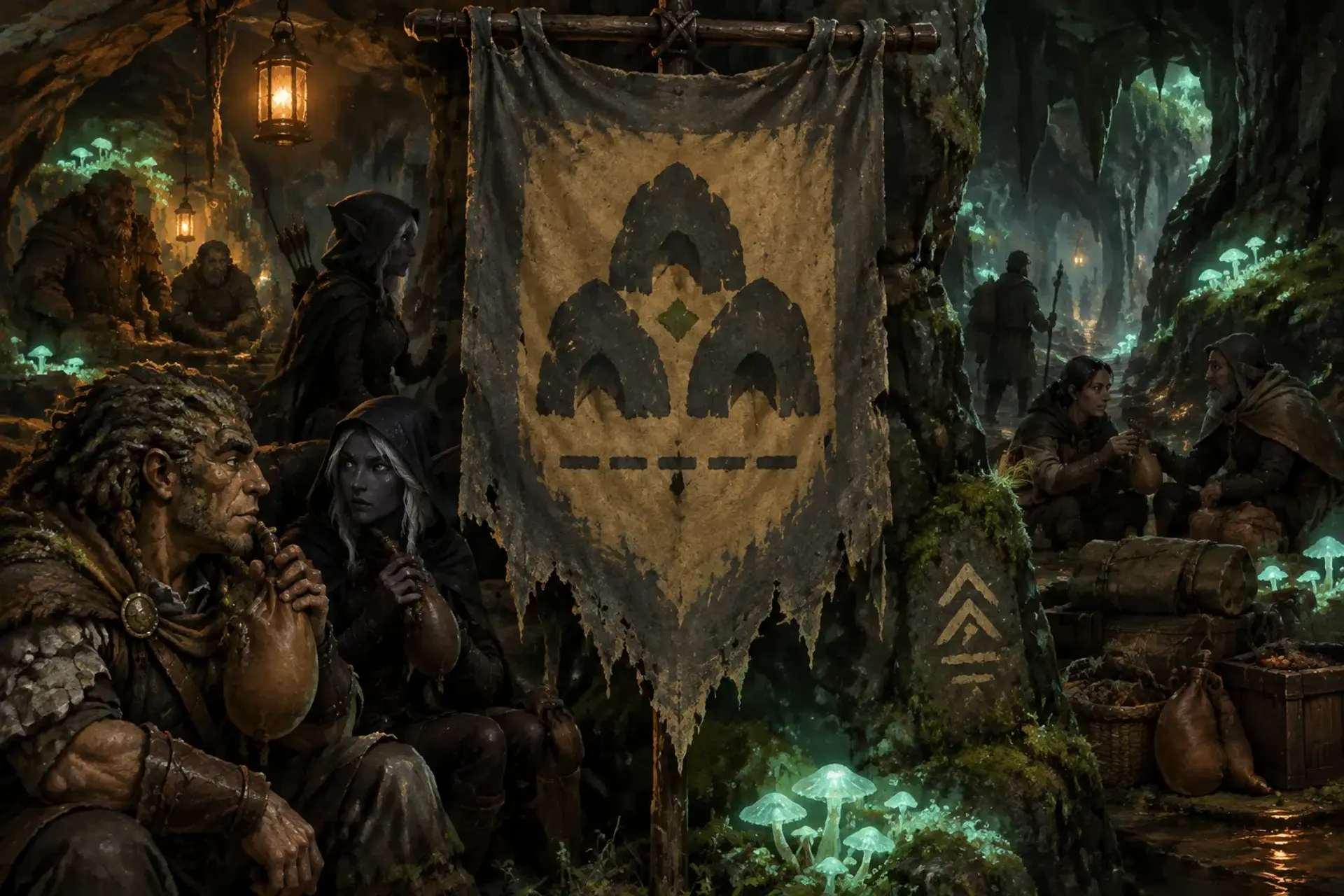
The Low-Road Compact
After the Siltfall, informal rescue routes developed into a loose compact among outcast Oreads, Drow defectors, and refugees with nowhere else to turn. Early members earned trust by keeping shelters stocked and escorting small caravans through unstable passages. The first major setback followed a false route mark that led a group into a collapse zone; the Compact adopted its two-exit rule and began using changing marks that only trained scouts could interpret. As K-12 expanded, the Compact turned to ledger theft and equipment sabotage to free laborers and disrupt press-gangs. This won gratitude from unaligned workers but sharpened the Claimholders’ pursuit. The Tectonic Cults’ rise created a second front: some route-keepers joined the Cults, while others rejected their tribute and indoctrination. The Compact’s defining evacuation during the raid on the vent-cut refuge established its present doctrine of protecting people before territory. It now operates through a scattered web rather than a fixed domain, its influence measured by how many people can find air and shelter when the stone shifts.
The Low-Road Compact
- Type
- Mutual defense league and…
- Size
- 190 members
- Reach
- High among independent…
- Base
- The Under-Roots, shifting among isolated waystations, outcast enclaves, and unmapped fractures.
Overview
After the Siltfall, informal rescue routes developed into a loose compact among outcast Oreads, Drow defectors, and refugees with nowhere else to turn. Early members earned trust by keeping shelters stocked and escorting small caravans through unstable passages. The first major setback followed a false route mark that led a group into a collapse zone; the Compact adopted its two-exit rule and began using changing marks that only trained scouts could interpret. As K-12 expanded, the Compact turned to ledger theft and equipment sabotage to free laborers and disrupt press-gangs. This won gratitude from unaligned workers but sharpened the Claimholders’ pursuit. The Tectonic Cults’ rise created a second front: some route-keepers joined the Cults, while others rejected their tribute and indoctrination. The Compact’s defining evacuation during the raid on the vent-cut refuge established its present doctrine of protecting people before territory. It now operates through a scattered web rather than a fixed domain, its influence measured by how many people can find air and shelter when the stone shifts.
How it began
The Compact’s name comes from a worn-down rendering of an old Under-Roots phrase meaning “the road beneath the road,” once used for routes known only to local guides. Its first members were not founders by intention. During the Siltfall, meltwater overwhelmed channels around an old quarry, leaving Oread crews, Drow defectors, and displaced families cut off from their employers and homes. A handful of scouts began laying shared marks between pockets of breathable air. Refugees who reached those marks left food, water, and spare air bladders for whoever followed. The first agreement was simple: anyone who used a shelter had to maintain it or leave it better stocked. As the K-12 Claimholders expanded their operations and the Tectonic Cults began demanding tribute, the route-keepers turned their mutual aid into a defense network. The watershed came when a Cult raid drove survivors into a vent-cut cavern that the Compact had marked as a refuge. The scouts held the narrow approach long enough to evacuate the wounded, then collapsed the route behind them. They lost the passage and several stores, but saved the settlement. Since then, no Safe-Cave is considered secure until it has at least two exits, and every shelter’s supplies are treated as belonging to the next person in need.
How to know them
Moss green, Smoke grey, Faded ochre
- The three-lobed cavern mark with its green dash.
- A loop of dark cord worn inside a sleeve, signifying an unrecorded rescue debt.
- A small, smooth stone passed between shelter keepers to show that a cache was checked and left safe.
Standing
What they say they want
What they are doing now
Where it leads
A web of self-sustaining shelters and locally trained guides that lets isolated people survive without needing permission from a syndicate, noble house, or cult. The Compact hopes to make its route knowledge common enough that no faction can monopolize it, but not so exposed that its shelters become targets.
How others see them
Among independent settlements, the Compact is known as a reliable source of guides, clean air, medicine, and rescue. People respect its refusal to claim territory, though some resent its secretive route marks and strict decisions about when rescue is possible. To wealthy syndicates and noble houses, it is a troublesome network of thieves and trespassers.
People
6 ranks
High Ranger
Measured, observant, and unsentimental about terrain. She treats shared air as a sacred obligation but refuses to promise rescue where no safe route exists. Her greatest flaw is withholding information even from allies when she fears they may act rashly.
- The Hearth Council7 members
Settlement delegates who decide which enclaves receive scarce supplies, approve large rescues, and set policy. Decisions normally require consent from at least five delegates; in an emergency, the High Ranger may act and answer for it afterward.
- High Rangers18 members
Senior route leaders responsible for regional maps, defense planning, and negotiations with other powers. The title is functional rather than hereditary.
- Way-Scouts64 members
Pathfinders who mark passages, maintain emergency caches, investigate hazards, and escort travelers. They may close a route without permission when conditions turn dangerous.
- Shield-Brothers39 members
A customary title for defenders of any gender. They answer distress calls, guard evacuations, and hold choke points while civilians withdraw.
- Grotto Herbalists23 members
Grow and gather fungal medicines, air-cleansing mosses, food cultures, and antivenoms; monitor the safety of local air and water.
- Hearthkeepers41 members
Caretakers, quartermasters, cooks, messengers, and shelter tenders who keep Safe-Caves usable. Membership counts shift as refugees arrive or move on.
Other key members
- Brannik Flintscar Shield-Brother captain and likely successor to Yvris
- Sesha Senior Grotto Herbalist
- Qorzhun of the Siltfall Hearth Council delegate and negotiator
- Thessik Way-Scout and potential informant
How they are organised
- Accept the doctrine that no traveler may be denied emergency air or water when a safe share is available.
- Agree not to sell Safe-Cave locations or route marks to a power that would endanger their occupants.
- Complete a supervised journey between two shelters and demonstrate practical respect for local hazards.
- New members are not required to disclose their former affiliations, though deliberate betrayal of the Compact is judged by the Hearth Council.
Relations
8 factionsWaystation keepers accept Compact guides and supplies; the Compact in turn shares hazard reports and helps evacuate threatened settlements. Their cooperation strains when a station conceals a dangerous route to protect its own trade.
Operations
What they do
How they do it
Services for hire
- Wayfinding EscortFree to those in immediate danger; otherwise a reciprocal task, supplies, or a modest contribution to the next shelter.A Way-Scout guides a traveler or small group along a known route, advising them on unstable ground, bad air, and signs of nearby hazards.
- Grotto RemediesTypically 30% below local open-market prices for trusted allies; urgent treatment is provided first and settled later.Herbalists supply fungal medicines, antivenoms, and air-cleansing mosses. Exact availability depends on recent harvests and local contamination.
- Safe-Cave ShelterNo charge for stranded travelers; repeat or commercial use requires replenishing what was taken when safe to do so.Temporary use of a Compact Safe-Cave and its emergency food, water, and air bladders, where supplies permit.
What they can do
What they have
Where they are weak
Territory
Headquarters
The Under-Roots, shifting among isolated waystations, outcast enclaves, and unmapped fractures.Rot-Grotto Sanctuary is named for a rot-choked fungal gallery that its first keepers drained and cleared for use. It is a mobile council base assembled from linked shelters, pack frames, and collapsible screens, moving through the Under-Roots when its current location becomes unsafe. Its inner chambers smell of wet stone, bitter herbs, and lamp oil. Pale moss gives enough light to read trail records, while hanging air bladders knock softly together whenever the base shifts. Rot-Grotto has no single permanent entrance; guides approach by separate paths and confirm identity using a sequence of taps against stone.
Lands they hold
Outposts
- Safe-Cave 7A narrow transit passage beneath the Plenty's End approachesA supply cache and temporary holding refuge for scouts, travelers, and families fleeing raiders. Its old route marks were copied recently.
- Moss-GrottoA fungal chamber serving three independent waystationsCultivates food and air-cleansing moss. A recent infestation of custom subterranean spore-lurkers threatens the farm.
- The Split-Air CacheAn unmapped fracture beyond an abandoned quarryA reserve of air bladders and water used only when established routes become impassable. Its location is known to very few scouts.
Secrets
Plot hooks
4 hooks- 1The Raid on Safe-Cave 7Levels 11–12, as supplied for this campaign hook; scale opposition and hazards to the party.Reward: Safe-Cave access, a confidential route fragment, and a standing favor from the rescued scoutsCult raiders have seized Safe-Cave 7 near Plenty's End and are holding local scouts for tribute. Yvris asks the party to infiltrate the cache, free the captives, and recover the route ledger before the captors drive them toward a magma vent. The captives disagree about whether to destroy the ledger or use it to negotiate.
- 2Press-Gang AmbushLevels 12–13, as supplied for this campaign hook; adjust the number of pursuers and travel hazards to fit.Reward: A safe escort through the Under-Roots, stolen contract evidence, and the gratitude of refugee familiesMercenaries backed by the K-12 Claimholders are rounding up unaligned Oread refugees for dangerous mining labor. The party must interrupt the press-gang, establish whether the debt papers are forged, and escort the refugees to Rot-Grotto Sanctuary without leading pursuers to its current location.
- 3Cleansing the Moss-GrottoLevels 13–14, as supplied for this campaign hook; use custom creatures or suitable 5e creatures adapted to the local ecology.Reward: Herbalist medicines, a lasting Compact alliance, and first choice of supplies from the restored farmA corrupted infestation of custom subterranean spore-lurkers has spread through Moss-Grotto, threatening the food and air-cleansing crops that sustain three waystations. The party must identify the source, clear the infestation, and decide whether the contaminated chamber can be restored or must be sealed.
- 4The Name Beneath the SealPersonal or party-scale investigation, with danger determined by the passage and the searchers closing in.Reward: A rescued person, proof of fraudulent claims, or leverage against a K-12 overseerA character’s former employer, family member, or traveling companion appears on a K-12 debt list that the Compact has stolen. The name is marked as deceased, yet a scout recently heard the person’s distress signal from a sealed passage.
Work they offer
What gets in the way
Rumours
Connections
Media
0 imagesNo images yet.
Turn The Low-Road Compact into a sheet
A high-res, share-ready sheet you can post or print.