
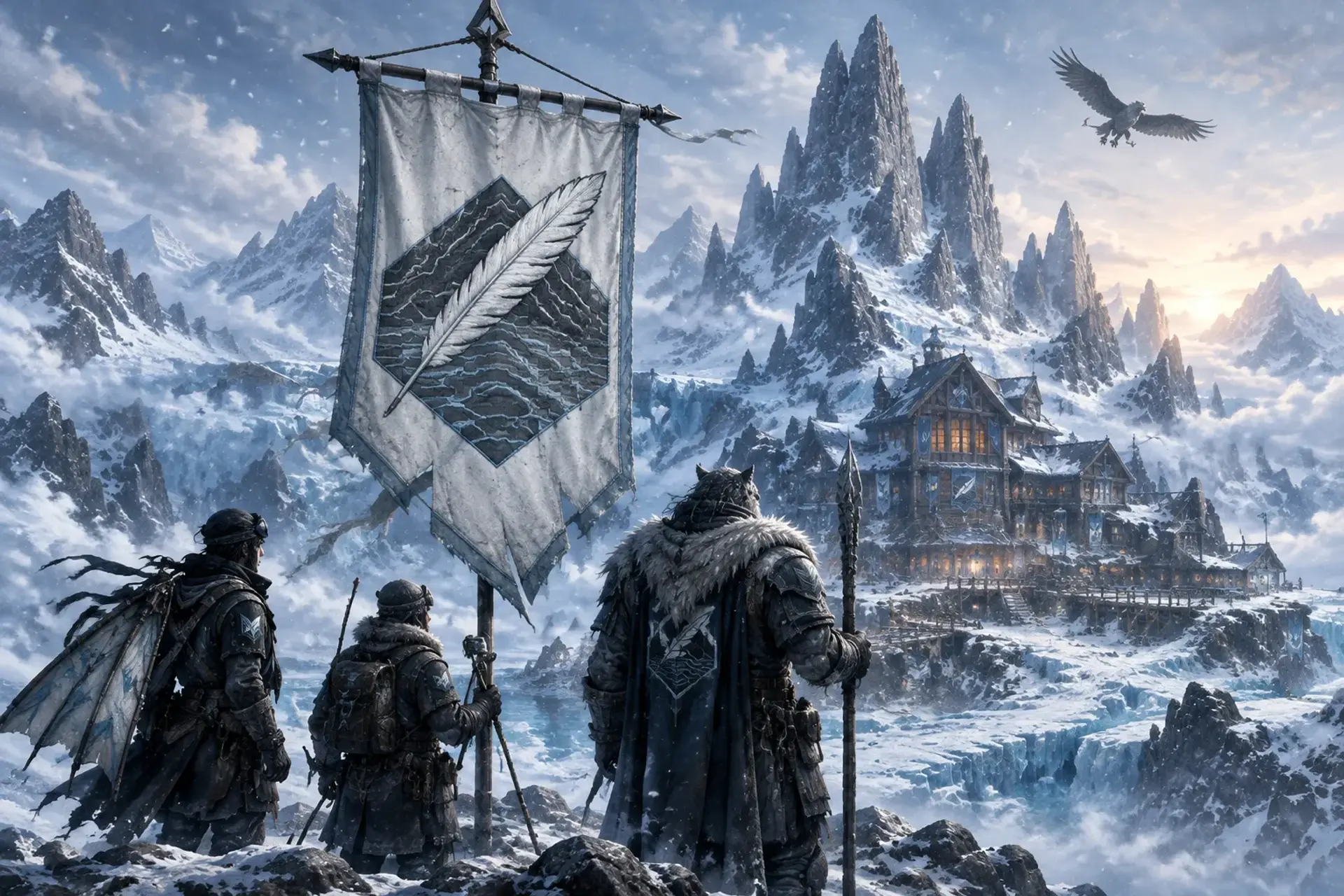
Rime Shelf Wardens
The Wardens grew from a practical rescue compact into a regional force as trade and extraction climbed higher into the Whispering Crown. Their early years were marked by route marking, storm rescues, and agreements with local roosts. The Shelf Turning made them known beyond the high settlements, but it also left a legacy of debate over how much humans and other communities may alter a living glacier. Later, the compact secured customary quiet-flight corridors and negotiated limits on blasting around several nesting spires. Those agreements remain unevenly observed, especially by lower trade circles that consider high-altitude restrictions costly. Today the Wardens are respected where their patrols can be seen and contested where their decisions threaten a valuable claim. Their founders’ old survey maps still guide patrol boundaries, but the maps were never legal deeds, a distinction that quarry interests now exploit.
Rime Shelf Wardens
- Type
- High-altitude conservation…
- Size
- 73 members
- Reach
- Strong in the Whispering…
- Base
- White Bowl
Overview
The Wardens grew from a practical rescue compact into a regional force as trade and extraction climbed higher into the Whispering Crown. Their early years were marked by route marking, storm rescues, and agreements with local roosts. The Shelf Turning made them known beyond the high settlements, but it also left a legacy of debate over how much humans and other communities may alter a living glacier. Later, the compact secured customary quiet-flight corridors and negotiated limits on blasting around several nesting spires. Those agreements remain unevenly observed, especially by lower trade circles that consider high-altitude restrictions costly. Today the Wardens are respected where their patrols can be seen and contested where their decisions threaten a valuable claim. Their founders’ old survey maps still guide patrol boundaries, but the maps were never legal deeds, a distinction that quarry interests now exploit.
How it began
The compact began after a sequence of sonic blasts triggered an avalanche above the high basins. The slide buried two nesting spires and cut off a winter route used by Aerost roosts, Oread ice-weavers, and Cloud Giant naturalists. Survivors gathered at White Bowl to mark safe ground, recover the dead, and agree that no single settlement could guard the peaks alone. Their first compact joined roost-guards, ice-workers, and giant witnesses under a shared rule: anyone disturbing a nesting slope or glacier seam had to answer to all three peoples. The Wardens were initially dismissed as rescue volunteers. Their standing changed when they redirected a second slide away from White Bowl by cutting a controlled channel through a fractured ice shelf. That costly operation, remembered as the Shelf Turning, established both their authority and their difficult principle: protecting the heights sometimes means making dangerous interventions before everyone agrees.
How to know them
Glacier blue, Slate grey, Weathered white
- A white feather laid over stepped survey contours
- Three short horn calls followed by one long call, the traditional sign that a route is closing
Standing
What they say they want
What they are doing now
Where it leads
A durable network of protected habitats, safe passage routes, and locally witnessed extraction limits, maintained by the communities who depend on the high country rather than imposed from distant trade centers.
How others see them
Among high-altitude communities, the Wardens are dependable rescuers and principled guardians who know the mountain’s moods. Lower trade circles often regard them as obstructive, sanctimonious, and too willing to hold commerce hostage to a nesting season.
People
5 ranks
Warden-Matron
Measured, wry, and difficult to hurry. She listens with her head slightly turned, as if weighing not only a speaker’s words but the wind beyond them. When she does give an order, she expects it to be followed.
- The Shelf Table3 members
A council of one elected voice from each Warden branch, joined by the Warden-Matron. Sets sanctuary policy, hears disputes, and can authorize emergency action. Ordinary decisions require two branch voices; permanent closures require all three.
- Aerie Rangers22 members
Mostly Aerost patrols who track wildlife, monitor flight corridors, sound avalanche warnings, and intervene against poachers. They report to rotating route captains.
- Ice-Weavers11 members
Mostly Mountain Oreads, with a few allied elemental shapers. They inspect glaciers, stabilize dangerous fractures, and seal hazardous vents when intervention is judged safer than leaving them alone.
- Rime Sentinels6 members
Cloud Giant treaty-guardians who witness excavation agreements, deter armed incursions, and mediate disputes that could otherwise become feuds. They do not take routine orders from the lodge.
- Trail Companions31 members
Guides, cooks, signal keepers, porters, and local volunteers. They are not all full members, but may earn standing through repeated service and rescue work.
Other key members
- Ruzan Senior Aerie Ranger and likely successor among the patrols
- Tetsu of Survey Marker Twelve Ice-Weaver fracture specialist
- Aminara Rime Sentinel treaty-witness
How they are organised
- Demonstrate practical respect for the high country through service, training, or a witnessed rescue.
- Accept the compact’s rules against poaching, reckless blasting, and unauthorized disturbance of active nesting sites.
- Complete a winter route watch under the supervision of members from at least two branches.
- Agree that protected wildlife is not property, even when a settlement or patron offers payment.
Relations
9 factionsLocal Aerost roosts share weather signs, nesting knowledge, and rescue duties with the Wardens. Cooperation can fray when patrols restrict customary routes.
Operations
What they do
How they do it
Services for hire
- High-Crest PassageA modest fee, a reciprocal service, or a contribution of useful field suppliesRoute advice, weather observations, and escort through designated protected wilderness zones when conditions permit.
- Cold-Route ProvisioningA standard local charge, with a 30% reduction for members and recognized alliesAccess to trained high-altitude mounts where available, gliders, climbing gear, and cold-weather survival supplies. Crag-Talon Griffons are not routinely offered as mounts.
- Roost-Trace AssistanceNo fee during an emergency; otherwise a reciprocal patrol or supply contributionTracking assistance from Aerost scouts familiar with local roosts and seasonal routes.
What they can do
What they have
Where they are weak
Territory
Headquarters
White BowlThe Frost-Vein Lodge is a low, stone-and-timber refuge built into the lee of White Bowl’s glacier basin. Its oldest wall follows an abandoned survey line, and its roof is weighted against katabatic winds. Inside, the air smells of lamp oil, wet wool, and cold stone. A narrow listening chamber holds route maps, horn signals, and ice samples; visitors can hear the glacier groan through the floor during warm spells.
Lands they hold
Outposts
- Survey Post TwelveA wind-scoured saddle above the northern glacial basinsA marker station and emergency shelter on a route named for its number on the founders’ old elevation survey.
- The Low DoorA narrow ledge below the eastern nesting spiresA cramped watch shelter whose name was borrowed from the founders’ lowland homeland, where it described a cellar entrance rather than a mountain refuge.
- Marker Forty-OneA high shelf overlooking a seasonal flight corridorA signal point used to record aircraft noise and relay temporary corridor closures.
Secrets
Plot hooks
5 hooks- 1The Log in the SnowPersonal, low to moderateReward: Warden standing, safe-route knowledge, or a favor owed by a local guideA character who knows the mountains is asked to guide an injured patrol member back to White Bowl before a storm closes the pass. The wounded ranger carries a field log that could expose an ally’s illegal flight through a nesting corridor.
- 2The Poached RoostRegional, level 11–12 if using the supplied campaign tierReward: Faction favor, access to protected trails, and possible future assistance from Aerost trackersA mercenary capture crew has set snares near an active Crag-Talon Griffon roost. The party must find the camp, free trapped fledglings, and decide what to do with a frightened crew member who claims a merchant hired them under a legitimate wildlife permit.
- 3The Illegal QuarryRegional, level 12–13 if using the supplied campaign tierReward: Payment from the endangered settlement, Warden recognition, or a negotiated mining concessionSonic charges are being used on an ice-locked mithral seam above the settlement of Lensend. The Wardens fear an avalanche; the operators insist the slope is stable and show paperwork bearing a disputed boundary. The party must halt the blasts, assess the ice, and uncover who authorized the work.
- 4Blight of the Frozen CoreCampaign-scale, level 13–14 if using the supplied campaign tierReward: Exalted standing, a major compact debt, or evidence linking the blight to a wider leyline disturbanceA Frost-Vein Cave-Stalker matriarch has become a source of necro-frost toxins in a primary nesting basin. The Wardens seek a capable team to reach the nursery cavern, identify whether the corruption is natural or introduced, and stop it without collapsing the habitat.
- 5The Missing RoostCampaign-scale social investigation with hazardous travelReward: A changed relationship with the Wardens and a decisive voice in their succession disputeThe disputed account of the Shelf Turning resurfaces when an Aerost family brings an old nesting token to White Bowl. Skadi asks the party to find the original survey notes before the accusation becomes a public rupture between the Wardens and a local roost.
Work they offer
What gets in the way
Rumours
Connections
Media
0 imagesNo images yet.
Turn Rime Shelf Wardens into a sheet
A high-res, share-ready sheet you can post or print.