
Loose-Stone Guides
The Loose-Stone Guides began as an informal rescue compact among Oread climbers and foothill haulers. Their first decades were spent recording slides, rebuilding trail signs, and teaching merchants that a route could be closed for safety rather than bargaining. Their defining watershed came during the Grayfall Season, when repeated rain loosened a major slope above the Mist-Step Switchbacks. A powerful ore concern demanded that its caravan proceed before the pass was lost to weather. The Guides refused, burned closure signals, and physically turned the wagons back. A slide buried the abandoned road hours later. The decision saved lives, but the ore concern retaliated by withholding supplies and hiring untrained guides. The association survived through food and rope shared by nearby settlements, and its reputation as an indispensable, stubborn service was made. Since then, the Guides have become a recognized part of foothill life. They maintain route logs, train local pathfinders, repair cairns, and coordinate warnings with coastal lookouts. Their influence grew whenever a storm or rockfall made ordinary travel impossible. Their largest setback came when a poorly judged closure diverted traffic away from a valley settlement during a lean harvest. The association compensated families where it could, but the incident sharpened the divide between members who prioritize immediate safety and those who argue that a closure must account for the people dependent on the route. Today, the Guides remain respected, needed, and increasingly challenged by merchants demanding faster passage.
Loose-Stone Guides
- Type
- Regional trail guild and…
- Size
- 120 members
- Reach
- High among foothill…
- Base
- Screefoot
Overview
The Loose-Stone Guides began as an informal rescue compact among Oread climbers and foothill haulers. Their first decades were spent recording slides, rebuilding trail signs, and teaching merchants that a route could be closed for safety rather than bargaining. Their defining watershed came during the Grayfall Season, when repeated rain loosened a major slope above the Mist-Step Switchbacks. A powerful ore concern demanded that its caravan proceed before the pass was lost to weather. The Guides refused, burned closure signals, and physically turned the wagons back. A slide buried the abandoned road hours later. The decision saved lives, but the ore concern retaliated by withholding supplies and hiring untrained guides. The association survived through food and rope shared by nearby settlements, and its reputation as an indispensable, stubborn service was made. Since then, the Guides have become a recognized part of foothill life. They maintain route logs, train local pathfinders, repair cairns, and coordinate warnings with coastal lookouts. Their influence grew whenever a storm or rockfall made ordinary travel impossible. Their largest setback came when a poorly judged closure diverted traffic away from a valley settlement during a lean harvest. The association compensated families where it could, but the incident sharpened the divide between members who prioritize immediate safety and those who argue that a closure must account for the people dependent on the route. Today, the Guides remain respected, needed, and increasingly challenged by merchants demanding faster passage.
How it began
Eighty-six years ago, a late-season slide swept away two pack trains on the lower Talus Shelf. Survivors found that the old trail marks had been covered by fresh scree, while merchants argued over who should pay to reopen the route. A small circle of Oread climbers and local haulers began keeping shared slope logs and placing temporary stone warnings where any traveler could read them. Their first winter brought another slide, but this time the warnings turned a caravan aside. The association took its name from the loose rock that could betray a careless step, and its first rule was that a guide's life could not be priced as an ordinary loss.
How to know them
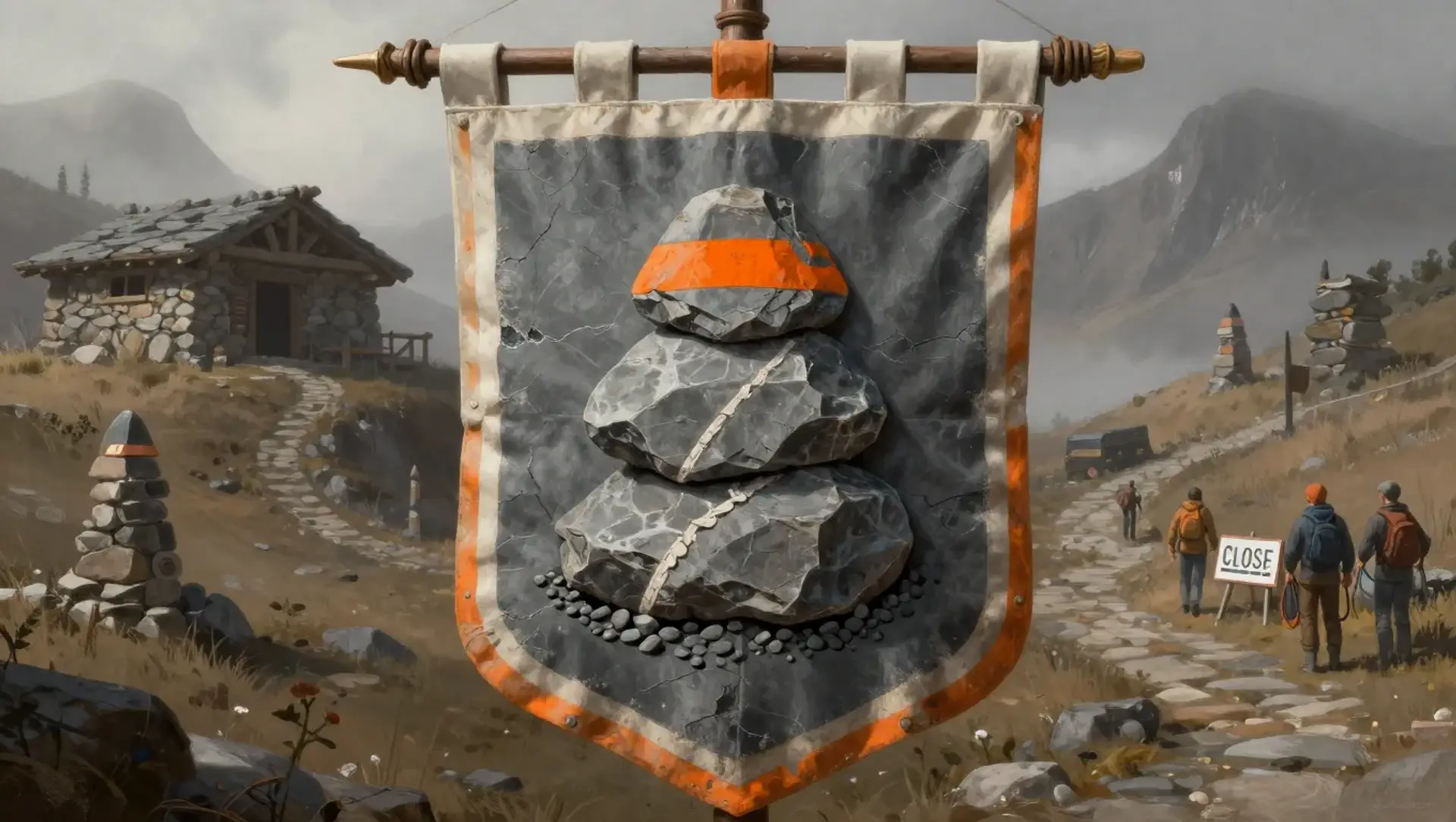
Slate gray, Chalk white, Signal orange
- A three-stone cairn with an orange stripe on the upper stone.
- A diagonal path-mark carved into trail rocks, with additional cuts indicating closure or unstable ground.
Standing
What they say they want
What they are doing now
Where it leads
A network of maintained, openly marked routes and locally trained guides, supported by shared emergency stores and controlled by the communities that depend on it. The association hopes to make safe passage a civic responsibility rather than a privilege sold to the highest bidder.
How others see them
Respected as indispensable, stubborn, and capable. Local travelers trust the Guides' hazard marks, while impatient merchants complain that their closures cost time and coin.
People
5 ranks
Master Guide
Steady, restrained, and attentive to small changes in weather and ground. He is slow to anger but remembers broken agreements. He sometimes withholds uncertain information until he can verify it, a habit that may cost others precious time.
- The Lodge Table5 members
The Master Guide and four elected senior members set policy, approve blacklists, allocate emergency stores, and settle disputes. Decisions are normally made by consensus; during an immediate hazard, the senior guide present may close a route without a vote.
- Cairn-Keepers18 members
Senior route wardens stationed at key junctions, including Screefoot and Whistlehead. They inspect trail signs, record slope changes, train apprentices, and signal closures with colored smoke.
- Path-Runners46 members
Certified scouts and caravan guides who lead travelers, assess pass conditions, clear small blockages, and report hazards. Many are Oreads, with human and other local members also serving.
- Stonehands21 members
Cairn-carvers, rope-makers, gear repairers, cooks, and lodge keepers who maintain the association's equipment and waystations. Their knowledge of supplies often gives them quiet influence over the guides.
- Learners30 members
Probationary members who carry messages, practice route reading, and accompany certified guides. They cannot lead a commercial caravan alone.
Other key members
- Ayo Senior Path-Runner and likely successor
- Tavik Stores keeper and gear steward
- Laleh of Screefoot Cairn-Keeper and caravan negotiator
How they are organised
- Demonstrate a practical ability useful to safe travel, such as route finding, climbing, trail repair, first aid, weather observation, or equipment maintenance.
- Complete a supervised journey across a route appropriate to the applicant's experience.
- Learn the association's signal marks and agree not to alter a hazard sign for personal gain.
- Accept that a certified guide may refuse a route they judge unsafe, even when a client offers additional payment.
Relations
9 factionsWhistlehead's lookouts share weather, surf, and cliff-road warnings with the Guides. The arrangement is strained when fishing crews need the same paths for urgent hauls.
Operations
What they do
How they do it
Services for hire
- Certified Trail GuideStandard negotiated guide fee; hazard pay may apply in poor weatherA certified Path-Runner leads a traveler or caravan along a route whose conditions have been checked recently.
- Slope and Route BriefingFree for urgent safety warnings; otherwise a small record-copying feeCurrent reports on closures, rockfall, weather damage, and known hazards across the association's routes.
- Climbing Gear ServiceMembers and trusted allies receive a 50% discount on hiring an expert guideInspection, fitting, and repair of climbing gear, including custom Talus-Grip Crampons and Silt-Filter Masks. These are custom setting equipment, not official D&D items.
- Waystation RefugeNegotiated contribution of food, coin, labor, or materialsEmergency shelter and a limited ration at a waystation when a storm or slide strands travelers. Supplies are finite and may be reserved for rescues.
What they can do
What they have
Where they are weak
Territory
Headquarters
ScreefootThe Slope-Watch Lodge is a stout stone waystation built into a sheltered fold above Screefoot. Its low roof is weighted against gale winds, and its outer wall doubles as a public board for route closures, slope readings, and missing-person notices. Inside, rope hangs beside soot-dark signal horns, crampons clack against a repair bench, and the air smells of wet wool, lamp oil, and chalk dust. The lodge is deliberately plain, with a broad map table where any caravan representative may inspect the current route marks.
Lands they hold
Outposts
- Whistlehead Cairn PostWhistlehead, near the Brine-Watch TowerReceives storm and cliff-road warnings, tracks coastal route conditions, and relays messages to the main lodge.
- Switchback MarkersThe Mist-Step Switchbacks above ScreefootA chain of small tool caches and marked resting shelves maintained by Path-Runners. Each is checked after heavy rain or rockfall.
- Salted Canyon Marker StationA trail junction overlooking Salted CanyonMonitors an exposed approach where drifting scree often buries old signs and where caravans have repeatedly attempted unverified shortcuts.
Secrets
Plot hooks
5 hooks- 1Rebuilding the RunesLow, suitable for beginning charactersReward: Faction standing, route information, and access to basic trail gearA Scree-Prowler pack has wrecked a warning cairn above Salted Canyon. The party must escort a junior Cairn-Keeper to restore the marks before a merchant caravan takes the unverified pass. The danger may be natural, or someone may have driven the creatures toward the cairn.
- 2The Blacklisted ShipmentModerate, with a moral and negotiation challengeReward: Payment, improved standing, or leverage with local caravan interestsA blacklisted ore factor hired an uncertified guide to rush a shipment through a failing gorge. The guide died, and the cargo is now stranded where a second slide could bury it. The Guides ask the party to recover the shipment and bring the factor before a local hearing. The party may discover that the merchant was trying to deliver urgently needed supplies.
- 3The Open SlopeModerate to high, depending on the threat beyond the fissureReward: Faction support, specialist equipment, and a lead toward deeper regional troubleA major slide has opened a fissure beneath a trade path. Sulfurous fumes rise from the crack, and a Scree-Slide Stalker has emerged near a waystation. Jorun needs the party to investigate and secure the breach before the route is lost. The fissure may connect to a wider disturbance in the region's unstable ground.
- 4The Closed RoadVariable, centered on judgment and urgent travelReward: Trust from the local community and a meaningful role in the Guides' internal disputeA settlement's winter stores are stranded behind a route closure. Ayo believes the path can be crossed in a narrow weather window; Jorun refuses to send a team until the slope readings are confirmed. The party must help assess the route, find another supply line, or persuade the Guides to accept the risk.
- 5Marks in the Wrong PlaceModerate investigationReward: A recovered route ledger, political influence, and possible access to the faction's sealed recordsA series of false safe-route signs has sent travelers toward a dangerous descent. Evidence points to a rival route broker, but the marks also resemble the work of a trained Cairn-Keeper. The investigation could expose Laleh's payments or implicate an innocent member.
Work they offer
What gets in the way
Rumours
Connections
Media
0 imagesNo images yet.
Turn Loose-Stone Guides into a sheet
A high-res, share-ready sheet you can post or print.