
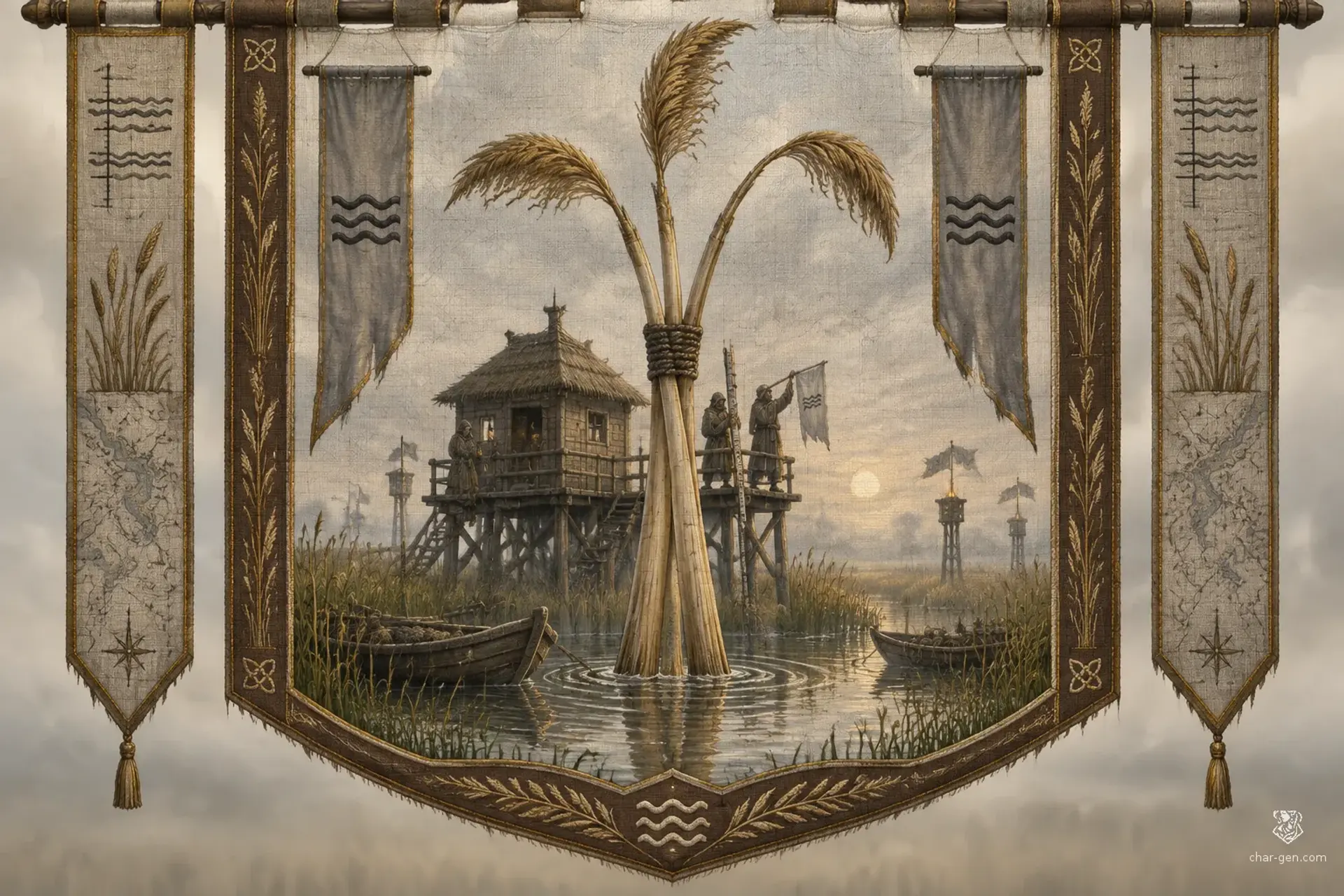
The Reed Measure
For its first decades, the Measure was a small network of volunteer Reedwright households. Its warnings gained a reputation for accuracy, and nearby settlements began asking its keepers to mark safe crossings and help distribute food during floods. The faction's first great triumph came when its members diverted a spring surge into abandoned reed beds, sparing several farms and leaving the fields richer the following year. Its watershed moment was the Second High Water, when two sets of measurements disagreed. The council sent a warning based on the older gauge, while Oru's successor believed the new readings. The disagreement delayed evacuation in the downstream hamlet of Sedge End, where dozens died. In the aftermath, the Measure adopted its three-reed emblem and a rule that no major warning could rest on a single gauge or a single reader. It also began keeping duplicate records, one in the hall and one carried by a traveling keeper. In later generations, the Measure became indispensable. It mapped seasonal channels, organized rescue boats, and negotiated shared access between settlements. That influence brought wealth and political attention. During the Charter Flood, an ambitious reeve tried to seize the faction's maps and appoint its keepers as crown officers. The Measure publicly refused. In secret, its leaders removed the most sensitive records before surrendering a harmless set of copies. The faction later helped open channels for trade, but the new traffic brought dredging, toll disputes, and pressure to keep routes open year-round. The Measure split between those who saw trade as a way to fund public safety and those who feared it would turn a living wetland into a managed road. Today it is respected as a lifesaving service and resented as an unelected power. Its members still speak of watching and warning, but they now make decisions capable of changing who prospers, who moves, and who gets wet.
The Reed Measure
- Type
- A Reedwright water-keeping…
- Size
- 190 members
- Reach
- Regional
- Base
- Reedwake
Overview
For its first decades, the Measure was a small network of volunteer Reedwright households. Its warnings gained a reputation for accuracy, and nearby settlements began asking its keepers to mark safe crossings and help distribute food during floods. The faction's first great triumph came when its members diverted a spring surge into abandoned reed beds, sparing several farms and leaving the fields richer the following year. Its watershed moment was the Second High Water, when two sets of measurements disagreed. The council sent a warning based on the older gauge, while Oru's successor believed the new readings. The disagreement delayed evacuation in the downstream hamlet of Sedge End, where dozens died. In the aftermath, the Measure adopted its three-reed emblem and a rule that no major warning could rest on a single gauge or a single reader. It also began keeping duplicate records, one in the hall and one carried by a traveling keeper. In later generations, the Measure became indispensable. It mapped seasonal channels, organized rescue boats, and negotiated shared access between settlements. That influence brought wealth and political attention. During the Charter Flood, an ambitious reeve tried to seize the faction's maps and appoint its keepers as crown officers. The Measure publicly refused. In secret, its leaders removed the most sensitive records before surrendering a harmless set of copies. The faction later helped open channels for trade, but the new traffic brought dredging, toll disputes, and pressure to keep routes open year-round. The Measure split between those who saw trade as a way to fund public safety and those who feared it would turn a living wetland into a managed road. Today it is respected as a lifesaving service and resented as an unelected power. Its members still speak of watching and warning, but they now make decisions capable of changing who prospers, who moves, and who gets wet.
How it began
The Measure began in the winter remembered as the Silt Year. A succession of sudden floods buried footpaths, split families from their fields, and trapped travelers on islands of high ground. A Reedwright basket-maker named Oru was among those stranded. Oru noticed that cut reeds left at the edge of the water showed the rise more clearly than the crude posts used by the local reeve. Oru and several neighbors began cutting, tying, and placing bundles at agreed landmarks so people could judge the water's height from a distance. They called the practice 'keeping the bend's reed measure.' Locals shortened the phrase to 'the Reed Measure,' then simply 'the Measure.' The first keepers did not claim authority; they promised only to watch, warn, and help move people before the water came.
How to know them
Reed gold, Silt brown, Rain gray
- Three pale reeds tied with dark cord.
- A short black mark on a post means water is rising; two marks mean a warning has been confirmed.
- A strip of rain-gray cloth hung low means a channel is unsafe even when its surface appears calm.
Standing
What they say they want
What they are doing now
Where it leads
A marshland where every settlement can read the water, no single ruler owns the channels, and warnings travel faster than floodwater. The contradiction is that achieving this vision may require the Measure to acquire authority over land and water that it claims should belong to everyone.
How others see them
Many residents regard the Measure as dependable, modest, and lifesaving. Travelers value its markers but complain about its fees and rules. Local rulers resent that people often trust a Bend Keeper's warning more than an official proclamation.
People
5 ranks
First Reader
Soft-spoken, attentive, and hard to hurry. Oru gives people time to disagree, then proceeds as if disagreement has not changed the arithmetic.
- First Reader1 member
Chosen for a three-year term by the senior keepers. Coordinates the faction, speaks for it in negotiations, and may order an emergency warning. Cannot permanently alter a channel without the measure council's approval.
- Measure Council7 members
Senior Reedwright surveyors elected by working crews. They approve channel work, settle disputes over records, and decide how warnings are distributed. A majority can overrule the First Reader, but only after an open hearing.
- Bend Keepers28 members
Experienced field officers responsible for particular waterways, gauges, stores, and rescue routes. They train apprentices and report readings to the council.
- Cutters64 members
Full members who maintain markers, survey banks, ferry warnings, and lead seasonal repair crews. They include boatwrights, basket-makers, herbalists, and local guides.
- Tied Hands90 members
Apprentices and part-time members. They learn reading marks, rescue signals, and the rules for recording measurements. They may speak at meetings but cannot vote on channel policy.
Other key members
- Dekk Bend Keeper responsible for the southern gauges; a likely reform candidate for the council.
- Mielu of the Upper Bends Healer and rescue organizer who knows which families are quietly being moved before official warnings.
- Aulava Map loft custodian and keeper of the duplicate records.
- Sava Apprentice who discovered that several new markers do not match the council's records.
How they are organised
- Be accepted by a local crew or a Bend Keeper who can vouch for your reliability.
- Complete a season of practical work: marker repair, rescue drills, record copying, or food-store maintenance.
- Learn the faction's warning signs and demonstrate that you can record a measurement without changing it to fit a preferred conclusion.
- Swear to assist people in immediate danger regardless of their status or faction, unless doing so would create a greater imminent danger.
Relations
8 factionsThe Reedwright ferry families depend on the faction's marked channels and flood warnings. Their support is conditional: they will abandon the Measure if it endangers their boats or children.
Operations
What they do
How they do it
Services for hire
- Channel ReadingA modest fee, waived for people displaced by flood or fireA guided passage through marked channels with advice on current depth, hazards, and safe stopping places.
- Bank CheckLabor owed in a later repair season, or a contribution of food, rope, or timberInspection of a bank, ferry crossing, or settlement edge, followed by practical recommendations and a recorded reading.
- High-Water AidUsually free during an emergency; a small contribution requested afterward if the household can afford itEvacuation help, temporary boat transport, and access to emergency stores when a community faces immediate danger.
What they can do
What they have
Where they are weak
Territory
Headquarters
ReedwakeA low, stilted hall on a gravel rise above the seasonal wetland. Its open ground floor holds boats, repair timber, and emergency stores; the upper floor contains a meeting room, a map loft, and sleeping mats for whoever is on flood watch. Water marks on one central post record every major rise since the faction's founding. The building is sturdy but deliberately plain, because its members believe a headquarters should survive being submerged.
Lands they hold
Outposts
- Three-Call PostA stilt platform at the narrow crossing where three seasonal channels meet.A signal station where a watch keeper can relay flood warnings with horn calls and colored cloth.
- Sedge End StoreAn abandoned reed-drying shed on a gravel tongue north of the main marsh.An emergency cache of food, rope, medicine, and spare marker bundles. Its name preserves the old hamlet that was lost in the Second High Water.
- The Long ReachA ferry landing near the upper edge of the wetland.A meeting point for traders, survey crews, and people seeking safe passage through unfamiliar channels.
Secrets
Plot hooks
4 hooks- 1The Wrong ReedLow to moderateReward: Payment, local contacts, and the apprentice's trustPersonal: A Reedwright apprentice asks the characters to escort them to a damaged marker before the next rain. The marker bears a warning signal the apprentice was taught never to use, and the council denies issuing it.
- 2A Bank Gives WayModerateReward: Coin, faction standing, or influence in a local water-rights disputeLocal: The village of Reedwake has begun sinking along one bank. The Measure blames unauthorized dredging; the Deep Cut Company blames a natural spring. Characters must inspect the site, find the cause, and decide whether to publicize evidence that could trigger evacuation.
- 3Three WarningsModerate to highReward: Access to the Measure's archive and a regional allianceRegional: Three communities receive conflicting flood warnings, each apparently bearing the Measure's mark. The faction asks for discreet investigators before panic empties the markets. The false warnings may be sabotage, but the real readings are also being withheld.
- 4Where the Water Must GoHighReward: Major political leverage, a lasting regional consequence, and the possibility of changing the MeasureCampaign: Oru asks the party to help prepare a controlled breach that would divert a predicted catastrophic flood. The plan could save thousands, but the redirected water would inundate a settlement whose residents have not been informed. The characters may uncover the old record that reveals why the Measure fears a public vote.
Work they offer
What gets in the way
Rumours
Connections
Media
0 imagesNo images yet.
Turn The Reed Measure into a sheet
A high-res, share-ready sheet you can post or print.