
Liftwright Brotherhood
The Brotherhood began as a compact among lift crews after a preventable platform collapse at the Three-Peaks Gap. Its members traded inspection knowledge across settlements that had previously guarded their mechanical methods as local secrets. The Long Hoist Dispute established its authority to halt a dangerous ascent, while later council recognition made certification a condition of operating major public lifts. During the following decades, the guild standardized inspection marks and emergency procedures across much of the Terraced Bastions. Its crews helped keep crossings open through storms and supply interruptions, earning a reputation for reliability. Growth also brought conflict: merchants resented delays, local operators resented outside oversight, and guild leaders discovered that control of lift schedules could secure political concessions. The Brotherhood now faces pressure from both sides. Infrastructure is aging, trade demands are increasing, and every closure risks isolating a community. Its members remain bound by a shared craft, but disagree over whether their duty is to protect people from unsafe systems or to preserve the guild's right to control those systems.
Liftwright Brotherhood
- Type
- Engineers'
- Size
- 229 members
- Reach
- Very high across mountain…
- Base
- Citadel of Terraces
Overview
The Brotherhood began as a compact among lift crews after a preventable platform collapse at the Three-Peaks Gap. Its members traded inspection knowledge across settlements that had previously guarded their mechanical methods as local secrets. The Long Hoist Dispute established its authority to halt a dangerous ascent, while later council recognition made certification a condition of operating major public lifts. During the following decades, the guild standardized inspection marks and emergency procedures across much of the Terraced Bastions. Its crews helped keep crossings open through storms and supply interruptions, earning a reputation for reliability. Growth also brought conflict: merchants resented delays, local operators resented outside oversight, and guild leaders discovered that control of lift schedules could secure political concessions. The Brotherhood now faces pressure from both sides. Infrastructure is aging, trade demands are increasing, and every closure risks isolating a community. Its members remain bound by a shared craft, but disagree over whether their duty is to protect people from unsafe systems or to preserve the guild's right to control those systems.
How it began
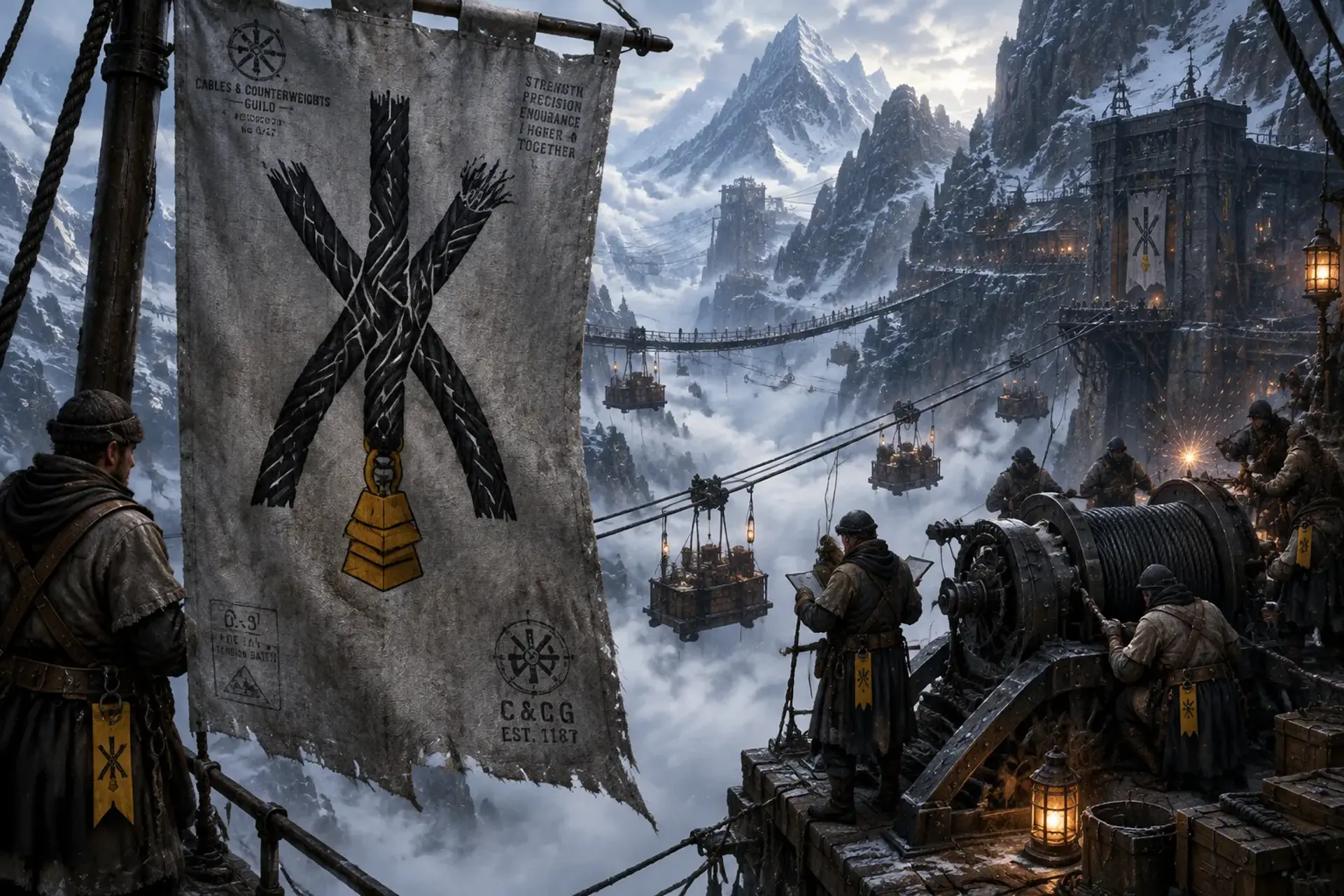
The Liftwright Brotherhood takes its name from the warning still stamped on its oldest surviving maintenance ledger: 'A lift that sings will fall.' In 1127 TF, a freight platform at the Three-Peaks Gap began to hum under an overloaded ascent. The keepers had reported a fraying line, but a quarry consortium ordered the platform raised anyway. It fell into the valley, killing workers and destroying a winter store of grain. Survivors from three lift crews joined to demand that only trained operators could certify high-tension lines. Their first badge bore a broken strand, a grim emblem they refused to replace even after the guild grew powerful. At first, the Brotherhood was a loose association of mechanics who shared tools, spare cable, and inspection notes. Its watershed moment came during the Long Hoist Dispute, when a merchant delegation tried to force a heavily laden platform up a storm-battered route. The Brotherhood lowered the platform, chained the controls, and held the line while angry petitioners crowded the gallery. The delay cost a season of trade, but the feared cable held through the gale. The council later recognized the guild's authority to certify high-tension equipment. As the cliff settlements expanded, the Brotherhood built standardized training, inspection schedules, and emergency shelters beside key routes. It became indispensable to the commerce and defense of the Terraced Bastions. That success hardened into a monopoly. Today its people still work in cold spray, rope burn, and the shriek of winch teeth, but their practical authority makes them a political power in its own right.
How to know them
Cable-black, Signal saffron, Quarry grey
- A broken strand stamped beside an inspection mark.
- Three crossed cables over a counterweight.
- A saffron strip tied to equipment cleared for service.
Standing
What they say they want
What they are doing now
Where it leads
A continent-wide system of maintained, inspected, and publicly documented crossings, with the Brotherhood recognized as the neutral custodian of its mechanical safety. The guild's ideal would protect communities from reckless deadlines; its danger is that neutrality may become a claim to rule every route.
How others see them
Regarded by many as indispensable, exacting, and slow to bend. Travelers trust their maintenance marks when a storm closes around a bridge, while merchants often curse their delays and fees. The Brotherhood's crews are known for working in sleet and thin air without much ceremony.
People
6 ranks
Master Cable-Wright
Calm, meticulous, and resistant to bluster. He can explain a load limit in terms a merchant understands, but will not pretend a dangerous calculation is negotiable. He dislikes how often the guild's authority is mistaken for infallibility.
- Master Cable-Wright1 member
Leads the Brotherhood, negotiates with the council, and may suspend a route when its safety is in doubt. The post does not grant unilateral control of guild funds.
- Peak Table7 members
Senior representatives for the principal crossing networks. They vote on budgets, discipline, and certification policy; disagreements are recorded rather than hidden.
- Gantry Masters28 members
Operate major steam-driven and water-powered winches, schedule crews, and control platform movement at busy hubs.
- Strand-Inspectors46 members
Inspect cable tension, counterweight gears, anchors, and stress fractures. They can issue a temporary closure pending review.
- Cable-Guards34 members
Protect lift stations, bridge heads, and repair crews. They use grapnels, heavy crossbows, signal lamps, and arresting lines.
- Linehands and apprentices113 members
Handle routine operation, rope work, records, hauling, and training. Seniority is earned through supervised service, not purchased.
Other key members
- Sesi Lead Strand-Inspector
- Batu Kelm Gantry Master at the Tri-Peak Cable Hub
- Oru Treasurer and council negotiator
- Sheshi of Pella Cable-Guard captain
How they are organised
- Complete a period of supervised work on a lift, bridge, or repair crew.
- Demonstrate competence in a chosen trade, such as inspection, operation, rigging, or route defense.
- Accept the guild rule that an operator must report damage and may not knowingly exceed a certified load.
- Submit to review after a serious safety breach; seniority does not grant immunity.
Relations
6 factionsThe High-Council depends on the Brotherhood to keep cliff roads, liftways, and trade moving. The relationship strains whenever delegates demand a load the engineers consider unsafe.
Operations
What they do
How they do it
Services for hire
- Load and Line InspectionStandard guild fee; waived for urgent rescue work when approved by a local Gantry MasterInspection of a lift, cable, bridge span, or anchoring point, with a written report and recommended repairs.
- Certified Lift PassageNegotiated by distance, weather, and available capacityPassage on an operating Brotherhood lift platform, subject to posted safety limits and current route conditions.
- Winch and Cable RepairMaterial cost plus labor; emergency work may require council approvalRepair or replacement of cable fittings, counterweight components, and standard rigging. The Brotherhood will not certify equipment it considers unsafe.
- Whiteout ShelterUsually a shelter contribution or documented service owed to the local crewTemporary protection in an emergency cable-car shelter during a whiteout, route closure, or lift failure.
What they can do
What they have
Where they are weak
Territory
Headquarters
Citadel of TerracesThe Tri-Peak Cable Hub occupies a broad gallery in the Citadel of Terraces, where three bridge approaches converge above the Three-Peaks Gap. Its public floor is full of route charts, repair notices, and the steady clatter of a working test winch. Beneath it, a locked inspection bay holds cable samples, tension gauges, and the Brotherhood's oldest ledgers. The air smells of hot grease, wet wool, and iron filings; wind whistles through narrow ventilation slots even with the doors shut.
Lands they hold
Outposts
- The Last RungPella Shelf gantryA warning-name retained after an evacuation ladder failed during a storm. The station supports inspections and replacement work on the shelf's main freight route.
- The Empty CradleCliff-bridge approaches throughout the Terraced BastionsA boastful name for a once-grand bridgehead depot that now serves mostly as a small repair store and storm shelter.
- The Windward Ledger HousesHigh-altitude gantry docks and lift stationsA practical network of modest record rooms where crews file load counts, repair needs, and route closures.
Secrets
Plot hooks
5 hooks- 1The Fraying StrandLevels 7–8; hazardous rescue, investigation, and a possible fight on a swaying gantry.Reward: Guild standing, safe passage, and access to specialist cable gearA strand-inspection apprentice finds fresh acid pits beneath a protective wrapping on the Pella Shelf tension cable. The party must protect a replacement crew suspended over a vast drop while determining whether the saboteur is still among the workers.
- 2Quota StandoffLevels 8–9; negotiation under time pressure with risk of violence and structural failure.Reward: Council favor, a repair contract, or a public ally among the linehandsMerchant delegates demand a double-load on a lift with a known anchor flaw. The Gantry Master refuses to operate it, and the crowd is closing around the controls. The party can mediate, inspect the anchor, find an alternative route, or uncover who concealed the damage.
- 3Gantry SiegeLevels 9–10; a fortified vertical site, hazardous traversal, and a ticking sabotage threat.Reward: Cable-Guard support, specialist transport, and influence over future route securityTectonic Cultists seize a high-altitude winch station and threaten acoustic charges against the main cable tower. Three military transport platforms hang over the valleys. The party must reach the controls, protect the defenders, and prevent the tower from being brought down.
- 4The Copy BelowPersonal or local; social investigation with consequences for the operator, the witness, and the Brotherhood's reputation.Reward: A trusted contact among the linehands and proof of a hidden safety failureA lift operator asks a character to carry a sealed inspection log to Vaelen, insisting that the official ledger has been altered. The evidence points toward an old repair decision and a living witness who wants the matter buried.
- 5The Humming RoutesRegional; investigation across multiple high-altitude sites, with a choice between immediate closures and risking a temporary repair.Reward: A standing alliance with the Brotherhood and a pivotal role in deciding which communities receive scarce repairsSeveral crossings begin to shudder in rhythm, though their mechanical inspections appear sound. The Brotherhood suspects interference with nearby infrastructure and asks the party to compare the failures before a heavily used route collapses.
Work they offer
What gets in the way
Rumours
Connections
Media
0 imagesNo images yet.
Turn Liftwright Brotherhood into a sheet
A high-res, share-ready sheet you can post or print.