
Cable and Ledge Keepers
After the Three-Rope Night, route crews slowly built a shared practice: inspect the anchor before trusting the cable, record every repair, and leave a shelter better stocked than they found it. For decades the association was little more than an agreement among scattered crews. Its watershed moment came when a heavily loaded span failed during a merchant rush. A crew had warned that an anchor was cracked, but the warning was ignored. The disaster killed travelers and Keepers alike. In response, the association adopted its Load Mark, a public record of inspection, capacity, and closure decisions. That mark gave the Keepers authority to halt crossings, a power they have defended ever since. Their reputation grew as they established shelters and rescue lines along the Whispering Crown’s high routes. Their greatest triumph was coordinating repairs across several isolated spans after a season of severe wind damage. Their lasting setback was the loss of experienced crews and stores in a whiteout soon afterward, which exposed how much the whole network depended on a few difficult-to-reach depots. Today, they are indispensable but stretched thin, and signs of anchor-stone drift have made their old methods feel less certain.
Cable and Ledge Keepers
- Type
- Bridgewright association…
- Size
- 109 members
- Reach
- Dominant over major…
- Base
- Split Ridge
Overview
After the Three-Rope Night, route crews slowly built a shared practice: inspect the anchor before trusting the cable, record every repair, and leave a shelter better stocked than they found it. For decades the association was little more than an agreement among scattered crews. Its watershed moment came when a heavily loaded span failed during a merchant rush. A crew had warned that an anchor was cracked, but the warning was ignored. The disaster killed travelers and Keepers alike. In response, the association adopted its Load Mark, a public record of inspection, capacity, and closure decisions. That mark gave the Keepers authority to halt crossings, a power they have defended ever since. Their reputation grew as they established shelters and rescue lines along the Whispering Crown’s high routes. Their greatest triumph was coordinating repairs across several isolated spans after a season of severe wind damage. Their lasting setback was the loss of experienced crews and stores in a whiteout soon afterward, which exposed how much the whole network depended on a few difficult-to-reach depots. Today, they are indispensable but stretched thin, and signs of anchor-stone drift have made their old methods feel less certain.
How it began
The association traces its beginning to a storm crossing remembered locally as the Three-Rope Night. Outsiders often say the first Keepers saved a caravan by building a bridge in a single night. The crews’ own account is less tidy: three unrelated rescue lines were thrown across a broken route, and the survivors spent the night hauling people and supplies one at a time. Afterward, the surviving riggers, masons, and guides agreed to share inspection marks, shelter stores, and rescue duties. The title Cable and Ledge Keepers came later, from a persistent cable-lichen that grows around old iron fixings and must be scraped away before it hides corrosion. Outsiders sometimes claim the name honors a legendary first bridge; the Keepers say it honors the nuisance that reminds them to inspect one.
How to know them
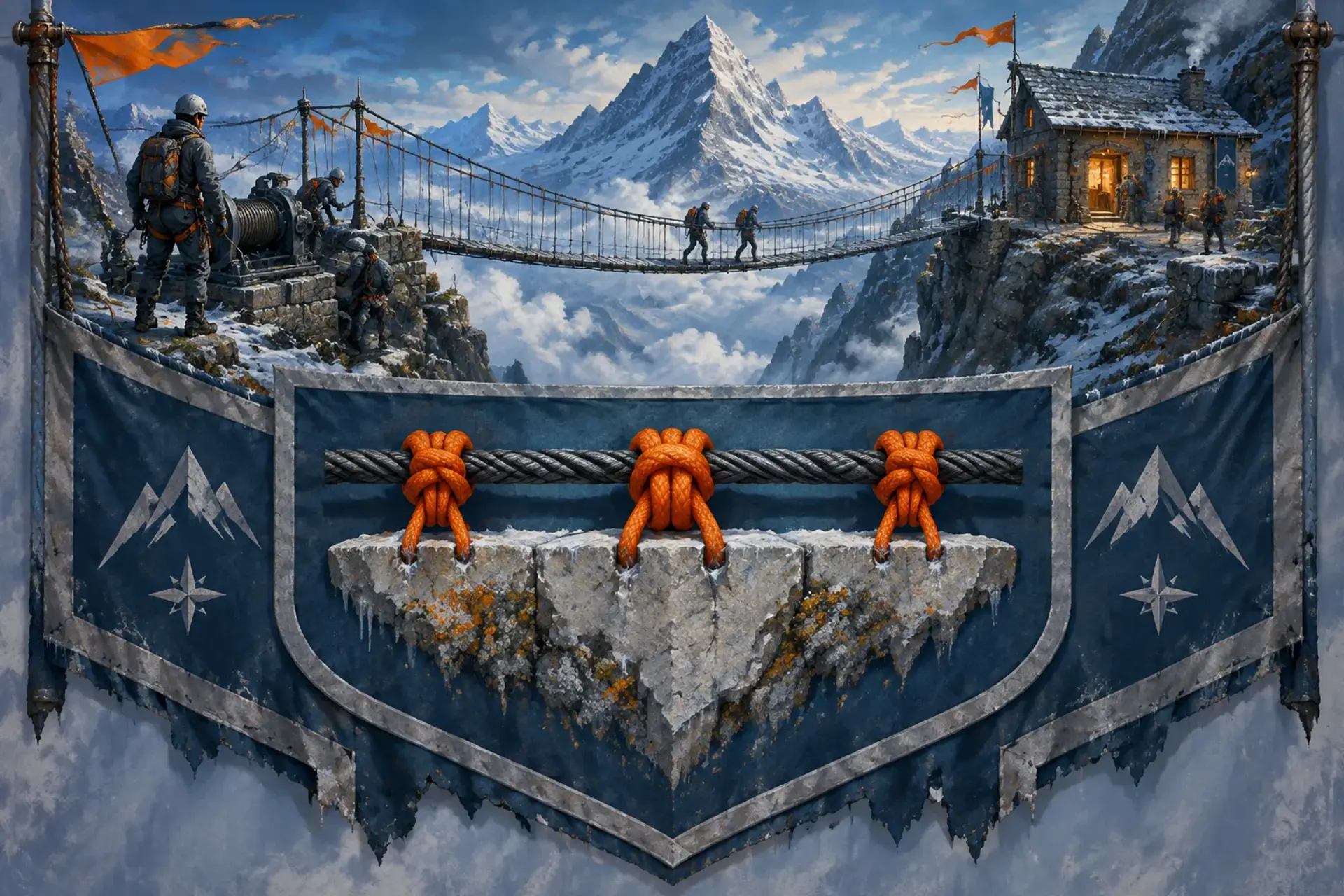
Slate blue, Iron grey, Signal orange
- Three orange knots mark a route as inspected, repaired where needed, and covered by a rescue plan.
- A length of cable-lichen is sometimes pinned to an old coat as a reminder that corrosion hides under what appears harmless.
Standing
What they say they want
What they are doing now
Where it leads
A connected high-route network where each crossing is inspected, each shelter is supplied, and no settlement can be cut off because a merchant’s cargo is more profitable than its safety. The Keepers disagree over whether that future requires stronger central authority or greater local control.
How others see them
Travelers regard them as stern but dependable. Merchants complain about closures and load checks; people rescued from a whiteout tend to remember the warmth of the shelter and the crew that came back for them.
People
6 ranks
Chief Wright
Controlled, unsentimental under pressure, and unexpectedly gentle with frightened travelers. Vaelen treats written procedures as promises, but knows that a rule applied without judgment can strand people to die.
- Chief Wright1 member
Sets safety policy, can close a major route, negotiates with settlements and carriers, and answers for failures under the association’s care.
- Linewright Council7 members
Senior riggers, masons, and route stewards who review inspections, allocate scarce materials, and advise the Chief Wright. They seek consensus, but the Chief Wright may issue an emergency order.
- Span Riggers28 members
Maintain suspension lines, winches, grapnels, and anchor-stones. Aerost riggers often work aloft while Oread masons secure the rockwork.
- Ledge Wardens19 members
Patrol cliff paths, clear ice, inspect way-shelters, post route warnings, and escort travelers through dangerous sections.
- Wind-Anchorers8 members
Use custom magical techniques and carefully supervised elemental bindings to reduce dangerous wind shear around vulnerable crossings.
- Learners and Shelter Hands46 members
Train in rope care, load counting, first aid, cooking, and emergency shelter work. Many are local residents who serve seasonally.
Other key members
- Brannoc Senior Span Rigger and leading critic of Vaelen’s proposed route register
- Orua Wind-Anchoring specialist and advocate for ending involuntary bindings
- Eirwen of Split Ridge Ledge Warden and organizer of local shelter crews
How they are organised
- Complete supervised training in rope safety, route signals, and emergency response.
- Show competence in at least one useful discipline, such as rigging, stonework, shelter care, navigation, or weather observation.
- Accept the duty to refuse an unsafe crossing even when the refusal costs the association income or influence.
- Contribute either field service or skilled work. The association does not require a particular ancestry, culture, or magical talent.
Relations
5 factionsAerost couriers depend on the Keepers’ route reports and rescue lines. They share weather observations in return, though some resent crossing closures that delay urgent messages.
Operations
What they do
How they do it
Services for hire
- Way-shelter and escortFree to members and recognized emergency cases; otherwise negotiated by route and riskWarm shelter, basic thermal rations, and emergency rope-escort at maintained high-route stations.
- Route gearThirty percent discount for Allied-standing visitors where supplies are availableClimbing gear, carabiners, thermal salve, and practical advice about current route conditions. These goods and techniques are setting details, not claims of special official rules.
- Crossing maintenanceContract price, with emergency repairs prioritized by danger rather than wealthSpan inspection, cable replacement, anchor assessment, and shelter repair.
- Master Span-Watcher privilegesReserved for trusted allies and urgent casesAt Exalted standing, a visitor may receive the title Master Span-Watcher, use high-speed glider cables where available, request maintenance winches, and call for Aerost rescue support.
What they can do
What they have
Where they are weak
Territory
Headquarters
Split RidgeThe Crest Bridge-House stands beside Split Ridge’s stone arch, where two jet-streams meet above the crevasse. Its lower rooms are cut into the granite; its upper gantries hold winches, spare cable, climbing gear, and weather vanes that clatter through the night. A broad hearth dries gloves and rope, while the house’s floorboards tremble whenever a loaded line crosses outside.
Lands they hold
Outposts
- Route sheltersAlong maintained ridge shelters and suspension crossings in the Whispering CrownProvide emergency warmth, supplies, route notices, and places for crews to cache repair materials.
Secrets
Plot hooks
5 hooks- 1The Sheared PierHigh-level expedition, intended for levels 11–12 in the supplied scenarioReward: Allied standing, safe passage, and access to specialist rigging equipmentA frost surge has cracked the primary anchor pier on the main suspension route to Clink. Vaelen asks the party to secure temporary tension cables across the chasm while Crag-Talon Griffons harry the repair crew. The Keepers can supply equipment and route knowledge, but the party must decide whether to risk reopening the span before a full stone inspection.
- 2Cold RoomsHigh-level investigation and wilderness operation, intended for levels 12–13 in the supplied scenarioReward: Shelter access, route intelligence, and the trust of local wardensTravelers report that emergency braziers in high-pass shelters have been systematically wrecked before a whiteout. The evidence points toward Tectonic Cultists, but a damaged supply ledger suggests someone may have diverted the replacement parts. Find the saboteurs, identify who benefits, and restore the shelters before the weather closes the route.
- 3The Floating AnchorHigh-level planar hazard and technical repair, intended for levels 13–14 in the supplied scenarioReward: Access to a high-speed glider cable, unusual route knowledge, and influence over the Keepers’ policyA gravimetric anchor-stone near Lensend is drifting toward an Astral rift. Wind-Anchorers need a team to reach it, protect the repair crew from planar horrors, and restore its runes. Orua suspects the stone’s original alignment may have been wrong for generations, so repairing it exactly as recorded could worsen the instability.
- 4The Mark Beneath the IcePersonal-scale investigation with a dangerous traversalReward: A rescued contact, a route favor, or leverage over a Keeper officerAn individual character recognizes a shelter mark as one used by a missing mentor, relative, or former crew. The mark indicates that someone altered the route record after its inspection. The trail leads to an exposed ledge where the character must choose between revealing the falsification and protecting the person who made it.
- 5The Weight of PassageRegional negotiation, exploration, and engineering challengeReward: A durable alliance with the aerie and a voice in the association’s next route policyAn isolated aerie asks for an emergency crossing repair, but its elders refuse the Keepers’ load rules and its merchant representative insists a heavy shipment must pass. The party must earn local trust, assess the span, and find a solution that does not turn the safety dispute into a political rupture.
Work they offer
What gets in the way
Rumours
Connections
Media
0 imagesNo images yet.
Turn Cable and Ledge Keepers into a sheet
A high-res, share-ready sheet you can post or print.