
Iron-Vein Compact
After the Split-Lift Season, the Compact secured a limited right to inspect several mine galleries before each shift. Its next decades were marked by practical victories and uneven enforcement. Stewards became trusted sources of rescue knowledge, while Tally Auditors built a reputation for careful records that could outlast a foreman’s denial. When extraction expanded toward the Under-Roots, the Compact added hazard-pay demands and rescue protocols, though many crews still descend without adequate protection. The union’s growth has not erased its divisions. Some members want steady, incremental reforms; others believe the High Council will never share power unless the mines stop producing. Its present influence is greatest among workers who depend on one another underground, and weakest in the council chambers where aristocrats and guildmasters control formal votes.
Iron-Vein Compact
- Type
- Labor league and miners’…
- Size
- 390 members
- Reach
- Dominant among mine shifts
- Base
- Iron-Vein Mines
Overview
After the Split-Lift Season, the Compact secured a limited right to inspect several mine galleries before each shift. Its next decades were marked by practical victories and uneven enforcement. Stewards became trusted sources of rescue knowledge, while Tally Auditors built a reputation for careful records that could outlast a foreman’s denial. When extraction expanded toward the Under-Roots, the Compact added hazard-pay demands and rescue protocols, though many crews still descend without adequate protection. The union’s growth has not erased its divisions. Some members want steady, incremental reforms; others believe the High Council will never share power unless the mines stop producing. Its present influence is greatest among workers who depend on one another underground, and weakest in the council chambers where aristocrats and guildmasters control formal votes.
How it began
The name Iron-Vein Compact comes from a warning older miners gave new crews: a black line running through an iron seam could carry poisonous air, and anyone who ignored it might never return. The name was kept after the warning marks became the workers’ sign of mutual protection. The Compact began when dwarf pit-workers, Oread haulers, and forge-smiths at Iron-Vein Mines refused to descend after a series of fatal collapses and gas pockets. Their first pact was practical: no crew would work a marked gallery alone, and no lift would run until a missing worker was accounted for. In the Split-Lift Season, mine owners ordered a loaded cage lowered despite a failed brake. Workers chained the winding gear, then held the lift for three days while rescuers reached those trapped below. That confrontation became the Compact’s defining watershed. The stranded miners survived, but the authorities arrested several organizers and dismissed dozens. In the years that followed, the Compact evolved from a mutual rescue pact into a disciplined league of stewards, tally witnesses, and strike defenders. It won safer bracing rules in some galleries and lost them in others. Its strongest achievement was making collective stoppage credible; its most painful setback came when a later strike ended after an unverified promise, followed by renewed quota abuses. Today, the Compact is powerful underground and largely shut out of formal council votes.
How to know them
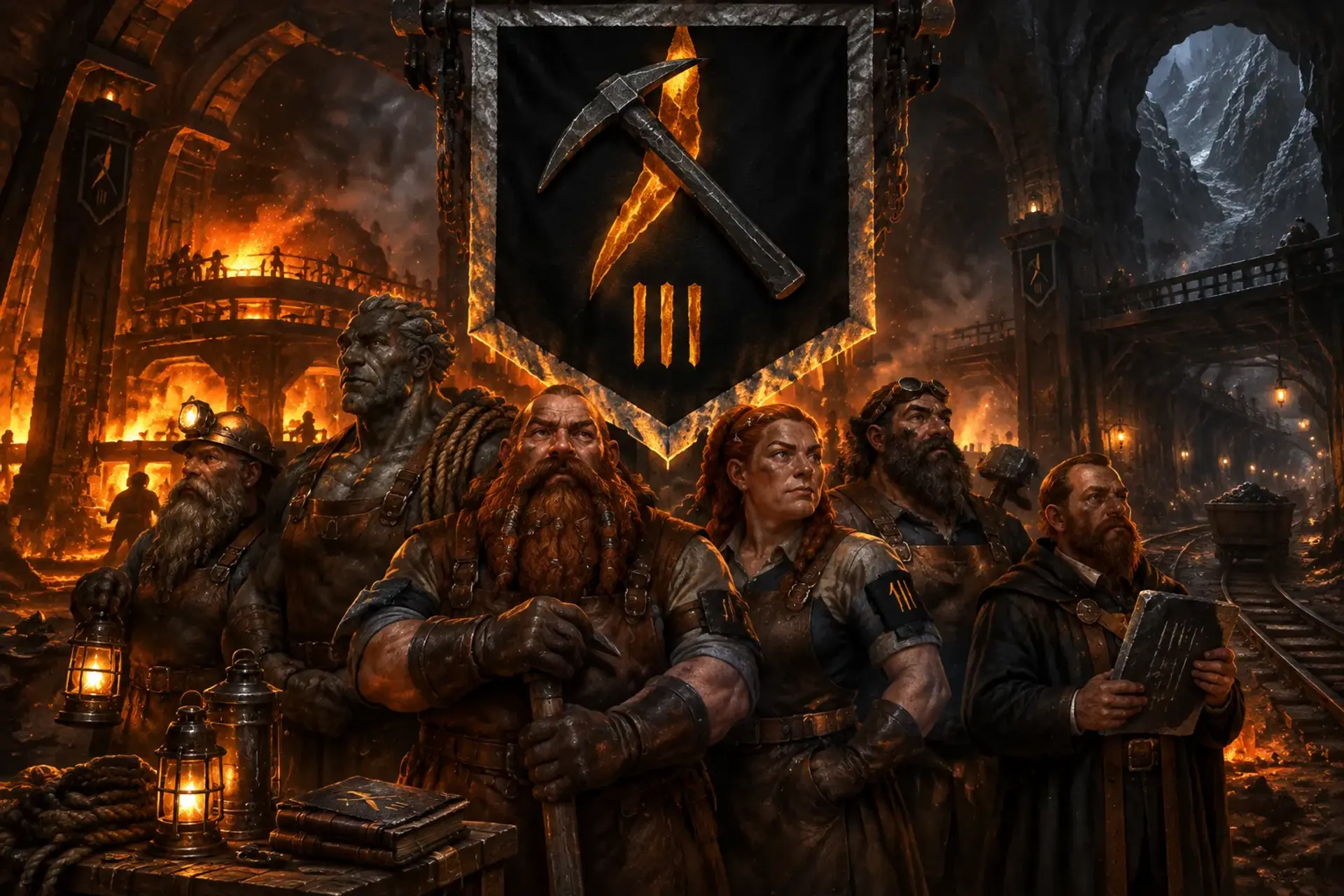
Soot black, Furnace amber, Mineral grey
- A black iron pick crossed over an amber seam
- Three short tally marks, representing the worker, the witness, and the crew above
Standing
What they say they want
What they are doing now
Where it leads
A mining culture in which no crew is sent below without safe ventilation, adequate bracing, and a meaningful share of the wealth it extracts. The Compact wants worker representation in decisions that govern the mines, not merely permission to protest after a disaster.
How others see them
Among workers, the Compact is known for showing up when a lift stalls or a crew fails to return. Mine owners and council officials often describe it as disruptive, stubborn, and too quick to halt production. Even its critics know that its members understand the workings of the mines better than most people who regulate them.
People
5 ranks
Mine Master
Pragmatic, steady under pressure, and alert to the human cost of grand gestures. He has a habit of asking who will be left underground if a negotiation fails.
- Mine Master1 member
Coordinates the Compact’s public position, chairs disputes between crews, and can call a region-wide stoppage after consulting the stewards.
- Pit Stewards18 members
Elected by work gangs. Inspect bracing and ventilation, record hazards, and speak for their crews during disputes.
- Tally Auditors11 members
Verify ore weights at lift heads, preserve duplicate records, and investigate discrepancies in assessments.
- Hammer Guards42 members
Maintain picket lines, escort rescue crews, and defend workers from immediate threats in the galleries. They answer to the Mine Master during emergencies but are expected to refuse orders that endanger unarmed workers.
- Compact Members320 members
Miners, haulers, furnace crews, and smiths who contribute dues, elect stewards, and vote on major labor actions.
Other key members
- Kavri Senior Tally Auditor
- Brzhek of the Lower Shafts Pit Steward for Under-Roots crews
- Tetsu Captain of the Hammer Guards
How they are organised
- Work in mining, hauling, smelting, or a closely connected forge trade in the Terraced Bastions.
- Accept the Compact’s rescue rule: a crew does not abandon a missing worker to protect a quota or a schedule.
- Contribute a small share of wages or labor to the common rescue fund.
- Agree to stand with a member facing an unsafe order, while permitting the Compact to investigate claims before taking collective action.
Relations
4 factionsMany Compact members are also members of the Free Miners’ League. The League supports worker solidarity, though it sometimes disputes the Compact’s willingness to negotiate with mine owners.
Operations
What they do
How they do it
Services for hire
- Lodge BedsFree to members; a modest contribution to the rescue fund from nonmembersShort-term lodging in worker quarters when a crew is stranded, injured, or locked out during a dispute.
- Crew SupplyThirty percent below ordinary local prices for unrefined ore, metal, and heavy mining equipment when stock permitsConnections to fair-minded suppliers and worker-owned stores for basic mining and forge materials.
- Gallery EscortA reciprocal favor, a signed rescue obligation, or payment for suppliesAn experienced guide and escort through known mine shafts. The Compact refuses to promise safety in unstable or uncharted galleries.
- Forge CommissionBy agreement, usually including materials and a future serviceAccess to custom weapon commissions through sympathetic forge crews. Rare materials such as adamantine or mithral are never guaranteed.
What they can do
What they have
Where they are weak
Territory
Headquarters
Iron-Vein MinesThe headquarters occupies the Lower Furnace Galleries at Iron-Vein Mines, in chambers once used to store slag before it cooled. The air tastes of soot and hot stone; chains groan overhead, and the floor carries a steady vibration from the smelting works. A board of marked ventilation routes hangs beside the meeting benches. Every shift leaves a witness mark there before descending. The Compact keeps its records in fireproof cases, but its most trusted tally books are copied by hand and carried by different members.
Lands they hold
Outposts
- Scale PostsThe lift-head weigh stations at Iron-Vein MinesServe as tally checkpoints where auditors can witness ore weights and compare them with official records.
- Rescue CachesDeep galleries and work routes leading toward the Under-RootsProvide emergency lamps, rope, food, and basic rescue supplies for crews cut off by collapses or gas.
Secrets
Plot hooks
5 hooks- 1The Rigged ScaleLevels 7–8Reward: Compact standing, payment, and access to mine expertise or equipmentAt Pella Shelf, a council assayer is suspected of undercounting high-grade mithral yields. Suvor asks the characters to observe the weighing process and find proof without provoking a dockside riot. The false figures may hide a second diversion unrelated to personal theft.
- 2Pressure Behind the BarricadeLevels 8–9Reward: A safety agreement, allies among the crews, and possible political leverageWorkers barricade Shaft 2 after steam pressure rises beyond the crew’s safe limit. Council mercenaries gather outside, while the strike leaders disagree over whether to negotiate or hold the line. The characters can investigate the valve, broker a safety accord, or keep both sides from turning a stoppage into a massacre.
- 3The Air Runs ThinLevels 9–10Reward: Rescue gear, a substantial favor, and trusted access to dangerous routesA blast in a deep Under-Roots shaft traps thirty miners behind a collapsed wall. Their air pocket is filling with poisonous gas, and something has entered the gallery from the new fissure. The Compact needs an experienced team to reach the survivors before the gas ignites.
- 4A Mark on the Shift BoardLow to moderateReward: A personal ally and evidence that could reshape a local labor disputeA Pit Steward is accused of falsifying a ventilation report after a worker falls ill. The report could be forged, or the steward may have concealed a hazard to keep the crew employed. The characters must find the truth before the Compact’s rescue-first principle fractures into accusations.
- 5The Way BelowCampaign-scale or exploratoryReward: Trusted access to concealed routes and a consequential political favorA hidden route through the lower galleries bypasses surface tolls, but its map is split among several retired miners who will not share it until the Compact agrees on who may use it. A claimant, a smuggler, and a desperate family all want passage for different reasons.
Work they offer
What gets in the way
Rumours
Connections
Media
0 imagesNo images yet.
Turn Iron-Vein Compact into a sheet
A high-res, share-ready sheet you can post or print.