
Drairesse Imperial Hierarchy
The Draconic Mandate began before the first imperial election, when Houses took the Celestial Edict and reshaped it for their own use. Later rulers taught that Dra'Vareth had ordained the resulting order; critics argue the faith was made to bless a political settlement. The first Vareth-Om, Rathurh Naxireilar of House Bidhido, ruled from Sunpetra and reportedly destroyed the original code. Sorvik Lorarkan Khordain, the second ruler, imposed the succession tests and eligible bloodline rules that made the throne harder to seize by force. The empire expanded through House alliances, conquest, and control of elemental resources. Its triumphs include unifying distant biomes under one legal system and building durable routes between their cities and academies. Its costs include forced service, cultural suppression, and the transformation of religious rites into instruments of state power. Karzagon, remembered as the Flame Prophet, became a demigod ruler and remains a contested precedent for whether prophecy can outrank law. In 7300VIII the priesthood elected Skagala as its first Ember Hierophantate, beginning the enduring separation between religious election and imperial succession. The current Arch-Warden, elected in 9015X, represents a priesthood that can oppose the Crown without claiming the throne. Xhal'Dra Varethis has ruled since 9700X. The empire is powerful, but its institutions are strained by rival Houses, concealed versions of its founding law, and the unresolved question of whether order can survive without coercion.
Drairesse Imperial Hierarchy
- Type
- Imperial theocracy and…
- Size
- Huge
- Reach
- Global within its world
- Base
- Sunpetra, an imperial seat named in the old calendar; its original linguistic meaning is no longer understood.
Overview
The Draconic Mandate began before the first imperial election, when Houses took the Celestial Edict and reshaped it for their own use. Later rulers taught that Dra'Vareth had ordained the resulting order; critics argue the faith was made to bless a political settlement. The first Vareth-Om, Rathurh Naxireilar of House Bidhido, ruled from Sunpetra and reportedly destroyed the original code. Sorvik Lorarkan Khordain, the second ruler, imposed the succession tests and eligible bloodline rules that made the throne harder to seize by force. The empire expanded through House alliances, conquest, and control of elemental resources. Its triumphs include unifying distant biomes under one legal system and building durable routes between their cities and academies. Its costs include forced service, cultural suppression, and the transformation of religious rites into instruments of state power. Karzagon, remembered as the Flame Prophet, became a demigod ruler and remains a contested precedent for whether prophecy can outrank law. In 7300VIII the priesthood elected Skagala as its first Ember Hierophantate, beginning the enduring separation between religious election and imperial succession. The current Arch-Warden, elected in 9015X, represents a priesthood that can oppose the Crown without claiming the throne. Xhal'Dra Varethis has ruled since 9700X. The empire is powerful, but its institutions are strained by rival Houses, concealed versions of its founding law, and the unresolved question of whether order can survive without coercion.
How it began
Before the first election, the great Houses found the Celestial Edict and recast it to serve their own ambitions. The surviving account says they turned an older, more limited covenant into the Draconic Mandate, a law that made authority sacred and the Houses its interpreters. The first Vareth-Om seized power and burned the original documents. Whether the originals were destroyed to protect the empire or to conceal the Houses' alterations remains disputed. The second Vareth-Om established the succession trials and bloodline standards that still constrain the throne. Centuries later, the priesthood's first independent election created the Ember Hierophantate, a watershed that divided spiritual authority from imperial appointment. The present system grew from that settlement: one Crown above five biome sovereignties, fifteen Great Houses, and a vast body of appointed officials and bound workers.
How to know them
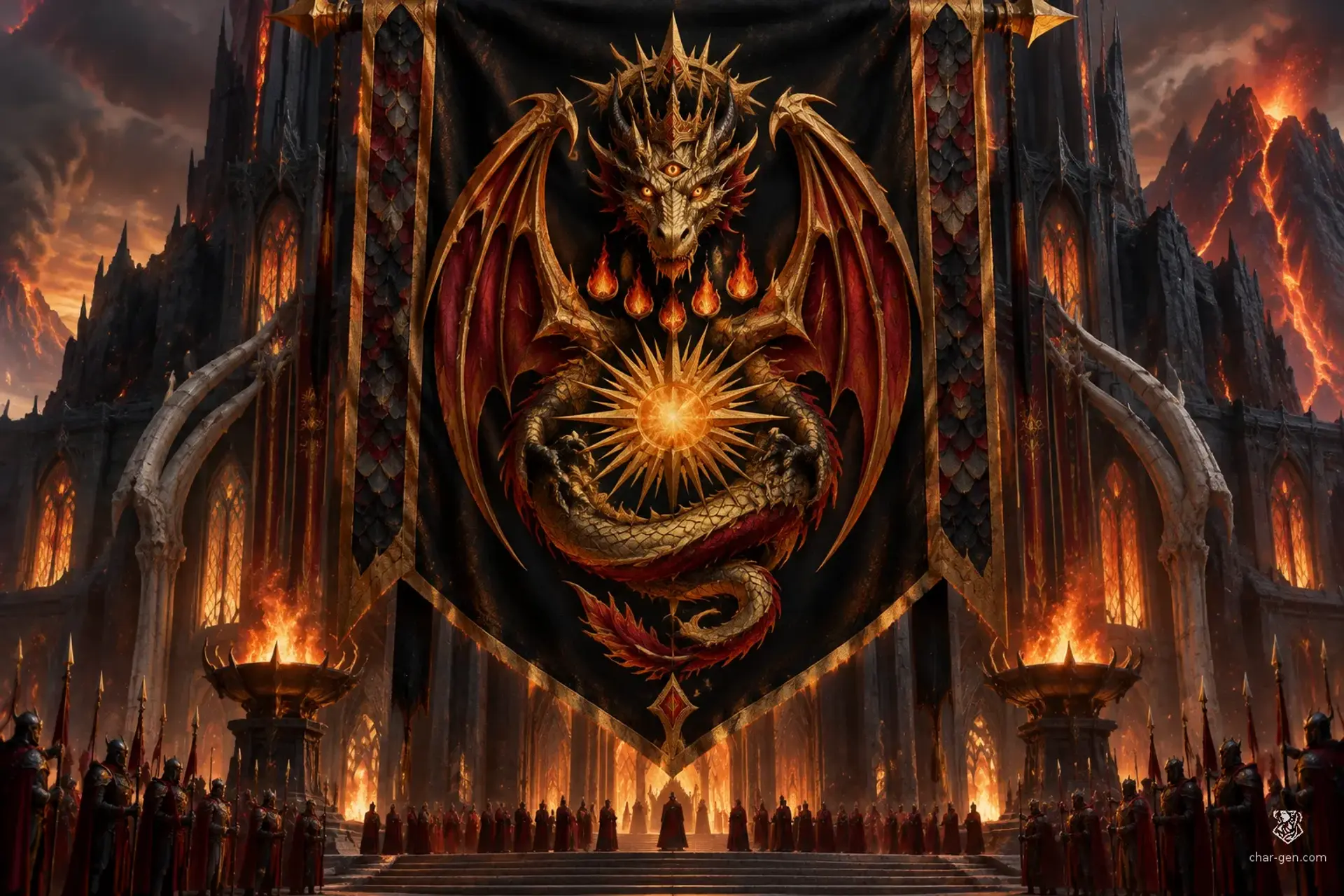
Crimson, Obsidian, Molten gold, Ash grey
- A three-eyed crowned dragon encircling a sunburst
- Five lower flames beneath the imperial flame
- The Ember Scale, a fragment said to hold the First Flame
- A burning ring pierced by a dragon fang
- Flame glass and obsidian used in temples and public courts
Standing
What they say they want
What they are doing now
Where it leads
A unified empire in which every biome and House serves a common Mandate, the Crown remains legitimate, and the Warden Flame endures beyond any individual ruler. The hierarchy's ideal is a cosmos ordered like a living body. Its danger is that it treats people as organs whose worth is measured by their usefulness to the whole.
How others see them
To supporters, the Hierarchy is a formidable guarantor of order, shared infrastructure, and continuity across immense distances. Its temples feed the poor in some regions, its courts can restrain feuding nobles, and its public rites give meaning to loss. To its subjects and neighbors, it is also a coercive empire that sanctifies inherited privilege, compels obedience, and treats dissent as a threat to cosmic order. Reputation depends heavily on which official holds power locally.
People
7 ranks
Vareth-Om, the Wing in Ash
Disciplined, politically patient, and guarded. Xhal'Dra can be genuinely protective of the empire's people, but tends to value stability over an individual's freedom.
- Vareth-Om, the Crown1 member
Sovereign authority over Mandate law, war, bloodline succession, imperial resources, the Legion, and appointments of biome sovereigns. The office is both political throne and sacred embodiment of the Crown flame.
- The Ember Hierophantate and the Circle of Five Flames6 members
The Arch-Warden leads the independent religious body; five biome sovereigns govern Perma Day, Perma Night, Twilight, Cratered Edge, and Deepways. The Arch-Warden is elected by the religious body, not appointed by the Emperor. The Circle deliberates on inter-biome disputes, while the Arch-Warden interprets doctrine and can challenge the religious legitimacy of imperial acts.
- Flame Regents15 members
Leaders of the fifteen Great Houses. They control lineage resources, House forces, academy access, land assignments, and House rites. Each is formally bound to the biome sovereign in whose territory the House operates.
- Broodline Lords250 members
Territory governors drawn chiefly from cadet branches. They oversee cities, forges, vault districts, trade routes, bloom fields, memory corridors, and garrisons. Their authority depends on House approval and continued success in truth and element-bond trials.
- Oathmasters and Sigil Lords900 members
Judges, magistrates, guildmasters, vault keepers, scribes, psionic enforcers, armory wardens, and provincial commanders. Skilled members of other peoples can hold these offices, though law bars them from the upper hereditary tiers.
- Oathbound12,000 members
Trained clerks, soldiers, artisans, healers, messengers, and other skilled servants. They swear ritual obligations to a House, temple, or office, with rights that vary greatly by contract and region.
- Servitor Castes and attached households80,000 members
Laborers, attendants, dependents, and workers who sustain the imperial apparatus. Their status is not uniform: some hold negotiated protections, while others face inherited obligations or severe restrictions on movement.
Other key members
- Oru of the Third Scale Arch-Warden, elected head of the Ember Hierophantate
- Veshkaar Il'Rem Flame-Ward Cardinal and regional interpreter of Mandate law
- Hralveth Scale-Deacon and traveling ordeal enforcer
- Lyssara Norn Cinder-Page, novice flame scribe and potential whistleblower
How they are organised
- There is no single membership test for the entire hierarchy. Most people enter through an oath, appointment, House service, military enlistment, education, or religious vocation.
- High imperial office requires recognized Drairesse ancestry and passage through political, ritual, and psionic tests. The Ember Hierophantate has fewer bloodline restrictions, but its additional election requirements are secret.
- House leadership generally requires descent from the House's founder, a House-specific trial, recognition by a Scalespeaker Council, and a public reputation for the House's defining virtues.
- Territorial governors require Drairesse heritage, academy training, a bond with the biome's element, truth tests, House approval, and a lineage without active Mandate sanctions.
- Oathmasters and Sigil Lords qualify through skill, loyalty, and ritual obedience. Humans, Qhacret, dwarves, fairies, and other peoples may rise to these offices, but not to the hereditary upper tiers under current law.
Relations
10 factionsThe Searing Archive supplies the state with scholars, interpreters of the Mandate, and trained psionic adjudicators. Its alliance with the Crown is indispensable but uneasy: archivists preserve records that rulers would rather revise.
Operations
What they do
How they do it
Services for hire
- Imperial instructionOath, documented service, or a House sponsorTraining in law, administration, military discipline, ritual practice, craft, or scholarship. Access and curriculum vary by House and biome.
- Ember careDonations, political favor, or an accepted vowLocal temples offer healing, funeral rites, public counsel, and mediation. The quality and conditions of care vary by clergy and region.
- Mandate judgmentFees, formal petition, and often a patronThe courts record contracts, adjudicate House disputes, certify offices, and investigate claims of lineage or oath-breaking.
- House craft and supplyTrade rights, labor agreements, or material tributeHouse and imperial workshops produce tools, armor, infrastructure, and specialized elemental goods for approved clients.
What they can do
What they have
Where they are weak
Territory
Headquarters
Sunpetra, an imperial seat named in the old calendar; its original linguistic meaning is no longer understood.The imperial seat is a compound of black volcanic stone, flame glass, and draconic-bone arches built around a great ceremonial brazier. Its oldest chambers are sealed behind a succession of legal and religious wards. The public courts face sunrise; the private archive rooms have no windows and are lit by lamps whose flames are said never to consume fuel.
Lands they hold
Outposts
- The Sun GatesPerma Day, near the Sun GatesA sovereign's trial site and a fortified checkpoint controlling access to the sunward roads.
- The Mirror NightPerma Night, along the memory corridorsAn academy and judicial retreat where testimony, inherited memory, and recorded history are compared.
- The Twilight BloomTwilight, among the renewal fieldsA temple infirmary and botanical storehouse where Ember Monks provide healing and study renewal rites.
- The Edge StormsCratered Edge, on the volcanic frontierA garrison and trial ground used to train officers in unstable terrain and changing conditions.
- The Deep SilenceDeepways, beneath the metal citiesA sealed archive, mine complex, and place of contemplation where official records are stored away from surface politics.
Secrets
Plot hooks
5 hooks- 1The Page That Would Not BurnPersonal, low to moderateReward: A reliable contact, legal favor, or access to restricted testimonyA Cinder-Page asks the characters to hide her journal before an inspection. It documents a temple official's misuse of the Trial of Cinders, but also contains evidence that could implicate her mentor.
- 2A Line Written in SmokeLocal, moderateReward: Payment, political leverage, or protection for a threatened communityA district governor has vanished after announcing that the local House's lineage records are forged. The characters must find the governor, verify the claim, and decide who should receive the evidence before rival Houses seize the district.
- 3The Moon That Refused the CrownRegional, highReward: A sovereign's favor, a dangerous secret, or a role in succession negotiationsA would-be sovereign passes the Five Flames but fails the Imperial Sigil test. The Crown calls the candidate a fraud; the candidate claims the Sigil has been tampered with. The party is asked to investigate before the Circle of Five Flames fractures.
- 4The Debt Beneath the ForgeLocal, moderateReward: Allies among officials and workers, or control of a strategically important charterWorkers in a Deepways forge refuse an inherited service obligation after discovering that their contract was copied from an older law. A House envoy seeks to suppress the dispute; an Oath-Forged officer wants witnesses protected.
- 5The Tomb That Has a LockCampaign-scale, very highReward: A world-changing revelation, a sacred relic, or the gratitude of a faction that should not be trustedA volcanic tremor opens a route into a sealed chamber beneath the Ashen Crown. The Arch-Warden wants the chamber secured quietly, while an imperial minister insists it belongs to the Crown. The characters find records that suggest the site is a prison rather than a tomb.
Work they offer
What gets in the way
Rumours
Connections
Media
0 imagesNo images yet.
Turn Drairesse Imperial Hierarchy into a sheet
A high-res, share-ready sheet you can post or print.