
The Silt Measure
The society's first century was spent as a network of impartial counters. It earned trust by recording debts and deliveries in duplicate, with one copy held by each party and a third hidden in a neutral archive. Its first triumph came when its records disproved a forged grain-shortage claim and prevented a siege. Its first major setback followed: a prince seized a local archive and executed three keepers as spies. In response, the society divided its records among distant cells and made membership deliberately difficult to map. The watershed moment came during the Ledger War, a succession conflict fought across five states. The Measure possessed evidence that could have exposed the pretender who started the war, but revealing it would also have shown that the sitting monarch had secretly financed both sides. The society released only enough evidence to force a truce. The fighting stopped, but thousands remained displaced, and the Measure's choice left it with a permanent contradiction: it had preserved the balance by withholding the truth. Since then, the Silt Measure has grown into a continental web of counters, couriers, scribes, and discreet mediators. It helped standardize weights and verify treaties, then quietly began shaping the movement of credit and supplies. The present generation inherits a respected reputation for resolving disputes and a shadow reputation for deciding which disputes are allowed to end.
The Silt Measure
- Type
- Secret Society
- Size
- 1,146 members
- Reach
- Continental
- Base
- Kesh
Overview
The society's first century was spent as a network of impartial counters. It earned trust by recording debts and deliveries in duplicate, with one copy held by each party and a third hidden in a neutral archive. Its first triumph came when its records disproved a forged grain-shortage claim and prevented a siege. Its first major setback followed: a prince seized a local archive and executed three keepers as spies. In response, the society divided its records among distant cells and made membership deliberately difficult to map. The watershed moment came during the Ledger War, a succession conflict fought across five states. The Measure possessed evidence that could have exposed the pretender who started the war, but revealing it would also have shown that the sitting monarch had secretly financed both sides. The society released only enough evidence to force a truce. The fighting stopped, but thousands remained displaced, and the Measure's choice left it with a permanent contradiction: it had preserved the balance by withholding the truth. Since then, the Silt Measure has grown into a continental web of counters, couriers, scribes, and discreet mediators. It helped standardize weights and verify treaties, then quietly began shaping the movement of credit and supplies. The present generation inherits a respected reputation for resolving disputes and a shadow reputation for deciding which disputes are allowed to end.
How it began
The Measure began during the Year of Three Floods, when waters wrecked the bridges between the inland granaries and the coast. Merchants, ferrymen, and village counters met in a disused tollhouse at Kesh, a settlement name worn down from an older word for a ford-marker. The founders used knotted cords and paired tallies to record which wagons had crossed, what they carried, and who had been paid. Their first purpose was modest: stop officials and caravan masters from blaming one another for missing food. Their name, the Silt Measure, comes from the trade of measuring silt depth at fords, a practical occupation that vanished when the first stone causeways were built. The society grew because its records could settle arguments across borders where no court held authority.
How to know them
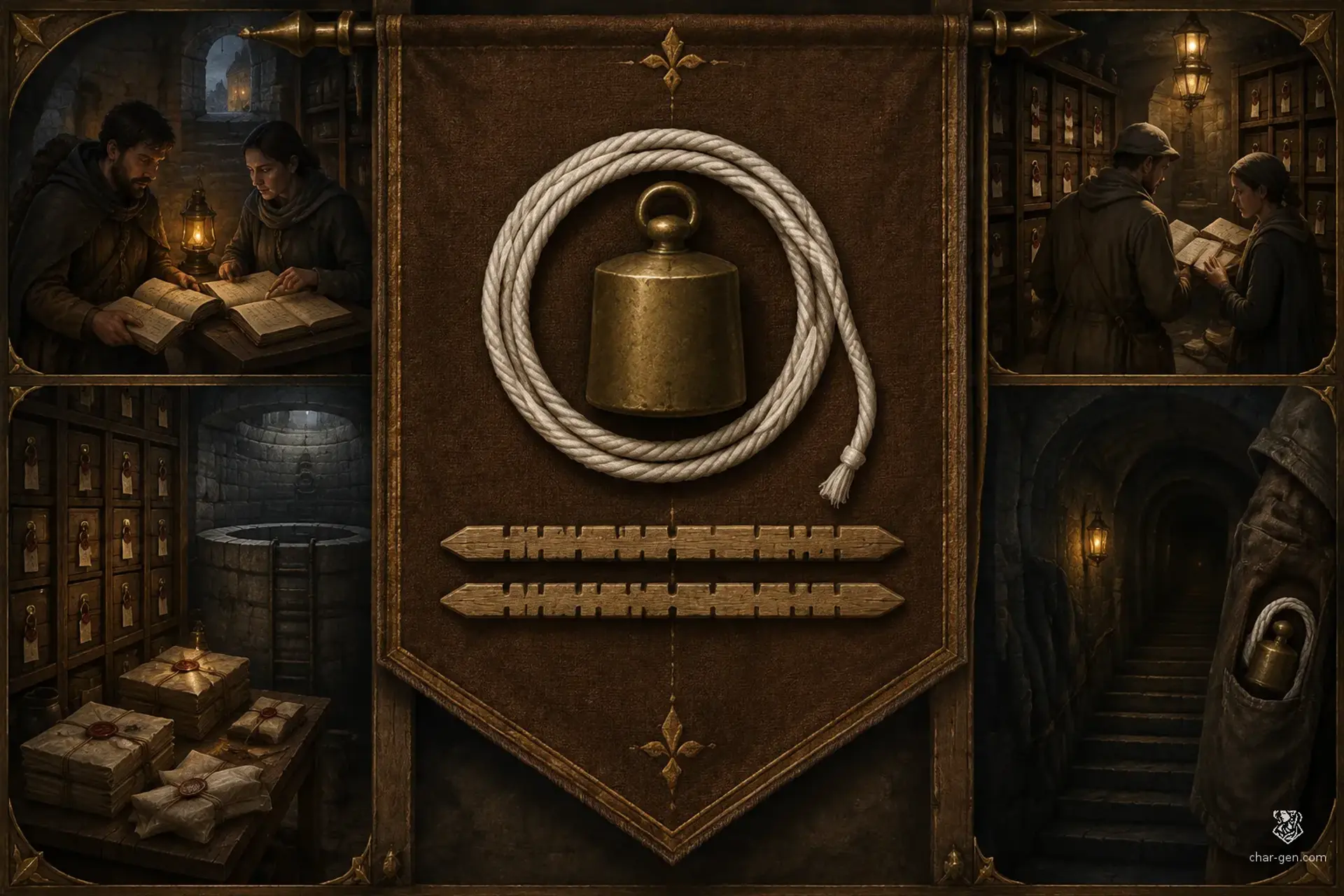
Dried-reed brown, Chalk white, Dull brass
- A loose white cord
- A dull brass weight
- Two notched sticks whose marks match only when laid together
Standing
What they say they want
What they are doing now
Where it leads
A continent where disputes are settled by verifiable evidence and no ruler can quietly rewrite the account of what happened. The contradiction is that the Measure hopes to achieve this by keeping its own most consequential records secret until it believes the world is ready.
How others see them
Among merchants, the Silt Measure is respected as careful, discreet, and difficult to bribe. Among rulers, it is considered useful but intrusive. Ordinary people often know its members only as patient counters who can prove what was delivered, borrowed, or promised.
People
5 ranks
First Counter
Measured and considerate, with a habit of answering difficult questions by asking who will be harmed by the answer. He genuinely wants fewer wars, but has become too comfortable deciding which truths the world can bear.
- First Counter1 member
Presides over the continental council, safeguards the founding charter, and may delay a decision but cannot impose one alone.
- High Weights11 members
Represent broad regions, approve major interventions, and supervise the exchange of sealed records. Each has one vote, regardless of wealth.
- Road Counters84 members
Coordinate national and regional circles, verify reports, arrange witnesses, and decide which disputes merit intervention.
- Cord Keepers290 members
Maintain local records, recruit trusted informants, and carry paired tallies between settlements.
- Unknotted760 members
Probationary members and occasional agents who perform one task at a time. They know only the contact needed for their assignment.
Other key members
- Bruk High Weight and keeper of the western road records
- Shizha of Kesh Archive steward and likely successor to the First Counter
- Tavren Salk Road Counter responsible for sensitive diplomatic work
- Etsu Cord Keeper who organizes local witnesses and safe houses
How they are organised
- Demonstrate patience with conflicting testimony and keep a record without changing it to favor a patron.
- Accept that a member may be asked to preserve evidence without being told when it will be used.
- Have no unresolved obligation to a ruler, creditor, or employer that could force disclosure of confidential records.
- Submit to a probationary task whose purpose is deliberately limited and clearly explained.
Relations
7 factionsThe Salt Counting Houses began as toll clerks who measured salt cargoes along the western road. They trade the Measure reliable shipping records in exchange for protection from political seizure. Their alliance strains whenever the Measure conceals a shipment.
Operations
What they do
How they do it
Services for hire
- A Third TallyA verified account of equivalent value, a future favor, or a modest fee scaled to the client's meansComparison of documents, testimony, and cargo records to establish what most likely happened.
- Cord PassageA substantial fee or a reciprocal service; waived for endangered witnessesDiscreet transport of a witness or sealed document between regional circles.
- Quiet ReckoningA deposit held in escrow and both parties' agreement to a binding processPrivate mediation by counters who record terms and provide each side with a copy.
What they can do
What they have
Where they are weak
Territory
Headquarters
KeshThe society has no publicly acknowledged headquarters. Its oldest meeting rooms occupy a sealed archive beneath a former tollhouse in Kesh. The archive has no grand hall: it consists of low rooms with stone shelves, waxed cabinets, and a dry cistern used for private votes. Access requires three independent keys held by members who do not share a regional circle.
Lands they hold
Outposts
- The Ford CounterA river crossing in the western grain countryA modest counting room that checks cargo tallies and quietly shelters couriers.
- The White Cord RoomThe old salt road between two rival portsA rented upper room used for arbitration and the exchange of sealed statements.
- The Silt StepsA mountain pass above the quarry settlementsA storehouse for winter provisions and duplicate records. Its name is an old trade term for measuring sediment at a crossing.
Secrets
Plot hooks
5 hooks- 1The Unpaid DebtPersonal, low to moderateReward: Debt relief, a contact in the society, or evidence of a local fraudA character receives a paired tally from an unknown Cord Keeper. Its matching copy proves that a relative's debt was paid years ago, but the creditor's heirs now control the character's home.
- 2The Witness in the Reed BedsLocal, moderateReward: Local allies, safe passage, or access to verified recordsA village asks the party to find a missing witness before the Silt Measure settles a land dispute. The witness is alive, but has been hiding because both claimants want to control what they testify.
- 3Three Copies, One TruthRegional, highReward: A powerful secret, an alliance with a faction inside the Measure, or political leverageThe party is hired to escort a sealed case across a border. Several groups pursue it, each claiming the case contains proof of the other's crimes. The case actually holds a copy of the founding charter's suppressed clause.
- 4The Empty GranariesRegional, highReward: Influence with provincial leaders, supplies, or a lasting enemy among the High WeightsFood shipments are vanishing from a contested province. The Measure's ledgers show that no theft occurred, but the records were altered by one of its own circles to conceal an intentional diversion. The party must decide whether to expose the truth before winter or bargain for a quieter correction.
- 5A Balance of AshesCampaign-scale, very highReward: The power to reshape the society, avert a war, or decide who inherits a throneA succession conflict is about to spread across several nations. The First Counter offers the party access to decisive evidence, but asks them to destroy a second record that implicates the society in the conflict's beginnings.
Work they offer
What gets in the way
Rumours
Connections
Media
0 imagesNo images yet.
Turn The Silt Measure into a sheet
A high-res, share-ready sheet you can post or print.