
K-12 Claimholders
The K-12 Claimholders grew from the investors who drained the old quarry and financed its pumps. Their first triumph was opening an iron seam that had been written off as inaccessible. They used those profits to purchase drilling gear, hire Drow overseers, and secure labor contracts with Oread crews. The contracts were presented as temporary advances against future wages. Their defining watershed came during the Siltfall, when a seasonal melt surge overwhelmed several channels. The Claimholders diverted water through their quarry to protect their pumps and ore stores. The diversion prevented a catastrophic flood in their workings, but left neighboring camps short of clean water. The consortium later paid for repairs and called the matter settled. Residents of the affected camps remember it as the moment a private claim became a public threat. As the mines expanded, debt agreements began to include water, air, food, and tool charges. The Claimholders became indispensable to small settlements while making repayment increasingly difficult. A failed seam and a costly tunnel collapse briefly weakened them, but new mithral and adamantine finds restored their influence. Today they present themselves as practical stewards of dangerous resources. Their critics see a company that has learned to profit from every shortage it helps create.
K-12 Claimholders
- Type
- Mining consortium and…
- Size
- 450 members
- Reach
- High within Sector K-12…
- Base
- Sector K-12 Deep Quarry
Overview
The K-12 Claimholders grew from the investors who drained the old quarry and financed its pumps. Their first triumph was opening an iron seam that had been written off as inaccessible. They used those profits to purchase drilling gear, hire Drow overseers, and secure labor contracts with Oread crews. The contracts were presented as temporary advances against future wages. Their defining watershed came during the Siltfall, when a seasonal melt surge overwhelmed several channels. The Claimholders diverted water through their quarry to protect their pumps and ore stores. The diversion prevented a catastrophic flood in their workings, but left neighboring camps short of clean water. The consortium later paid for repairs and called the matter settled. Residents of the affected camps remember it as the moment a private claim became a public threat. As the mines expanded, debt agreements began to include water, air, food, and tool charges. The Claimholders became indispensable to small settlements while making repayment increasingly difficult. A failed seam and a costly tunnel collapse briefly weakened them, but new mithral and adamantine finds restored their influence. Today they present themselves as practical stewards of dangerous resources. Their critics see a company that has learned to profit from every shortage it helps create.
How it began
The Claimholders began when a circle of investors paid to drain a flooded quarry corridor in the Under-Roots. The work exposed a rich iron seam, but the old pumps failed before the first ore could be hauled out. Rather than abandon the excavation, the investors charged nearby work camps for replacement pumps, clean water, and air filtration. Their original charter pledged that every debt would be retired once the quarry produced its first full season of ore. The investors declared that season successful; the camps' accounts never did. The organization took its name from the K-12 survey marker left above the drained quarry, a numbered claim that grew into a company and then a system of obligations.
How to know them
Dull iron, Sluice-green, Chalk white
- The K-12 survey square, recalling the marker at the drained quarry
- A white tally cut into a dark claim plate
- A green channel line painted on pump housings
Standing
What they say they want
What they are doing now
Where it leads
Varek's stated vision is a network of dependable, engineered settlements linked by safe channels and productive mines. The Claim Board's preferred future is less generous: a chain of outposts whose water, air, tools, and ore all pass through consortium accounts. If the Free Miners' League succeeds, the faction may fracture between reformers seeking a durable charter and investors who would rather abandon a settlement than lose leverage.
How others see them
To investors and merchants, the Claimholders are efficient operators who make difficult mines productive. To many workers and residents, they are a necessary supplier whose contracts turn every emergency into a lasting obligation. Their reputation for competent engineering is real, but so is their willingness to use that competence to make dependence profitable.
People
6 ranks
Executive Director
Measured and exacting, Varek treats each promise as a future entry in a ledger. He dislikes waste and despises public disorder, yet can offer practical concessions when he believes they will preserve long-term control.
- Claim Board7 members
Dao investors and senior account-holders set extraction priorities, approve major claims, and appoint the Executive Director. Votes are weighted by capital, not by risk borne underground.
- Executive Director1 member
Varek Iron-Tongue directs the consortium's policy, negotiates contracts, and can deploy enforcement teams. He may act alone in emergencies, but must later defend the expense to the Claim Board.
- Ledger Auditors24 members
Collectors, contract clerks, and legal specialists maintain debt records, assess fees, and arrange repayment in ore, labor, or access to water.
- Seam Engineers46 members
Oread and Dao surveyors, sappers, and geomancers assess rock, manage controlled excavation, and inspect supports. Their safety recommendations can be overruled by the Claim Board.
- Claim Enforcement63 members
Armed guards escort auditors, patrol claim boundaries, and evict unauthorized crews. The force includes Drow crossbow specialists and Dao earth-shapers.
- Contract Hands310 members
Miners, haulers, pump operators, water tenders, and camp laborers perform the work that sustains the enterprise. Many are bound by debt contracts and have no vote in consortium decisions.
Other key members
- Kett Oread chief seam engineer
- Sazra Ktakk Senior Ledger Auditor
- Tembek Claim Board representative
How they are organised
- Investors must provide capital, equipment, or a productive claim acceptable to the Claim Board.
- Employees must accept written terms governing tools, provisions, air, and water supplied on the job.
- Enforcement recruits must swear to uphold registered boundaries and obey an auditor's documented order.
- Independent contractors may work a seam only after its ownership and access terms are entered into the consortium ledger.
Relations
8 factionsPlenty's End depends on the Claimholders for sluice maintenance, tools, and food shipments. Its residents resent the terms, but some engineers still negotiate with the consortium to keep the water moving.
Operations
What they do
How they do it
Services for hire
- Ore AssayStandard price for nonmembers; negotiated credit for approved contractorsAssay raw ore and issue a written estimate of quality and likely extraction costs.
- Seam Survey and OpeningContract price, with equipment charges recorded separatelySupply pumps, filters, drilling gear, and supervised crews for a limited excavation.
- Outpost CreditFees vary; emergency loans carry steep deductions from future outputProvide water treatment parts, tools, or provisions to settlements willing to sign repayment terms.
- Claim PassagePayment in coin, ore, or documented serviceProvide escorted passage through consortium-controlled workings and arrange access to registered channels.
What they can do
What they have
Where they are weak
Territory
Headquarters
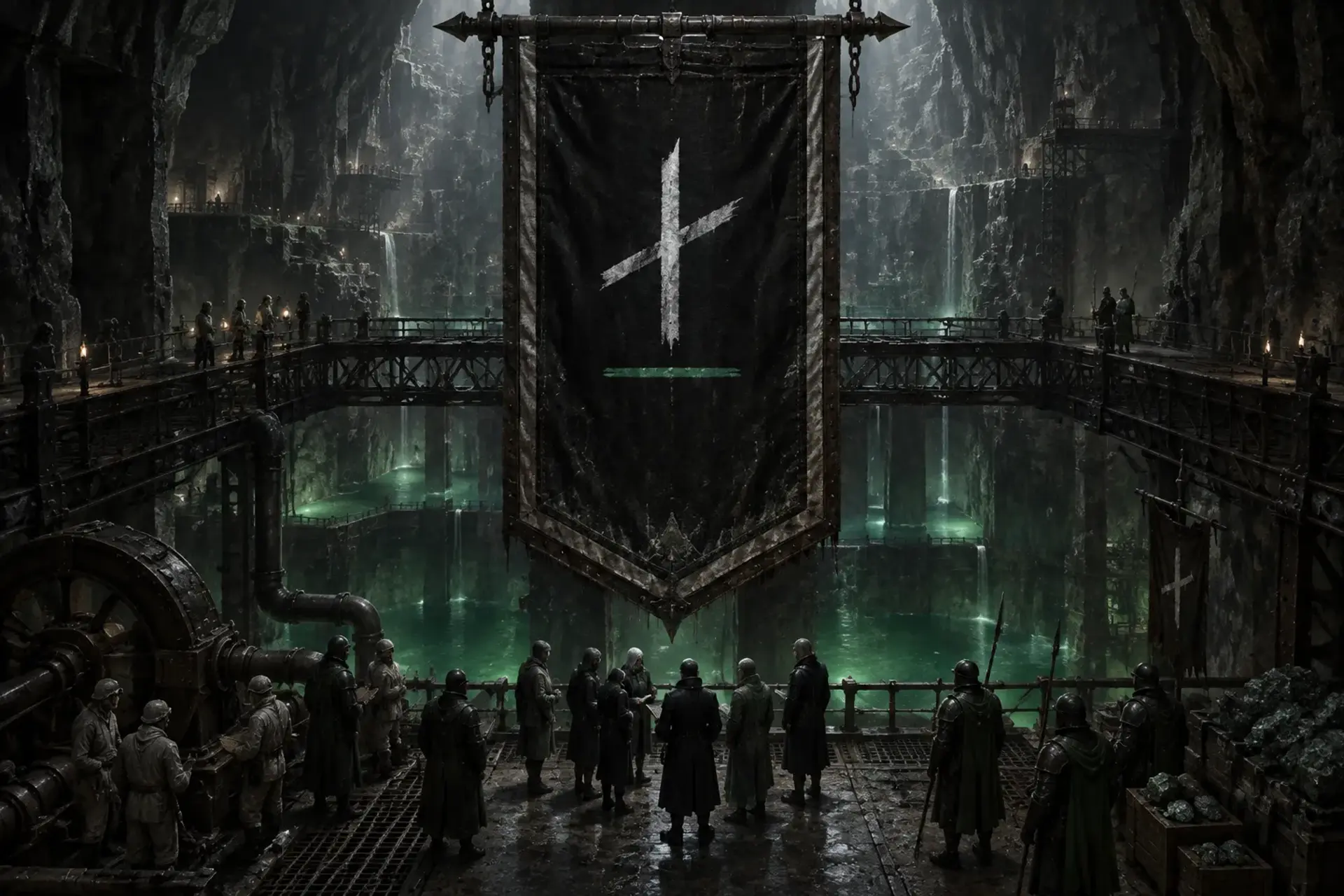
Sector K-12 Deep QuarryThe Iron-Bourse occupies the drained chambers of Sector K-12 Deep Quarry. Iron walkways cross the old sump, where water still ticks from the rock into collection cisterns. A public assay counter and contract hall face the entrance; behind them, barred lifts descend to private counting rooms, ore vaults, and a map chamber where claim boundaries are revised in chalk. The headquarters' boastful name once promised that every worker would find a fair price for their labor. Now most who enter come to learn what they owe.
Lands they hold
Outposts
- The Sluice LedgerMeltwater Basalt Channels, Sub-Level 1A pump station and contract desk built where a natural spillway was cleared of fallen basalt. It monitors water flow and records supply charges.
- Whitecut Survey CampOre-Seams, Sub-Level 2A temporary survey camp established after crews cut through a pale crust of mineralized rock. It marks disputed boundaries and stores drilling equipment.
- The Dry SumpDeep Quarries, Sub-Level 3An old drainage chamber converted into a guarded ore depot. Its name is now an ironic boast, since seepage constantly gathers beneath the floor.
Secrets
Plot hooks
5 hooks- 1A Name in the LedgerPersonal, low to moderateReward: Evidence, local trust, or a negotiated debt reductionA resident of Plenty's End asks the characters to find a missing copy of her family's contract before an auditor takes her brother's remaining work years as repayment. The record is somewhere in the Iron-Bourse, and the brother may have signed a clause he does not remember.
- 2The Marker MovedLocal, moderateReward: Payment, access to a contested seam, or a lasting relationship with one sideThe party is hired to recover a survey marker from a newly opened fissure. Claim Enforcement calls the prospectors there trespassers; the prospectors say the marker was moved after they discovered the seam. Both sides have witnesses, and the stone itself is beginning to tremble.
- 3The Gate and the AccountRegional, moderate to highReward: A settlement's independence, a technical favor, or a costly consortium concessionA water channel supplying Plenty's End is failing. The Claimholders offer emergency repairs in exchange for control of its main sluice-gate. The settlement asks the characters to find another way to stabilize it before the water runs out.
- 4The Weight AboveRegional, highReward: Rescued lives, access to consortium resources, or proof of negligenceA tunnel collapses, trapping workers and cutting off a rich seam. Varek blames seismic sabotage and wants the party to rescue the survivors before pursuing the suspected attackers. An engineer's notes suggest that ignored safety warnings, rather than deliberate sabotage, triggered the collapse.
- 5When the Pumps StopCampaign-scale, highReward: A changed labor order, powerful allies, or control over vital infrastructureThe Free Miners' League plans a coordinated stoppage across the Claimholders' workings. The party can protect organizers, negotiate a charter, expose falsified debts, or help Varek keep the mines operating. Each choice changes who controls water and work in the Under-Roots.
Work they offer
What gets in the way
Rumours
Connections
Media
0 imagesNo images yet.
Turn K-12 Claimholders into a sheet
A high-res, share-ready sheet you can post or print.