
Council of Hearths
The Council emerged from emergency cooperation during the Long Frost, when failed harvests and blocked roads forced Sune's Gift's leading interests to share stores and protection. After the crisis, Lisgardo recognized the compact as a practical local administration and granted it authority over town markets, civic security, and Hvelmar's Port, subject to the city-state's broader oversight. The Council grew more influential as the town's orchards and market agriculture became reliable exports, while ancient masonry drew specialist buyers and visiting builders. Its greatest commercial transformation came when local hosts began presenting the town's temperate climate, fine wines, baths, private salons, and carefully preserved stonework as a northern retreat for wealthy travelers. The watershed moment was the Ashen Thaw, a Furnace disturbance that briefly turned a normally mild night into killing cold. The Temple sealed the relic chamber, the watch evacuated vulnerable residents, and merchants opened their storehouses. The town survived, but only after the Council accepted that Furnace access could not be treated as a normal civic resource. Since then, the Temple has held spiritual custody, the Council has controlled permits and security, and every public promise of prosperity has carried the unspoken question of what happens if the Furnace fails. Today the Council is more polished, more prosperous, and more divided than its founders imagined. It balances Lisgardo's demands, local livelihoods, religious authority, and the ambitions of outside factions, while privately debating whether survival requires more control or less.
Council of Hearths
- Type
- Town ruling council
- Size
- 66 members
- Reach
- Local
- Base
- Sune's Gift
Overview
The Council emerged from emergency cooperation during the Long Frost, when failed harvests and blocked roads forced Sune's Gift's leading interests to share stores and protection. After the crisis, Lisgardo recognized the compact as a practical local administration and granted it authority over town markets, civic security, and Hvelmar's Port, subject to the city-state's broader oversight. The Council grew more influential as the town's orchards and market agriculture became reliable exports, while ancient masonry drew specialist buyers and visiting builders. Its greatest commercial transformation came when local hosts began presenting the town's temperate climate, fine wines, baths, private salons, and carefully preserved stonework as a northern retreat for wealthy travelers. The watershed moment was the Ashen Thaw, a Furnace disturbance that briefly turned a normally mild night into killing cold. The Temple sealed the relic chamber, the watch evacuated vulnerable residents, and merchants opened their storehouses. The town survived, but only after the Council accepted that Furnace access could not be treated as a normal civic resource. Since then, the Temple has held spiritual custody, the Council has controlled permits and security, and every public promise of prosperity has carried the unspoken question of what happens if the Furnace fails. Today the Council is more polished, more prosperous, and more divided than its founders imagined. It balances Lisgardo's demands, local livelihoods, religious authority, and the ambitions of outside factions, while privately debating whether survival requires more control or less.
How it began
The Council's own account begins during the winter remembered as the Long Frost, when Sune's Gift's orchards failed and the road to Hvelmar's Port became dangerous. A small group of merchants, stonecutters, and residents brought stores into the Temple of the Warm Flame and negotiated common rules for rationing, watch duty, and trade. The temple's priest joined their deliberations because the Furnace, an arcane relic kept beneath the Temple, was already the only known reason the surrounding land remained temperate. The first agreement was supposedly written on a broken hearthstone and required each signatory to keep one fire burning for those who had nowhere else to go. The Council later formalized this emergency compact into a permanent civic body. Its name honors the hearths that kept people alive, while also warning that the town's warmth must never be taken for granted.
How to know them
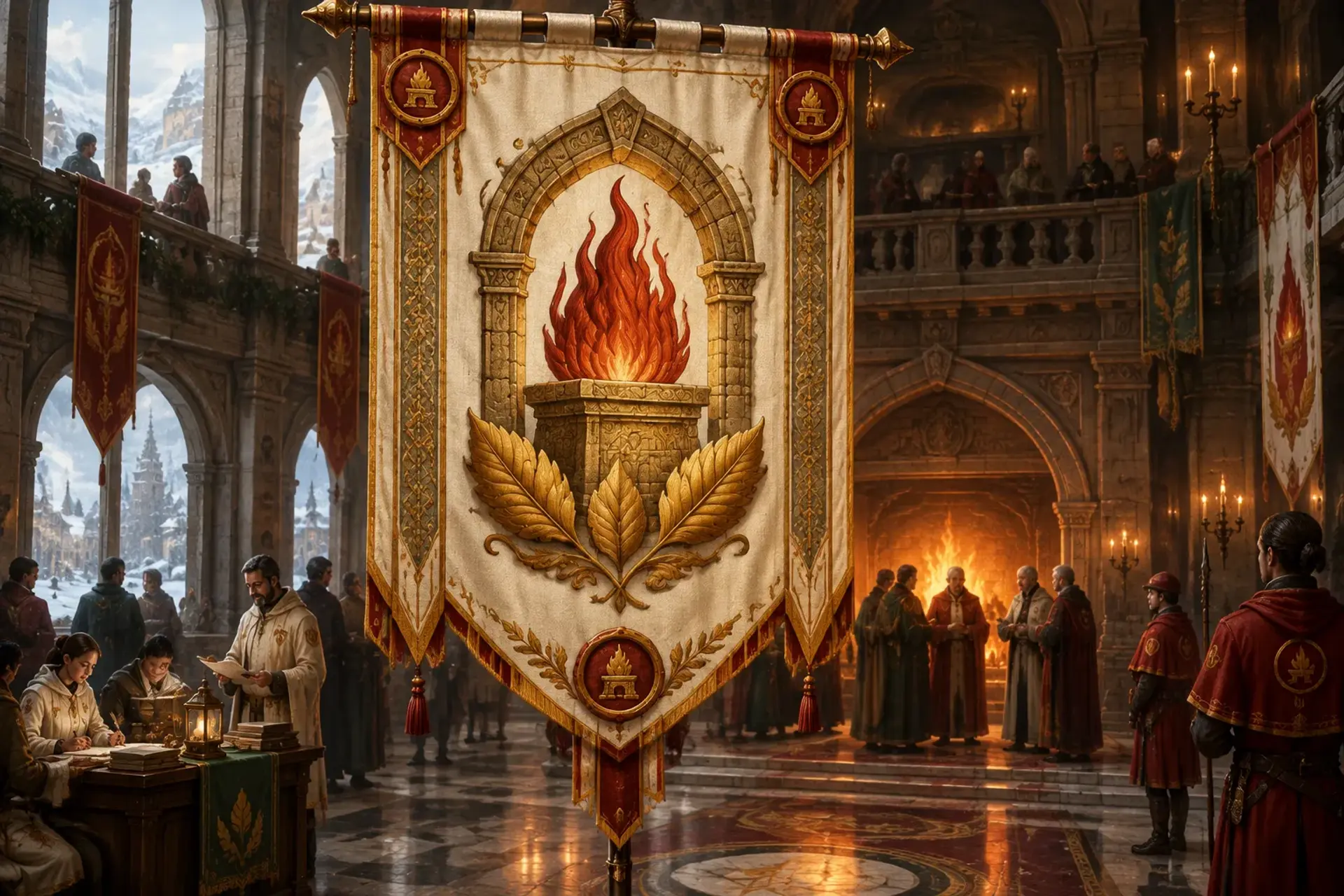
Hearth-ember red, Orchard gold, Warm ivory
- A communal hearth flame
- Three orchard leaves
- An open stone arch
- The red-and-gold seal used on port licenses
Standing
What they say they want
What they are doing now
Where it leads
Make Sune's Gift a prosperous, self-governing northern destination whose farms, stonecraft, hospitality, and safe climate support one another. The Council wants Lisgardo to see the settlement as too valuable and well administered to micromanage, while ensuring that no outside power can seize the Furnace or force the town to depend on a single source of income.
How others see them
To visitors, the Council is an efficient and gracious host that has made an unlikely northern settlement comfortable, safe, and profitable. Residents often see it as competent but distant, attentive to the powerful and slow to hear ordinary complaints. Merchants respect its predictable regulations, while some religious observers believe it treats the Temple's stewardship as a negotiable business arrangement.
People
5 ranks
First Voice of the Hearth Council
Charming, astute, and relentlessly composed. Serel is rarely openly cruel, but she can make a person feel indebted through kindness more effectively than another leader could through threats. She believes stability is built by knowing what people desire and deciding which desires can safely be satisfied.
- The Keeper of the Furnace1 member
Brother Halvor is the sole religious seat on the Council. He speaks for the Temple of the Warm Flame, oversees religious stewardship of the Furnace, and can demand a temporary halt to access when he believes the relic is in danger. He has no formal veto over ordinary trade, but the Council rarely ignores him.
- Brother Halvor Keeper of the Furnace, head-priest of Sune's Temple of the Warm Flame, and the Council's sole religious member.
- The Hearth Council6 members
The six voting civic seats are held by prominent town interests, including hospitality, agriculture, stonecraft, and trade. The Council sets policy, approves major contracts, regulates Furnace access in cooperation with the Temple, appoints senior watch officers, and administers Hvelmar's Port. It prefers consensus, but can decide by majority vote after a public hearing.
- Wardens of the Ledger and Lamp12 members
These clerks, inspectors, market officers, and port agents carry out Council policy. They record harvest yields, issue licenses, track customs, investigate complaints, and maintain the paper trail that makes local administration function.
- The Hearthwatch38 members
The town watch is directly managed and funded by the Council. Its members patrol streets, guard civic stores, escort high-value shipments, and provide security during festivals and noble visits. Watch captains report to the Council's appointed watch marshal.
- Petitioners and Seasoned Advisers9 members
A rotating body of respected craftspeople, orchard representatives, innkeepers, and residents may advise the Council at open hearings. They have no guaranteed vote, but a petition signed by a substantial number of households must receive a formal response.
Other key members
- Fenrick Tole Master Orchardist and marketwarden; oversees agricultural yields and export logistics.
- Torin Marrek Council representative for stonecraft and masonry goods.
How they are organised
- Council seats are limited to recognized civic interests and are granted by local appointment, not open recruitment.
- Candidates must demonstrate an ongoing contribution to Sune's Gift through trade, public service, craft, agriculture, or religious stewardship.
- A candidate must disclose significant debts, commercial partnerships, and obligations to outside powers to the Council's clerk.
- Council members swear to defend the settlement, respect Temple custody of the Furnace, and maintain the lawful operation of Hvelmar's Port.
- The Hearthwatch requires local sponsorship, a service oath, and training in de-escalation, patrol procedure, and emergency response.
Relations
8 factionsThe Council relies on the Merchants' Guild of the Larder to coordinate buyers, storage, and reliable food shipments. Their cooperation is strained whenever the guild pushes for lower prices or expanded control over the town's markets.
Operations
What they do
How they do it
Services for hire
- Port and Market RegistrationPublished fee, with exemptions for residents in hardshipRegisters cargo, resolves ordinary market disputes, issues trading permits, and arranges standard inspections at Hvelmar's Port.
- Civic EscortContract price based on season, distance, and riskProvides Hearthwatch escorts for approved cargoes, visiting dignitaries, and public events. The Council may refuse requests that would leave the town underprotected.
- Petition and Furnace Access ReviewDonation or sponsorship; no fee guarantees accessArranges a formal hearing with the Council or a referral to Temple custodians. Requests to approach the Furnace require separate approval and may be denied.
- Harvest BrokerageVaries by contract and harvest conditionsConnects buyers with local orchardists and market growers, verifies customary measures, and coordinates bulk shipment schedules.
What they can do
What they have
Where they are weak
Territory
Headquarters
Sune's GiftThe Council meets in a broad chamber built into the town's oldest civic hall, where ancient masonry forms a dark, close-set lower level and later Renaissance-style galleries overlook it. A working public hearth stands in the center. Council business is conducted around it, but the chamber has no direct entrance to the Temple or the Furnace. The Council keeps records, customs ledgers, watch rosters, and sealed port correspondence in separate locked rooms, a practice created after a past records theft.
Lands they hold
Outposts
- Port OfficeHvelmar's Port, half a day's travel from Sune's GiftAdministers customs, records cargo, coordinates export schedules, and communicates Council policy to harbor workers and visiting captains.
- Marketwarden's HallThe principal market square of Sune's GiftHandles produce inspections, market disputes, public notices, and emergency food distribution.
- Furnace GateThe Temple of the Warm Flame in Sune's GiftA jointly staffed checkpoint where Temple custodians and civic officers verify permits and record authorized access. It does not give the Council custody of the relic.
Secrets
Plot hooks
7 hooks- 1The Guest ListLow, social investigation with possible stealthReward: Payment, a useful introduction, or leverage with SerelA household worker at Serel of the Gilded Vine's salon asks the characters to recover a missing invitation ledger before a noble guest learns that their private meeting was recorded. The ledger could also expose a Council member's improper Furnace-access promise.
- 2False Measure at the PortModerate, investigation and negotiationReward: A share of recovered goods, agricultural supplies, or Fenrick's supportFenrick Tole Master discovers that an export shipment's declared weight does not match its cargo. The discrepancy could be simple theft, smuggling, or an attempt to conceal a load of stone fragments taken from near the Temple. He needs discreet help before the Council accuses the growers.
- 3A Petition Under GuardModerate, social conflict with risk of a larger disturbanceReward: Community trust, legal favors, or a negotiated settlementA watch patrol arrests a group of orchard laborers after a dispute over wages and withheld winter stores. The Council says the arrest prevented a riot. The laborers say they were peacefully petitioning. The characters can uncover who ordered the escalation and decide whether to seek redress, prevent retaliation, or keep the harvest moving.
- 4The Wall Beneath the TempleModerate to high, exploration and a consequential choiceReward: Access to restricted records, a stonecraft commission, or knowledge about the FurnaceTorin Marrek hires the characters to inspect a cracked arch in an ancient masonry passage. The damage is fresh, the repair marks are unfamiliar, and a sealed void behind the stone appears to predate the current Temple. Brother Halvor asks them not to enter until he can consult the Council.
- 5Terms of WarmthHigh, investigation, faction negotiation, and possible magical dangerReward: A formal Council favor, access to research, or a place in the Furnace emergency planThe Emberbound present evidence that the Furnace's stability has changed, while Brother Halvor insists that their measurements were taken without proper permission. The Council asks the characters to escort a joint inspection team, but each side has a different idea of what counts as a safe examination.
- 6The Road That Should Not Be OpenedHigh, regional diplomacy and wilderness travelReward: A lasting agreement, safe passage, or a change in the Council's policyDo Not Wake the Cairns sends an urgent warning that a route used by port caravans crosses a place that must not be disturbed. The Council believes abandoning the route will cost the town a major contract. The characters must find another path, discover what has been disturbed, or persuade both sides to accept a costly compromise.
- 7The Price of a Warm HearthCampaign-scale crisis involving civic authority, religious stewardship, and uncertain magical consequencesReward: The fate of Sune's Gift, major political influence, and a defining alliance or enmityA Furnace fluctuation threatens the town during the height of the luxury season. The Council orders an evacuation of vulnerable residents, the Temple seals its inner doors, and Lisgardo's agents arrive demanding control of the emergency. The characters must decide who gets access to the relic's records and whether the concealed maintenance protocol should be used.
Work they offer
What gets in the way
Rumours
Media
0 imagesNo images yet.
Turn Council of Hearths into a sheet
A high-res, share-ready sheet you can post or print.