
The Kharad Vey
The Kharad Vey developed quietly from a small circle of mourners into a cross-border network of funeral workers and disaffected veterans. For generations, they concentrated on preserving names and securing secret burials, practices that made them useful during wars and epidemics. The Ashen Regiment changed their scale and character. Its founding gave the sect the means to take territory, protect sanctuaries, and threaten officials who resisted. The Red Vigil was their decisive watershed: the mass taking of souls proved the rite could work at scale and brought the Hollow Sovereign fully awake, but it also exposed the cult to serious retaliation. A coalition of temple investigators and city militias destroyed the Ordel Pass sanctuary the following year. The cult survived because its civilian cells had already spread across borders and because the coalition's leaders turned on one another over the captured prisoners and relics. Since then, the Kharad Vey have favored redundancy over empire. They cultivate multiple small sanctuaries, maintain separate regional ledgers, and avoid holding cities for long. Their modern campaign has two linked parts: gathering souls through concealed local operations and sending the greater regiment across the continent to locate the Cinder Crown. The two efforts are increasingly at odds. Soul-taking cells want time and secrecy; the regiment's commanders believe the Crown will make secrecy unnecessary.
The Kharad Vey
- Type
- A continent-spanning death…
- Size
- 7,500 members
- Reach
- Continental
- Base
- Near the abandoned customs settlement of Veyra's Ford, on the border between three rival states.
Overview
The Kharad Vey developed quietly from a small circle of mourners into a cross-border network of funeral workers and disaffected veterans. For generations, they concentrated on preserving names and securing secret burials, practices that made them useful during wars and epidemics. The Ashen Regiment changed their scale and character. Its founding gave the sect the means to take territory, protect sanctuaries, and threaten officials who resisted. The Red Vigil was their decisive watershed: the mass taking of souls proved the rite could work at scale and brought the Hollow Sovereign fully awake, but it also exposed the cult to serious retaliation. A coalition of temple investigators and city militias destroyed the Ordel Pass sanctuary the following year. The cult survived because its civilian cells had already spread across borders and because the coalition's leaders turned on one another over the captured prisoners and relics. Since then, the Kharad Vey have favored redundancy over empire. They cultivate multiple small sanctuaries, maintain separate regional ledgers, and avoid holding cities for long. Their modern campaign has two linked parts: gathering souls through concealed local operations and sending the greater regiment across the continent to locate the Cinder Crown. The two efforts are increasingly at odds. Soul-taking cells want time and secrecy; the regiment's commanders believe the Crown will make secrecy unnecessary.
How it began
The cult claims that its first members gathered during the winter of the Seven Bells, when a siege left the frontier city of Halvek without food, firewood, or room in its graveyards. A battlefield surgeon named Oru Vask began hearing the voices of the unburied dead through a cracked bronze funerary bell. He persuaded a band of deserters and bereaved families that the dead were not gone, only trapped beyond reach. They dug a chamber beneath the bell tower and performed a rite assembled from scraps of old funerary scripture. Something answered. The first voice promised that no faithful soul need be lost to oblivion. Oru disappeared before dawn, leaving behind a lantern that burned without oil and the first names of the dead written on its glass. The survivors called themselves the Kharad Vey, a name borrowed from the old homeland dialect of the deserters, though none can now agree on its original meaning. They spread as mourners, gravediggers, and penitents, taking small offerings from the living and quietly collecting the names of the recently dead. Three decades ago, they crossed from hidden sect to armed movement when a disgraced captain, Teren Vosk, organized their converts into the Ashen Regiment. Its knights seized the fortified monastery of Ordel Pass and used its crypts to hold a mass rite. The event, later remembered inside the cult as the Red Vigil, took hundreds of souls in one night. It also awakened the presence they now call the Hollow Sovereign. The Sovereign's first command was not to conquer, but to find the Cinder Crown. Since the Red Vigil, the Kharad Vey have survived inquisitions, civil wars, and the destruction of two major sanctuaries. Each setback drove them toward more ordinary institutions: military companies, funeral charities, debt offices, and noble household chapels. Their present strength lies less in hidden temples than in the records, roads, and people that make death administratively invisible.
How to know them
Lampblack, Dried-blood red, Bone ivory
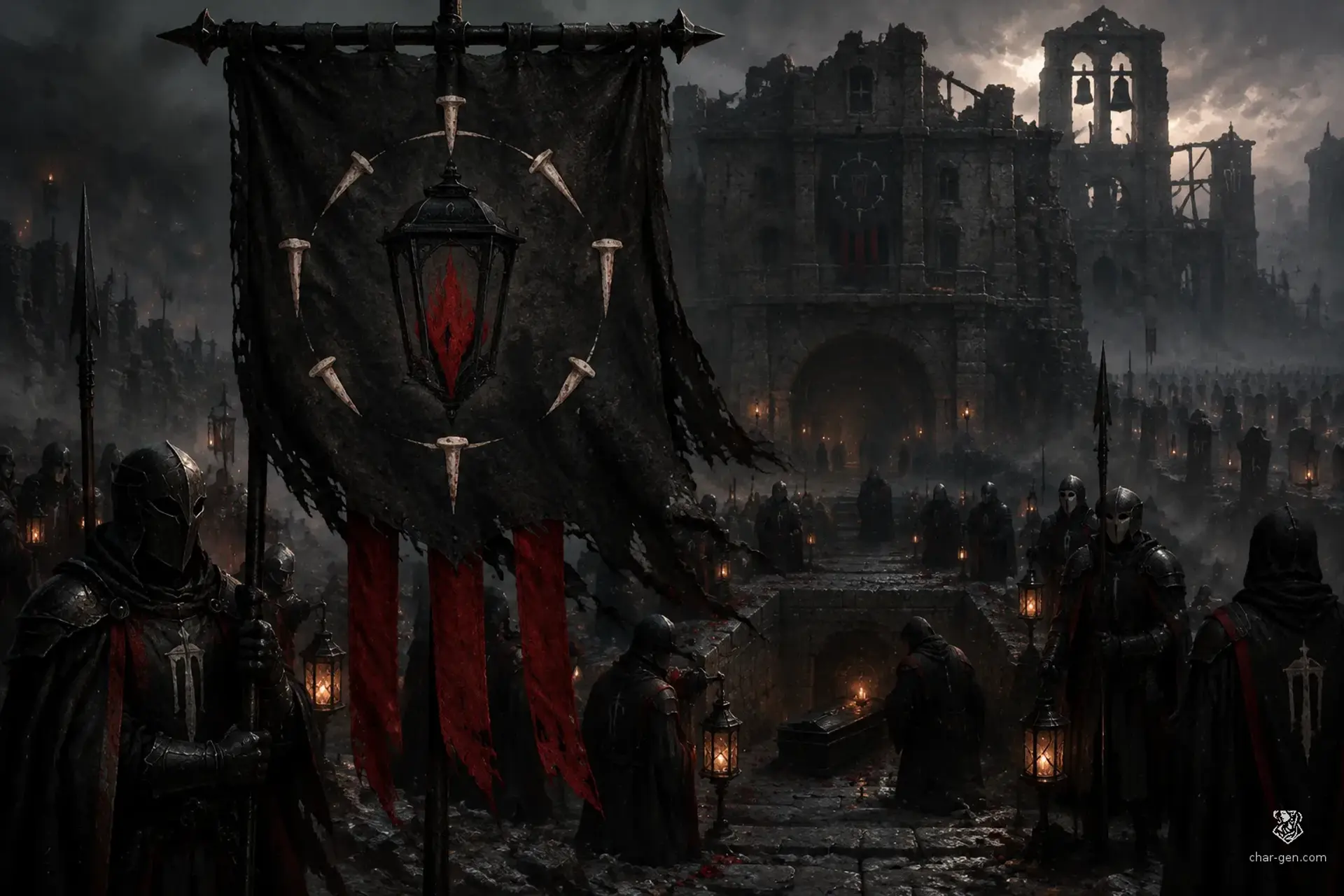
- A black iron lantern, representing the light kept for the dead
- Seven ivory nails, representing the seven witnesses said to have survived the Red Vigil
- A strip of red cloth tied around the wrist during funerals attended by a Keeper
- An inverted flame, used by senior members as a discreet sign that a message concerns the Hollow Sovereign
Standing
What they say they want
What they are doing now
Where it leads
The Kharad Vey publicly envision a world in which no soul is abandoned, no burial is denied, and every dead person is remembered. Their deeper leadership imagines a continent bound into a single funerary order under the Hollow Sovereign, with the Cinder Crown granting the power to claim souls regardless of distance or death. Whether this would be a peaceful communion or an empire of the dead is the central question the faction refuses to answer.
How others see them
To ordinary people, the Kharad Vey are a somber but dependable network of mourners who appear when institutions fail. In regions with weak burial services, their hospice workers are sincerely valued. Clergy and officials often consider them secretive and unsettling, but hard evidence of their crimes is scarce. Veterans may praise the Ashen Regiment's discipline, while survivors of its operations describe them as patient, courteous, and merciless.
People
5 ranks
The Listening Vessel
Gentle in conversation, relentless in negotiation, and capable of accepting terrible losses if she can describe them as temporary. She rarely raises her voice and remembers every broken promise.
- The Listening Vessel1 member
The senior interpreter of the Hollow Sovereign's utterances. Claims no personal authority, yet determines which voices count as commands. The role is currently held by Mother Edris.
- The Bell Synod7 members
Regional leaders who oversee doctrine, finance, recruitment, and intelligence. They make policy by recorded vote, but the Listening Vessel may declare a command beyond debate.
- The Ashen Regiment420 members
Knights, scouts, quartermasters, and attached specialists. The regiment is the cult's visible armed arm and is divided into companies operating across several nations.
- Keepers of the Last Names1,100 members
Cell leaders, undertakers, couriers, healers, record clerks, and local recruiters. Many are true believers; others think they serve a secretive funerary charity.
- The Unlit6,000 members
Uninitiated sympathizers and temporary allies. They provide lodging, rumors, transport, donations, and access to cemeteries, often without knowing the faction's full purpose.
Other key members
- Seln Arvo Prior-General of the Ashen Regiment and commander of the artifact expedition.
- Pell Keeper of records at the Sump of Bells and potential whistleblower.
- Krzat Vey of the Salt March Knight-Captain of the Third Company, rival claimant to Seln's command.
- Haru Nao Confessor and custodian of the ritual fragments used in the soul-taking ceremonies.
How they are organised
- Applicants must provide a true name for someone the world has forgotten, or explain why they have no such name.
- New members must complete a period of service in a hospice, funeral house, or supply company.
- Initiates swear not to sell, surrender, or falsify a fellow member's burial record without authorization.
- Knights must survive a night watch beside an unclaimed grave without leaving their post. This is a cultural test, not a supernatural guarantee.
- The cult accepts people of any ancestry or prior allegiance, but requires obedience to the cell's secrecy rules.
Relations
8 factionsThe Quiet Ledger sells the cult forged death certificates, shipping papers, and discreet transport across three borders. Its masters believe they are serving ordinary political clients, though some suspect the scale of the soul theft.
Operations
What they do
How they do it
Services for hire
- Last RitesA donation of coin, supplies, or a favor owed to a local Keeper.Funerary aid, grave repair, a memorial record, or discreet recovery of remains. This service is often sincere and open to nonmembers.
- Quiet PassageA significant fee or a promise of silence.Forged travel papers, altered death records, or the relocation of a body. The service carries a risk of blackmail if the client later becomes inconvenient.
- Names Beneath the DustA personal secret, a recovered relic, or a future service.Information about old battle sites, unmarked graves, or the movements of regional military forces.
- Lantern EscortCustomary payment plus a sworn obligation to the local cell.Armed escort by a small group of Ashen Regiment veterans. They are disciplined guards, but may report the client's route and companions to their superiors.
What they can do
What they have
Where they are weak
Territory
Headquarters
Near the abandoned customs settlement of Veyra's Ford, on the border between three rival states.The faction has no single headquarters. Its central sanctuary, the Sump of Bells, occupies flooded catacombs beneath a ruined customs house near the old imperial road. The upper floors appear to be a storehouse for funeral goods. Below, a maze of dry chambers holds stolen death registers, relics, training rooms, and a black iron bell that is rung only when the Hollow Sovereign speaks. The site is protected by mundane locks, paid watchmen, false walls, and custom warding rites. It is not an official D&D location or spell effect.
Lands they hold
Outposts
- The Sump of BellsA disused toll station on the old imperial road, a day's ride from Veyra's Ford.Central sanctuary, ritual chamber, and archive for stolen death records.
- Saint Orva's HouseA walled hospice in the river city of Cadrin.Publicly provides shelter and burial aid; covertly recruits mourners and tracks unclaimed bodies.
- The Bent MileA deserted watch fort above the salt flats of the western marches.Staging post and training ground for the Third Company.
- The Quiet Ledger RoomA cellar beneath a legitimate tombstone workshop in the capital of Mereth.Stores forged documents, bribes, and copies of royal burial registers.
Secrets
Plot hooks
6 hooks- 1The Letter After BurialPersonal; suitable for a single character or a short investigation.Reward: A family truth, a rescued soul, or a dangerous ally among the Keepers.A character receives a letter from a dead relative, written in the relative's hand after the funeral. It contains a plea for help and a warning about a local Keeper who has been kind to the character's family.
- 2Names Scraped CleanLocal; investigation, social choices, and a possible confrontation with a small cult cell.Reward: Evidence, local gratitude, and the chance to turn a Keeper against the cult.A village's cemetery records have been altered, and several families insist their dead are missing from the graves. The local hospice is genuinely helping the poor, but its cellar contains a concealed ritual chamber.
- 3A Captain's Quiet MutinyRegional; infiltration or negotiation with an armed outpost.Reward: A map fragment, a potential faction defector, and a choice about exposing Krzat's actions.Krzat asks the party to extract captives from the Bent Mile before Seln's officers discover she has hidden them. The captives include a wounded cult knight and a foreign cartographer who has seen part of the route to the Cinder Crown.
- 4The Ledger That Must Not BurnRegional; competing factions, protection, and difficult decisions about disclosure.Reward: Political leverage, the Last Vigil's trust, or a chance to broker a temporary truce.The Last Vigil has acquired a ledger proving that the Kharad Vey have operated in several nations. Publishing it may unite rulers against the cult, but the ledger also names innocent families whom the cult uses as informants. The Vigil asks the party to secure it before both sides arrive.
- 5The Crown Beneath MerethCampaign-scale; exploration, faction strategy, and a consequential choice about the relic.Reward: Access to the Crown, a continent-wide alliance, or knowledge of the Hollow Sovereign's true nature.Seln's greater regiment has found a sealed route into Mereth's ruins, but an allied expedition has vanished there. The party can race the regiment to the Cinder Crown, join its search under false pretenses, or persuade Edris to delay the operation.
- 6Seven Bells in the DarkCampaign-scale; supernatural crisis, moral dilemma, and a possible schism within the faction.Reward: A chance to free the stolen souls, alter the faction's leadership, or give the Sovereign a stronger foothold.The black iron bell begins ringing without hands, and every soul the cult has stolen speaks through it at once. The voices disagree: some demand release, some warn that destroying the bell will kill them, and one voice claims to be Oru Vask, the founder.
Work they offer
What gets in the way
Rumours
Media
0 imagesNo images yet.
Turn The Kharad Vey into a sheet
A high-res, share-ready sheet you can post or print.