
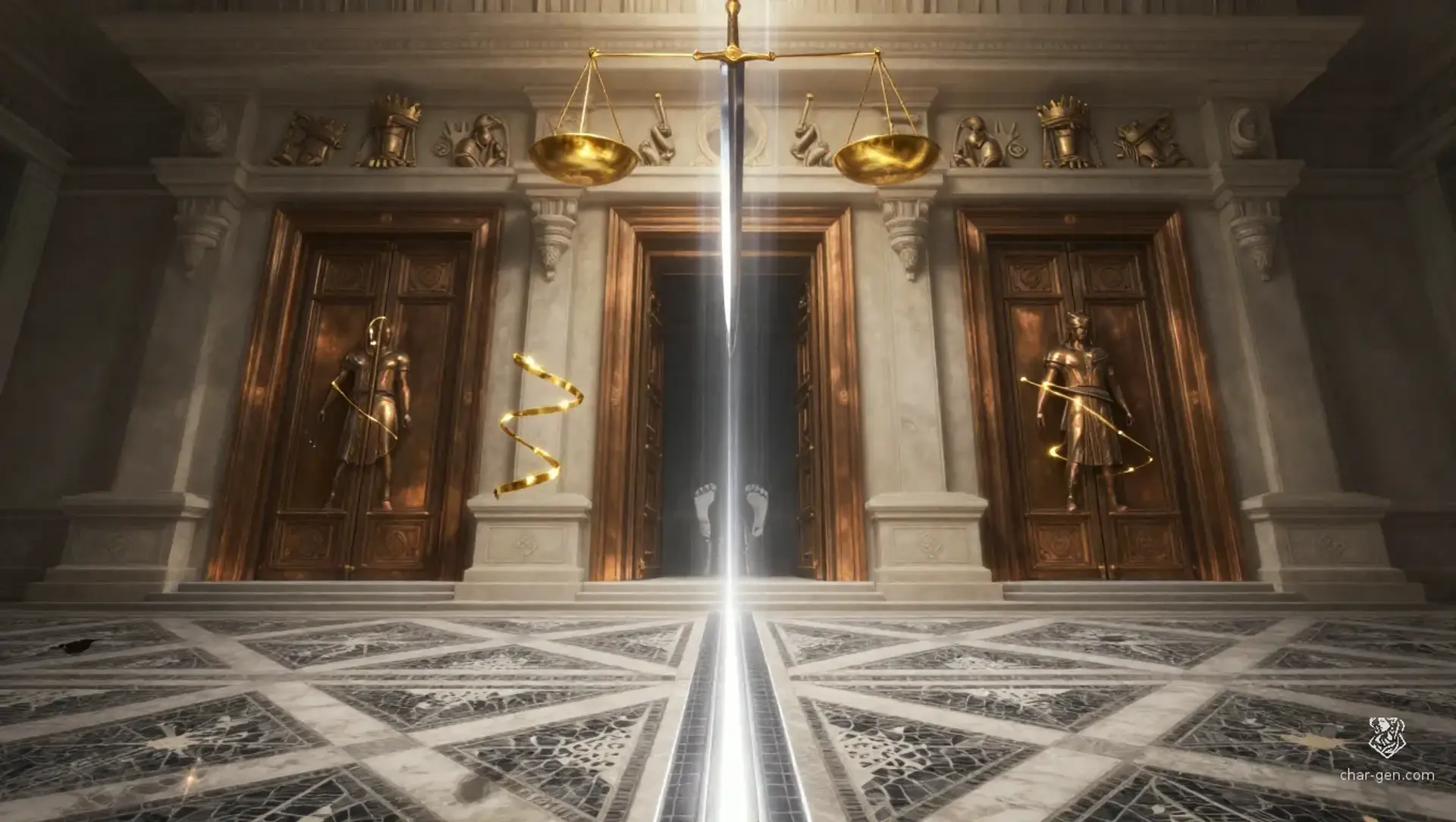
The Judgment of the Even Measure
The Judgment of the Even Measure is a divine entrance ward that weighs intent, action, and consequence. It does not simply punish trespassers. It creates a supernatural accounting of every creature crossing the threshold, magnifying aggression, hypocrisy, theft, and attempts to evade responsibility. The ward is most dangerous when the intruders insist they have done nothing wrong.
The Judgment of the Even Measure
Defenses
Detection
“A pair of enormous bronze doors stands beneath a triangular pediment carved with scales, crowns, and kneeling supplicants. The floor before the entrance is a mosaic of black and white stone divided by a perfectly straight silver line. Above the doors, a blindfolded deity holds a sword in one hand and balanced scales in the other. The scales subtly tilt whenever someone speaks, moves, or draws steel.”
Standard Engagement
The hazard activates when a creature crosses the silver line, touches either temple door, attempts to open the doors without permission, or takes a hostile action within 20 feet of the entrance. The first creature to trigger it becomes the initial Witness.
On initiative count 20, the hazard uses The Scales Tip if any hostile action, theft, or attempted forced entry occurred since the previous count. On initiative count 10, it creates The Dividing Line. At the end of each round, the creature with the greatest number of active judgments becomes the hazard's Witness. Until the next round, the Witness has disadvantage on saving throws against the hazard, while all other marked creatures have advantage on saving throws against it. If no creature is Judged, the hazard does not act on initiative count 20 or 10 that round.
The hazard resets 1 minute after the doors close or after all creatures leave the entrance area. Destroyed anchors reform at dawn unless the temple's central altar has been consecrated or desecrated.
When a creature enters the 20-foot-wide area before the doors, the hazard marks it with a glowing scale sigil. The creature must make a DC 16 Wisdom saving throw. On a failure, it is Judged until the end of its next turn. On a success, it is marked but not Judged. A creature can be marked only once per activation.
A Judged creature must choose one of the following imbalances that applies to it, if any: it has lied during the current negotiation, harmed a creature that could not fight back, taken something without permission, or abandoned an ally in danger. If none apply, the god's magic instead judges the creature's most recent serious wrongdoing as perceived by the creature itself. The creature takes 4d8 radiant damage and is restrained by bands of golden light until the end of its next turn. On a successful DC 16 Wisdom saving throw, it takes half damage and is not restrained.
At initiative count 20, the hazard examines the most recent hostile action taken within its area. If a creature attacked another creature, stole an object, or attempted to force the doors, the scales tip. Every marked creature must make a DC 16 Dexterity saving throw. On a failure, it takes 3d8 radiant damage and is pushed up to 10 feet toward the silver line. On a success, it takes half damage and is not pushed.
At initiative count 10, the hazard creates a 5-foot-wide wall of translucent golden force along the silver line. The wall lasts until initiative count 10 on the next round. A creature that crosses it for the first time on a turn must succeed on a DC 16 Strength saving throw or be pushed to the side it entered from and take 2d8 force damage. A creature that crosses willingly while carrying stolen goods has disadvantage on this saving throw.
The hazard does not distinguish between heroes and villains. It responds to perceived imbalance and to each creature's own understanding of its conduct. A character who genuinely believes an action was justified may avoid the corresponding judgment, subject to the GM's discretion.
A creature can use its action to ask the scales one direct question about how to pass safely. The answer appears as a brief phrase in golden script, but the creature must succeed on a DC 15 Wisdom (Insight) check to interpret it correctly. On a failure, the phrase is truthful but misleadingly incomplete.
If every marked creature spends one full round taking no hostile action, moving no closer to the doors, and openly stating one obligation it has failed to fulfill, the hazard pauses until the end of the next round. During this pause, no creature is Judged and the doors can be opened normally.
If a creature knowingly lies while attempting a confession, its scale sigil turns black. It immediately becomes Judged, takes 4d8 radiant damage, and cannot benefit from Restored Proportion for 1 minute.
Turn The Judgment of the Even Measure into a sheet
A high-res, share-ready sheet you can post or print.