
The Drowning Rootway
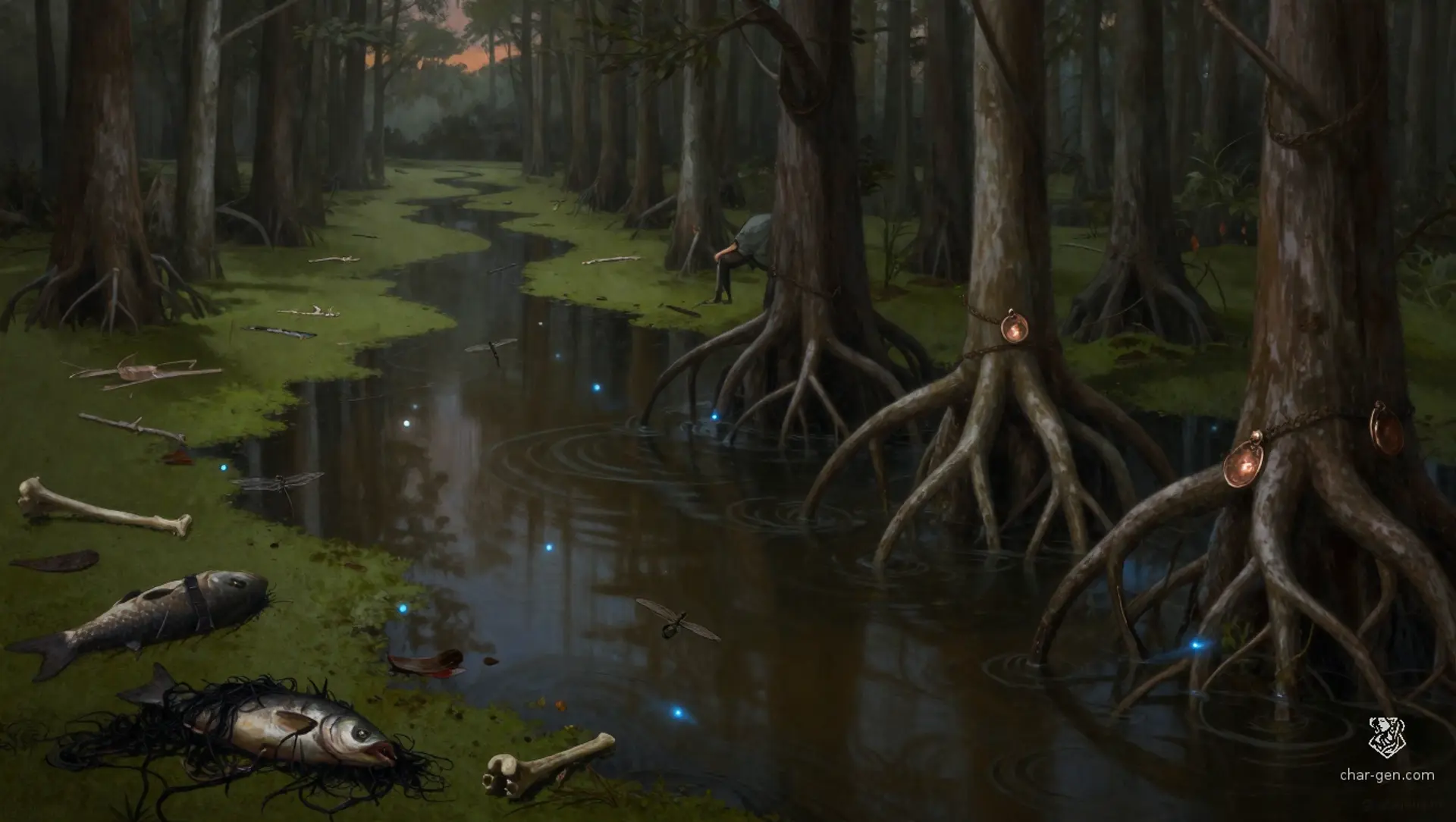
The Drowning Rootway is a concealed mat of living mangrove roots that grows through a shallow channel beside the river. It is not immediately lethal. Its purpose is to separate travelers, drag them into stagnant water, and hold them until exhaustion, crocodiles, or the current finishes the work. The hazard rewards careful observation and gives the party several ways to counter it.
The Drowning Rootway
Defenses
Detection
“A broad stretch of brown-green water lies beside the river, apparently no deeper than a boot. Mats of duckweed cover the surface, broken by pale cypress knees and half-submerged branches. Beneath the water, drowned roots form a shifting lattice that catches ankles, packs, and boat poles. A faint sweet odor of rotting fruit mixes with the metallic smell of river mud.”
Standard Engagement
A creature triggers the hazard when it enters a trapped 10-foot square, moves through the area at a run, or disturbs the submerged roots with a weapon, pole, or spell. The first creature to trigger the hazard is targeted, and up to two other creatures in adjacent trapped squares are targeted as the roots convulse.
After triggering, the roots pull each restrained creature 5 feet toward the deepest water at the end of that creature's turn. The hazard does not attack creatures that remain on firm ground or follow a discovered safe route.
The rootway resets immediately after a creature escapes or is pulled free. If disabled by severing the marked roots, it regrows after 24 hours unless the copper charms are removed or the current is redirected.
When a creature enters a trapped 10-foot square, it must succeed on a DC 16 Dexterity saving throw or become restrained by submerged roots. A restrained creature takes 10 (3d6) bludgeoning damage and is pulled 5 feet toward the deepest part of the channel. On a successful save, the creature moves through the square but treats it as difficult terrain.
A restrained creature can use its action to make a DC 16 Strength (Athletics) or Dexterity (Acrobatics) check, ending the restrained condition on itself on a success. Another creature within reach can use its action to make the same check with advantage if it has a rope, pole, or cutting tool.
If a creature is restrained at the end of its turn, stagnant water rises over its mouth and nose. It must begin holding its breath or start suffocating. A creature that fails two consecutive escape checks is pulled beneath the surface and falls prone in the water.
The hazard occupies a 60-foot-long, 30-foot-wide stretch of shallow swamp beside the river. Divide the area into 10-foot squares. Six of the squares are trapped, and the Game Master should place them to create multiple possible routes rather than a single unavoidable line.
Moving through the hazard normally costs twice as much movement. A creature that dashes, is shoved, or is moved unwillingly through the area triggers any trapped square it enters.
A creature can secure itself with a rope, climbing harness, or similar equipment. While secured to solid ground, it has advantage on checks made to escape the root snare and cannot be pulled more than 5 feet unless the anchor fails.
If the hazard is triggered during combat, its movements create loud splashes and a chorus of creaking roots. Creatures within 30 feet have disadvantage on Wisdom (Perception) checks that rely on hearing until the end of their next turn.
Turn The Drowning Rootway into a sheet
A high-res, share-ready sheet you can post or print.