
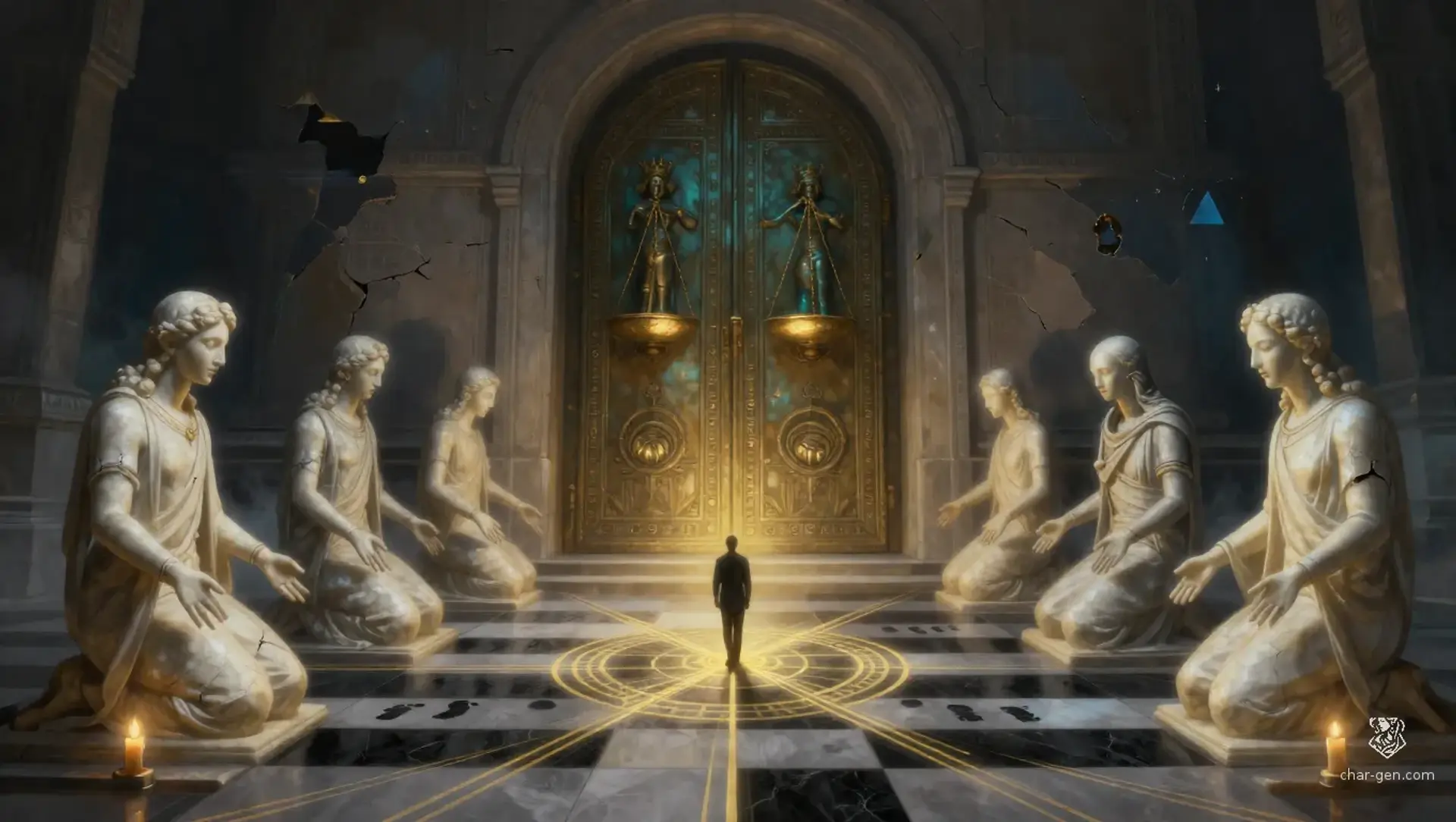
The Sixfold Judgment
The entrance does not ask whether visitors are good. It asks whether they are willing to be measured honestly. The divine judgment trap weighs a creature's stated intentions, recent actions, and willingness to accept consequences. It rewards restraint and accountability while punishing greed, deceit, and violence.
The Sixfold Judgment
Defenses
Detection
“A monumental pair of bronze doors stands beneath a broken stone arch. Each door bears a perfectly balanced scale, one pan showing a crowned figure and the other showing a faceless beggar. Six white marble statues kneel before the threshold, their hands extended toward the doors. Fine golden lines form a geometric pattern across the floor, converging on a circular seal directly before the entrance.”
Standard Engagement
The hazard triggers when a creature enters the golden floor pattern, touches the temple doors without making an offering, speaks a deliberate lie within 30 feet of the threshold, attacks a statue or door, or attempts to bypass the entrance with teleportation, ethereal travel, or similar magic.
On initiative count 20, the hazard activates the next available judgment seal in order. The seals activate in this sequence: First Measure, Weight of Falsehood, Law of Separation, Cost of Force, Mirror of Intent, and Final Due. After the sixth seal activates, the sequence begins again. A seal cannot activate while disabled. If a creature intentionally damages a statue, breaks the door, lies during a declared confession, or attempts to teleport past the threshold, the hazard activates the next two available seals instead.
At the next dawn, all disabled seals restore themselves and the threshold returns to full strength. If the doors are opened by successfully completing the judgment, the hazard remains dormant for 24 hours.
Each creature in the threshold's 30-foot-wide, 40-foot-long area must make a DC 16 Wisdom saving throw. On a failure, the creature takes 14 (4d6) psychic damage and is Restrained by bands of spectral golden light until the end of its next turn. On a success, it takes half damage and is not Restrained.
A glowing scale appears above a creature that has lied, stolen from another creature in the area, or claimed an undeserved reward. That creature must make a DC 16 Charisma saving throw. On a failure, it takes 18 (4d8) radiant damage and cannot benefit from advantage until the end of its next turn. On a success, it takes half damage and suffers no additional effect.
The floor divides into alternating black and white tiles. Each creature must choose a tile before moving. A creature that ends its turn on the same color tile as an ally must make a DC 16 Dexterity saving throw. On a failure, it takes 13 (3d8) force damage and is pushed 15 feet toward the nearest statue. On a success, it takes half damage and is not pushed.
The statues point at the creature that has dealt the most damage to the hazard or another creature during the previous round. That creature must make a DC 16 Constitution saving throw. On a failure, it takes 22 (4d10) radiant damage and its speed becomes 0 until the end of its next turn. On a success, it takes half damage and its speed is reduced by 10 feet until the end of its next turn.
A spectral duplicate of the creature appears on the opposite scale. The creature must make a DC 16 Intelligence saving throw. On a failure, it is overwhelmed by memories of a past betrayal and is frightened of the doors until the end of its next turn. While frightened this way, it must use half its movement to move toward the entrance. On a success, it is not frightened but has disadvantage on its next attack roll before the end of its next turn.
The doors open one inch, revealing absolute darkness and a voice that says, 'What will you surrender?' Each creature must make a DC 16 Wisdom saving throw. On a failure, the creature must use its reaction, if available, to drop one held object or move up to 15 feet toward the doors. On a success, it can choose whether to drop a held object or remain in place.
The hazard is not automatically fooled by disguises, illusions, silence, or forged documents. It judges deliberate intent and recent actions, not appearance or spoken identity alone.
The hazard tracks meaningful actions taken within the previous 24 hours. Characters who have acted selflessly, accepted fair consequences, or restored stolen property have advantage on one saving throw against the hazard. Characters who knowingly betrayed an ally, stole from the helpless, or caused disproportionate harm have disadvantage on their first saving throw against it.
When a creature willingly accepts a fair cost during the hazard, such as surrendering a valued item or taking responsibility for a harmful act, the DM can suppress the next seal that would target that creature. The cost must be personally meaningful and cannot be satisfied by an object purchased solely for this purpose.
If the party attempts to destroy the doors or statues, the hazard does not make attack rolls. Instead, the targeted object briefly becomes weightless, then releases a pulse of divine force. Every creature within 15 feet must make a DC 16 Strength saving throw, taking 18 (4d8) force damage and falling prone on a failure, or half damage without falling prone on a success.
Turn The Sixfold Judgment into a sheet
A high-res, share-ready sheet you can post or print.